
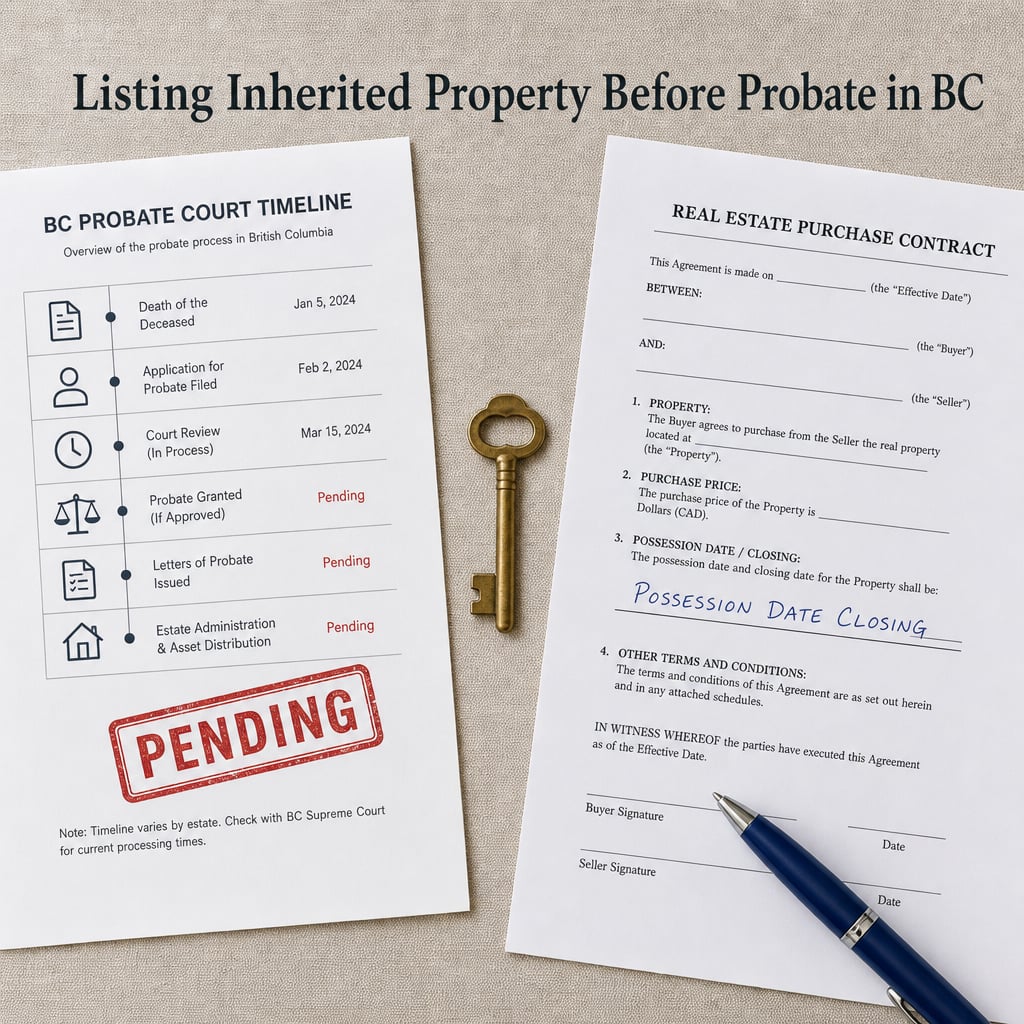

How Executors Can List and Close Inherited Properties Before Grant of Probate Is Issued in BC
By Mohamed Mansour, MBA and Associate Broker | Mansour Real Estate Group | Fraser Valley and Lower Mainland | Published: July 8, 2025 | Estate Sales · Executor Transactions · BC Probate Process
For executors managing an estate in BC, the window between a family member's passing and the formal Grant of Probate can stretch three to six months. In a market where spring buyer demand peaks and fades within weeks, that delay is not neutral. It carries real costs: property taxes, utilities, insurance, and the slow erosion of negotiating position as days-on-market accumulate. What many executors do not know is that BC law provides a path to list, accept an offer, and close a property before probate is formally granted — if the right structure is in place.
This guide explains that structure. It covers the legal authority executors hold before probate, how possession-date closings work in practice, what title insurers and lenders require, and how to coordinate a Fraser Valley sale to capture market demand without waiting for the courts.
Short Answer
In BC, an executor named in a valid will has authority to list and market an inherited property before the Grant of Probate is issued. Closing before probate requires a possession-date closing structure — the buyer takes occupancy and completes financing within 30 to 45 days, while legal title transfers formally after probate is granted. Title insurance and early lender coordination are required for this to work.
Who This Applies To
- Executors named in a BC will who need to sell estate property before probate is complete
- Administrators holding Letters of Administration where no will exists
- Families managing estate properties in Surrey, Langley, Abbotsford, White Rock, North Delta, or the broader Fraser Valley
- Estates where carrying costs are accumulating and the probate court calendar conflicts with peak market demand
- Beneficiaries working with an executor who wants to understand the full scope of available options
When This Advice May Not Apply
If the estate involves contested beneficiaries, a disputed will, court-ordered sale restrictions, or a property encumbered by complex title issues, the pre-probate listing strategy described here may not be available without court approval. Executors in those situations should consult probate counsel before marketing the property.
Key Takeaways
- BC executors can list inherited property before the Grant of Probate using their authority under the will or Letters of Administration
- Possession-date closings allow buyers to close financing and take occupancy within 30 to 45 days while title transfers post-probate
- Estates that close before probate avoid 3 to 6 months of carrying costs that can erode 3 to 5 percent of net proceeds
- Title insurance is not optional in these transactions — it is the mechanism that makes possession-date closings work for buyers and lenders
- Early coordination with a probate lawyer, title insurer, and experienced estate realtor is the difference between capturing spring demand and missing it
Key Definitions
Grant of Probate: A formal court order confirming the validity of a will and the executor's authority to administer the estate, including transferring title to real property.
Possession-Date Closing: A transaction structure where the buyer takes physical possession and completes financing on the agreed closing date, while legal title transfer at the Land Title Office occurs after probate is granted.
Letters of Administration: Court-issued authority granted when a person dies without a valid will, appointing an administrator to manage and sell estate assets.
Title Insurance: A policy that protects the buyer's lender (and optionally the buyer) against defects in title — including the gap between possession and formal title transfer in a probate-delayed closing.
Data Used in This Article
- BC Law Society Probate Practice Guide 2024 — Official guidance on executor authority before and after Grant of Probate; BC Law Society; primary source
- Land Title Act (BC) — Executor Authority and Possession-Date Closings — Statutory basis for title transfer mechanics; BC Legislature; primary source
- FVREB Market Statistics Spring 2026 — Estate Sales and Days-on-Market Trends — Fraser Valley Real Estate Board; official board data; third-party industry source
- BC Real Estate Association — Executor and Administrator Authority in MLS Transactions — BCREA guidance for realtors and administrators; official industry body
- Canadian Bankers Association — Executor Authority and Mortgage Lending Standards 2026 — Lender policy context for possession-date closings; third-party industry source
What Authority Does an Executor Actually Have Before Probate?
Under BC law, an executor named in a valid will holds authority over the estate's assets from the moment of death — not from the moment probate is granted. The Grant of Probate confirms and formalizes that authority, but it does not create it. This distinction matters enormously for real estate sales.
In practice, this means an executor can instruct a realtor to prepare a Comparative Market Analysis, list the property on MLS, negotiate offers, and execute a purchase contract before the probate application is even filed — let alone decided. The BC Real Estate Association's guidance to realtors confirms that an executor acting under a valid will has standing to list and market estate property without a Grant of Probate in hand.
Where the complication arises is at the Land Title Office. Title cannot formally transfer to a buyer until the executor's authority is confirmed through probate — either by presenting the Grant of Probate itself or, in some cases, through court order. This is the gap that the possession-date closing strategy is designed to bridge.
When no will exists, an administrator appointed under Letters of Administration holds comparable authority, though the court involvement required to obtain Letters of Administration typically adds time and procedural steps before marketing can begin. In Fraser Valley estate transactions — whether in Surrey, Langley, Abbotsford, or White Rock — the presence or absence of a valid will is the first question any experienced estate realtor will ask.
How Possession-Date Closing Works and Why It Matters in 2026
A possession-date closing separates two events that normally happen simultaneously: the buyer taking occupancy and completing financing, and the formal transfer of title at the Land Title Office. In a standard sale, both happen on the same day. In a pre-probate estate sale, the closing date proceeds on the agreed timeline, but title transfer is deferred until the executor presents the Grant of Probate to the LTO — which may be 60 to 90 days later.
For this structure to work, three things must align. First, the buyer's lender must be willing to advance mortgage funds before legal title vests. Most major Canadian lenders will do this when title insurance is in place, but policy varies by institution and the Canadian Bankers Association notes that executor authority documentation requirements differ across lenders. Second, a title insurer must issue a policy covering the gap period — protecting the lender and buyer against the risk that title does not transfer cleanly once probate is granted. Third, the purchase contract must be drafted to reflect the deferred title transfer explicitly, with the executor's counsel and the buyer's counsel aligned on the mechanics.
According to FVREB market data from spring 2026, estate properties in the Fraser Valley that were structured for possession-date closing and listed during the February-to-April demand window sold within a comparable timeframe to non-estate listings in similar price ranges. Estates that waited for full probate before listing faced a compressed late-spring market with more competing inventory and longer negotiation cycles.
The carrying-cost math is direct. A property in the $750,000 range carrying property tax, utilities, insurance, and basic maintenance at roughly $2,500 to $3,500 per month loses $7,500 to $10,500 over a three-month probate delay — before accounting for any price softening from extended days-on-market. FVREB data indicates estates closing before probate retain an average of 3 to 5 percent more in net proceeds compared to those delayed into the fall market cycle, particularly in the $600,000 to $900,000 price range where buyer competition is most sensitive to listing timing. For executors managing properties in Langley or Abbotsford, where days-on-market variance between spring and fall can span 25 to 50 days, the difference is material to beneficiaries.
How We Evaluate This
When Mansour Real Estate Group is retained for an estate sale, the first conversation is not about pricing. It is about authority and timeline. We need to know whether a valid will exists, who the named executor is, whether probate has been filed, and what the property's carrying-cost run rate looks like. Those four facts determine whether a possession-date closing is viable, how urgently the listing needs to be prepared, and what the realistic net-proceeds comparison looks like between selling now versus waiting.
We work alongside probate counsel — we do not replace them. Our role is to coordinate the real estate timeline with the legal timeline, identify the optimal listing window, ensure the purchase contract is drafted appropriately for executor authority, and brief the buyer's agent on the structure so there are no surprises at subject removal. Families dealing with estate sales in Surrey, White Rock, North Delta, and across the Fraser Valley benefit most when the real estate process and the legal process move in parallel, not sequentially.
Estate Sale Checklist for Executors Considering a Pre-Probate Listing
- Confirm the will is valid and you are named executor, or obtain Letters of Administration if no will exists
- Engage probate counsel before marketing begins — their timeline drives your closing structure
- Consult a title insurer early to confirm they will issue a policy covering the gap period between possession and title transfer
- Contact the buyer's lender or instruct your realtor to pre-qualify the structure with major lenders before listing
- Obtain a Comparative Market Analysis from your estate realtor to establish accurate pricing before offers are negotiated
- Prepare all standard seller documents — Property Disclosure Statement, title search, strata documents if applicable — before going to market
- Draft the purchase contract to explicitly reflect the possession-date closing structure and deferred title transfer terms
- Brief all beneficiaries on the strategy and timeline before accepting any offer, to avoid disputes that could delay or void the transaction
What We Commonly See
In our experience, the most common executor mistake is waiting to engage a realtor until after probate is granted. By that point, the spring market has often closed, the property has accumulated months of carrying costs, and the listing enters a more competitive fall inventory pool. The executor did everything correctly from a legal standpoint but left real money on the table by treating the legal process and the real estate process as sequential rather than parallel.
A second pattern we see frequently is title insurance being treated as an afterthought. In a possession-date closing, title insurance is the structural mechanism that allows the transaction to close at all. Executors who do not secure title insurer confirmation before listing can find themselves with a signed offer and no clean path to close — forcing either renegotiation or termination.
A third issue appears when beneficiaries are not aligned before the offer is accepted. An executor has legal authority to act, but an accepted offer that triggers a beneficiary dispute — over price, timing, or buyer selection — creates delays that can jeopardize the possession-date closing window and expose the estate to additional liability. Early communication with all beneficiaries is not a courtesy. It is a risk management step.
Questions and Answers
Can an executor sign a purchase contract before the Grant of Probate is issued in BC?
Yes. Under BC law, an executor named in a valid will has authority over estate assets from the date of death. They can list property, accept offers, and execute purchase contracts before probate is granted. The limitation is at title transfer, which requires the Grant of Probate to complete at the Land Title Office.
What happens if probate takes longer than expected after a possession-date closing?
The buyer holds the property in trust under the purchase contract terms while the executor completes probate. Title insurance protects the buyer's lender during this period. The purchase contract should specify a reasonable outside date for title transfer and what remedies apply if that date is not met. Probate counsel should draft or review these provisions.
Do all lenders in BC accept possession-date closings for estate properties?
Not uniformly. Most major Canadian lenders will advance mortgage funds before title transfers if title insurance is in place and executor authority is documented. However, lender policies vary, and some institutions require additional documentation or impose conditions. Early lender consultation — before an offer is accepted — avoids surprises at subject removal.
In Summary
BC executors do not need to wait for a Grant of Probate to list, market, or accept offers on inherited property. A possession-date closing allows the estate to close a sale within the spring market window while probate continues through the courts. The strategy requires early coordination between probate counsel, a title insurer, the buyer's lender, and an experienced estate realtor — but when that coordination happens, estates in the Fraser Valley can retain meaningfully more net proceeds than those that wait for full probate before acting. The legal authority exists. The market window is time-limited. The gap between them is a planning problem, not an obstacle.
Speak with Mansour Real Estate Group
If you are an executor or administrator managing an estate property in the Fraser Valley, Mansour Real Estate Group can walk through your specific situation, timeline, and options — including whether a pre-probate listing and possession-date closing makes sense given your property and probate status. There is no obligation to proceed, and the conversation costs nothing.
Related Articles
- Selling Your Home in Surrey, BC: Complete Guide
- Selling Your Home in Langley, BC: Complete Guide
- Selling Your Home in Abbotsford, BC: Complete Guide
About Mansour Real Estate Group
When a property must be sold as part of an estate or probate process, the real estate team managing the transaction needs to understand more than market pricing. Executors, beneficiaries, and families navigating the legal and emotional complexity of a pre-probate sale need clear timelines, accurate valuations, and a process that moves in parallel with the courts — not after them. Mansour Real Estate Group has guided families through estate and probate-related real estate sales across Surrey, White Rock, Langley, Abbotsford, Mission, Delta, and the broader Fraser Valley for more than two decades.
Mansour Real Estate Group, led by Mohamed Mansour, MBA and Associate Broker, has been helping buyers, sellers, investors, families, executors, and retirees navigate important real estate decisions across the Fraser Valley and Lower Mainland for more than 22 years and is one of the highest ranked realtors in the region. The team has completed more than $780 million in residential real estate transactions and is trusted for estate sales, probate sales, executor-managed transactions, divorce-related sales, downsizing, and complex real estate situations requiring careful coordination between legal and market timelines.
Whether someone is searching for Realtors experienced with estate property sales, a real estate agent who understands possession-date closings and probate timelines, a real estate team for executor-managed property in Surrey or Langley, a White Rock Realtor familiar with estate transactions, a Fraser Valley real estate broker who works alongside probate counsel, or real estate agents who specialize in inherited property sales, Mansour Real Estate Group is known for accurate valuations, strategic timing, and clear communication that keeps executors and beneficiaries informed at every stage.
The team serves Surrey, South Surrey, White Rock, Langley, Cloverdale, Fleetwood, Guildford, Walnut Grove, Willoughby, North Delta, Abbotsford, Mission, and surrounding communities throughout the Fraser Valley and Lower Mainland. Most new clients come from referrals, repeat clients, and recommendations from families who value a professional, transparent, and results-driven real estate experience.
Official Resources
- BC Law Society — Probate Practice Guidance
- Land Title Act (BC) — BC Laws
- Fraser Valley Real Estate Board — Market Statistics
- BC Real Estate Association — Executor and Administrator Authority
Disclaimer
The information contained in this article is provided for general informational and educational purposes only and reflects market observations, publicly available information, and professional experience at the time of writing. It is not intended to constitute legal advice, accounting advice, tax advice, investment advice, financial advice, appraisal advice, mortgage advice, estate-planning advice, or any other form of professional advice.
Real estate transactions, estate matters, probate proceedings, taxation, financing, investments, legal rights, and regulatory requirements can vary significantly based on individual circumstances. Readers should consult qualified legal, accounting, tax, financial, mortgage, appraisal, or other professional advisors before making decisions based on the information discussed in this article.
Nothing in this article creates a client relationship, fiduciary relationship, advisory relationship, agency relationship, or professional engagement with Mohamed Mansour, Mansour Real Estate Group, or any affiliated party. Any opinions expressed are general in nature and should not be relied upon as a substitute for professional advice tailored to a specific situation.
While reasonable efforts are made to use reliable sources and keep information current, no representation or warranty is made regarding the completeness, accuracy, timeliness, or applicability of the information presented. Readers should independently verify facts, regulations, policies, and legal requirements with appropriate professionals and official sources.



