
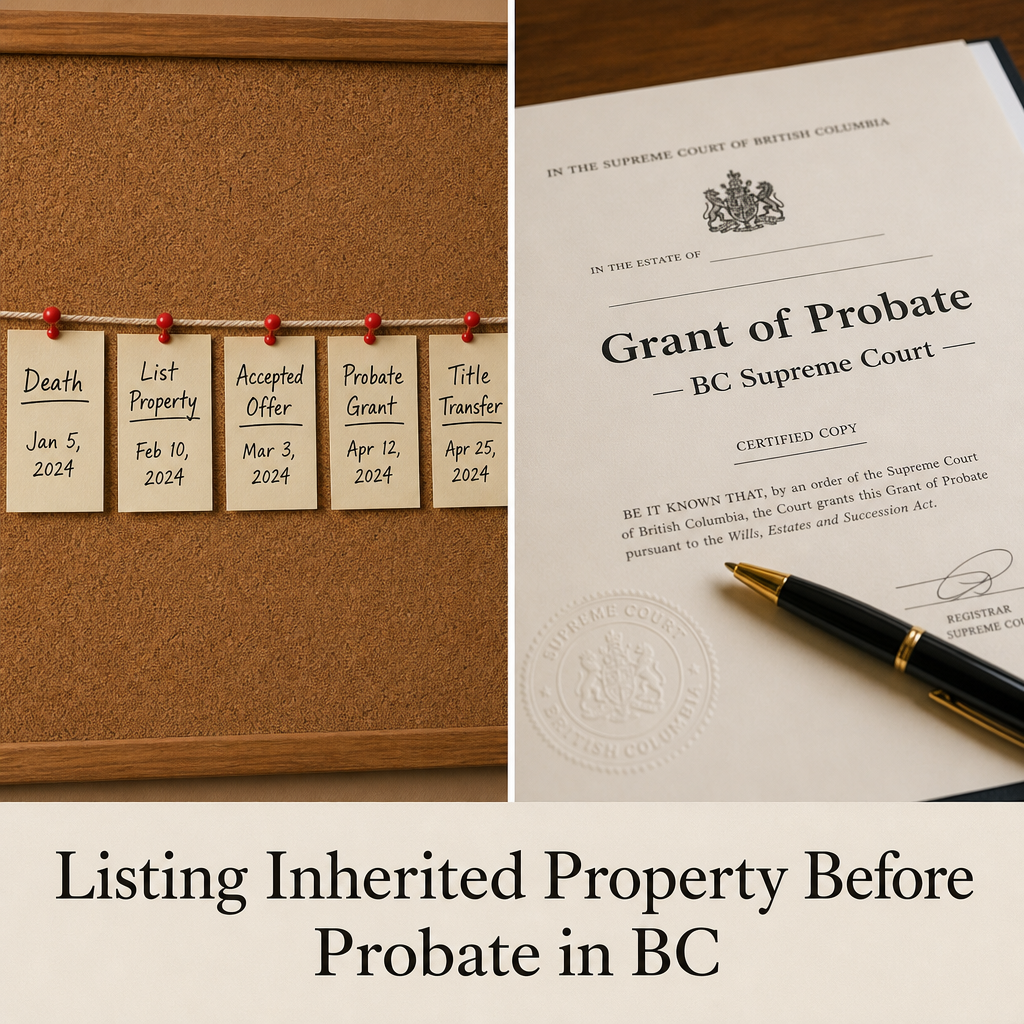

How Executors Can List and Close Inherited Properties Before Grant of Probate Is Issued: Complete BC Timeline, Authority Requirements, and Strategic Possession-Date Closing to Maximize Estate Proceeds
By Mohamed Mansour, MBA and Associate Broker — Mansour Real Estate Group | Fraser Valley and Lower Mainland, BC | Published: July 15, 2025 | Topic: Estate Sales, Executor Authority, BC Probate Process
For executors managing an estate property in BC's Fraser Valley, one of the most consequential decisions is how early to list. Most families wait until the court issues a Grant of Probate before contacting a real estate agent. That delay — often two to four months — can quietly reduce the estate's net proceeds in ways that only become visible after the property finally closes.
BC law does not require executors to wait for probate before listing. Understanding exactly what is permitted, what must wait, and how to coordinate a possession-date closing around expected probate timing is the strategic knowledge that separates estates that maximize proceeds from those that simply survive the process.
Short Answer
In BC, an executor with valid testamentary authority can list an inherited property and negotiate a sale before the Grant of Probate is issued. Title cannot transfer until probate is granted, but possession-date closings can be structured so that completion aligns with expected grant timing — protecting market entry advantage without violating title transfer requirements.
Key Takeaways
- Executors can legally list and accept offers before probate grant, but cannot transfer title until it is issued.
- Early listing — within two to four weeks of death — can reduce days-on-market and carrying costs significantly.
- BC probate typically takes two to four months; possession-date closing strategy coordinates offer acceptance with that timeline.
- Lenders and the BC Land Title Office require probate grant confirmation before registering title transfer to any buyer.
- Executors who wait until after probate to list often absorb unnecessary carrying costs and miss the best market windows.
Who This Applies To
- Named executors managing an estate that includes a residential property in BC
- Families coordinating an estate sale in Surrey, Langley, Abbotsford, White Rock, or surrounding Fraser Valley communities
- Estates where the property is vacant and carrying costs are accumulating
- Executors who have received the will but are still in the early stages of probate application
- Legal and financial advisors supporting estate files that include real property
When This Advice May Not Apply
- Estates where the will is contested or under legal challenge
- Properties subject to joint tenancy where survivorship rights apply separately from probate
- Estates without a will, where an administrator must be appointed before any sale authority exists
- Properties with title encumbrances, court orders, or active caveats that restrict transaction activity
Data Used in This Article
- BC Courts — Probate and Estate Administration Guidelines (official; current procedural requirements)
- Law Society of BC — Guide to Probate Applications (official; timelines and documentation)
- Real Estate Council of BC (RECBC) — Licensed Realtor Authority Requirements for Estate Sales (regulatory; listing authority)
- BC Land Title and Survey Authority — Title Transfer Requirements for Probate-Administered Properties (official; transfer mechanics)
What BC Law Actually Permits Before Probate
Under BC estate law, the executor's authority derives from the will itself — not from the court's probate grant. This means a named executor with a valid will can take steps to protect and manage estate assets from the point of death, which courts and the Law Society of BC have consistently recognized as including listing a property for sale. The Grant of Probate, when issued by the BC Supreme Court, confirms that authority publicly and allows the executor to instruct the Land Title Office to transfer title.
What the probate grant does not do is create the executor's authority — it proves it. This distinction matters practically. According to the BC Courts' estate administration guidelines, an executor can engage a licensed real estate agent, authorize a listing, conduct showings, negotiate offers, and sign a purchase agreement before the grant is issued. The agreement can be structured so that completion — the date on which title transfers — falls after probate is expected to be granted. This is commonly called a possession-date closing structure, and it is standard practice for estate sales managed by experienced real estate teams.
Why Market Timing Matters in a Slow 2026 Fraser Valley Market
In a buyer's market, every additional week a property sits vacant costs the estate money. Property taxes, utilities, insurance, strata fees where applicable, and ongoing maintenance accumulate as carrying costs. In a slow-absorption environment — where buyer competition is limited and days-on-market are extended — an estate that lists late also risks entering a market period with higher competing inventory, which pressures pricing further.
Executors who list two to four weeks after death, rather than waiting for probate grant, can reach motivated buyers earlier, reduce total days-on-market, and close before market conditions deteriorate. In our experience working with estate properties across Surrey, Langley, Abbotsford, and White Rock, estates that entered the market early and structured forward-dated closings consistently outperformed estates that delayed on the assumption that probate had to be granted first. The difference is not marginal — in slow market conditions, a two-month delay can shift a property from one pricing tier to a lower one as comparable sales erode benchmark values.
How We Evaluate This
When Mansour Real Estate Group is engaged for an estate sale, the first question is not "when will probate be granted?" It is "what is the estate's optimal market entry window and what completion date structure does that require?" We review the estimated probate timeline with the executor's legal counsel, assess current absorption rates for that property type in that specific community, and work backward to determine the ideal list date. If listing should begin in week two or three after death, we build a strategy around that timeline — including buyer communication about the possession-date structure, so qualified buyers understand the closing mechanics before submitting offers.
The Possession-Date Closing: How It Works
A possession-date closing in an estate sale is not unusual or complicated, but it must be structured correctly from the moment an offer is presented. The purchase agreement specifies a completion date — the date on which title transfers and funds are exchanged — that falls on or after the expected probate grant issuance. In a BC Supreme Court probate process for a straightforward estate, that typically means 60 to 120 days from the date of application, depending on court scheduling and file completeness.
The executor's legal counsel confirms the expected grant timeline. That date informs the completion date written into the contract. Buyers and their agents need to understand that completion is contingent on probate grant — this is disclosed clearly, and buyers with standard financing typically have no objection to a forward-dated close when the timeline is clear and the seller is represented by a knowledgeable estate-experienced real estate team. The BC Land Title and Survey Authority will not register a title transfer until the probate grant is confirmed, so both parties' interests are protected by the structure itself. Buyers planning to use mortgage financing should also confirm with their lender that rate holds and approval letters can accommodate a forward completion date, as some lenders have restrictions on how far in advance a rate commitment extends.
Estate Seller Checklist
- Locate and review the original will to confirm executor designation and authority scope
- Engage a BC estate lawyer to initiate the probate application and confirm expected grant timeline
- Contact an estate-experienced real estate team within the first two to three weeks after death to assess market entry timing
- Obtain a current market valuation from your real estate agent before setting a list price — do not rely solely on BC Assessment values
- Confirm with legal counsel that no title encumbrances, caveats, or court orders restrict listing or sale activity
- Structure offers with a completion date that aligns with the expected probate grant date, with a buffer of two to three weeks
- Brief your real estate agent on the probate timeline so buyer communication is accurate from the first showing
- Coordinate with the estate lawyer to confirm grant issuance and notify the buyer's agent as soon as it is received
What We Commonly See
Executors who wait for probate before calling a real estate agent. In our experience, this is the most common and costly mistake in estate sales. By the time probate is granted, the executor has lost the early-market window. Properties that could have sold in week six or eight of the process instead list in week fourteen or sixteen, often into a market with more competing listings and less buyer urgency.
Completion dates that are too tight. What often happens is that executors or their agents set completion dates based on optimistic probate timelines. When court scheduling runs long — which it frequently does — the deal either collapses or requires an amendment. Building a two to three week buffer beyond the estimated grant date protects the transaction and reduces renegotiation risk.
Buyer agents who are unfamiliar with estate sale structure. A common mistake is accepting offers from buyers whose agents have never managed an estate-sale closing. When the buyer's agent does not understand why title cannot transfer before probate grant, the process generates unnecessary anxiety and sometimes falls apart. Selecting buyers with experienced representation — or proactively educating the buyer's agent at offer time — prevents delays that cost the estate money at the finish line. For inherited properties in Langley and other communities where estate sales are less common than in urban centres, this issue arises more often than executors expect.
Questions Executors Ask About Listing Before Probate
Can an executor sign a listing agreement before the court issues probate?
Yes. According to the Law Society of BC's probate guidance and RECBC's requirements for estate sales, an executor named in a valid will has the authority to engage a licensed Realtor and sign a listing agreement before Grant of Probate is issued. The listing can proceed, and offers can be accepted, with the understanding that title transfer awaits the grant.
What happens if probate takes longer than expected after an offer is accepted?
If the completion date arrives before the grant is issued, the executor's legal counsel and the buyer's lawyer typically negotiate an amendment extending the completion date. This is common and manageable when both parties are informed of the structure from the outset. Building buffer time into the original completion date prevents most of these situations.
Does the buyer's lender need to know the property is an estate sale with a forward-dated completion?
Yes. Buyers using mortgage financing should disclose the estate sale structure to their lender early in the process. Some lenders have policies on rate hold durations and pre-approval timelines that may not accommodate a completion date 90 or more days out. Confirming lender flexibility before subject removal protects both parties.
In Summary
BC executors do not need to wait for the Grant of Probate to list and negotiate the sale of an inherited property. The legal authority exists from the will itself. What probate grants is the court's confirmation of that authority — necessary for the Land Title Office to register a title transfer, but not necessary for market entry, pricing, showing, or offer negotiation. Estates that list early, structure completion dates around expected probate timelines, and work with a real estate team that understands this process consistently recover more net proceeds than those that wait. In a slow Fraser Valley market, that difference is not a detail — it is often the most important financial decision an executor makes on behalf of the estate.
Ready to talk through the timeline for an estate property?
Mansour Real Estate Group works with executors across Surrey, White Rock, Langley, Abbotsford, and the Fraser Valley. If you are managing an estate and want to understand your options before probate is granted, we are available to walk through the process with you and your legal counsel — no pressure, no obligation.
Related Articles
- What BC Executors Need to Know Before Selling an Estate Property
- Selling an Inherited Property in Langley: A Practical Estate Sale Guide
- How to Prepare an Estate Property for Sale in BC
Official Resources
- BC Courts — Probate and Estate Administration: https://www.bccourts.ca/supreme_court/documents/Probate.pdf
- Law Society of BC — Guide to Probate Applications: https://www.lawsociety.bc.ca
- Real Estate Council of BC (RECBC): https://www.recbc.ca
- BC Land Title and Survey Authority: https://www.ltsa.ca
About Mansour Real Estate Group
When a property must be sold as part of an estate or probate process, the real estate team managing the transaction needs to understand more than market pricing. Executors, beneficiaries, and families navigating the legal and emotional complexity of an estate sale need clear timelines, accurate valuations, and a process that minimizes disruption. Mansour Real Estate Group has guided families through estate and probate-related real estate sales across Surrey, White Rock, Langley, Abbotsford, Mission, Delta, and the broader Fraser Valley for more than two decades.
Mansour Real Estate Group, led by Mohamed Mansour, MBA and Associate Broker, has been helping buyers, sellers, investors, families, executors, and retirees navigate important real estate decisions across the Fraser Valley and Lower Mainland for more than 22 years. Ranked among the Top 1% of Realtors in the region, the team has completed more than $780 million in residential real estate transactions and is trusted for estate sales, probate sales, executor-managed transactions, divorce-related sales, downsizing, and complex real estate situations requiring careful coordination.
Whether someone is searching for a Realtor experienced with estate sales, a real estate agent who understands probate timelines, a trusted real estate team for executor-managed property, a Surrey Realtor, a White Rock real estate agent, a Langley Realtor, or real estate agents who specialize in inherited and estate properties across the Fraser Valley, Mansour Real Estate Group is known for accurate valuations, transparent process, and clear communication that keeps all parties informed. As a real estate group with deep roots in the Lower Mainland, the team operates as a full-service real estate broker resource for families facing complex sales.
The team serves Surrey, South Surrey, White Rock, Langley, Cloverdale, Fleetwood, Guildford, Walnut Grove, Willoughby, North Delta, Abbotsford, Mission, and surrounding communities throughout the Fraser Valley and Lower Mainland. Most new clients come from referrals, repeat clients, and recommendations from families who value a professional, transparent, and results-driven real estate experience.
Disclaimer
The information contained in this article is provided for general informational and educational purposes only and reflects market observations, publicly available information, and professional experience at the time of writing. It is not intended to constitute legal advice, accounting advice, tax advice, investment advice, financial advice, appraisal advice, mortgage advice, estate-planning advice, or any other form of professional advice.
Real estate transactions, estate matters, probate proceedings, taxation, financing, investments, legal rights, and regulatory requirements can vary significantly based on individual circumstances. Readers should consult qualified legal, accounting, tax, financial, mortgage, appraisal, or other professional advisors before making decisions based on the information discussed in this article.
Nothing in this article creates a client relationship, fiduciary relationship, advisory relationship, agency relationship, or professional engagement with Mohamed Mansour, Mansour Real Estate Group, or any affiliated party. Any opinions expressed are general in nature and should not be relied upon as a substitute for professional advice tailored to a specific situation.
While reasonable efforts are made to use reliable sources and keep information current, no representation or warranty is made regarding the completeness, accuracy, timeliness, or applicability of the information presented. Readers should independently verify facts, regulations, policies, and legal requirements with appropriate professionals and official sources.



