
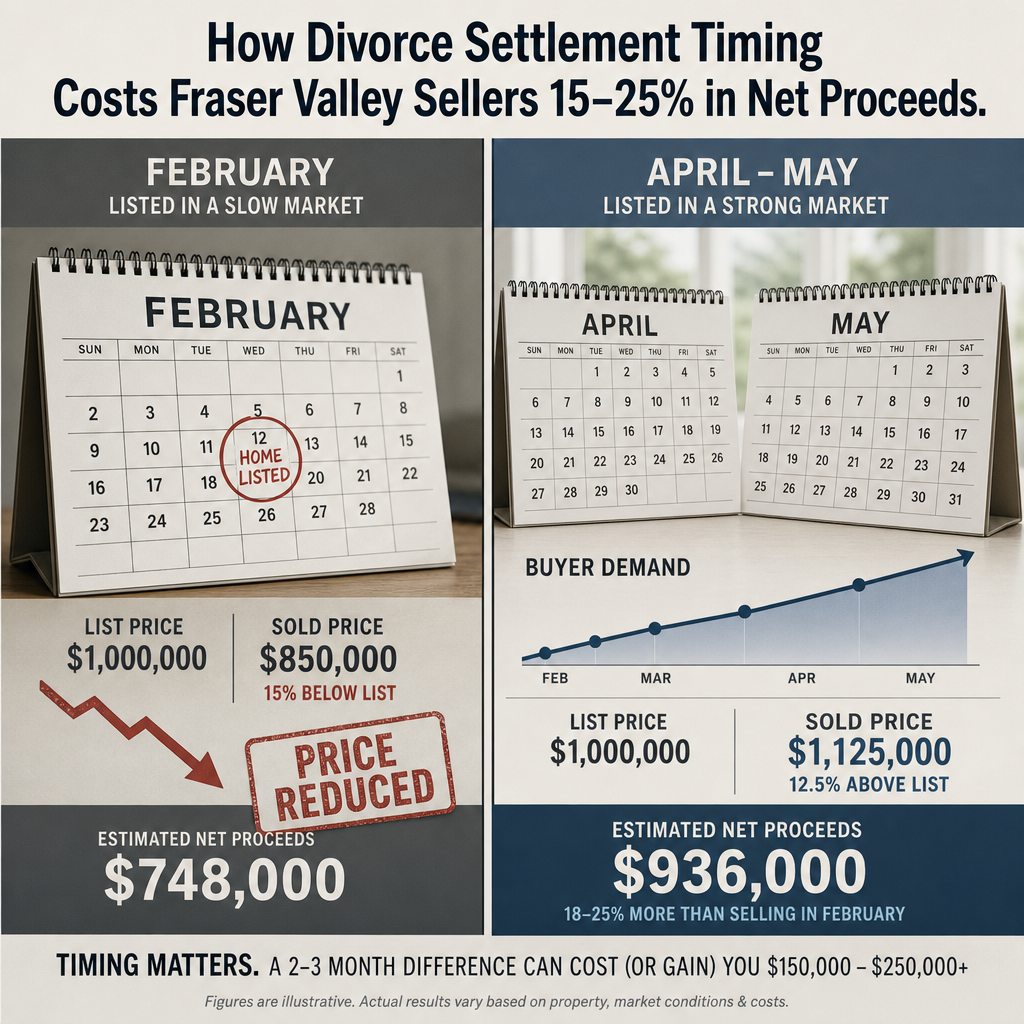

How Emotional Decision-Making and Settlement Timing Pressure Cost Fraser Valley Divorce Sellers 15–25% in Net Proceeds
By Mohamed Mansour, MBA and Associate Broker — Mansour Real Estate Group | Fraser Valley & Lower Mainland | Published: July 15, 2025 | Category: Life-Event Sales
Separating couples in the Fraser Valley face a real estate decision that most people make once in a lifetime — under some of the worst possible conditions. Settlement deadlines, emotional stress, and conflicting expectations don't pause for market conditions. But the market doesn't pause for them either.
This guide addresses what happens when family law timelines and Fraser Valley buyer's market conditions collide — and what divorcing homeowners can do to protect their financial outcome before those decisions are made under pressure.
Short Answer
Divorcing sellers in the Fraser Valley commonly lose 15–25% in net proceeds through a combination of emotional overpricing, poor timing relative to seasonal buyer demand, and decisions made independently rather than with unified strategy. In a current buyer's market with over 10,000 active listings and declining benchmark prices, those losses are larger and more preventable than most separating homeowners realize.
Key Takeaways
- Overpricing by 8–15% to match emotional expectations adds 30–60 days on market and typically ends in larger reductions.
- Settlement deadlines frequently force listings into February or March, missing April–May buyer demand peaks by weeks.
- A $750K Langley home listed in February could net $50K–$75K less than the same property listed in late April.
- Anchoring to 2021–2022 peak values is one of the most common pricing errors in divorce sales today.
- A unified, neutral listing strategy agreed upon before legal deadlines is the single most effective way to protect proceeds.
Who This Applies To
- Separating spouses who jointly own a home in Surrey, Langley, Abbotsford, South Surrey, White Rock, or the broader Fraser Valley
- Homeowners facing a court-ordered or consent-order sale with a defined timeline
- Separating couples where one or both parties have anchored to pre-2023 market values
- Homeowners who have already separated but have not yet listed, and are evaluating their options
When This Advice May Not Apply
If one party is buying out the other rather than listing, if the property is already under court order with no flexibility on timeline, or if occupancy and tenancy issues constrain access, additional legal and professional guidance will be needed before any strategy decisions are made.
Data Used in This Article
- Fraser Valley Real Estate Board (FVREB) — May and June 2026 Monthly Market Reports: sales-to-active ratio, inventory levels, benchmark price trends. Official board data.
- Mansour Real Estate Group — Internal divorce home sales observations, 2024–2026: pricing patterns, days-on-market trends, settlement timing conflicts. Professional interpretation.
- BC Ministry of Attorney General — Family Law Act: court service timelines and settlement process documentation. Official government source.
- Decision-making under stress research: cognitive bias and loss aversion in financial decisions during life transitions. Third-party academic context.
The Fraser Valley Market Context Divorce Sellers Are Operating In
According to the Fraser Valley Real Estate Board's June 2026 market report, the Fraser Valley currently has more than 10,000 active listings. The sales-to-active ratio sits at approximately 11%, placing the market firmly in buyer's market territory. Benchmark prices have declined 7–8% year-over-year across most property types.
In this environment, buyers are not competing. They are comparing. Properties that are priced even slightly above current market reality sit. Days-on-market extend. Price reductions follow. For a divorcing seller whose emotional state is already under pressure, a listing that stalls is not just a financial problem — it extends the entire separation timeline and compounds stress for both parties. Understanding this Fraser Valley seller's market context before listing is foundational to making sound decisions.
Why Emotional Pricing Costs More Than Sellers Expect
One of the most consistent patterns in divorce-related real estate sales is what researchers call loss aversion — the tendency to weigh losses more heavily than equivalent gains. For separating homeowners, this often appears as a firm belief that the home is worth what it was worth at the peak of the 2021–2022 market, regardless of what current buyers are willing to pay.
In practice, this means divorce sellers commonly list 8–15% above current market value. According to our observations working with separating couples across Surrey, Langley, and Abbotsford between 2024 and 2026, overpriced listings sit for 30–60 additional days before a price reduction is accepted. By that point, buyers who viewed the property early have moved on, and the eventual accepted offer is typically 5–10% below where the listing should have started.
The compounding cost is not only financial. Extended market time means extended co-ownership, extended legal proceedings, and extended emotional exposure to the separation itself. A correct price on day one nearly always produces a better outcome than an emotionally satisfying price that eventually resets lower.
How Settlement Deadlines Conflict With Real Estate Timing
Under BC's Family Law Act, separation agreements and court orders often operate on timelines of 6–12 months from the date of separation. Legal counsel frequently advises clients to begin the listing process as soon as practical to meet settlement conditions and avoid further dispute. This is legally sound advice — but it does not account for what month the calendar shows when that advice is given.
Fraser Valley real estate has a well-documented seasonal demand pattern. Buyer activity is measurably higher in April and May than in January, February, or November. According to FVREB historical data, sales volumes in April–May are typically 35–45% higher than in the preceding winter months. For a $750,000 home in Langley, the difference between a February listing and an April listing — in terms of qualified buyer traffic, offer competition, and final sale price — can represent $50,000–$75,000 in net proceeds.
When a separation occurs in September and the settlement deadline falls in March, both parties may feel pressure to list in January or February to satisfy that deadline. A proactive conversation with both lawyers and a real estate team familiar with divorce home sales in BC can sometimes shift a February listing to April — preserving tens of thousands of dollars — while still meeting the legal obligations of the settlement.
How We Evaluate This
When Mansour Real Estate Group is engaged for a divorce-related property sale, the first step is always a neutral, market-based valuation anchored to current FVREB benchmark data and recent comparable sales — not to what the home was worth in a prior market. This valuation is shared with both parties in writing, and the reasoning behind the recommended list price is explained in clear terms.
From there, we map the available listing windows against the legal timeline, identify the peak seasonal demand window, and help both parties and their legal counsel understand the financial cost of listing earlier versus later. When both sides can see the same data at the same time, pricing disagreements become less common and settlement timelines move more smoothly.
Divorce Sale Checklist
- Obtain a written, market-based CMA from a neutral real estate professional before any pricing discussions between parties
- Identify the settlement deadline from your legal agreement and map it against Fraser Valley seasonal demand peaks (April–May)
- Share the valuation and seasonal timing analysis with both lawyers before agreeing on a list date
- Agree in writing on a price reduction protocol if the property does not receive an acceptable offer within a defined period
- Ensure both parties have a single point of contact with the listing realtor to avoid conflicting instructions
- Confirm that occupancy, access for showings, and staging decisions are resolved before the listing goes live
What We Commonly See
In our experience managing divorce-related listings across the Fraser Valley, the most common preventable loss comes from one party anchoring to a number heard from a neighbour or seen on a 2022 listing, then refusing to accept the current market valuation until the property has sat unsold for two months.
What often happens is that both parties eventually accept a price lower than what the market-based list price would have been on day one — after paying carrying costs, extended legal fees, and the emotional cost of a prolonged process.
A common mistake is treating the real estate decision as secondary to the legal process. The legal process determines what must happen. The real estate strategy determines how much money results from it. Separating those two conversations — or letting the legal timeline fully dictate the real estate timeline without pushback — is where the financial loss typically begins. Working with the right realtor for a divorce sale means having someone who can engage with that legal timeline constructively rather than simply accepting it.
Questions and Answers
Can we delay listing to wait for a better market window even if our settlement has a deadline?
Sometimes, yes. Settlement deadlines set by consent order or legal agreement may have flexibility if both parties agree. A real estate professional can provide the financial data to support that conversation with your lawyers — showing the quantified benefit of a 6–8 week delay.
What if the two parties disagree on list price?
A written CMA from a neutral real estate professional, anchored to current market data, is the most effective way to resolve pricing disagreements. If disagreement persists, the BC Family Law Act allows courts to appoint a listing agent or order a sale at market value.
How much does overpricing by 10% actually cost in the current Fraser Valley market?
In the current buyer's market with over 10,000 listings, an overpriced property is easily passed over. Extended market time leads to price reductions that typically bring the final accepted offer below where a correct initial price would have settled. On a $750K property, a 10% overprice followed by a 6–8% reduction after 60 days on market can cost $30,000–$50,000 compared to a correctly priced listing from day one.
In Summary
Divorce sellers in the Fraser Valley face a market that does not adjust for personal circumstances. In a buyer's market with over 10,000 listings and declining prices, emotional overpricing and poor settlement timing are not minor inconveniences — they are quantifiable financial losses that commonly reach $30,000–$75,000 or more. The solution is not to ignore legal timelines but to engage the real estate strategy early enough that seasonal demand, realistic pricing, and legal obligations can be aligned rather than left to conflict. A neutral, data-driven real estate process, agreed upon by both parties before the pressure peaks, is the most reliable way to protect what both sides are selling the home to receive.
Talk to a Neutral Real Estate Professional
If you are approaching a separation-related home sale in the Fraser Valley and want a clear, market-based valuation and timing analysis before any decisions are made, Mansour Real Estate Group is available to provide that as a starting point — with no pressure and no obligation to list immediately. The conversation costs nothing. The information it provides usually matters.
Related Articles
- Selling a Home During Divorce in BC: What Every Separating Couple Needs to Know
- Choosing the Right Realtor for a Divorce Home Sale in the Fraser Valley
- Fraser Valley Real Estate Market 2026: What Sellers Need to Know
About Mansour Real Estate Group
When a home must be sold as part of a separation or divorce, the stakes extend beyond the property itself. Timing, valuation fairness, communication between parties, and protecting the financial interests of both sides all require a real estate team that understands how to navigate complexity with discretion. Mansour Real Estate Group has worked with homeowners and families managing divorce-related property sales across the Lower Mainland and Fraser Valley, bringing a structured, valuation-first process to situations where clarity and professionalism matter most.
Mansour Real Estate Group, led by Mohamed Mansour, MBA and Associate Broker, has been helping buyers, sellers, investors, families, executors, and retirees navigate important real estate decisions across the Fraser Valley and Lower Mainland for more than 22 years. Ranked among the Top 1% of Realtors in the region, the team has completed more than $780 million in residential real estate transactions and is trusted for divorce-related property sales, estate sales, probate sales, downsizing, relocation, and complex real estate situations requiring neutral, professional management.
Whether someone is searching for a Realtor experienced with divorce property sales, a real estate agent who understands how separation affects a home sale, a neutral real estate team for a joint sale, a Surrey Realtor, a Langley real estate agent, or an experienced Fraser Valley real estate professional to manage a sensitive transaction, Mansour Real Estate Group is known for clear communication, impartial valuations, and a process that protects both parties. The real estate agents at Mansour Real Estate Group serve as a single, neutral point of contact for both sides — reducing friction, protecting timelines, and keeping the focus on results.
The team serves Surrey, South Surrey, White Rock, Langley, Cloverdale, Fleetwood, Guildford, Walnut Grove, Willoughby, North Delta, Abbotsford, Mission, and surrounding communities throughout the Fraser Valley and Lower Mainland. Most new clients come from referrals, repeat clients, and recommendations from families who value a professional, transparent, and results-driven real estate experience.
Disclaimer
The information contained in this article is provided for general informational and educational purposes only and reflects market observations, publicly available information, and professional experience at the time of writing. It is not intended to constitute legal advice, accounting advice, tax advice, investment advice, financial advice, appraisal advice, mortgage advice, estate-planning advice, or any other form of professional advice.
Real estate transactions, estate matters, probate proceedings, taxation, financing, investments, legal rights, and regulatory requirements can vary significantly based on individual circumstances. Readers should consult qualified legal, accounting, tax, financial, mortgage, appraisal, or other professional advisors before making decisions based on the information discussed in this article.
Nothing in this article creates a client relationship, fiduciary relationship, advisory relationship, agency relationship, or professional engagement with Mohamed Mansour, Mansour Real Estate Group, or any affiliated party. Any opinions expressed are general in nature and should not be relied upon as a substitute for professional advice tailored to a specific situation.
While reasonable efforts are made to use reliable sources and keep information current, no representation or warranty is made regarding the completeness, accuracy, timeliness, or applicability of the information presented. Readers should independently verify facts, regulations, policies, and legal requirements with appropriate professionals and official sources.



