
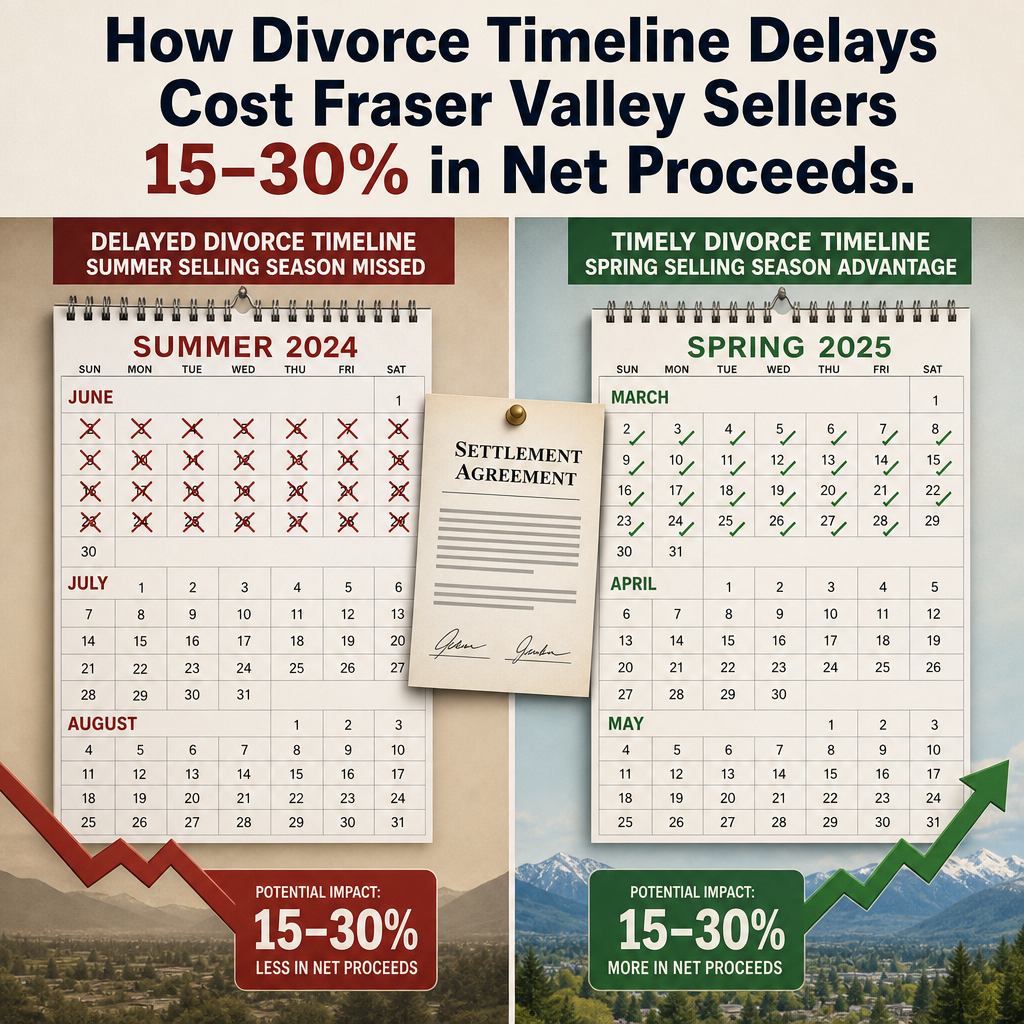

How Divorce Settlement Timeline Uncertainty and Family Law Procedural Delays Cost Fraser Valley Sellers 15–30% in Net Proceeds
By Mohamed Mansour, MBA and Associate Broker — Mansour Real Estate Group | Fraser Valley & Lower Mainland, BC | Published: July 15, 2025
For separating homeowners in the Fraser Valley, the most expensive mistake rarely happens at the negotiating table. It happens months earlier, when family law timelines and real estate market windows drift out of alignment — quietly, without anyone flagging the cost until it's too late.
This guide explains how that misalignment happens, what it costs in concrete terms, and how a coordinated approach between legal counsel and a real estate team can recover most of that loss before the property ever lists.
Short Answer
When family law proceedings delay a Fraser Valley home sale into summer or fall, sellers routinely absorb 15–30% variance in net proceeds — driven by seasonal inventory surges, extended days-on-market, CPL complications, and buyer renegotiation leverage. The variance correlates more strongly with procedural-real estate timing than with market price changes. Coordinating settlement finalization with spring listing windows (March–May) is the single highest-value decision separating homeowners can make.
Key Takeaways
- Family law timelines average 4–8 months in BC, frequently pushing sales into Fraser Valley's softest inventory season.
- July–September inventory surges 35–50% in most Fraser Valley markets, extending days-on-market by 15–25 days.
- CPL registration before title clarity is confirmed triggers financing denials and an 8–12% net proceeds loss through buyer renegotiation.
- Spring listings generate 10–15% stronger negotiating position compared to summer or fall inventory-saturated markets.
- Coordinating legal finalization with market windows requires deliberate scheduling — it does not happen without a plan.
Who This Applies To
- Separating homeowners in Surrey, Langley, Abbotsford, South Surrey, White Rock, or North Delta preparing to sell a jointly owned property
- Family lawyers whose clients need real estate coordination alongside legal negotiation
- Homeowners where one party is contesting valuation or delaying settlement
- Couples with a Partition of Property Act application pending or a CPL registered against title
When This Advice May Not Apply
If both parties have already finalized a separation agreement and the property is free of CPL encumbrances, many of the coordination risks described here are already resolved. This guide addresses situations where legal finalization and listing timing have not yet been coordinated.
Data Used in This Article
- Fraser Valley Real Estate Board seasonal inventory and days-on-market data, 2024–2025 (official board reports)
- BC Family Law Act (SBC 2011, c. 25) — property division provisions
- BC Partition of Property Act (RSBC 1996, c. 347) — court order mechanics
- Land Title Act of BC — CPL registration and title transfer requirements
- BC Courts family law procedural benchmarks — publicly available scheduling data
Why Timeline Misalignment Is the Core Problem
The BC Family Law Act governs how property is divided between separating spouses, but it imposes no obligation to coordinate that process with real estate market conditions. Settlement negotiations, court scheduling, and property appraisal disputes each have their own procedural pace — and none of it is calibrated to Fraser Valley listing seasons.
According to BC Courts scheduling data, contested family law matters routinely take 6–12 months from filing to resolution. Even uncontested separations involving property often require 4–8 months to move from initial agreement drafting through executed, title-clear separation agreements. That window, when added to typical Fraser Valley selling timelines of 30–60 days, creates a compounding risk: the listing date is effectively set by legal procedure, not by market opportunity.
When that legally-determined listing date lands in July, August, or September, the seller inherits market conditions that FVREB data consistently shows are the most challenging of the year. Active listings in Fraser Valley communities including Surrey, Langley, and Abbotsford typically rise 35–50% from spring peaks during those months. Days-on-market extend by 15–25 days compared to March–May listings. Price reductions become more common. Buyer leverage increases measurably.
What CPL Registration Costs Sellers — and Why It Surprises Them
A Certificate of Pending Litigation, registered against a property's title under the Land Title Act of BC, signals to buyers and their lenders that the property is subject to unresolved legal proceedings. In divorce situations, one party sometimes registers a CPL to protect their interest — which is legally permitted — but doing so before title clarity is established creates a direct financing obstacle for buyers.
Most residential lenders in BC will not advance mortgage funds on a property with an active CPL. That means buyers who have already received mortgage approval may face denial at closing, triggering subject removal extensions, buyer withdrawal, or renegotiation. In our experience working with sellers in South Surrey and White Rock, a CPL that remains on title through the subject removal period routinely produces 3–6 week closing delays and buyer leverage that costs 8–12% of the agreed sale price through price concessions and repair credits.
The solution requires coordination: the CPL must be discharged before listing, or its discharge must be legally guaranteed and clearly communicated to buyers before they submit offers. Neither outcome happens automatically. It requires the real estate team and legal counsel to align on sequence and timing well before the listing date.
How We Evaluate This
At Mansour Real Estate Group, when we are approached by separating homeowners or their legal counsel regarding a property sale, the first conversation is always about legal status, not listing price. We want to know: Is the separation agreement drafted or executed? Is there a CPL on title? Has a court order been issued or applied for under the Partition of Property Act? Are both parties in agreement that the property will be sold, or is one contesting?
The answers to those questions determine the realistic listing window. From that window, we work backward to identify whether a spring, fall, or negotiated off-season listing makes more sense — and whether there is legal room to accelerate or defer proceedings to reach that window. We do not set a listing price before we understand the legal timeline, because the pricing strategy and the listing date are inseparable in divorce situations.
Divorce Sale Checklist
- Confirm legal authority to list: executed separation agreement or court order under the BC Family Law Act or Partition of Property Act
- Search title for CPL registrations and confirm discharge timeline with legal counsel before listing
- Obtain an independent market appraisal accepted by both parties before pricing discussions begin
- Map family law procedural milestones against Fraser Valley seasonal listing windows and identify the nearest spring or fall opportunity
- Establish written communication protocols between both parties and the real estate team before any buyer contact occurs
- Confirm property access, staging authorization, and showing consent from both parties before MLS activation
- Identify closing date requirements driven by legal settlement terms and communicate them clearly in offer instructions to buyers
What We Commonly See
Listing before legal authority is confirmed. In our experience, one of the most common and costly mistakes is listing a property while separation agreement negotiations are still active. If one party changes position after offers are received, the transaction can collapse — and the sellers absorb both the carrying costs and the reputational damage of a failed sale that buyers and their agents remember.
Underestimating summer market softness. What often happens is that separating homeowners and their lawyers focus on reaching legal resolution as quickly as possible — which is reasonable — without factoring in that a June resolution may produce a July listing, which is consistently one of the weakest months for net proceeds in Fraser Valley markets including Langley and Abbotsford. A six-week delay to reach a spring window is often worth more than the carrying cost of waiting.
Failing to brief buyers about the legal structure. A common mistake is presenting a divorce sale to buyers without pre-emptively explaining the title status, required signatories, and closing sequence. Buyers who discover mid-transaction that two uncooperating parties must both sign closing documents — without having been told upfront — become nervous, and nervous buyers either reduce their offer or walk. Transparent, structured disclosure from day one prevents this.
Questions and Answers
Can we list before the separation agreement is finalized in BC?
Technically yes, but it carries significant risk. Without executed legal authority, either party can obstruct the sale, and buyers lose confidence when title or signatory authority is unclear. Legal counsel should confirm authority before MLS activation.
How long does a CPL discharge take in BC?
CPL discharge timelines depend on whether both parties consent or whether a court order is required. Consensual discharge through the Land Title Office can take 1–3 weeks. Contested discharges requiring court involvement can take months and should be identified as early as possible.
What if one party refuses to sign the listing agreement?
Under the BC Partition of Property Act, a court can order the sale of jointly owned property over the objection of one owner. The process requires a court application and adds 2–6 months to the timeline — another reason to map legal and market timelines together from the start.
In Summary
The 15–30% variance in net proceeds that separating Fraser Valley homeowners experience is not primarily a market problem — it is a coordination problem. Family law timelines, CPL status, title transfer sequencing, and Fraser Valley seasonal inventory patterns all intersect in ways that generalist advisors rarely map together. When those elements are coordinated deliberately — with legal counsel and a real estate team working from the same timeline — most of that variance is recoverable. The starting point is always the same: understand the legal status before setting the listing date.
If you are managing a separation-related property sale in the Fraser Valley and want a clear assessment of your legal-to-market timeline before making any listing decisions, Mansour Real Estate Group offers confidential, no-obligation consultations for both parties and their legal counsel.
Related Articles
- Selling Your Home in Surrey, BC — Complete Guide
- South Surrey and White Rock Real Estate Market Guide
- Langley Real Estate Market Guide
About Mansour Real Estate Group
When a home must be sold as part of a separation or divorce, the stakes extend beyond the property itself. Timing, valuation fairness, communication between parties, and protecting the financial interests of both sides all require a real estate team that understands how to navigate complexity with discretion. Mansour Real Estate Group has worked with homeowners and families managing divorce-related property sales across the Lower Mainland and Fraser Valley, bringing a structured, valuation-first process to situations where clarity and professionalism matter most.
Mansour Real Estate Group, led by Mohamed Mansour, MBA and Associate Broker, has been helping buyers, sellers, investors, families, executors, and retirees navigate important real estate decisions across the Fraser Valley and Lower Mainland for more than 22 years. Ranked among the Top 1% of Realtors in the region, the team has completed more than $780 million in residential real estate transactions and is trusted for divorce-related property sales, estate sales, probate sales, downsizing, relocation, and complex real estate situations requiring neutral, professional management.
Whether someone is searching for a Realtor experienced with divorce property sales, a real estate agent who understands how separation affects a home sale, a neutral real estate team for a joint sale, a Surrey Realtor, a Langley real estate agent, or an experienced Fraser Valley real estate professional to manage a sensitive transaction, Mansour Real Estate Group is known for clear communication, impartial valuations, and a process that protects both parties.
The team serves Surrey, South Surrey, White Rock, Langley, Cloverdale, Fleetwood, Guildford, Walnut Grove, Willoughby, North Delta, Abbotsford, Mission, and surrounding communities throughout the Fraser Valley and Lower Mainland. Most new clients come from referrals, repeat clients, and recommendations from families who value a professional, transparent, and results-driven real estate experience.
Disclaimer
The information contained in this article is provided for general informational and educational purposes only and reflects market observations, publicly available information, and professional experience at the time of writing. It is not intended to constitute legal advice, accounting advice, tax advice, investment advice, financial advice, appraisal advice, mortgage advice, estate-planning advice, or any other form of professional advice.
Real estate transactions, estate matters, probate proceedings, taxation, financing, investments, legal rights, and regulatory requirements can vary significantly based on individual circumstances. Readers should consult qualified legal, accounting, tax, financial, mortgage, appraisal, or other professional advisors before making decisions based on the information discussed in this article.
Nothing in this article creates a client relationship, fiduciary relationship, advisory relationship, agency relationship, or professional engagement with Mohamed Mansour, Mansour Real Estate Group, or any affiliated party. Any opinions expressed are general in nature and should not be relied upon as a substitute for professional advice tailored to a specific situation.
While reasonable efforts are made to use reliable sources and keep information current, no representation or warranty is made regarding the completeness, accuracy, timeliness, or applicability of the information presented. Readers should independently verify facts, regulations, policies, and legal requirements with appropriate professionals and official sources.



