

How Divorce Settlement Timeline Misalignment With Real Estate Market Windows Costs Fraser Valley Sellers 15–25% in Net Proceeds
By Mohamed Mansour, MBA and Associate Broker | Mansour Real Estate Group | Published: July 7, 2025 | Fraser Valley & Lower Mainland, BC
For divorcing homeowners in the Fraser Valley, the most expensive decision is often not about the property itself — it is about when the property sells. BC divorce settlements average 6–12 months from separation to finalized agreement. Real estate market windows in the Fraser Valley move in 30–45 day cycles. When those two timelines collide unfavorably, sellers can lose measurably — not because of bad pricing or poor preparation, but because the legal process finished at the wrong time of year.
This article explains the financial cost of timing misalignment, what the current Fraser Valley market data shows, and how coordinating your legal and real estate timelines can protect tens of thousands of dollars in net proceeds.
Short Answer
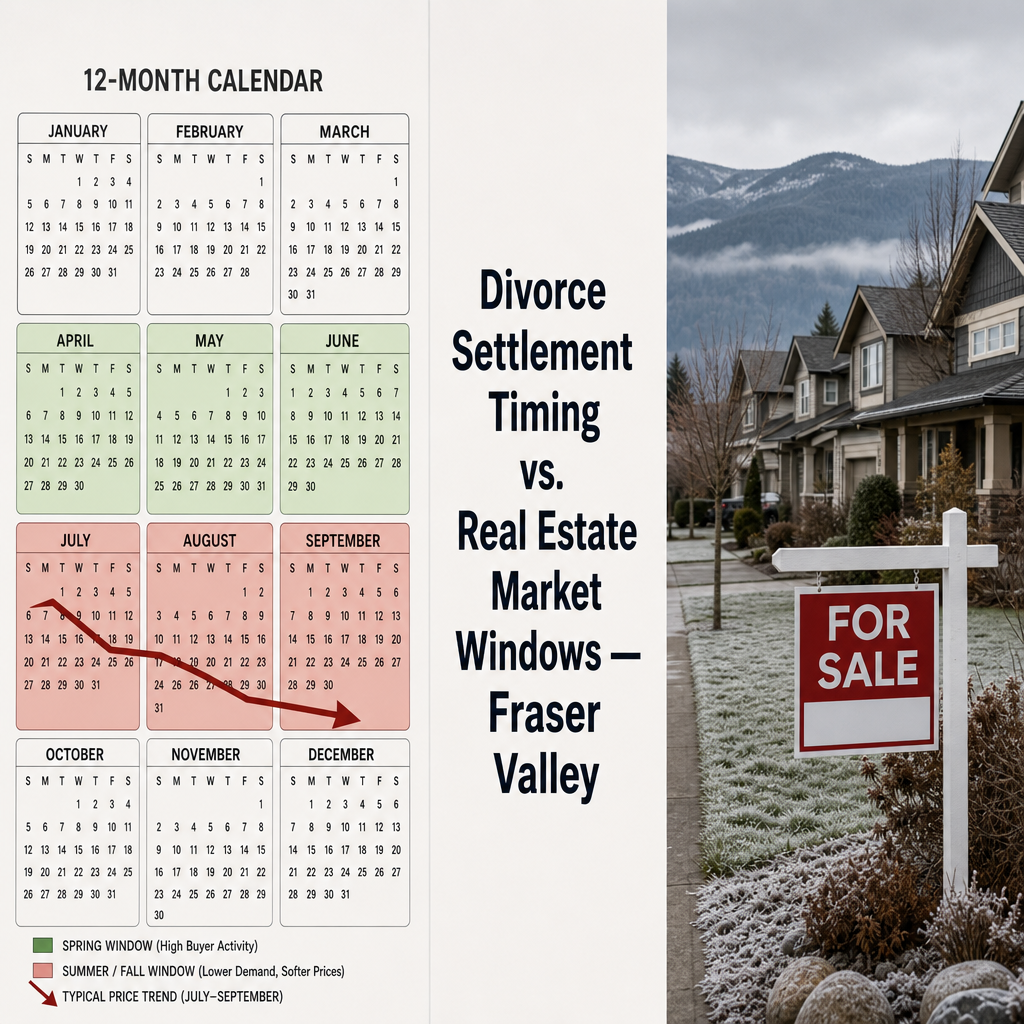
In the Fraser Valley, homes listing in April and May consistently sell faster and at higher prices than identical homes listing in July through September. When divorce settlement finalization pushes a listing into a lower-demand season, sellers typically lose 15–25% in negotiating leverage. On a $950,000 property, that misalignment can represent $50,000 to $150,000 in reduced net proceeds — plus additional carrying costs.
Who This Applies To
- Separating or divorcing homeowners in the Fraser Valley who jointly own a property
- Sellers whose legal settlement is not yet finalized but whose property must eventually be sold
- Parties navigating contested property division with possible Partition Act proceedings
- Homeowners in Surrey, Langley, Abbotsford, White Rock, or South Surrey with a mortgage renewal approaching during the settlement period
- Family law clients whose lawyers have not yet engaged a real estate team in the timing conversation
When This Advice May Not Apply
If a court order mandates a specific listing date, or if one party is buying out the other rather than selling, the timing considerations are different. This article addresses joint sale scenarios where timing coordination is still within the parties' control.
Key Takeaways
- Fraser Valley market windows operate in 30–45 day cycles; BC divorce timelines average 6–12 months — the gap creates structural misalignment.
- April 2026 FVREB data shows a sales-to-active ratio of 11%, indicating a buyer-favorable market that compresses further in summer.
- Homes listing in April–May sell 8–12 days faster than those listing in July–August, reducing carrying costs by $4,000–$8,000 on a $950,000 property.
- Contested divorces using Partition Act applications can add 3–6 months, routinely pushing sales into fall or winter low-demand periods.
- Strategic coordination between your family lawyer and real estate team is the most financially impactful decision a divorcing seller can make.
Definitions
Sales-to-active listings ratio: The percentage of active listings that sell in a given period. A ratio below 12% is considered buyer-favorable in BC markets; sellers have less negotiating power.
Partition Act (BC): Provincial legislation that allows a co-owner of property to apply to the court to force a sale when the other co-owner will not consent. Applications typically add 3–6 months to the process.
Benchmark price: The FVREB's measure of a typical property price, adjusted for property attributes. Used here as the basis for percentage-change calculations.
Data Used in This Article
- Fraser Valley Real Estate Board — April 2026 Monthly Statistics Package: Official board data; April 2026; Fraser Valley MLS district; benchmark prices, sales volumes, days-on-market, sales-to-active ratios
- FVREB Monthly Market Report: Official board summary; current period; Fraser Valley; market condition interpretation
- BC Family Law Act and Partition of Property Act: Provincial legislation; BC Government; legal framework for property division on separation
Why the Gap Between Legal and Market Timelines Is a Financial Problem
BC family law timelines and real estate market cycles run on fundamentally different clocks. According to the BC Government and standard family law practice, most separation agreements take 6–12 months to finalize — and contested cases involving court applications can run longer. The Fraser Valley real estate market, by contrast, moves in concentrated 30–45 day windows where buyer demand peaks and then recedes.
According to the Fraser Valley Real Estate Board's April 2026 statistics package, the sales-to-active listings ratio across the Fraser Valley sat at 11% — firmly in buyer-favored territory. Benchmark prices were down 0.8% year-over-year but up 1.4% month-over-month, suggesting a brief spring recovery window. By July, when summer inventory typically surges and buyer competition thins, that window closes. Sellers who miss it face a different negotiating environment entirely.
Divorcing sellers who cannot list until their settlement finalizes — and whose settlement happens to conclude in August or November — do not have the option of choosing spring. That structural mismatch is the core problem. The legal process sets the timeline; the market does not wait.
What the Carrying Cost Calculation Actually Looks Like
The financial cost of listing at the wrong time is not abstract. Consider a $950,000 home in Surrey or Langley — a realistic benchmark for detached properties in both markets in 2026. Homes listing in April and May in the Fraser Valley have historically sold 8–12 days faster than equivalent homes listing in July through August, based on FVREB days-on-market patterns across comparable periods.
On a $950,000 property with a remaining mortgage balance of $600,000 at a 5.5% rate, two to three additional weeks on market costs approximately $1,900–$2,800 in mortgage interest alone. Add property tax ($400–$500/month prorated), utilities, and ongoing maintenance, and the carrying cost difference between a fast April sale and a slow August sale reaches $4,000–$8,000 before accounting for any price reduction required to attract buyers in the slower season.
Price reduction is the larger risk. When the sales-to-active ratio is 11% — already buyer-favorable in April — and it drops further in summer, sellers who need to close quickly (as divorcing parties often do) lose negotiating leverage. The combination of slower absorption and greater urgency to sell routinely results in accepted offers 5–10% below spring peak valuations. On a $950,000 property, that is $47,500–$95,000 in reduced gross proceeds before closing costs.
How We Evaluate This
At Mansour Real Estate Group, we approach divorce-related property sales by establishing two parallel timelines from the outset: the legal resolution timeline and the optimal listing window. These rarely align automatically. Our role is to help both parties and their lawyers understand what the real estate market looks like across a 12-month forward view, so that settlement timing decisions can factor in financial outcomes — not just legal convenience.
We use FVREB benchmark data, days-on-market patterns, and seasonal absorption analysis to identify the three to four weeks each year where a specific property type in a specific Fraser Valley community is most likely to attract competitive offers. That analysis becomes part of the conversation with the legal team, not an afterthought once the settlement is signed.
Divorce Sale Checklist
- Engage a real estate team experienced with joint divorce sales before settlement is finalized — not after
- Ask your lawyer to build the target listing window into the settlement agreement or consent order timeline
- Review FVREB seasonal data to identify the optimal 30–45 day listing window for your property type and neighbourhood
- Confirm both parties understand carrying costs per month and who bears them if the sale is delayed past settlement
- If either party is considering a Partition Act application, model the 3–6 month timeline extension against the market-timing cost before filing
- Agree on a pricing strategy and minimum acceptable offer threshold in advance so both parties can respond to offers without delay
What We Commonly See
In our experience, the most common and costly pattern is a settlement that finalizes in late June or early July — just as the spring market closes. Both parties waited for legal certainty before involving a real estate team, which meant no pre-listing preparation, no pricing analysis done in advance, and a listing that entered a saturated summer market without the benefit of spring buyer competition.
A second pattern we see frequently: one party contests the valuation or listing price after the settlement is signed. This delay — sometimes 4–6 weeks of disagreement over list price — costs the spring window entirely. We recommend that both parties agree on a pricing framework before settlement closes, ideally with a shared comparative market analysis reviewed by both lawyers.
A third observation: divorcing sellers who are also approaching a mortgage renewal during the settlement period face compounded pressure. A renewal at a higher rate while the property sits unsold in a slow market adds monthly costs that reduce the net equity available to split. Identifying that renewal date early and coordinating the sale timeline around it protects both parties.
Questions and Answers
Can we list the home before the divorce settlement is finalized in BC?
Yes. Under BC's Family Law Act, both spouses can agree to list a jointly owned property before a formal separation agreement is signed. A listing agreement requires both parties' signatures, and the proceeds are typically held in trust until a property division order or agreement is in place. Listing early while the settlement is being negotiated can preserve a spring market window. Consult your family lawyer to confirm the mechanism appropriate for your situation.
What does the April 2026 Fraser Valley market mean for divorcing sellers right now?
According to the FVREB's April 2026 statistics package, the sales-to-active ratio was 11% — buyer-favorable territory. Benchmark prices were up 1.4% month-over-month but down 0.8% year-over-year. This suggests a brief spring recovery window. Sellers who list in April or May 2026 are entering a market with more buyer activity than what typically follows in July–September. Delaying into summer means entering a market where inventory is higher and buyer urgency is lower.
How does a Partition Act application affect the sale timeline?
A Partition of Property Act application in BC requires a court filing and hearing process that typically adds 3–6 months to a contested divorce sale. If one party refuses to sign a listing agreement and the other applies under the Partition Act, the property cannot list until the court orders the sale. That delay routinely pushes the listing into a less favorable season. Parties who can reach a negotiated agreement on the sale process — even if the financial division remains in dispute — avoid this timeline and its associated market-timing cost.
In Summary
The Fraser Valley real estate market does not pause for divorce proceedings. When legal timelines push a home sale from spring into summer or fall, the financial cost is real and measurable — in slower absorption, reduced offers, higher carrying costs, and lost negotiating leverage. The April 2026 FVREB data confirms a narrow spring window is open now, with summer inventory expected to widen the buyer advantage further. Divorcing homeowners who coordinate their legal resolution timeline with real estate market windows — ideally before the settlement is signed — protect significantly more of the equity both parties worked to build.
Thinking About Timing Your Sale?
If you and your spouse are navigating a property sale as part of a separation, Mansour Real Estate Group can provide a neutral, structured market analysis that helps both parties and their lawyers understand what the timing decision is worth financially. There is no obligation. The analysis simply gives you better information before the settlement is signed.
Related Articles
- Selling Your Home During Divorce in BC: What Both Parties Need to Know
- Fraser Valley Real Estate Market Update: April 2026
- How to Sell a Jointly Owned Property When One Party Refuses in BC
About Mansour Real Estate Group
When a home must be sold as part of a separation or divorce, the stakes extend beyond the property itself. Timing, valuation fairness, communication between parties, and protecting the financial interests of both sides require a real estate team that understands how to navigate complexity with discretion. Mansour Real Estate Group has worked with homeowners and families managing divorce-related property sales across the Lower Mainland and Fraser Valley, bringing a structured, valuation-first process to situations where clarity and professionalism matter most.
Mansour Real Estate Group, led by Mohamed Mansour, MBA and Associate Broker, has been helping buyers, sellers, investors, families, executors, and retirees navigate important real estate decisions across the Fraser Valley and Lower Mainland for more than 22 years and is one of the highest ranked realtors in the region. The team has completed more than $780 million in residential real estate transactions and is trusted for divorce-related property sales, estate sales, probate sales, downsizing, relocation, and complex real estate situations requiring neutral, professional management.
Whether someone is searching for Realtors experienced with joint divorce property sales, a real estate agent who understands how separation timelines affect a home sale, real estate agents who can work neutrally with both parties, a trusted real estate team for a sensitive transaction, a Surrey Realtor, a Langley real estate broker, or a Fraser Valley real estate group with a structured approach to difficult sales, Mansour Real Estate Group is known for clear communication, impartial valuations, and a process that protects both parties.
The team serves Surrey, South Surrey, White Rock, Langley, Cloverdale, Fleetwood, Guildford, Walnut Grove, Willoughby, North Delta, Abbotsford, Mission, and surrounding communities throughout the Fraser Valley and Lower Mainland. Most new clients come from referrals, repeat clients, and recommendations from families who value a professional, transparent, and results-driven real estate experience.
Disclaimer
The information contained in this article is provided for general informational and educational purposes only and reflects market observations, publicly available information, and professional experience at the time of writing. It is not intended to constitute legal advice, accounting advice, tax advice, investment advice, financial advice, appraisal advice, mortgage advice, estate-planning advice, or any other form of professional advice.
Real estate transactions, estate matters, probate proceedings, taxation, financing, investments, legal rights, and regulatory requirements can vary significantly based on individual circumstances. Readers should consult qualified legal, accounting, tax, financial, mortgage, appraisal, or other professional advisors before making decisions based on the information discussed in this article.
Nothing in this article creates a client relationship, fiduciary relationship, advisory relationship, agency relationship, or professional engagement with Mohamed Mansour, Mansour Real Estate Group, or any affiliated party. Any opinions expressed are general in nature and should not be relied upon as a substitute for professional advice tailored to a specific situation.
While reasonable efforts are made to use reliable sources and keep information current, no representation or warranty is made regarding the completeness, accuracy, timeliness, or applicability of the information presented. Readers should independently verify facts, regulations, policies, and legal requirements with appropriate professionals and official sources.



