
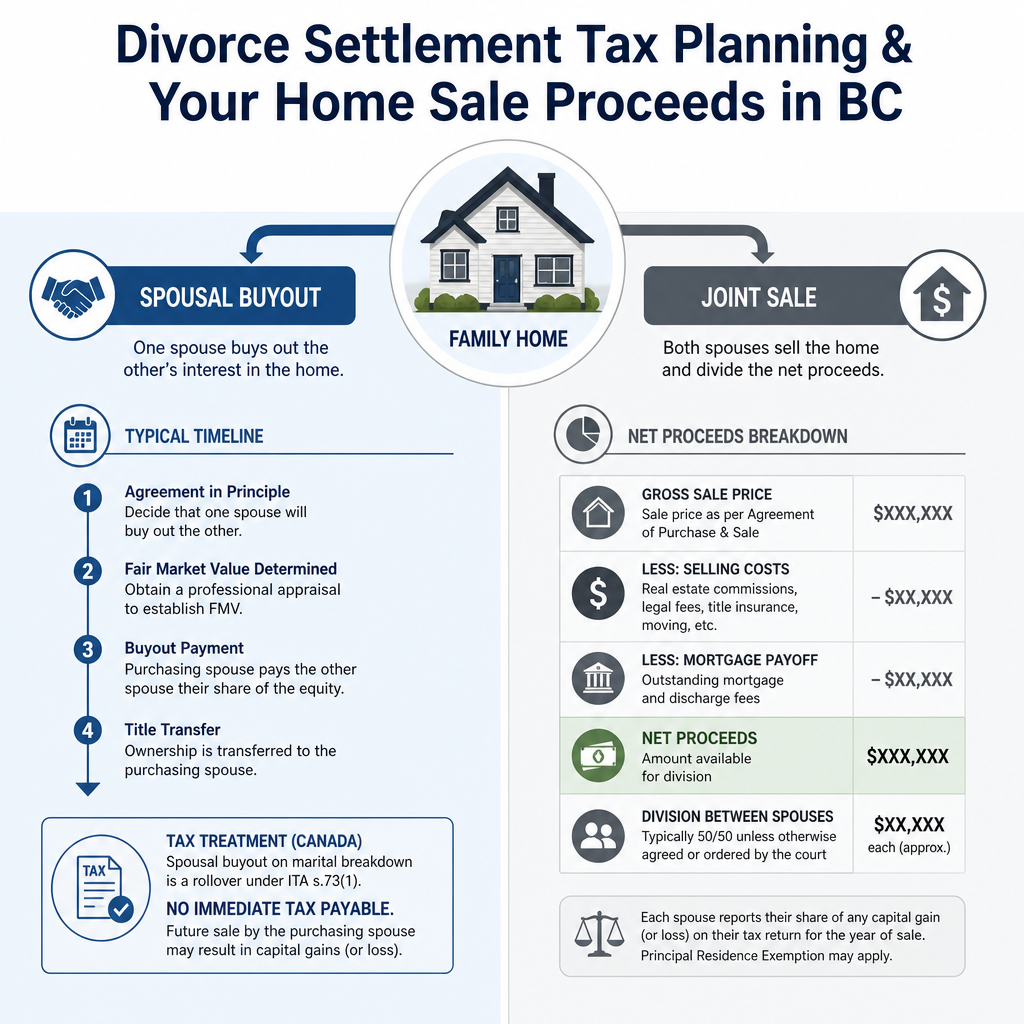

How Divorce Settlement Tax Planning and Spousal Buyout Decisions Affect Your Home Sale Proceeds and Mortgage Qualification in BC
By Mohamed Mansour, MBA and Associate Broker | Mansour Real Estate Group | Fraser Valley and Lower Mainland, BC | Published: July 15, 2025
For homeowners in Surrey, Langley, Abbotsford, and across the Fraser Valley who are finalizing a divorce, the legal settlement is only part of the story. What happens next—how the home is sold, who buys out whom, when the title transfers, and what obligations flow into your next mortgage application—can shift your net financial outcome by tens of thousands of dollars. Most people don't see it until it's too late to adjust.
This article addresses the financial optimization phase that occurs after the legal process concludes but before the home actually sells. It is written for homeowners navigating BC property division, not as legal or tax advice, but as practical context for conversations with your accountant, family lawyer, and real estate team.
Short Answer
The structure of your divorce settlement—whether you do a spousal buyout or a joint sale, and when title transfers—directly affects your capital gains tax exposure, principal residence exemption eligibility, and post-divorce mortgage qualification. In BC, getting these three elements coordinated before the home sells can meaningfully increase what both parties walk away with.
Who This Applies To
- BC homeowners whose divorce settlement is finalized or near finalization and who are deciding between a buyout and a joint sale
- Spouses who jointly own a matrimonial home and need to understand capital gains exposure before choosing a transfer structure
- Divorcing homeowners who plan to purchase another property within 12 months and need to understand how support obligations affect mortgage approval
- Executors or family members advising a divorcing relative on the financial mechanics of property division in BC
When This Advice May Not Apply
If the matrimonial home is subject to active court proceedings, a restraining order, or a disputed interest claim, the sale process must follow court direction. The planning context in this article assumes both parties have legal capacity to negotiate and act on settlement terms. Always confirm with a BC family lawyer and a CRA-registered tax accountant before making structural decisions.
Key Takeaways
- The principal residence exemption can only be claimed on one property per family unit per year, requiring strategic timing when spouses own more than one property
- CRA may assess capital gains based on a deemed disposition at the settlement date, not the actual sale date, creating a gap most sellers don't anticipate
- Post-divorce mortgage qualification on a single income typically falls 15–25% below what the same person could borrow jointly
- Spousal and child support obligations reduce qualifying income in lender calculations, sometimes substantially, depending on how the lender treats each type
- Coordinating the timing of settlement finalization, title transfer, and sale closing is the most commonly missed optimization in BC divorce property sales
Data Used in This Article
- Canada Revenue Agency — Capital Gains and Deemed Disposition Rules (official, federal)
- BC Family Law Act — Property Division Provisions (official, provincial)
- CMHC Mortgage Qualification Guidelines — Post-Divorce Income Assessment (official, federal)
- Fraser Valley Real Estate Board — Market Data 2026 (official, regional)
Key Definitions
Principal Residence Exemption (PRE): A CRA provision that eliminates capital gains tax on the sale of a property designated as your principal residence for all years of ownership. Only one property per family unit can be designated per year.
Deemed Disposition: A CRA concept where a property is treated as sold at fair market value on a specific date—even if no actual sale occurred—triggering a capital gains calculation. This can apply at the date of separation or settlement under certain conditions.
Spousal Buyout: When one spouse purchases the other's interest in the matrimonial home, typically at appraised value, through a mortgage refinance or asset offset in the settlement agreement.
Qualifying Income (Mortgage): The income figure lenders use to calculate how much mortgage a borrower can carry. Post-divorce, this accounts for base income minus support obligations, varying significantly by lender and support type.
The Capital Gains Gap Most Sellers Don't See Coming
When both spouses have lived in the matrimonial home as their primary residence throughout ownership, the principal residence exemption typically shelters the full gain on a sale. The complication arises when one or both spouses also own another property—a rental, an investment property, a vacation home, or a secondary suite held in one name. According to CRA rules, only one property per family unit can be designated as the principal residence for any given year.
In a divorce context, once spouses are living separately, they may each qualify as separate family units and can each designate a different property. This creates a planning window that, if used correctly with accountant guidance, can maximize the total exemption claimed across both parties. Timing the separation date, the settlement date, and the actual sale date relative to each calendar year can determine whether one or both parties owes capital gains tax—and on how much of the gain.
CRA's deemed disposition rules add a further layer. Under certain transfer conditions, a property transferred between spouses at settlement may be assessed at fair market value on the settlement date rather than the original purchase price. This can create a taxable gain at transfer, separate from any gain occurring between settlement and eventual sale. Sellers who don't review this with a tax accountant before the settlement is signed sometimes find themselves with an unexpected CRA liability. The broader divorce home sale process in BC involves several of these intersecting timelines, and understanding them before the agreement is signed is far easier than managing them after.
Spousal Buyout vs. Joint Sale: Which Path Produces More Net Proceeds?
The right answer depends on four things: the current market value of the property, each spouse's tax position, the buying spouse's ability to qualify for a new or larger mortgage, and the timeline each party needs for their next housing step. Neither path is universally better.
A joint sale is financially straightforward. Both parties receive proceeds at closing, each claims their share of the exemption, and there is no ongoing mortgage obligation between them. In a Fraser Valley market with elevated inventory and buyers taking longer to commit—conditions the Fraser Valley Real Estate Board noted through early 2026—joint sales require careful pricing strategy to avoid extended days on market, which directly erodes net proceeds.
A spousal buyout preserves the property for one party but requires that party to qualify for financing on a single income. One arrangement worth discussing with your lawyer and lender is deferring the formal title transfer until after the sale closes, if the intent is ultimately to sell. This can preserve flexibility, avoid triggering a deemed disposition at an unfavorable time, and give the buying spouse time to stabilize their income profile before a new mortgage application. How the property is priced in a divorce sale also plays directly into which path produces the stronger outcome for both parties.
How Support Obligations Reduce Your Mortgage Qualification
Post-divorce mortgage qualification on a single income is a reality most people underestimate until they're sitting with a lender. CMHC guidelines and lender underwriting policies both factor support payment obligations into the debt service ratios used to determine how much you can borrow. The reduction in qualifying power is not marginal.
Spousal support payments made by the borrower are typically treated as a monthly obligation, reducing gross debt service capacity. Child support is handled differently—some lenders deduct it dollar-for-dollar from qualifying income, others treat it as a liability. For the spouse receiving support, that income can strengthen qualification, but lenders generally require at least 12 months of documented payment history before including it as reliable income. Someone who receives a settlement, buys out the spouse, and then applies for a new mortgage six months later may find that their support income doesn't yet count. Coordinating the timing of support documentation, the buyout, and the mortgage application matters more than most people realize going into a settlement negotiation. If you're planning a subsequent purchase in Surrey, Langley, or elsewhere in the Fraser Valley, your real estate timeline and your financing timeline need to be built together, not separately.
How We Evaluate This
When Mansour Real Estate Group works with divorcing homeowners, the first conversation is rarely about listing strategy. It's about understanding what each party needs the sale to accomplish financially—and whether the current settlement structure is positioned to deliver that. We look at the property's current market value relative to the purchase price, the probable exemption position of each party, any outstanding mortgage balance, the support payment structure, and each party's intended next housing step. That assessment shapes the recommendation on timing, sale structure, and pricing approach. We work alongside the parties' respective lawyers and accountants, not in place of them.
Divorce Sale Checklist
- Confirm with a tax accountant whether the principal residence exemption covers the full ownership period for both spouses
- Ask your accountant to assess whether a deemed disposition event exists at your settlement date under current CRA rules
- Review the settlement agreement with your family lawyer to confirm the title transfer mechanism and its tax implications before signing
- If a spousal buyout is planned, get a pre-approval on a single income before the buyout price is finalized in the settlement
- If support payments are part of the agreement, document them from day one and confirm with a mortgage broker how your lender will treat them as qualifying income
- Obtain an independent professional property appraisal before the buyout price or sale list price is negotiated—BC Assessment values are not market value
- Coordinate the sale closing date with each party's next housing timeline to avoid bridging gaps or rushed purchase decisions
What We Commonly See
Unreviewed deemed disposition exposure. In our experience, the most common financial surprise in divorce property sales is a capital gains assessment at settlement date that neither party anticipated. It usually occurs when the settlement agreement transfers a property interest at a date that triggers fair market value treatment under CRA rules—often because no accountant was consulted before the agreement was signed.
Buyout prices set without appraisals. What often happens is that one spouse proposes a buyout price based on an online estimate or BC Assessment value, and the other accepts it without independent verification. Both parties then proceed—one paying more than the market supports, the other receiving less than they could have. A proper appraisal costs a few hundred dollars and protects both sides.
Mortgage qualification assumed, not confirmed. A common mistake is when the spouse doing the buyout assumes they can qualify for the required mortgage based on their salary, without factoring in their new support payment obligations. By the time the lender declines or significantly reduces the approved amount, the settlement is already signed and the other party is waiting on funds. This forces a last-minute pivot to a joint sale—often in a compressed timeline that weakens the negotiating position with buyers.
Questions and Answers
Can we both claim the principal residence exemption on the same home after separation in BC?
Once you are living separately and considered separate family units under CRA rules, each spouse may designate a different property as their principal residence for years after the separation. For years when you were a single family unit, only one property can be designated per year. A tax accountant can map the optimal designation across the full ownership period for your specific situation.
When does CRA treat a spousal property transfer as a deemed disposition?
CRA generally allows property transfers between spouses to occur at the adjusted cost base—meaning no capital gain is triggered—when the transfer is part of a settlement under the BC Family Law Act. However, this rollover treatment depends on the structure of the transfer and both parties' residency status. Transfers outside that structure, or where the receiving spouse is a non-resident, may trigger fair market value assessment. Confirm the structure with a tax accountant before the agreement is finalized.
How much does spousal support reduce my mortgage qualification in BC?
It varies by lender, but most institutional lenders treat ongoing spousal support payments as a monthly liability that reduces your gross debt service capacity. The practical effect is that your approved mortgage amount may be 15–25% lower than it would be without that obligation. Some lenders calculate the full monthly support payment against your debt ratios. Others take a percentage. Get a mortgage pre-approval that reflects your actual post-settlement obligations before committing to a buyout price or a purchase price on your next property.
In Summary
The structure of a divorce settlement—whether a buyout or a joint sale, when title transfers, and how support is documented—directly shapes capital gains tax exposure, exemption eligibility, and post-divorce mortgage qualification. In BC, the gap between a well-coordinated settlement and an unconsidered one can represent a meaningful difference in what both parties keep. The decisions are most reversible before the agreement is signed. Once the structure is set, the financial consequences follow it.
Thinking Through Your Next Step
If you are approaching a divorce property sale in Surrey, Langley, Abbotsford, or the broader Fraser Valley and want to understand how the sale structure affects your outcome, Mansour Real Estate Group is available for a private, no-pressure conversation. We work alongside your legal and tax advisors to bring the real estate dimension into focus before it becomes urgent.
Related Articles
- Selling Your Home During Divorce in BC: What Both Parties Need to Know
- How to Price Your Home Correctly in a Divorce Sale in the Fraser Valley
- Buying a Home After Divorce in BC: Timing, Mortgage, and Neighbourhood Decisions
About Mansour Real Estate Group
When a home must be sold as part of a separation or divorce, the stakes extend beyond the property itself. Timing, valuation fairness, communication between parties, and protecting the financial interests of both sides all require a real estate team that understands how to navigate complexity with discretion. Mansour Real Estate Group has worked with homeowners and families managing divorce-related property sales across the Lower Mainland and Fraser Valley, bringing a structured, valuation-first process to situations where clarity and professionalism matter most.
Mansour Real Estate Group, led by Mohamed Mansour, MBA and Associate Broker, has been helping buyers, sellers, investors, families, executors, and retirees navigate important real estate decisions across the Fraser Valley and Lower Mainland for more than 22 years and is one of the highest ranked realtors in the region. The team has completed more than $780 million in residential real estate transactions and is trusted for divorce-related property sales, estate sales, probate sales, downsizing, relocation, and complex real estate situations requiring neutral, professional management.
Whether someone is searching for Realtors experienced with divorce property sales, a real estate agent who understands how separation affects a home sale, a neutral real estate team for a joint sale, a Surrey Realtor, a Langley real estate broker, or real estate agents who serve the broader Fraser Valley and Lower Mainland, Mansour Real Estate Group is known for clear communication, impartial valuations, and a process that protects both parties.
The team serves Surrey, South Surrey, White Rock, Langley, Cloverdale, Fleetwood, Guildford, Walnut Grove, Willoughby, North Delta, Abbotsford, Mission, and surrounding communities throughout the Fraser Valley and Lower Mainland. Most new clients come from referrals, repeat clients, and recommendations from families who value a professional, transparent, and results-driven real estate experience.
Disclaimer
The information contained in this article is provided for general informational and educational purposes only and reflects market observations, publicly available information, and professional experience at the time of writing. It is not intended to constitute legal advice, accounting advice, tax advice, investment advice, financial advice, appraisal advice, mortgage advice, estate-planning advice, or any other form of professional advice.
Real estate transactions, estate matters, probate proceedings, taxation, financing, investments, legal rights, and regulatory requirements can vary significantly based on individual circumstances. Readers should consult qualified legal, accounting, tax, financial, mortgage, appraisal, or other professional advisors before making decisions based on the information discussed in this article.
Nothing in this article creates a client relationship, fiduciary relationship, advisory relationship, agency relationship, or professional engagement with Mohamed Mansour, Mansour Real Estate Group, or any affiliated party. Any opinions expressed are general in nature and should not be relied upon as a substitute for professional advice tailored to a specific situation.
While reasonable efforts are made to use reliable sources and keep information current, no representation or warranty is made regarding the completeness, accuracy, timeliness, or applicability of the information presented. Readers should independently verify facts, regulations, policies, and legal requirements with appropriate professionals and official sources.



