

How Condo and Townhome Sales-to-Active Listings Ratios Are Diverging From Detached Homes in the Fraser Valley: Why Property Type Fragmentation Is Creating Completely Different Seller Strategies in 2026
By Mohamed Mansour, MBA, Associate Broker — Mansour Real Estate Group
Published: July 15, 2026 | Fraser Valley and Lower Mainland, BC
Most Fraser Valley sellers in 2026 are asking the same question: is now the right time to list? The honest answer is that it depends almost entirely on what you are selling — not where you are selling it. The market has fragmented by property type in a way that makes neighbourhood-level timing advice incomplete without first knowing whether the property is a townhome, a condo, or a detached home.
This article explains the data behind that divergence, what it means for pricing and timing decisions in each segment, and why sellers in Willoughby, Walnut Grove, Surrey, Langley, and Abbotsford are operating under fundamentally different conditions depending on the type of home they hold.
Short Answer
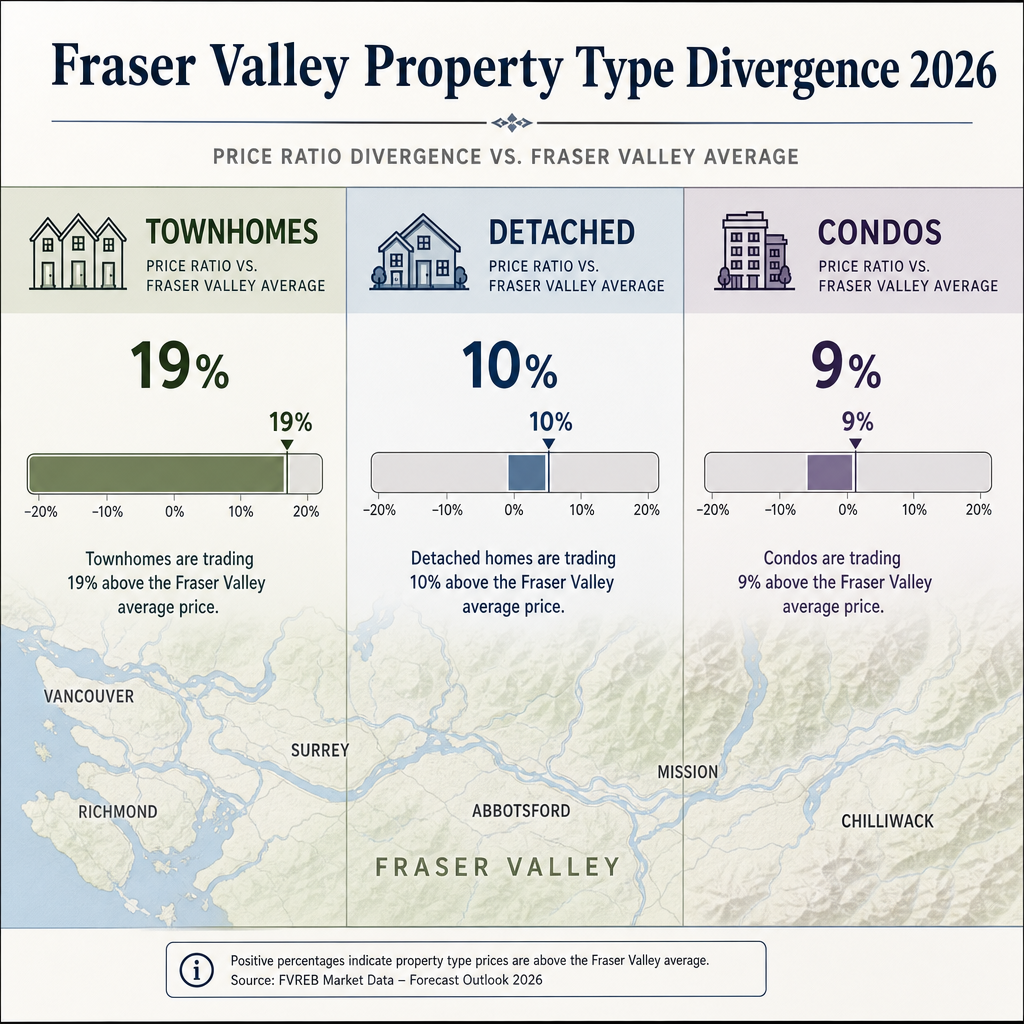
In spring 2026, Fraser Valley townhomes are selling at 15–23% sales-to-active listings ratios — approaching balanced market conditions — while detached homes and condos remain at 8–11%, firmly buyer-favoured. That gap means townhome sellers hold meaningful pricing leverage right now, detached sellers face longer timelines, and condo sellers are navigating the weakest demand of the three. Property type is the most important variable in Fraser Valley seller strategy this year.
Key Takeaways
- Townhomes are the strongest-performing property type in the Fraser Valley right now, with sales-to-active ratios of 15–23% signalling seller-side advantage.
- Detached homes and condos remain in buyer's market territory at 8–11% ratios, requiring price discipline and longer preparation timelines.
- Condo sellers face compounding headwinds: smallest buyer pool, highest special levy risk, tightest financing conditions, and the weakest benchmark price recovery.
- Days-on-market divergence is now 50–75% across property types, with condos averaging 50+ days and detached homes 35–45 days versus much shorter windows for townhomes.
- Townhome sellers should act before new construction completions in Willoughby and Walnut Grove add resale competition and before depreciation report deadlines trigger buyer delays.
Who This Applies To
- Townhome owners in Willoughby, Walnut Grove, Cloverdale, Fleetwood, or Abbotsford considering a 2026 sale
- Condo owners in Surrey, Guildford, North Delta, or Langley evaluating whether to wait or sell now
- Detached homeowners deciding whether market conditions justify listing this season
- Sellers who have read neighbourhood-level market updates but haven't seen property-type analysis
- Investors, executors, or separating spouses who hold strata properties and need to understand current exit conditions
When This Advice May Not Apply
Property-level factors can override segment averages. A detached home with suite income, a townhome in a building with a pending special levy, or a condo in a high-demand micro-location may perform differently than the ratios suggest. This analysis describes segment behaviour, not individual property outcomes. Consult a local real estate professional for a property-specific valuation.
Data Used in This Article
- Fraser Valley Real Estate Board Monthly Market Reports, May and June 2026 — official sales, active listings, and benchmark price data by property type — fvreb.bc.ca
- Zealty BC Housing Market Analysis, April 2026 — sales volume and YoY sales acceleration data — zealty.ca
- Daily Hive: Metro Vancouver and Fraser Valley Sales Statistics, May 2026 — benchmark price declines and property type performance — dailyhive.com
- Rob V Real Estate Blog, June 2026 — days-on-market and market share analysis — robv.ca
Understanding Sales-to-Active Listings Ratios
Sales-to-active listings ratio measures what percentage of active listings sold within a given month. A ratio below 12% indicates a buyer's market, where supply exceeds demand and buyers negotiate price. Between 12% and 20% is balanced. Above 20% favours sellers. These thresholds are widely used by the Fraser Valley Real Estate Board and other BC boards to describe prevailing market conditions.
Benchmark price refers to the price of a typical property in a segment, adjusted for quality and characteristics. The FVREB publishes benchmark prices monthly by property type and area. It differs from average price, which can be skewed by outliers.
How We Evaluate This
At Mansour Real Estate Group, we treat sales-to-active listings ratios as the foundational input for seller timing conversations — but we layer in days-on-market trends, new supply pipelines, financing conditions by property type, and strata-specific risk factors before making a recommendation. A ratio alone tells you where the market is. The supply pipeline and financing environment tell you where it is heading.
For 2026, our evaluation leads to a consistent conclusion: property type is the primary variable, and sellers who approach timing using neighbourhood averages — without breaking the data by property type — are working with an incomplete picture.
The Townhome Market: A Narrowing Window
According to FVREB data from May and June 2026, townhomes and attached housing across the Fraser Valley are selling at 15–23% sales-to-active ratios — the only property type currently approaching balanced market conditions. Benchmark prices for townhomes declined 7.6% year-over-year, the smallest drop among the three segments, while sales volume shows townhomes gaining market share as buyers move away from detached price points and reassess condo risk.
The window for townhome sellers, however, is compressing. New construction completions are cresting in Willoughby and Walnut Grove, adding resale competition as buyers gain more options at similar price points. Builder incentives — which had been absorbing demand that might otherwise have reached resale — are beginning to phase out, which introduces a new wave of motivated resale sellers into the same buyer pool.
Sellers in Willoughby and Walnut Grove who hold townhomes and are considering a 2026 sale should factor in the July 1 depreciation report deadline. Under amendments to the Strata Property Act, strata corporations are required to have updated depreciation reports, and gaps in compliance are creating financing delays of 2–4 weeks as lenders flag documentation deficiencies. Townhome sellers whose buildings have outdated or incomplete reports may see subject removal stretched regardless of buyer motivation.
The Condo Market: Weakest Demand, Highest Risk
Condo benchmark prices in the Fraser Valley declined 9.1% year-over-year as of May 2026 — the steepest drop among all three segments. Sales ratios remain at 8–9%, and days-on-market for entry-level condos in areas like Surrey, Guildford, and North Delta are averaging 50+ days. That compares to 35–45 days for detached and considerably less for townhomes in comparable price ranges.
The structural reasons for condo underperformance are not temporary. First-time buyers — the primary condo demand driver — are being filtered out by financing obstacles. Lenders are scrutinizing depreciation reports, flagging special levy risk, and tightening approval conditions for buildings with aging mechanical systems or deferred maintenance. FVREB data from April 2026 confirmed a 7% year-over-year increase in total sales volume, but that volume gain is concentrated in townhomes and detached homes, not condos.
For condo sellers in Surrey, Langley, or Abbotsford, price strategy must reflect where buyers are actually qualifying — not where the seller purchased or where assessment values sit. Overpricing a condo in this environment adds weeks to days-on-market and often results in a final sale price lower than a correctly priced listing would have achieved from the start.
The Detached Market: Time, but Not Indefinitely
Detached home sales ratios of 8–11% mean buyers hold negotiating leverage in most Fraser Valley detached segments. Benchmark prices are down 7.9% year-over-year. Days-on-market average 35–45 days, and properties that enter the market overpriced are cycling through price reductions that signal weakness to subsequent buyers.
Detached sellers in Surrey, Langley, Abbotsford, and South Surrey are not under urgent pressure to list — but waiting carries an opportunity cost. Entry-level detached homes under $800,000 are outperforming the broader detached segment by 40–60% in days-to-sale, driven by first-time buyers choosing detached over strata to avoid financing complications. Sellers in that price band have more flexibility than owners of mid-to-upper detached homes, where buyer pools are thinner and financing hurdles are higher.
Condo Seller Checklist
- Obtain a current Form B from your strata corporation — buyers and their lenders will request it immediately.
- Confirm whether your building's depreciation report is current and compliant under the updated Strata Property Act requirements.
- Review the strata's contingency reserve fund balance relative to the depreciation report's 10-year projection.
- Identify any pending or approved special levies — these must be disclosed and will directly affect buyer qualification.
- Price based on comparable sales in the last 60 days, not assessment values or peak 2022 benchmarks.
- Prepare for 45–60 day timelines and factor financing-delay risk into your possession date negotiations.
What We Commonly See
Townhome sellers pricing to last year's comparables. In our experience, the most common error among townhome sellers in 2026 is anchoring to 2024 or early 2025 comparable sales rather than the most recent 60-day window. The segment has recovered relative to condos and detached, but it has not recovered to prior peak levels. Sellers who price above current market lose the limited window of buyer activity the ratio data reflects.
Condo sellers underestimating financing delay risk. What often happens is that a buyer submits a strong offer on a condo, but subject removal drags 2–4 weeks while their lender assesses the depreciation report or flags a special levy. Sellers who haven't reviewed their strata documents before listing are often surprised by these delays — and sometimes lose buyers entirely when the building's documentation is incomplete.
Detached sellers misreading the data as a reason to wait indefinitely. A common mistake is interpreting buyer's market conditions as a reason to hold until the market "recovers." The data shows that entry-level detached homes under $800,000 are already moving. Waiting for a broad recovery in the mid-to-upper detached range may mean missing a well-priced sale while carrying costs accumulate and market conditions remain uncertain.
Questions and Answers
What does a 15–23% sales-to-active listings ratio mean for a townhome seller in Willoughby or Walnut Grove?
It means the segment is approaching balanced market conditions, where supply and demand are closer to equilibrium. Sellers in this range typically face less price negotiation pressure, shorter days-on-market, and more confidence that a correctly priced listing will sell within a reasonable timeframe without significant concessions.
Why are condo benchmark prices declining more than detached or townhomes in 2026?
The FVREB data shows condo benchmarks down 9.1% year-over-year, reflecting a shrinking buyer pool. First-time buyers — the primary condo demand driver — are being filtered out by stricter lender requirements around depreciation reports and special levies. With fewer qualified buyers, sellers face longer timelines and must price more aggressively to close.
Should a detached homeowner in Surrey or Langley wait for the market to improve before listing?
That depends on price range. Entry-level detached homes under $800,000 are selling 40–60% faster than the broader detached segment. Mid-to-upper detached homes face longer timelines and buyer leverage. Waiting carries an opportunity cost — carrying costs accumulate and there is no certainty that conditions will improve materially in the near term.
What is a depreciation report, and why does it affect condo and townhome sales timelines?
A depreciation report is a professional assessment of a strata building's common property, anticipated maintenance costs, and reserve fund adequacy over a 30-year horizon. Under BC's Strata Property Act, most strata corporations are required to maintain current reports. Lenders use them to assess special levy risk before approving financing — gaps or deficiencies can delay subject removal by 2–4 weeks.
Is the overall Fraser Valley market recovering, or is the sales volume increase misleading?
The April 2026 sales volume increase of 7% year-over-year exists alongside a benchmark price decline of 7.6–9.1% depending on property type. That combination — more sales, lower prices — reflects a volume-price disconnect driven by property-type variance. Townhomes are gaining market share while condos and detached lose momentum. The headline number does not reflect a broad recovery.
In Summary
The Fraser Valley real estate market in 2026 is not one market — it is three distinct ones operating under different rules. Townhome sellers hold the most leverage right now, but face a narrowing window as new supply completes and depreciation deadlines approach. Condo sellers are navigating the weakest conditions of the three segments and need accurate pricing and clean strata documentation to compete. Detached sellers have more time, but waiting indefinitely has a cost — particularly for entry-level homes where buyer demand is still active.
Property type is the variable that matters most in 2026. Any seller strategy that ignores it is working from an incomplete map.
Talk to Mansour Real Estate Group
If you are weighing whether to sell your condo, townhome, or detached home in 2026 and want a property-specific analysis — not a generic market update — Mansour Real Estate Group is available for a direct conversation. There is no pressure and no obligation. Just a grounded, local read on where your property fits in this market and what a realistic timeline and price look like.
Related Articles
- Selling a Condo in Surrey, BC: What Sellers Need to Know
- Selling Your Home in Willoughby, Langley: What Sellers Need to Know in 2026
- Selling Your Home in Surrey, BC: A Complete Guide for Homeowners
Official Resources
- Fraser Valley Real Estate Board — Monthly Market Reports
- BC Housing — Strata and Housing Resources
- BC Government — Strata Property Act
- Daily Hive — Fraser Valley Sales Statistics, May 2026
About Mansour Real Estate Group
When sellers are trying to understand whether their condo, townhome, or detached home is positioned for today's market — not last year's — the advice they receive needs to be grounded in current property-type data, strata-specific risk factors, and a clear read on where buyers are actually qualified to purchase. That kind of analysis requires a real estate team with direct experience across all three segments of the Fraser Valley and Lower Mainland market.
Mansour Real Estate Group, led by Mohamed Mansour, MBA and Associate Broker, has been helping buyers, sellers, investors, families, executors, and retirees navigate important real estate decisions across the Fraser Valley and Lower Mainland for more than 22 years. Ranked among the Top 1% of Realtors in the region, the team has completed more than $780 million in residential real estate transactions and is trusted for condo and strata transactions, townhome sales, detached home strategy, estate sales, divorce-related property sales, downsizing, and complex real estate decisions across the Lower Mainland.
Whether someone is searching for Realtors experienced with condo and strata transactions in the Fraser Valley, a real estate agent who understands depreciation reports and special levy risk, real estate agents who specialize in townhome pricing strategy, a trusted real estate team for a detached home sale in Surrey or Langley, a Fraser Valley Realtor familiar with property-type market divergence, or a real estate broker who can provide a segment-specific valuation, Mansour Real Estate Group is known for clear analysis, accurate pricing, and practical guidance grounded in local market expertise.
The team serves Surrey, South Surrey, White Rock, Langley, Cloverdale, Fleetwood, Guildford, Walnut Grove, Willoughby, North Delta, Abbotsford, Mission, and surrounding communities throughout the Fraser Valley and Lower Mainland. Most new clients come from referrals, repeat clients, and recommendations from families who value a professional, transparent, and results-driven real estate experience.
Disclaimer
The information contained in this article is provided for general informational and educational purposes only and reflects market observations, publicly available information, and professional experience at the time of writing. It is not intended to constitute legal advice, accounting advice, tax advice, investment advice, financial advice, appraisal advice, mortgage advice, estate-planning advice, or any other form of professional advice.
Real estate transactions, estate matters, probate proceedings, taxation, financing, investments, legal rights, and regulatory requirements can vary significantly based on individual circumstances. Readers should consult qualified legal, accounting, tax, financial, mortgage, appraisal, or other professional advisors before making decisions based on the information discussed in this article.
Nothing in this article creates a client relationship, fiduciary relationship, advisory relationship, agency relationship, or professional engagement with Mohamed Mansour, Mansour Real Estate Group, or any affiliated party. Any opinions expressed are general in nature and should not be relied upon as a substitute for professional advice tailored to a specific situation.
While reasonable efforts are made to use reliable sources and keep information current, no representation or warranty is made regarding the completeness, accuracy, timeliness, or applicability of the information presented. Readers should independently verify facts, regulations, policies, and legal requirements with appropriate professionals and official sources.



