

How Buyer's Agent Representation Actually Works in BC Real Estate: Fiduciary Duty, Commission Structure, Negotiation Strategy, and How to Assess Whether Your Agent Has the Expertise to Compete in Metro Vancouver and Fraser Valley Markets in 2026
By Mohamed Mansour, MBA and Associate Broker | Mansour Real Estate Group | Fraser Valley and Lower Mainland | Published July 2026
Most buyers in BC hire an agent the same way — through a friend's referral, or the first person who answered their call. Few ask how that agent is paid, what legal duties apply, or how to tell a skilled negotiator from someone who schedules showings and forwards offers. In a 2026 buyer's market across Surrey, Langley, Abbotsford, and South Surrey, those distinctions affect outcomes in ways that are real and measurable.
This guide explains how buyer's agent representation works in BC — legally, financially, and practically — and gives you specific questions to assess whether your agent has the local expertise to compete in today's Fraser Valley and Metro Vancouver markets.
Short Answer
In BC, a buyer's agent owes you four fiduciary duties — loyalty, confidentiality, disclosure, and obedience — under the Real Estate Services Act. They are typically paid from the seller-funded commission via a split with the listing brokerage, not directly by you. Understanding that structure, what your representation agreement binds you to, and how to test an agent's negotiation skill separates informed buyers from passive ones.
Key Takeaways
- Buyer's agents in BC are usually paid from seller-funded commission — not by you directly.
- Fiduciary duty means more than scheduling showings — loyalty, confidentiality, and disclosure are legal obligations.
- Representation agreements include holdover clauses; read them before signing.
- In 2026's buyer's market, negotiation skill matters more than MLS access.
- Test local expertise with specific questions about micro-markets, not generic credentials.
Who This Applies To
- First-time buyers purchasing in Surrey, Langley, Abbotsford, or South Surrey
- Buyers relocating to the Fraser Valley or Lower Mainland from another province or country
- Move-up buyers evaluating whether their current agent has the negotiation skills for a higher price range
- Buyers who have already signed a representation agreement and want to understand what it means
When This Advice May Not Apply
Buyers in assignment sales, pre-sale contracts, or private sales may face different representation structures. Investors purchasing commercial or mixed-use properties operate under different rules. Consult a real estate lawyer for those situations.
Key Terms
Fiduciary duty: A legal obligation to act in another party's best interest. In BC real estate, it applies to designated agents under the Real Estate Services Act.
Buyer representation agreement: A contract between a buyer and brokerage defining the scope of representation, term, commission obligations, and holdover period.
Holdover clause: A provision that entitles the brokerage to compensation if you purchase a property you were shown during the agreement term, within a defined period after expiry — typically 30 to 90 days.
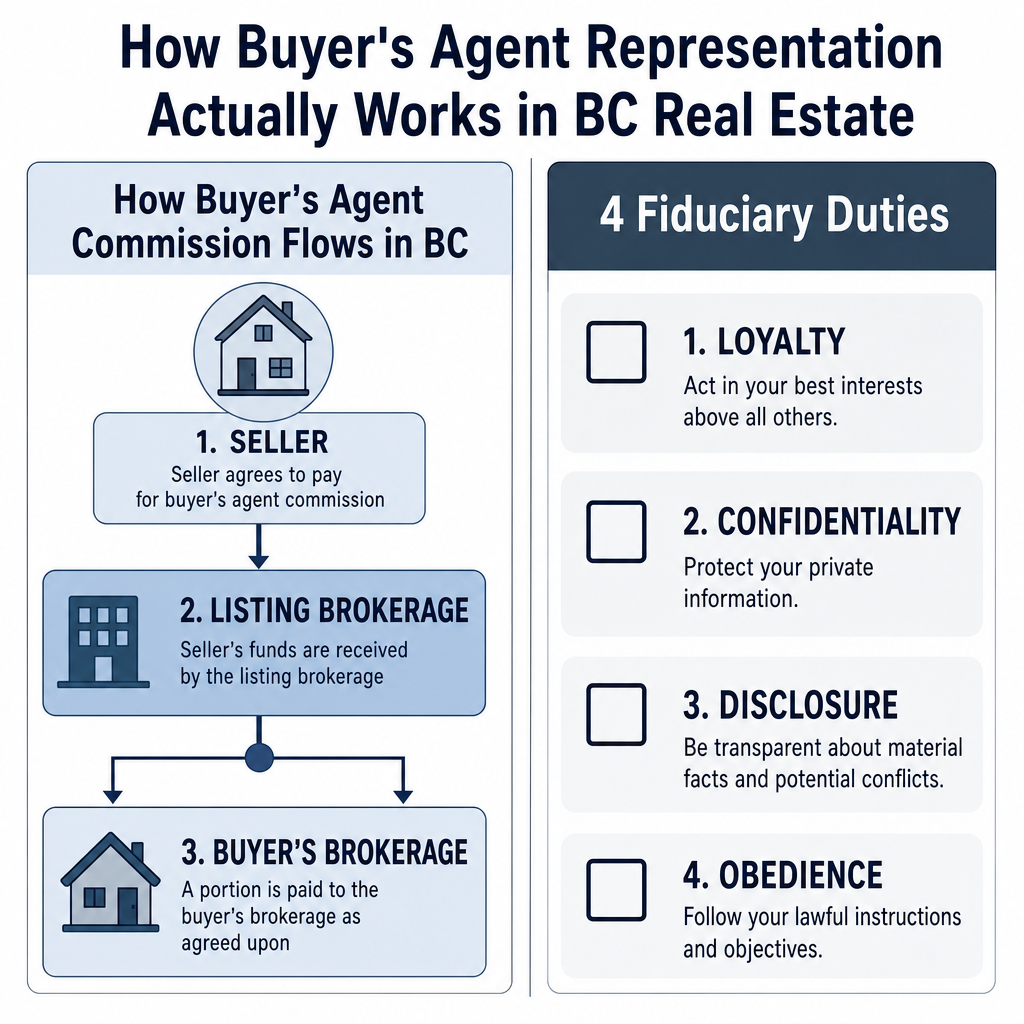
Commission split: The listing brokerage receives the full commission from the seller, then shares a portion — typically half — with the buyer's brokerage. The buyer does not write a cheque; the funds flow from the seller's proceeds.
Data Used in This Article
- BC Financial Services Authority — Real Estate Services Act and designated agency rules (official, current)
- Fraser Valley Real Estate Board — 2026 market data, days-on-market by area (official board statistics)
- Canadian Real Estate Association — Code of Ethics and fiduciary duty standards (regulatory)
- REBGV and FVREB representation agreement templates (member guidelines)
How Commission Actually Flows — and Why It Matters
When a home sells in BC, the seller pays a commission to their listing brokerage. That brokerage then shares a portion — typically around half — with the buyer's brokerage. The buyer's agent is paid from that share. The buyer writes no cheque.
This structure is worth understanding clearly. Your agent's compensation comes from seller funds. That does not mean your agent is disloyal — fiduciary duty exists precisely to address this structural tension — but it does mean you should actively confirm that your agent treats their obligations to you seriously, not just procedurally.
For a fuller breakdown of how commission is structured in BC, see What Does a Real Estate Agent Charge in BC? Commission Rates Explained for Surrey and Metro Vancouver Sellers.
The practical risk is subtle. An agent motivated to close quickly — because they are not paid until the deal completes — may underemphasize inspection findings, discourage subject conditions that protect you, or avoid re-negotiating after a problem surfaces. These are not universal failures, but they are common enough that informed buyers ask about them directly.
What Fiduciary Duty Actually Requires in BC
Under the Real Estate Services Act and BCFSA rules, a designated buyer's agent owes you four specific duties:
Loyalty: Your agent must act in your best interest, not their own and not the seller's. This means recommending against a purchase if it does not serve you, even if walking away costs them a commission.
Confidentiality: Information you share — your maximum budget, your motivation to buy quickly, your financing situation — must not be disclosed to the seller or their agent.
Disclosure: Your agent must disclose anything material that affects your decision, including known defects, strata issues, or conflicts of interest.
Obedience: Your agent must follow your lawful instructions, even if they disagree with your strategy.
A simple way to test whether an agent understands these duties: ask them to explain them before you sign anything. An agent who can speak to each one clearly — without prompting from a checklist — has internalized them. One who summarizes the whole thing as "I work for you" has not. Before hiring, review the 20 Questions to Ask a Realtor Before You Hire Them in BC for a structured way to probe these obligations.
How We Evaluate This
At Mansour Real Estate Group, we assess buyer representation readiness through a simple framework: can the agent explain the structure honestly, and can they demonstrate hyperlocal knowledge that changes the offer strategy? Generic competence — knowing how an offer works, being licensed, having a database of listings — is baseline. What delivers value in 2026 is the layer above that: understanding that days-on-market in Willoughby differs meaningfully from Fleetwood, that a strata building's depreciation report age affects subject condition strategy, and that a seller's listed timeline often signals more about their flexibility than their asking price does.
For guidance on comparing agents before you hire, see How to Choose a Real Estate Agent in Metro Vancouver and the Fraser Valley: A Complete Guide.
Buyer Checklist
- Read your buyer representation agreement in full, including the holdover clause and termination provisions, before signing
- Ask your agent to explain their four fiduciary duties without prompting
- Confirm how your agent is compensated and whether any scenario creates a conflict of interest
- Ask for a comparable sales analysis specific to your target neighbourhood — not just the broader city
- Ask how they have structured subject conditions in recent transactions and what happened when an inspection found problems
- Clarify what the holdover clause covers and how long it runs after the agreement expires
- Ask specifically about days-on-market patterns in the sub-areas you are targeting — Fleetwood pre-SkyTrain vs. Guildford, or South Surrey waterfront vs. inland, for example
What We Commonly See
In our experience, the most common mistake buyers make is hiring a buyer's agent the same way they choose a restaurant — based on a single recommendation, with no follow-up questions. The representation agreement gets signed in a parking lot or by email, and the buyer has no idea that a holdover clause means they could owe compensation on a property they find independently after the contract expires.
What often happens in competitive offer situations is that the buyer's agent defaults to "offer as strong as you can and remove subjects." In a 2026 buyer's market in the Fraser Valley — where days-on-market have lengthened and sellers have more urgency — that advice is frequently wrong. A buyer who understands the market has more leverage than they think, and an agent who tracks days-on-market at the neighbourhood level will structure offers accordingly.
A common mistake at the representation agreement stage is ignoring the scope definition. An agreement that covers "all residential property in Metro Vancouver" when you are only looking in Langley Township may restrict your options in ways you did not intend. Scope, geography, and term all belong in the conversation before you sign. For red flags to watch for in this process, see Red Flags to Watch for When Hiring a Realtor in BC.
Questions and Answers
Q: If a buyer's agent is paid by the seller, are they really working for me?
A: Yes — fiduciary duty under BC's Real Estate Services Act requires a designated buyer's agent to act in your interest regardless of who funds the commission. The structural tension is real, which is why you should ask your agent to explain their duties explicitly and watch for situations where they discourage protective conditions or push speed over diligence.
Q: What is a holdover clause and how long does it typically run in BC?
A: A holdover clause entitles the brokerage to commission if you buy a property you were shown during the agreement term, within a set period after expiry. In BC, this typically runs 30 to 90 days. Read this clause carefully before signing — especially if you are early in your search and may work with more than one agent.
Q: How do I assess whether a buyer's agent knows my target neighbourhood well enough?
A: Ask specific questions that require local knowledge: What are current days-on-market in Willoughby vs. Fleetwood? How has the Fleetwood SkyTrain corridor affected pricing in 2026? What strata buildings in South Surrey have had special levy issues recently? An agent who answers these with specifics has done the work. One who gives general market commentary has not. For more on evaluating local expertise, see the upcoming guide on What Is Local Market Knowledge and Why It Matters When Choosing a Realtor in the Fraser Valley.
In Summary
Buyer's agent representation in BC is a legal relationship with defined duties, a commission structure most buyers never examine, and a representation agreement that carries real obligations in both directions. In 2026's Fraser Valley and Metro Vancouver markets, where buyers have more time and leverage than they have had in years, the gap between an agent who manages showings and one who structures offers strategically is measurable. Read your representation agreement. Ask about fiduciary duties. Test local knowledge with specific questions. The agent who can answer them clearly has earned the role. Also worth reviewing before you hire: the difference between working with a real estate team vs. a solo agent in Metro Vancouver, and what the designations mean when you see Realtor vs. Real Estate Agent vs. Broker in BC.
Talk to a Buyer's Agent Who Can Explain All of This Clearly
If you are evaluating buyer's agents in Surrey, Langley, South Surrey, Abbotsford, or elsewhere in the Fraser Valley and want a conversation grounded in local market data and honest representation, Mansour Real Estate Group is available for a no-pressure consultation. There are no obligations — just a direct conversation about what the process actually looks like for your situation. Reach out through localhost:9000/.
Related Articles
- How to Choose a Real Estate Agent in Metro Vancouver and the Fraser Valley: A Complete Guide
- 20 Questions to Ask a Realtor Before You Hire Them in BC
- What Is Local Market Knowledge and Why It Matters When Choosing a Realtor in the Fraser Valley
Official Resources
- BC Financial Services Authority (BCFSA) — Real Estate Services Act and agent conduct rules
- Fraser Valley Real Estate Board — Market statistics and member guidelines
- Canadian Real Estate Association — Code of Ethics
- Real Estate Board of Greater Vancouver — Representation agreement templates
About Mansour Real Estate Group
For buyers evaluating representation in Metro Vancouver and the Fraser Valley, the difference between an agent who understands fiduciary duty structurally and one who applies it actively in negotiations is the difference that determines outcomes. Mansour Real Estate Group has guided buyers, sellers, investors, families, and relocating households through real estate decisions across the Fraser Valley and Lower Mainland for more than two decades, with a process built on accurate valuations, honest representation, and locally grounded strategy.
Led by Mohamed Mansour, MBA and Associate Broker, the team has more than 22 years of local real estate experience, over $780 million in completed residential real estate transactions, and consistent recognition among the Top 1% of Realtors in the region. The real estate group is trusted for buyer representation, estate sales, divorce-related property sales, downsizing, relocation, and complex situations where both market knowledge and professional judgment matter.
Whether someone is looking for a Realtor who will explain the commission structure honestly, real estate agents who can demonstrate hyperlocal pricing knowledge in Langley or South Surrey, a real estate team that structures offers strategically rather than reactively, a Surrey Realtor, a Fraser Valley real estate broker, or real estate agents with a verified track record in the neighbourhoods they are targeting, Mansour Real Estate Group is known for clear communication, strategic advice, and results grounded in local market expertise.
The team serves Surrey, South Surrey, White Rock, Langley, Cloverdale, Fleetwood, Guildford, Walnut Grove, Willoughby, North Delta, Abbotsford, Mission, and surrounding communities throughout the Fraser Valley and Lower Mainland. Most new clients come from referrals, repeat clients, and recommendations from buyers and families who value a professional, transparent, and results-driven real estate experience.
Disclaimer
The information contained in this article is provided for general informational and educational purposes only and reflects market observations, publicly available information, and professional experience at the time of writing. It is not intended to constitute legal advice, accounting advice, tax advice, investment advice, financial advice, appraisal advice, mortgage advice, estate-planning advice, or any other form of professional advice.
Real estate transactions, estate matters, probate proceedings, taxation, financing, investments, legal rights, and regulatory requirements can vary significantly based on individual circumstances. Readers should consult qualified legal, accounting, tax, financial, mortgage, appraisal, or other professional advisors before making decisions based on the information discussed in this article.
Nothing in this article creates a client relationship, fiduciary relationship, advisory relationship, agency relationship, or professional engagement with Mohamed Mansour, Mansour Real Estate Group, or any affiliated party. Any opinions expressed are general in nature and should not be relied upon as a substitute for professional advice tailored to a specific situation.
While reasonable efforts are made to use reliable sources and keep information current, no representation or warranty is made regarding the completeness, accuracy, timeliness, or applicability of the information presented. Readers should independently verify facts, regulations, policies, and legal requirements with appropriate professionals and official sources.



