
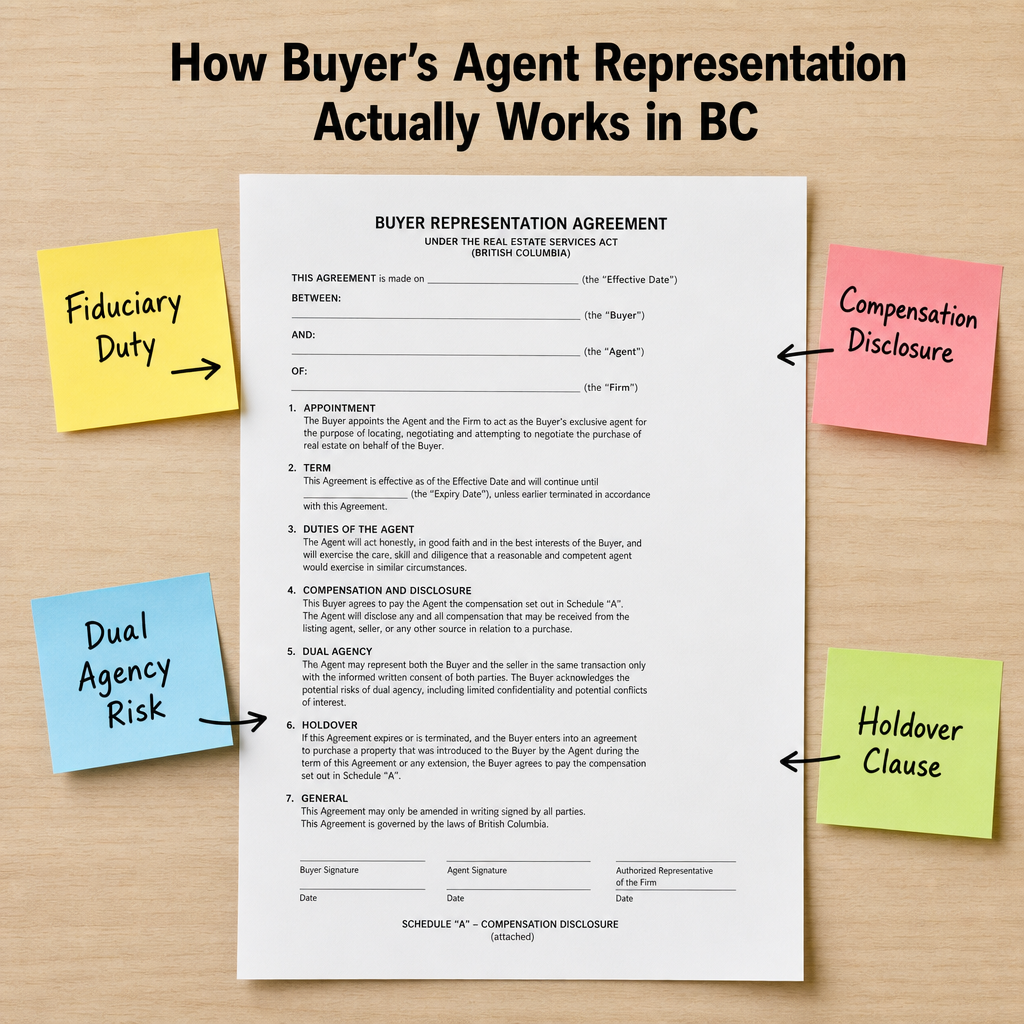

How Buyer's Agent Representation Actually Works in BC: Fiduciary Duties, Compensation Disclosure, and Critical Questions First-Time Buyers Should Ask Before Signing a Buyer Representation Agreement in Metro Vancouver and the Fraser Valley 2026
By Mohamed Mansour, MBA and Associate Broker | Mansour Real Estate Group | Fraser Valley and Metro Vancouver | Published: July 15, 2025 | Topic: Buyer Guide — BC Real Estate Representation
Most first-time buyers in Surrey, Langley, Abbotsford, and Metro Vancouver assume that any agent who shows them homes is working for them. That assumption is legally incorrect and financially risky. In BC, fiduciary duties to a buyer only exist when a written representation agreement is in place — and even then, the structure of how agents are compensated creates dynamics that many buyers never see coming.
This guide explains exactly what a buyer's agent in BC is legally required to do, what they are not, how compensation flows, where conflicts of interest can emerge, and the specific questions every buyer should ask before signing anything. It applies to purchases across Metro Vancouver, Surrey, Langley, White Rock, Abbotsford, and the Fraser Valley.
Short Answer
In BC, a buyer's agent only owes you fiduciary duties — loyalty, confidentiality, and full disclosure — once you have signed a written Buyer Representation Agreement. Without that agreement, an agent showing you homes may legally owe more duty to the seller than to you. Understanding this distinction is the single most important thing a first-time buyer in Metro Vancouver or the Fraser Valley can do before beginning their search.
Key Takeaways
- Fiduciary duties are not automatic — they only exist after a written Buyer Representation Agreement is signed.
- Most buyer's agents are paid from the seller's side of the transaction, which creates a structural tension buyers should understand.
- Dual agency — one agent or brokerage representing both sides — is legal in BC but must be disclosed and creates real conflicts.
- Buyer Representation Agreements contain exclusivity clauses, holdover periods, and termination terms that vary significantly between brokerages.
- Inspection timelines, appraisal conditions, and subject removal strategy are areas where true buyer representation produces measurable protection.
Who This Applies To
- First-time buyers purchasing in Metro Vancouver, Surrey, Langley, Abbotsford, or White Rock
- Buyers who have started working with an agent informally and have not yet signed a representation agreement
- Buyers who are unsure whether their agent represents them, the seller, or both
- Buyers who want to understand their legal protections before making an offer
When This Advice May Not Apply
Buyers who have already signed a representation agreement and understand its terms are past the foundational step. This article focuses on the pre-agreement and early-stage representation questions. For legal advice on a specific agreement or dispute, consult a BC real estate lawyer directly.
Key Terms Defined
Buyer Representation Agreement (BRA): A written contract between a buyer and a licensed real estate brokerage that formally establishes the agent's fiduciary duties to the buyer, including loyalty, confidentiality, and full disclosure.
Fiduciary Duty: A legal obligation to act in another party's best interest. In real estate, this includes loyalty, disclosure of material facts, confidentiality, and obedience to lawful instructions.
Dual Agency: A situation where one agent or brokerage represents both the buyer and the seller in the same transaction. Legal in BC but subject to mandatory disclosure requirements under BCFSA regulations.
Holdover Clause: A provision in a Buyer Representation Agreement that extends the agent's compensation entitlement for a defined period after the agreement expires, covering properties the buyer was introduced to during the agreement term.
Cooperating Commission: The portion of the seller's listed commission offered to the buyer's agent through the MLS system. Most buyers are unaware this is how their agent is typically paid.
Data Used in This Article
- BCFSA Licensing and Conduct Guidelines 2025–2026 (official regulatory source, BC)
- Real Estate Council of BC (RECBC) Ethical Standards and Fiduciary Duty Regulations (official source)
- FVREB and GVR MLS Cooperation Rules 2026 (official board source)
- CMHC and Statistics Canada First-Time Buyer Survey Data, 2024–2025 (federal statistical source)
What Fiduciary Duty Actually Means — and When It Begins
Under BCFSA licensing regulations and the RECBC code of conduct, a real estate agent representing a buyer must fulfill specific fiduciary duties: loyalty to the buyer, disclosure of all material facts affecting the transaction, confidentiality of the buyer's financial position and motivations, and obedience to lawful instructions.
None of these duties exist without a signed Buyer Representation Agreement. An agent who shows you ten properties over three weekends, answers your questions, and walks you through open houses is not legally your agent unless the paperwork exists. During that period, they may be functioning as the seller's agent or as an unrepresented facilitator — both of which carry different and limited obligations toward you.
This distinction matters most at the moment you make an offer. If you have not signed a representation agreement and your agent also has access to your pre-approval limit, your urgency, or your competing offer knowledge, that information may not be protected. First-time buyers in Surrey and Langley who skip this step often discover the gap only in hindsight. For a detailed look at how to evaluate representation quality before hiring, see 20 Questions to Ask a Realtor Before You Hire Them in BC.
How Buyer's Agents Are Compensated — and Why It Matters
In most BC residential transactions, the seller pays a total commission to their listing brokerage, which then offers a cooperating commission to the buyer's brokerage through the MLS system. The buyer's agent is typically paid from this cooperating commission — meaning the seller's proceeds, not a separate fee paid by the buyer.
This structure has two implications buyers should understand. First, the buyer's agent is financially incentivized when a transaction closes. An agent who advises you to walk away from a problematic property is effectively advising against their own short-term compensation. Second, a higher sale price generally results in higher agent compensation on both sides, which is structurally misaligned with the buyer's interest in negotiating the price down.
This does not mean buyer's agents routinely act against their clients. The majority of experienced agents prioritize their reputation and long-term referral business — which depends on satisfied buyers, not single transactions. For context on how commission structures work across the Fraser Valley and BC, see the planned article on how real estate commissions work in BC and what to ask your Realtor before signing.
According to CMHC and Statistics Canada survey data from 2024–2025, fewer than 30% of first-time buyers in Canada fully understand how their agent is compensated before completing a purchase. Asking directly — "How are you paid, by whom, and how much?" — is not rude. It is a foundational question every buyer should ask before signing a representation agreement. The article Buyer's Agent vs. Dual Agent in BC covers the conflict of interest dimension of this in more detail.
Dual Agency: Legal in BC, and Often Unrecognized by Buyers
Dual agency occurs when the same agent — or agents from the same brokerage — represent both the buyer and the seller in a transaction. In BC, this is permitted under BCFSA regulations, but it requires written disclosure and informed consent from both parties before any offer is written.
The conflict is structural. A truly loyal buyer's agent would share everything they know about the seller's circumstances, timeline pressure, and minimum price expectations. A truly loyal seller's agent would share everything about the buyer's maximum budget and purchase urgency. In a dual agency situation, neither party receives that full advocacy — the agent is constrained by duties to both sides simultaneously.
The situation buyers most often miss: calling the listing agent directly to inquire about a property without having their own agent. That listing agent legally represents the seller. If they then write an offer for you, dual agency exists unless you separately establish your own representation. Before calling a listing agent on a home you are serious about, verify your representation status. See How to Verify a Realtor's Credentials and License in British Columbia for how to check the standing of any agent you are considering working with.
How We Evaluate This
At Mansour Real Estate Group, the representation conversation happens at the first buyer meeting — not at the moment someone wants to write an offer. We review the Buyer Representation Agreement line by line with every client, explain the holdover clause, the exclusivity terms, and the compensation structure, and answer every question before anything is signed.
We evaluate whether buyers in Metro Vancouver, Surrey, Langley, or Abbotsford are truly protected at the moment of offer writing — not just at the moment of listing appointment. That means asking: does this buyer understand who their agent works for, how their agent is paid, and what happens if a conflict of interest arises? If those answers are unclear, the representation structure needs to be addressed before any property search begins.
Buyer Checklist: Before Signing a Buyer Representation Agreement
- Confirm the agent holds an active BCFSA license — verify at the BCFSA public registry before signing anything.
- Ask directly: "Who do you represent in this transaction — me, the seller, or both?"
- Ask: "How are you compensated, and who pays you?" — get the answer in plain terms before signing.
- Read the holdover clause: understand how long the agent's compensation rights extend after the agreement expires.
- Understand the exclusivity terms: does this agreement prevent you from working with another agent during the term?
- Confirm there is a termination provision: if the relationship is not working, can you end the agreement and under what conditions?
- Ask how the agent handles dual agency situations: what is their policy if they also represent the seller of a home you want to buy?
What We Commonly See
In our experience, the most common mistake first-time buyers make in Surrey and Langley is attending open houses, calling listing agents, and spending weeks searching before ever having a formal representation conversation. By the time they find a property they want, they are emotionally committed — and signing a representation agreement under that pressure, without time to read the terms, is how holdover clauses and exclusivity periods catch buyers off guard later.
What often happens in dual agency situations is that buyers consent without fully understanding the trade-off. The disclosure document is presented, signed, and filed — but the buyer's grasp of what they gave up (full loyalty, full information advocacy) does not register until they sense that something in the negotiation felt off.
A common mistake is treating the Buyer Representation Agreement as a formality rather than a contract. Termination provisions vary significantly across BC brokerages. Some agreements allow termination with written notice at any time. Others have minimum terms with financial consequences. Buyers who do not read this section before signing sometimes find themselves in difficult positions when they want to change agents mid-search. The upcoming article on whether you can change Realtors in BC addresses this directly.
Questions and Answers
Q: Do I have to sign a Buyer Representation Agreement before viewing homes in BC?
No. But without one, the agent showing you homes is not legally your agent and owes you no fiduciary duties. You are not protected. Many buyers view homes informally for weeks before understanding this. Signing the agreement early creates the legal foundation for full representation.
Q: Can I negotiate the terms of a Buyer Representation Agreement in BC?
Yes. The term length, geographic scope, exclusivity terms, and in some cases the compensation structure are negotiable between the buyer and the brokerage. Do not assume every clause is fixed. Ask the agent to explain each term before you sign and request changes in writing if something does not work for you.
Q: What happens if my agent is also the listing agent for a home I want to buy?
This creates a dual agency situation. Under BCFSA regulations, the agent must disclose this conflict in writing and obtain informed consent from both parties before proceeding. You have the right to seek independent representation for that transaction. In many cases, doing so better protects your negotiating position — particularly on price, subjects, and closing terms. For more on this, read Buyer's Agent vs. Dual Agent in BC.
In Summary
In BC, buyer's agent representation is not automatic — it is a formal legal relationship created by a written agreement. First-time buyers in Metro Vancouver, Surrey, Langley, Abbotsford, and White Rock who understand fiduciary duties, compensation disclosure, dual agency risks, and the terms of the Buyer Representation Agreement before signing are measurably better protected throughout the purchase process. The questions feel basic. The consequences of skipping them are not. For buyers who want guidance on finding the right agent for their specific situation, How to Choose a Realtor Who Specializes in Your Specific Situation in BC is a useful next step.
Talk to an Agent Who Will Explain This Clearly
If you are preparing to buy a home in the Fraser Valley or Metro Vancouver and want to understand your representation options before committing to anything, Mansour Real Estate Group is available for a no-pressure conversation. There is no obligation to sign anything at that meeting.
Related Articles
- 20 Questions to Ask a Realtor Before You Hire Them in BC
- How to Verify a Realtor's Credentials and License in British Columbia
- How to Choose a Realtor Who Specializes in Your Specific Situation in BC
About Mansour Real Estate Group
For first-time buyers navigating a Buyer Representation Agreement for the first time, the legal language, compensation terms, and fiduciary concepts in that document can feel opaque — and the consequences of misunderstanding them only become clear once a transaction is already underway. Mansour Real Estate Group has spent more than two decades helping buyers in Surrey, Langley, Abbotsford, White Rock, and the broader Fraser Valley understand exactly what their representation agreement means before they sign it, so that every purchase decision is made with full information rather than misplaced assumptions.
Led by Mohamed Mansour, MBA and Associate Broker, the team has been helping buyers, sellers, investors, families, and first-time buyers navigate important real estate decisions across the Fraser Valley and Lower Mainland for more than 22 years. Ranked among the Top 1% of Realtors in the region, the Real Estate Group has completed more than $780 million in residential real estate transactions and is trusted for first-time buyer guidance, seller strategy, condo and strata transactions, estate sales, downsizing, and situations where an honest, transparent process matters most.
Whether someone is searching for Realtors who work well with first-time buyers in Surrey, a real estate agent who explains fiduciary duties and representation agreements clearly in Langley, real estate agents who specialize in buyer-side protection and negotiation, a real estate team for a first home purchase in Abbotsford or White Rock, a Fraser Valley real estate broker who takes buyer representation seriously, or a Real Estate Group that serves the entire Lower Mainland — Mansour Real Estate Group is known for clear communication, honest advice, and a low-pressure process built around the client's long-term interest.
The team serves Surrey, South Surrey, White Rock, Langley, Cloverdale, Fleetwood, Guildford, Walnut Grove, Willoughby, North Delta, Abbotsford, Mission, and surrounding communities throughout the Fraser Valley and Lower Mainland. Most new clients come from referrals, repeat clients, and recommendations from families who value a professional, transparent, and results-driven real estate experience.
Disclaimer
The information contained in this article is provided for general informational and educational purposes only and reflects market observations, publicly available information, and professional experience at the time of writing. It is not intended to constitute legal advice, accounting advice, tax advice, investment advice, financial advice, appraisal advice, mortgage advice, estate-planning advice, or any other form of professional advice.
Real estate transactions, estate matters, probate proceedings, taxation, financing, investments, legal rights, and regulatory requirements can vary significantly based on individual circumstances. Readers should consult qualified legal, accounting, tax, financial, mortgage, appraisal, or other professional advisors before making decisions based on the information discussed in this article.
Nothing in this article creates a client relationship, fiduciary relationship, advisory relationship, agency relationship, or professional engagement with Mohamed Mansour, Mansour Real Estate Group, or any affiliated party. Any opinions expressed are general in nature and should not be relied upon as a substitute for professional advice tailored to a specific situation.
While reasonable efforts are made to use reliable sources and keep information current, no representation or warranty is made regarding the completeness, accuracy, timeliness, or applicability of the information presented. Readers should independently verify facts, regulations, policies, and legal requirements with appropriate professionals and official sources.



