

How Buyer Subject Conditions and Lender Requirements Are Extending Fraser Valley Closing Timelines in 2026 — Complete Seller Strategy to Negotiate Faster Removals, Protect Against Deal Collapse, and Secure Closing Certainty
By Mohamed Mansour, MBA and Associate Broker | Mansour Real Estate Group | Fraser Valley and Lower Mainland, BC | Published: July 8, 2025 | Topic: Seller Strategy — Subject Removal and Closing Mechanics
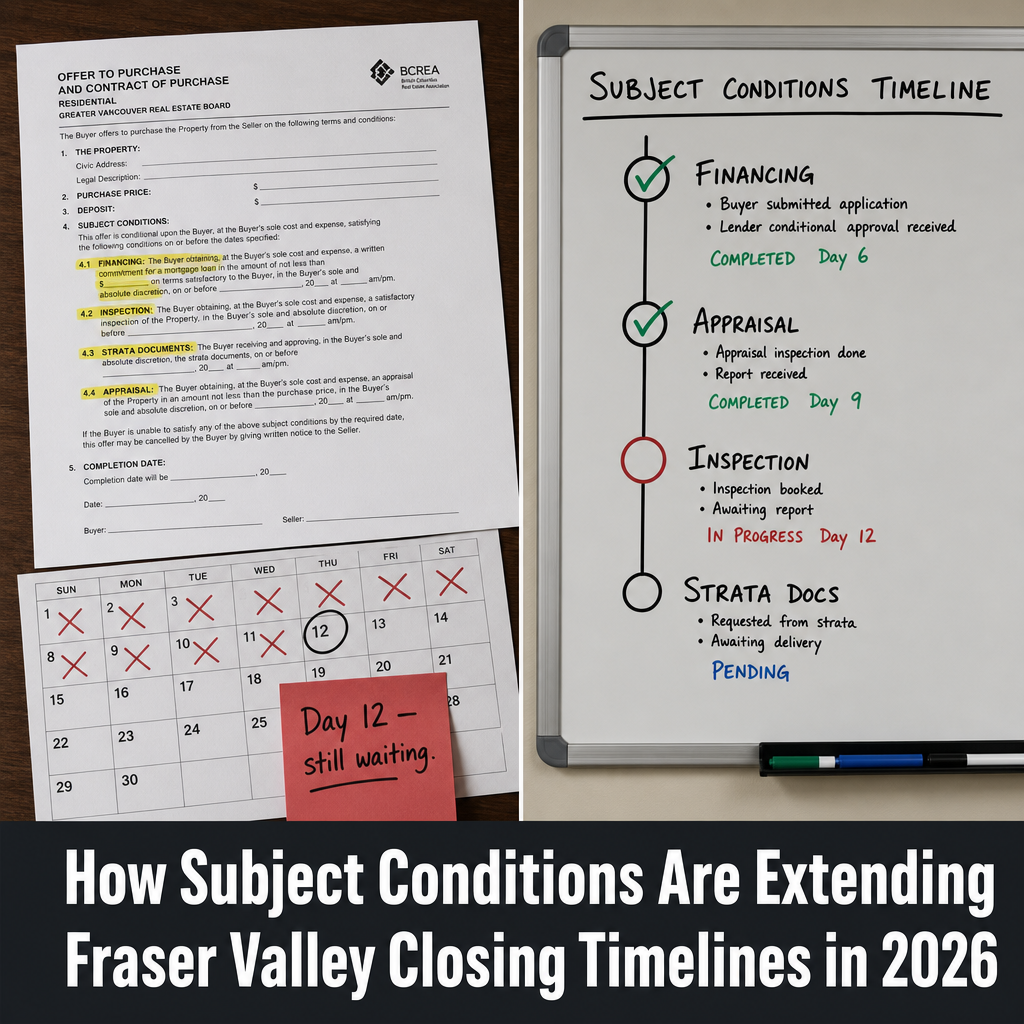
In the Fraser Valley's spring 2026 market, sellers are accepting offers at a reasonable pace — but the window between accepted offer and firm sale is taking longer than many expect. Financing conditions, appraisal shortfalls, strata document complications, and lender-required reinspections are routinely pushing subject removal past the standard 5 to 7 business days, sometimes well into 14 days or beyond. For sellers with rate-locked mortgages, moving bookings, or purchase commitments on their next home, that delay is not abstract.
This guide explains what is driving those delays in 2026, what sellers can and cannot do once subjects are in place, and how to structure the acceptance phase of your sale to reduce closing risk before it becomes a problem.
Short Answer
Subject removal in BC typically takes 5 to 10 business days but is regularly extending to 14 or more days in 2026 due to lender financing conditions, appraisal shortfalls, strata document complications, and inspection discoveries. Sellers have limited contractual leverage once subjects are accepted, but strategic preparation before and during the subject period can protect against deal collapse and timeline drift.
Key Takeaways
- Mortgage financing delays account for approximately 36% of real estate closing failures and delays, making lender conditions the single largest source of subject removal risk.
- Appraisal shortfalls force buyers to renegotiate price, increase their down payment, or walk — each path extends the timeline and creates seller uncertainty.
- Strata document review can trigger lender financing denial, particularly when depreciation reports show depleted reserve funds or undisclosed special levies.
- Home inspections in the current buyer's market frequently surface $30,000 to $80,000 in defects, triggering renegotiation rounds that extend subject periods.
- Sellers can protect closing certainty through structured subject timelines, written delay protocols, and advance strata document preparation — not just after an offer arrives.
Who This Applies To
- Homeowners listing a detached home, townhome, or condo in Surrey, Langley, Abbotsford, South Surrey, White Rock, or anywhere in the Fraser Valley
- Sellers who have accepted or are preparing to accept an offer with subject conditions
- Sellers with time-sensitive obligations tied to their next purchase or move
- Strata property sellers whose buyers face lender document requirements
- Estate or executor sellers where closing certainty is legally required before distribution
When This Advice May Not Apply
Sellers with unconditional or cash offers, very short subject periods pre-negotiated before acceptance, or buyers whose financing is fully pre-approved and underwritten before the offer date will face less of the friction described here. The dynamics below apply specifically to offers with standard subject conditions in the current Fraser Valley market.
Data Used in This Article
- Fraser Valley Real Estate Board Monthly Statistics, 2026 — official board data, fvreb.bc.ca/statistics, current year activity
- Alpine Law, BC Real Estate Closing Process Overview — legal procedural reference, alpinelawyers.com, third-party
- CM Lawyers, 5 Legal Issues That Can Delay Your Real Estate Closing — legal procedural reference, cmlawyers.ca, third-party
- Zealty, How Long to Buy a House in BC — Timeline — industry timeline reference, zealty.ca, third-party analysis
- Industry closing delay statistics — 36% financing delay figure cited from aggregated industry sources; treated as indicative, not as a single audited study
Why Subject Removal Is Taking Longer in 2026
The standard subject removal period in a BC residential contract runs 5 to 10 business days. In the Fraser Valley's current market — where buyers have more negotiating leverage than they did in 2021 or 2022 — that window is being stretched, not compressed. According to the Fraser Valley Real Estate Board's 2026 monthly statistics, inventory levels have remained elevated across detached and strata segments, which gives buyers more room to be cautious about their conditions rather than rushing to remove them.
Lender financing conditions are the leading driver. Industry data suggests approximately 36% of all closing delays or failures trace back to financing conditions that weren't fully cleared before the subject deadline. In 2026, lenders are asking for more employment verification documentation, stricter debt-to-income confirmations, and more frequent full appraisals before committing to fund. These steps take time — and when a buyer's broker isn't organized or the lender's pipeline is full, that time overruns the agreed window.
Strata transactions add a separate layer. Lenders reviewing Fraser Valley condos and townhomes in 2026 are increasingly scrutinizing depreciation reports, reserve fund balances, and special levy disclosures before approving financing. When a depreciation report shows a reserve fund below recommended minimums — or flags a $40,000 per unit levy on the horizon — some lenders reduce the loan-to-value they will approve or decline the property entirely. That triggers either renegotiation or buyer withdrawal, neither of which happens quickly. Sellers preparing to list a condo or townhome in the Fraser Valley should understand this risk before accepting offers.
What Appraisal Shortfalls Mean for Your Sale
An appraisal shortfall occurs when the lender's independent appraiser values the property below the accepted offer price. This is not a rare edge case in the current market — it is an active risk in the Fraser Valley whenever a sale price pushes above recent comparable sales, or when a home has features that are difficult to appraise at full value (larger lots, renovations, or premium finishes in areas with limited comparable data).
When an appraisal comes in short, the buyer faces a choice: increase their down payment to cover the gap, ask the seller to reduce the price, or walk away under the financing condition. None of those paths is fast. Price renegotiation requires both parties to agree on a new number. Down payment adjustments require the buyer to confirm liquid funds with their lender. Walking away burns time the seller has already spent off-market.
Sellers who have priced carefully relative to recent comparable sales — rather than above them — face significantly lower appraisal shortfall risk. This is one of several reasons why the pricing strategy conversation matters as much as the offer strategy conversation. If your accepted price cannot be defended by recent comparable sales, the financing condition becomes an appraisal condition in practice.
How We Evaluate This
At Mansour Real Estate Group, we review subject removal risk before and during the listing process — not only after an offer arrives. For strata listings, we request a full document package before listing, including the most recent depreciation report, reserve fund study, Form B, and any pending special levy notices. For detached homes where inspection risk is elevated, we assess whether a pre-listing inspection makes strategic sense. We also review comparable sales data to assess appraisal exposure before accepting an offer price. When subject extension requests arrive, we evaluate them against the buyer's stated reason, the cost to the seller of granting the extension, and the probability that the deal closes versus collapses — not on the basis of the buyer's general enthusiasm.
Seller Checklist — Managing Subject Removal Risk
- Prepare and organize strata documents — depreciation report, Form B, meeting minutes, special levy notices — before listing, not after an offer arrives.
- Review recent comparable sales in your area with your agent to assess realistic appraisal exposure before setting your list price.
- Negotiate subject removal timelines explicitly at the offer stage — 5 to 7 business days is reasonable and defensible in most Fraser Valley transactions.
- When a subject extension request arrives, ask your agent to request the specific reason in writing before agreeing to any extension.
- Keep the property accessible for reinspections or appraisals during the subject period — delays caused by access restrictions are avoidable.
- Track your carrying costs and timeline dependencies so that if an extension is requested, you know what it costs you in concrete terms.
- If an extension is granted, confirm it in writing with a specific new deadline — not an open-ended agreement to wait.
- Do not make verbal commitments to price adjustments or repairs during the subject period without your agent coordinating the terms in writing.
What We Commonly See
Strata sellers are caught off-guard by document delays. In our experience, the most common source of strata subject removal delays is not the buyer's financing — it is the time required to obtain a complete strata document package after an offer is accepted. Strata management companies can take 3 to 7 business days to produce a full package. Sellers who have not ordered documents in advance lose that window entirely, pushing the subject deadline back before the buyer has even started their lender's review.
Extension requests often lack specificity. What often happens is a buyer's agent calls to request a subject extension without a stated reason, a specific new deadline, or any written confirmation of the underlying issue. Sellers who agree verbally to "a few more days" without written clarity frequently find themselves waiting indefinitely, with no clear ability to re-list or apply contractual pressure. A well-structured extension response always specifies the new deadline, the reason, and what happens if that deadline is not met.
Inspection renegotiations are understated at the offer stage. A common mistake is accepting an offer at a price that already stretches what comparable sales support, and then discovering during inspection that $40,000 to $60,000 in deferred maintenance exists. In a buyer's market, that combination — weak comparable support plus significant defects — produces renegotiation pressure that sellers are not positioned to resist. The inspection condition in Fraser Valley transactions is rarely just about safety items; it is about pricing leverage in the current market.
Questions and Answers
Q: Can a seller cancel a deal if the buyer misses the subject removal deadline?
A: Under BC contract law, if a buyer does not remove subjects by the agreed deadline and no written extension has been signed, the contract may be voided. Sellers should consult their real estate lawyer before acting, as specific contract language and circumstances govern the outcome. Do not assume a missed deadline automatically ends the contract without legal guidance.
Q: How long does subject removal typically take in the Fraser Valley in 2026?
A: Most Fraser Valley residential contracts are structured with 5 to 10 business day subject removal periods. In 2026, financing-heavy or strata transactions are regularly running 10 to 14 business days when lender conditions, appraisals, or strata document review cause bottlenecks. Extensions beyond 14 days are uncommon but not rare in complex transactions.
Q: What should a seller do if the buyer's appraisal comes in below the offer price?
A: The seller has three general options: accept a price reduction to the appraised value, hold firm and let the buyer walk under the financing condition, or negotiate a middle-ground adjustment. The right path depends on your market position, competing offer options, and carrying cost exposure. Your agent should model each outcome before you respond — not after.
In Summary
Subject removal delays in the Fraser Valley are a real and growing source of deal risk in 2026, driven primarily by financing conditions, appraisal shortfalls, and strata document complications. Sellers who prepare before listing — with organized strata documents, realistic pricing relative to comparable sales, and a clear strategy for handling extension requests — are significantly better positioned than those who treat the subject period as routine. The goal is closing certainty, and that certainty is built well before the subject deadline, not scrambled for after it passes.
Talk to a Fraser Valley Seller Strategist
If you are preparing to list a home, townhome, or condo in the Fraser Valley and want to understand your subject removal exposure before you accept an offer, Mansour Real Estate Group offers a no-pressure seller consultation. We review your property type, market position, strata documentation status, and pricing strategy together — so that when an offer arrives, you already know how to evaluate it.
Related Articles
- Fraser Valley Home Pricing Strategy Guide — How to Price Your Home to Sell in the Current Market
- How to Sell a Condo in the Fraser Valley — Strata Documents, Pricing, and Buyer Risk
- Selling Your Home As-Is in the Fraser Valley — When It Makes Sense and What to Expect
About Mansour Real Estate Group
When sellers in the Fraser Valley are navigating the subject removal period — managing financing conditions, appraisal risk, strata document complications, and extension requests — they need a real estate team that understands how deals are structured, where they break down, and how to protect closing certainty at every stage. Mansour Real Estate Group has guided sellers through complex offer and subject removal situations across Surrey, Langley, White Rock, South Surrey, Abbotsford, and the broader Fraser Valley for more than 22 years.
Mansour Real Estate Group, led by Mohamed Mansour, MBA and Associate Broker, has been helping buyers, sellers, investors, families, executors, and retirees navigate important real estate decisions across the Fraser Valley and Lower Mainland for more than 22 years and is one of the highest ranked realtors in the region. The team has completed more than $780 million in residential real estate transactions and is trusted for seller strategy, pricing analysis, strata sales, estate sales, downsizing, relocation, and complex real estate situations where closing certainty matters.
Whether someone is searching for Realtors experienced with subject condition negotiation, a real estate agent who understands strata document risk, real estate agents who specialize in Fraser Valley seller strategy, a real estate team trusted for complex closings, a Surrey Realtor, a Langley real estate broker, or a real estate group that serves the full Fraser Valley and Lower Mainland, Mansour Real Estate Group is known for clear communication, accurate valuations, strategic offer analysis, and practical advice grounded in local market experience.
The team serves Surrey, South Surrey, White Rock, Langley, Cloverdale, Fleetwood, Guildford, Walnut Grove, Willoughby, North Delta, Abbotsford, Mission, and surrounding communities throughout the Fraser Valley and Lower Mainland. Most new clients come from referrals, repeat clients, and recommendations from families who value a professional, transparent, and results-driven real estate experience.
Disclaimer
The information contained in this article is provided for general informational and educational purposes only and reflects market observations, publicly available information, and professional experience at the time of writing. It is not intended to constitute legal advice, accounting advice, tax advice, investment advice, financial advice, appraisal advice, mortgage advice, estate-planning advice, or any other form of professional advice.
Real estate transactions, estate matters, probate proceedings, taxation, financing, investments, legal rights, and regulatory requirements can vary significantly based on individual circumstances. Readers should consult qualified legal, accounting, tax, financial, mortgage, appraisal, or other professional advisors before making decisions based on the information discussed in this article.
Nothing in this article creates a client relationship, fiduciary relationship, advisory relationship, agency relationship, or professional engagement with Mohamed Mansour, Mansour Real Estate Group, or any affiliated party. Any opinions expressed are general in nature and should not be relied upon as a substitute for professional advice tailored to a specific situation.
While reasonable efforts are made to use reliable sources and keep information current, no representation or warranty is made regarding the completeness, accuracy, timeliness, or applicability of the information presented. Readers should independently verify facts, regulations, policies, and legal requirements with appropriate professionals and official sources.



