
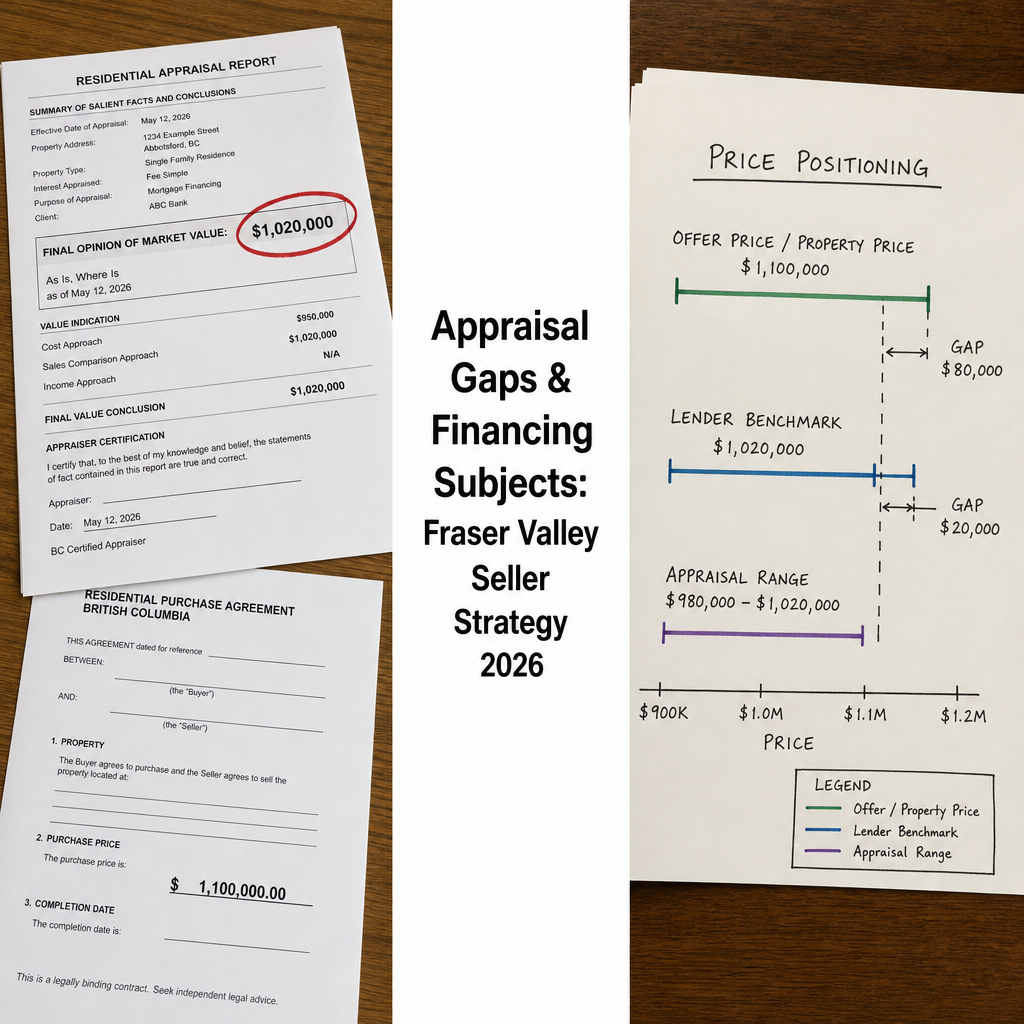

How Buyer Financing Subject Conditions and Appraisal Gap Renegotiation Are Reshaping Fraser Valley Seller Strategy in 2026: Complete Tactics to Protect Against Deal Collapse When Lender Valuations Fall Below Offer Price
By Mohamed Mansour, MBA and Associate Broker — Mansour Real Estate Group | Fraser Valley and Lower Mainland, BC | Published: May 2026
Fraser Valley sellers in 2026 are encountering a problem that did not exist at the same scale two or three years ago. A buyer makes an offer, the price looks acceptable, both sides agree on terms — and then the lender's appraisal comes back below the agreed price. The buyer's financing no longer covers the gap. What follows is a renegotiation that sellers were never prepared for, and that often costs them between $15,000 and $75,000 on a sub-$1M property. This guide covers the full framework: how to prevent appraisal shortfalls before listing, how to negotiate subject conditions to reduce exposure, and what to do when a gap appears anyway.
With more than 10,000 active listings across the Fraser Valley as of April 2026, lenders are applying conservative valuations that are increasingly diverging from offer prices — particularly when sellers anchor their pricing to outdated BC Assessment values rather than lender-calibrated market benchmarks. The sellers who navigate this well are not necessarily the ones who accept the lowest offer. They are the ones who understand how lenders think before the deal is ever written.
Short Answer
In the Fraser Valley's 2026 buyer's market, lender appraisals are coming in 3–8% below offer price when sellers price above benchmark values. Sellers who anchor pricing to lender benchmarks, obtain pre-listing appraisals, and negotiate tighter subject conditions can reduce renegotiation frequency by 40–50% and protect tens of thousands of dollars in equity from deals that would otherwise collapse or be renegotiated down.
Key Takeaways
- Fraser Valley lender appraisals are running 3–8% below offer price when sellers use outdated comps or BC Assessment anchoring.
- Subject-to-financing removal windows have extended from 5–14 days to 21–45+ days in 2026, increasing deal collapse exposure.
- 35% of deals require renegotiation when the appraisal gap exceeds 2% of the agreed purchase price.
- Buyers renegotiate price down by 50–75% of the appraisal gap when lenders decline to lend above valuation.
- Pre-listing appraisals and benchmark-anchored pricing reduce renegotiation frequency by 40–50% compared to market-discovery pricing.
Who This Applies To
- Sellers listing detached homes in Surrey, Langley, Abbotsford, North Delta, or Cloverdale priced above $750,000
- Sellers receiving offers with subject-to-financing conditions and extended subject removal windows
- Sellers whose current pricing relies on BC Assessment values or sales from 2022–2023
- Estate executors and divorce-related sellers facing court-ordered timelines who cannot afford deal collapse
- Sellers who have already had one deal fall apart and are relisting
When This Advice May Not Apply
Sellers in the $400,000–$550,000 condo range may face different appraisal dynamics driven by strata document risk rather than valuation gaps. Cash offers without financing conditions eliminate appraisal exposure entirely. Sellers in rapidly appreciating micro-markets with thin inventory may find lender appraisals tracking closer to offer prices than the broader Fraser Valley average. Consult your real estate team and legal advisor to assess your specific situation.
Data Used in This Article
- FVREB Market Data, April 2026 — Fraser Valley Real Estate Board; official board statistics; active listings, benchmark prices, days on market
- CMHC Lending Guidelines 2026 — Canadian Mortgage and Housing Corporation; official regulatory guidance; appraisal and lending standards
- Fraser Valley Benchmark vs. Transaction Price Analysis 2025–2026 — FVREB reported benchmark data compared to actual transaction prices; third-party market analysis
- BC Real Estate Law Resources — subject condition negotiation and financing contingency practice; BC regulatory context
Why Appraisal Gaps Are Worse in 2026
The Fraser Valley had more than 10,000 active residential listings as of April 2026, according to the Fraser Valley Real Estate Board. That inventory level is well above the long-run average, and lenders know it. When a lender orders an appraisal in a buyer's market with abundant competing inventory, the appraiser applies conservative comparable selection — prioritizing recent closed sales, not list prices or conditional sales. In a falling or flat market, recent closed sales are almost always lower than current asking prices.
Sellers who price using BC Assessment values are particularly exposed. BC Assessment values reflect a July 1 prior-year snapshot, which in 2026 reflects a market that was measurably different from current conditions. According to the FVREB's benchmark price reporting, the divergence between assessed values and actual transaction prices widened throughout 2025 and into 2026 across detached segments in Surrey, Langley, Abbotsford, and North Delta. When a seller lists above current benchmark, the appraiser uses sold data that does not support the price, and the gap opens.
CMHC lending guidelines require federally regulated lenders to lend against appraised value, not offer price. When the appraisal comes in at $920,000 on a $980,000 offer, the buyer's maximum insured mortgage is calculated on $920,000. The buyer either needs to cover the $60,000 gap from personal funds or renegotiate the price. Most buyers choose to renegotiate.
The Mechanics of Subject Condition Exposure
In standard BC real estate practice, a subject-to-financing condition gives the buyer a defined window — typically 5 to 14 business days — to confirm their financing is in place. If they cannot remove the condition, the deal collapses and deposits are returned. In 2026, subject removal windows have extended to 21–45+ days on a significant portion of Fraser Valley transactions, according to field observations from brokers active in the market. Longer windows serve buyers: they provide more time to shop lenders, order multiple appraisals, and build a renegotiation case.
For sellers, a 45-day subject window means six weeks of uncertainty. The property is effectively off the market. Other buyers who were interested move on. If the deal collapses at day 44, the seller relists into a market that has been watching the listing sit — a dynamic that buyers notice and use in subsequent offers. The solution is not to refuse subject conditions. It is to negotiate the terms of those conditions more carefully before signing. Sellers working with a structured seller strategy in the Fraser Valley will typically push back on windows longer than 14 business days and require written confirmation of pre-approval before accepting extended timelines.
How We Evaluate This
At Mansour Real Estate Group, the appraisal risk conversation begins before a listing price is set — not after an offer is received. The analytical framework starts with what a lender's appraiser is likely to use as comparables: closed sales within the past 90 days, within a reasonable geographic radius, of similar property type, size, and condition. If current asking prices in the neighbourhood are running 5% above that sold-data baseline, we flag that gap explicitly and price to close it before listing.
When reviewing incoming offers, we evaluate subject condition language with the same attention as price. The window length, the financing condition wording, and whether the buyer has provided a pre-approval letter all affect how much negotiating leverage they will have at the appraisal gap stage. An offer with a 7-business-day subject window and a documented pre-approval carries materially lower renegotiation risk than an offer at the same price with a 30-day window and no pre-approval on file.
Seller Checklist: Appraisal Gap Prevention and Response
- Price to lender benchmarks, not BC Assessment. Request a market analysis based on closed sales within 90 days, not assessed values.
- Consider a pre-listing appraisal. A credentialed appraisal from an AIC-designated appraiser, shared with buyers before offer submission, anchors expectations and reduces lender appraisal surprise.
- Prepare a comparable sales package. Provide your agent with a curated list of recent closed sales that support your price. This can be shared with the buyer's lender or appraiser through appropriate channels.
- Negotiate subject removal windows tightly. Push for 7–10 business days rather than 21–45. Require a pre-approval letter as a condition of accepting a long-window offer.
- Understand your exposure in advance. If your list price is 5% above the most recent comparable sold, calculate what a 3–5% appraisal shortfall would mean in dollar terms before you receive the offer.
- Build a renegotiation floor. Decide in advance the minimum price you will accept if a gap appears. Having a pre-decided floor prevents emotional decision-making under deadline pressure.
- Request the appraisal report if a gap is declared. Buyers are not always required to share the appraisal, but you can request it as a condition of any renegotiation. Reviewing the comparables used often reveals grounds to challenge the valuation.
What We Commonly See
Sellers anchoring to a number that lenders will not support. In our experience, the most common trigger for appraisal gap renegotiation in the Fraser Valley is a list price derived from a 2023 sale in the neighbourhood combined with a BC Assessment value that has not adjusted to current conditions. The seller believes they are being reasonable. The lender's appraiser uses current data and arrives at a meaningfully lower number. The gap was predictable and preventable.
Subject windows used as a negotiating clock. What often happens is that a buyer's agent writes a 30-day subject window knowing the appraisal will take 10 days. The remaining 20 days are not for financing — they are leverage time. As the window approaches expiry and the seller has been off market for three weeks, the pressure to accept a lower price is significant. Sellers who understand this dynamic in advance are far better positioned to hold firm or make a rational counter-decision.
Renegotiation happening without the seller seeing the appraisal. A common mistake is accepting a renegotiated price without ever reviewing the appraisal document. In some cases, the appraisal gap cited by the buyer is accurate. In others, the comparables selected by the appraiser are arguable, and a seller who requests the report — and has their agent review it — may find grounds to split the gap rather than absorb it entirely.
Questions and Answers
Can a seller refuse to renegotiate after an appraisal shortfall in BC?
Yes. A subject-to-financing condition gives the buyer the right to walk away if financing is not confirmed — it does not obligate the seller to reduce the price. The seller can hold their price, and if the buyer cannot remove the subject, the deal collapses. Whether that is the right decision depends on market conditions, timing, and the seller's alternatives. Consult your real estate agent and, where appropriate, a legal advisor before making that decision.
How often do Fraser Valley appraisals come in below offer price in 2026?
Based on available FVREB data and field observations, appraisals are coming in 3–8% below offer price at elevated frequency in 2026, particularly when sellers price above current benchmark values or use comparable sales from 2022–2023. The frequency is highest in the detached segment priced above $900,000 in Surrey, Langley, and Abbotsford.
What is a pre-listing appraisal and is it worth it in the Fraser Valley?
A pre-listing appraisal is an independent valuation ordered by the seller before listing, conducted by an AIC-designated appraiser. It typically costs $400–$700. In a market where appraisal shortfalls are costing sellers $15,000–$75,000+, the cost-benefit case is straightforward. The appraisal can also be shared with buyers' lenders, reducing the probability that a different appraiser arrives at a significantly lower number.
In Summary
Appraisal gaps in the Fraser Valley in 2026 are not a market anomaly — they are a predictable outcome of elevated inventory, conservative lender valuations, and sellers pricing to outdated benchmarks. The sellers who protect their equity are the ones who price to what lenders will support, negotiate subject condition windows tightly, and enter any renegotiation with a pre-decided floor and the appraisal report in hand. Prevention costs far less than recovery. The time to build that strategy is before the listing goes live, not after the gap appears.
Talk to Mansour Real Estate Group Before You List
If you are preparing to list in Surrey, Langley, Abbotsford, White Rock, or anywhere in the Fraser Valley and want to understand what a lender's appraiser is likely to see in your property before an offer arrives, Mansour Real Estate Group offers a no-obligation pricing consultation grounded in current lender-calibrated market data. There is no pressure and no obligation — just an honest, informed conversation about where your property sits relative to what the market will support.
Related Articles
- The Complete Fraser Valley Seller Strategy Guide
- How to Price Your Home in the Fraser Valley Without Leaving Money on the Table
- Subject Removal Timelines in BC: What Sellers Need to Know
About Mansour Real Estate Group
When a seller's deal is at risk because a lender's appraisal came in below the agreed price, the conversation that follows requires more than negotiation skill — it requires a real estate team that understood the appraisal risk before the offer was ever written. Mansour Real Estate Group has built its reputation in the Fraser Valley and Lower Mainland on exactly that kind of front-end discipline: pricing homes to what lenders will support, not just what sellers hope to achieve, and preparing sellers for every scenario before the listing goes live.
Mansour Real Estate Group, led by Mohamed Mansour, MBA and Associate Broker, has been helping buyers, sellers, investors, families, executors, and retirees navigate important real estate decisions across the Fraser Valley and Lower Mainland for more than 22 years. Ranked among the Top 1% of Realtors in the region, the team has completed more than $780 million in residential real estate transactions and is trusted for pricing strategy, seller preparation, estate sales, divorce-related property sales, downsizing, relocation, and any situation where accurate valuation and deal protection matter most.
Whether someone is searching for a Realtor with a track record of protecting sellers from appraisal-driven deal collapse, a real estate agent who understands how lender valuations work in the Fraser Valley, real estate agents who specialize in seller risk management, a Surrey Realtor, a Langley real estate broker, a White Rock real estate team, or a Fraser Valley real estate group with deep experience in complex pricing situations, Mansour Real Estate Group brings data-driven analysis, honest market context, and clear pre-listing strategy to every engagement.
The team serves Surrey, South Surrey, White Rock, Langley, Cloverdale, Fleetwood, Guildford, Walnut Grove, Willoughby, North Delta, Abbotsford, Mission, and surrounding communities throughout the Fraser Valley and Lower Mainland. Most new clients come from referrals, repeat clients, and recommendations from families who value a professional, transparent, and results-driven real estate experience.
Official Resources
- Fraser Valley Real Estate Board — fvreb.bc.ca
- Canada Mortgage and Housing Corporation — cmhc-schl.gc.ca
- BC Assessment — bcassessment.ca
- BC Financial Services Authority — bcfsa.ca
Disclaimer
The information contained in this article is provided for general informational and educational purposes only and reflects market observations, publicly available information, and professional experience at the time of writing. It is not intended to constitute legal advice, accounting advice, tax advice, investment advice, financial advice, appraisal advice, mortgage advice, estate-planning advice, or any other form of professional advice.
Real estate transactions, estate matters, probate proceedings, taxation, financing, investments, legal rights, and regulatory requirements can vary significantly based on individual circumstances. Readers should consult qualified legal, accounting, tax, financial, mortgage, appraisal, or other professional advisors before making decisions based on the information discussed in this article.
Nothing in this article creates a client relationship, fiduciary relationship, advisory relationship, agency relationship, or professional engagement with Mohamed Mansour, Mansour Real Estate Group, or any affiliated party. Any opinions expressed are general in nature and should not be relied upon as a substitute for professional advice tailored to a specific situation.
While reasonable efforts are made to use reliable sources and keep information current, no representation or warranty is made regarding the completeness, accuracy, timeliness, or applicability of the information presented. Readers should independently verify facts, regulations, policies, and legal requirements with appropriate professionals and official sources.



