
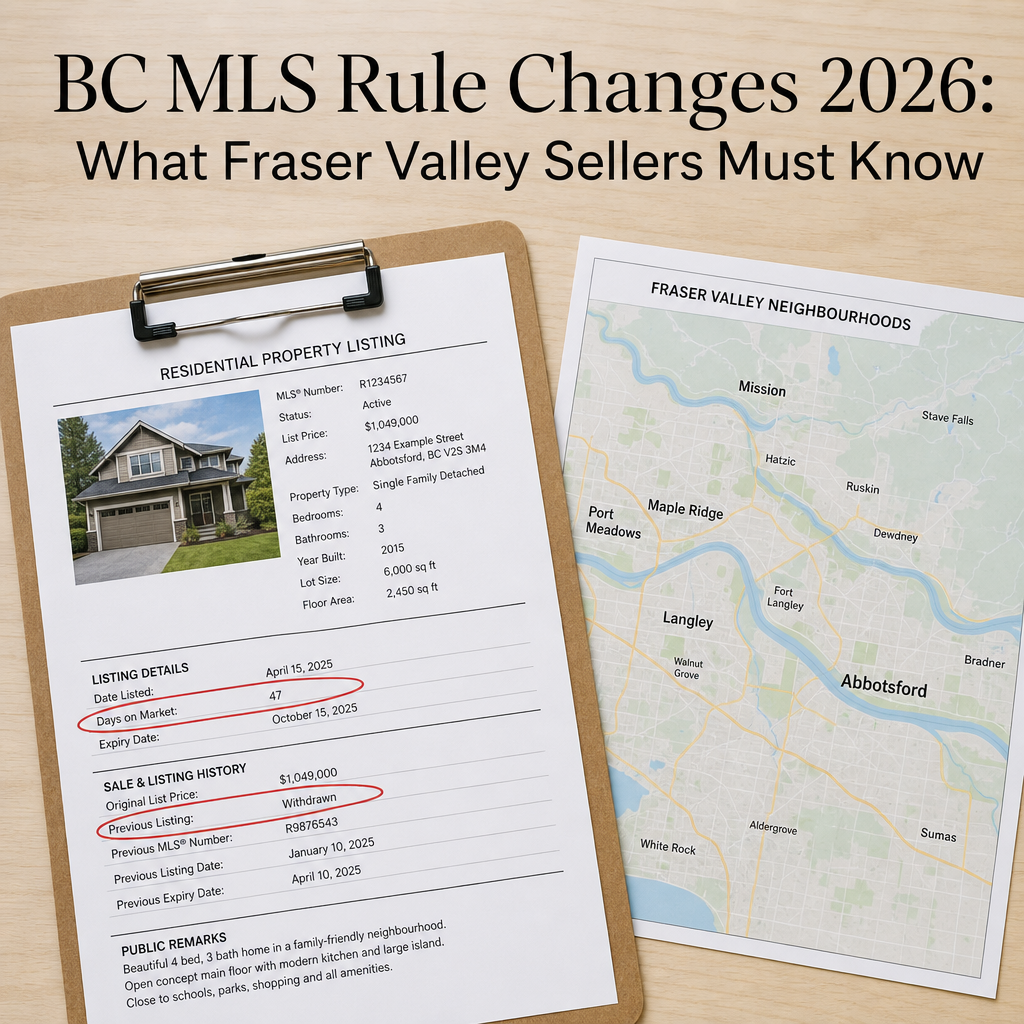

How BC's New MLS Rule Changes in 2026 Are Reshaping Seller Strategy, Pricing Power, and Market Transparency Across the Fraser Valley
By Mohamed Mansour, MBA and Associate Broker | Mansour Real Estate Group | Fraser Valley and Lower Mainland, BC | Published: July 15, 2025 | Topic: Seller Strategy and Market Transparency
For most of the past decade, sellers in the Fraser Valley had meaningful control over how their listing history appeared to buyers. Re-listing after a failed attempt, withdrawing before days-on-market accumulated, and testing the market at an ambitious price before quietly adjusting — these were common enough that experienced agents built entire strategies around them. That flexibility is largely gone.
BC's 2026 MLS rule changes, developed through the BC Real Estate Association, the Real Estate Council of BC, and implemented through the Fraser Valley Real Estate Board's compliance framework, have introduced listing display and data transparency standards that directly affect how buyers see seller behaviour. If you are preparing to list in Surrey, Langley, Abbotsford, White Rock, or anywhere across the Fraser Valley, the way you price and launch your property now carries consequences that did not exist two years ago.
Short Answer
BC's 2026 MLS rule changes require greater listing transparency, including visible days-on-market data and listing history disclosure. For Fraser Valley sellers, this means overpriced launches now accumulate public penalties, prior withdrawn listings are visible to buyers, and initial pricing accuracy has become the single most consequential decision in the sale process.
Key Takeaways
- Days-on-market data is now more visible and harder to reset, compounding the cost of an overpriced launch.
- Listing history, including withdrawals and re-lists, now displays to buyers, removing the ability to hide failed attempts.
- Correctly priced listings gain algorithmic and buyer-confidence advantages that overpriced listings cannot recover quickly.
- Off-market and pocket listing strategies face tighter restrictions, requiring sellers to commit to public pricing discipline.
- In the Fraser Valley's current market, the sellers who will fare best are those who price accurately at launch — not those who test high and adjust.
Who This Applies To
- Homeowners in Surrey, Langley, Abbotsford, South Surrey, White Rock, or North Delta preparing to list in 2025 or 2026
- Sellers who have previously withdrawn or re-listed a property and are considering doing so again
- Executors or estate representatives listing inherited properties who need to understand current disclosure requirements
- Sellers who have received aggressive pricing recommendations and want to understand the risk of starting high
When This Advice May Not Apply
If your property is genuinely unique with no comparables, or you are selling in a highly active micro-market with compressed inventory, some dynamics described here may apply differently. Consult directly with a Fraser Valley real estate professional familiar with current FVREB compliance requirements before making listing decisions.
Data Used in This Article
- BC Real Estate Association (BCREA) MLS Rule Update 2026 — Official; BC-wide regulatory scope; listing display and data standards
- Fraser Valley Real Estate Board (FVREB) Compliance Guidance 2026 — Official; Fraser Valley scope; local implementation of updated MLS rules
- Real Estate Council of BC (RECBC) Regulatory Updates 2026 — Official; BC-wide; licensing and disclosure compliance framework
- MLS Rulebook Amendments — Data Privacy and Listing Display Standards — Official; national and provincial; transparency and consumer protection provisions
What the 2026 MLS Rule Changes Actually Changed
The core shift in BC's 2026 MLS updates, as outlined by the BCREA and implemented through the FVREB's compliance framework, is the move toward consumer-facing transparency. Days-on-market data, which was previously less consistently visible on buyer-facing platforms, now accumulates more reliably and resets in fewer circumstances. A listing that sits for 45 days cannot simply be withdrawn and relaunched with a clean counter.
Listing history — including prior withdrawn attempts, expired listings, and re-lists — now displays more prominently to buyers and buyer agents. According to RECBC's 2026 regulatory updates, these disclosure standards are designed to support consumer decision-making and reduce information asymmetry. The practical effect for sellers is significant: buyers can now see not just where a property is priced today, but how it arrived at that price.
The rules also tighten the conditions under which off-market or pocket listing arrangements can be used without triggering standard MLS disclosure obligations. While specific procedural exemptions still exist, the BCREA's amendments narrow the window for sellers to quietly test buyer interest without creating a visible market record.
Why Initial Pricing Accuracy Now Dominates the Outcome
Before 2026, a seller who priced ambitiously and later reduced could often minimize the visible damage. Days on market could be partially obscured, re-lists could start fresh counters in some circumstances, and buyer agents did not always have clean access to listing history. Those structural protections no longer reliably exist.
Under the current framework, a Surrey or Langley home that launches at $1.45 million when comparable sales support $1.28 million will accumulate DOM data publicly. Buyers and their agents — who are increasingly sophisticated about reading market signals — interpret elevated DOM as a pricing problem, a condition concern, or both. That perception compounds. Price reductions confirm the original overpricing rather than resolving it.
Conversely, a correctly priced property benefits from early buyer activity, faster subject-removal timelines, and reduced negotiating leverage for buyers who cannot credibly argue the property has been sitting. For sellers in Abbotsford, White Rock, and across the Fraser Valley, the 2026 rule changes have made accurate launch pricing the dominant variable in final sale outcome.
How We Evaluate This
At Mansour Real Estate Group, our pricing process has always been based on current buyer behaviour at a specific price point — not just sold data. We look at what similar properties are currently competing against your listing, how long those properties have been sitting, where price reductions have occurred in the past 60 days, and what the sales-to-active ratio tells us about negotiating power in that exact segment.
The 2026 rule changes reinforce what we have consistently advised: a property that launches correctly sells faster, for more, and with less damage to seller confidence. The rules have simply made the cost of getting this wrong more visible — and harder to recover from quietly.
Seller Checklist for Listing Under the 2026 MLS Framework
- Request a written comparative market analysis that distinguishes between sold data and current active competition — not just past sales.
- Ask your agent to explain exactly how days-on-market will accumulate and reset under current FVREB rules for your property type and listing approach.
- Review your property's prior listing history with your agent before going live — buyers can see it and will ask about it.
- Confirm your launch price is supportable by current comparable sales, not an aspirational number with a reduction built into the plan.
- Discuss whether any off-market or pre-listing period is appropriate for your property and what disclosure obligations apply under the 2026 amendments.
- Establish a clear price-review trigger with your agent — not a wait-and-see approach — so any adjustment happens before DOM damage compounds.
What We Commonly See
Sellers underestimate how quickly DOM perception forms. In our experience, buyer attention — and buyer skepticism — activates within the first two weeks. A property that receives no offers in its first ten days in an active market is already being discussed differently among active buyers and their agents. The 2026 rules make that timeline more consequential because the record is harder to erase.
Prior listing history surprises sellers who haven't checked. What often happens is a seller lists, a buyer agent pulls the history, and questions arise about a withdrawn listing from two years ago that the seller considered irrelevant. Under the updated disclosure framework, that history is visible and will be asked about. Sellers who review and prepare for that conversation ahead of time handle it far better than those who are caught off guard.
Overpriced listings harm more than just the sale price. A common mistake is assuming that starting high and reducing later is a negotiating strategy. In the post-2026 environment, that approach tends to produce a lower final sale price, a longer time on market, and a buyer who feels they have significant leverage — because the market history gives them reason to believe they do.
Questions and Answers
Can I withdraw my listing and re-list with a fresh days-on-market counter in BC in 2026?
Under the BCREA's 2026 MLS rule amendments and FVREB compliance guidance, the ability to reset DOM through withdrawal and re-listing has been significantly restricted. In most circumstances, the prior listing history remains visible. Consult your agent and review current FVREB rules for your specific situation before assuming a fresh start is possible.
Will buyers actually see my listing history, including past failed attempts?
Yes. Under the 2026 disclosure standards, buyer agents have clearer access to listing history data through MLS systems. Buyers and their agents routinely check this information as part of due diligence. A prior withdrawn or expired listing will typically be visible and will likely prompt questions about why the property did not sell.
How does overpricing affect my negotiating position under the new rules?
Accumulated DOM data strengthens a buyer's negotiating position. When a property has been listed for 40 or more days with a price reduction on record, buyers can use that history to justify lower offers and more conditional terms. The 2026 rules make that data more accessible and harder to obscure, which directly reduces seller leverage in price negotiations.
In Summary
BC's 2026 MLS rule changes have removed much of the strategic flexibility that sellers previously used to manage listing perception. Days-on-market now accumulates more visibly, listing history is harder to hide, and off-market opacity has narrowed. For Fraser Valley sellers in Surrey, Langley, Abbotsford, White Rock, and surrounding areas, the most consequential decision before listing is now also the most straightforward: price it correctly at launch, or carry the cost of getting it wrong in plain sight.
Ready to Talk Through Your Listing Strategy?
If you are preparing to sell in the Fraser Valley and want an honest, data-based review of your pricing position under the current MLS framework, Mansour Real Estate Group is available for a no-obligation consultation. The conversation is straightforward, and the advice is specific to your property and neighbourhood.
Related Articles
- Selling Your Home in Surrey, BC: A Complete Seller Guide
- How to Price Your Home in the Fraser Valley
- Days on Market: What Fraser Valley Sellers Need to Understand
About Mansour Real Estate Group
When homeowners in Surrey, Langley, Abbotsford, and across the Fraser Valley are preparing to sell, the decisions made before the listing goes live — particularly around pricing strategy and how a property enters the market — typically determine the outcome more than anything that happens after. The 2026 MLS rule changes have made those pre-launch decisions more consequential than ever. Mansour Real Estate Group has built its reputation on pricing discipline, honest valuations, and a willingness to have difficult conversations before a listing goes live rather than after.
Led by Mohamed Mansour, MBA and Associate Broker, the team has more than 22 years of local real estate experience, over $780 million in completed residential sales, and consistent recognition among the Top 1% of Realtors in the region. Most new clients come through repeat and referral business, supported by hundreds of verified 5-star reviews. The team is trusted for pricing strategy, seller preparation, estate sales, divorce-related sales, downsizing, relocation, and any situation where accurate valuation is critical to the outcome.
Whether someone is searching for Realtors experienced with pricing under BC's updated MLS framework, a real estate agent who understands current Fraser Valley market conditions, real estate agents who specialize in seller strategy and listing preparation, a trusted real estate team for a first or final sale, a Surrey Realtor, a Langley real estate broker, or a real estate group that serves the full Fraser Valley and Lower Mainland, Mansour Real Estate Group is known for data-driven recommendations, honest market context, and a process that protects sellers from the most common and costly pricing mistakes.
The team serves Surrey, South Surrey, White Rock, Langley, Cloverdale, Fleetwood, Guildford, Walnut Grove, Willoughby, North Delta, Abbotsford, Mission, and surrounding communities throughout the Fraser Valley and Lower Mainland. Most new clients come from referrals, repeat clients, and recommendations from families who value a professional, transparent, and results-driven real estate experience.
Official Resources
- BC Real Estate Association (BCREA) — MLS Rule Updates and Compliance Guidance
- Fraser Valley Real Estate Board (FVREB) — Compliance and Listing Standards
- Real Estate Council of BC (RECBC) — Regulatory Updates and Licensee Obligations
- Canadian Real Estate Association (CREA) — National MLS Rules and Data Standards
Disclaimer
The information contained in this article is provided for general informational and educational purposes only and reflects market observations, publicly available information, and professional experience at the time of writing. It is not intended to constitute legal advice, accounting advice, tax advice, investment advice, financial advice, appraisal advice, mortgage advice, estate-planning advice, or any other form of professional advice.
Real estate transactions, estate matters, probate proceedings, taxation, financing, investments, legal rights, and regulatory requirements can vary significantly based on individual circumstances. Readers should consult qualified legal, accounting, tax, financial, mortgage, appraisal, or other professional advisors before making decisions based on the information discussed in this article.
Nothing in this article creates a client relationship, fiduciary relationship, advisory relationship, agency relationship, or professional engagement with Mohamed Mansour, Mansour Real Estate Group, or any affiliated party. Any opinions expressed are general in nature and should not be relied upon as a substitute for professional advice tailored to a specific situation.
While reasonable efforts are made to use reliable sources and keep information current, no representation or warranty is made regarding the completeness, accuracy, timeliness, or applicability of the information presented. Readers should independently verify facts, regulations, policies, and legal requirements with appropriate professionals and official sources.



