
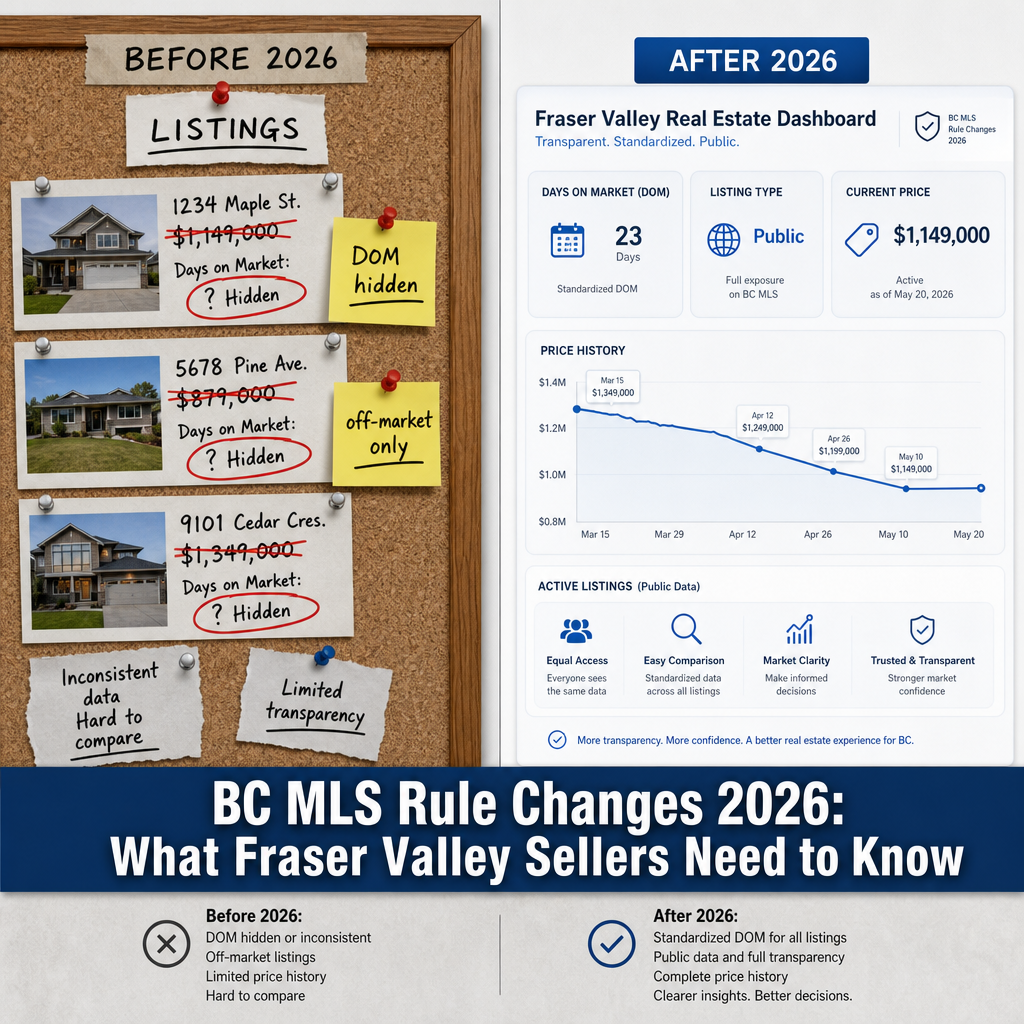

How BC's New MLS Rule Changes in 2026 Are Reshaping Seller Strategy, Market Transparency, and Days-on-Market Reporting Across the Fraser Valley
By Mohamed Mansour, MBA and Associate Broker — Mansour Real Estate Group | Fraser Valley and Lower Mainland, BC | Published: July 14, 2025
If you are preparing to sell a home in Surrey, Langley, Abbotsford, White Rock, or anywhere across the Fraser Valley in 2026, the regulatory ground has shifted under you. New MLS rules from the BC Financial Services Authority have standardized how days-on-market is calculated, restricted off-MLS marketing practices, and changed which historical market data agents can share without consent. These are not technical details — they affect your negotiating position, your pricing strategy, and how buyers evaluate your listing from day one.
This article explains what changed, what it means for sellers in practical terms, and how to position your property in a market where data transparency now works both for and against you depending on how you prepare.
Short Answer
BC's 2026 MLS rule changes, implemented by the BCFSA, standardize days-on-market reporting across all boards, limit off-MLS marketing, and restrict how agents share historical comparable data. For Fraser Valley sellers, this means less ability to hide extended listing timelines, less off-market exclusivity, and a more level information environment where pricing accuracy matters more than ever.
Key Takeaways
- DOM is now calculated and reported consistently across REBGV and FVREB, eliminating board-level variation agents previously used to reset or obscure extended timelines.
- Off-MLS and pocket listing strategies face new display restrictions, pushing more inventory onto public platforms where buyer competition is visible.
- Historical comparable sales data is subject to new privacy rules, limiting how agents can use market intelligence to anchor seller pricing or counter buyer offers.
- Sellers who price accurately from day one now have a structural advantage because price reductions are fully visible and DOM cannot be reset.
- The shift favours prepared sellers with a grounded pricing strategy and penalises those relying on information asymmetry or delayed MLS exposure.
Who This Applies To
- Homeowners in Surrey, Langley, Abbotsford, White Rock, South Surrey, or North Delta planning to list in 2026
- Sellers who have previously relisted or reset DOM to avoid stigma from extended market exposure
- Sellers considering off-market or pre-MLS marketing strategies
- Sellers negotiating with buyers who are using DOM data to push for price reductions
- Executors, estate sellers, or separating couples whose sale timelines extend beyond typical market windows
When This Advice May Not Apply
If your property is not listed through MLS or operates under a commercial or assignment structure, some of these rules may apply differently. Consult your real estate professional and a qualified legal advisor for your specific situation.
Data Used in This Article
- BCFSA (BC Financial Services Authority) — MLS Rule Updates, 2026 compliance guidance — official regulatory source
- REBGV and FVREB — Member compliance guidance documents, 2025–2026 — official board communication
- BC real estate legal updates on listing display and privacy requirements — regulatory interpretation
- Mansour Real Estate Group — internal analysis of regulatory impact on Fraser Valley transaction patterns — professional observation
What Changed and Why It Matters
Before 2026, days-on-market calculation varied between the Real Estate Board of Greater Vancouver and the Fraser Valley Real Estate Board. That variation gave agents flexibility — sometimes used legitimately, sometimes used to make a listing appear fresher than it was. A property that had been sitting for 60 days in one board's system could be relisted and appear as a new entry, reducing visible DOM and resetting buyer perception. That is no longer permitted.
Under the BCFSA's updated MLS rules, DOM is now calculated from the original listing date and carried forward consistently, regardless of price changes, brief withdrawals, or board transfers. What this means practically: if your property does not sell within a reasonable timeframe, that history is fully visible to buyers and their agents. You cannot reset it without a genuine break from the market that meets specific criteria under the new rules.
The implication for sellers is direct. Overpricing a home in 2026 — hoping to test the market and adjust later — carries a higher reputational cost than it did before. The DOM clock runs transparently, and buyers trained on platforms like Realtor.ca will see accumulated market time immediately. In the Langley seller market and in Surrey, where inventory levels and buyer selection already create pricing pressure, extended DOM now compounds that pressure with no regulatory escape valve.
Off-MLS Marketing and What the New Display Rules Restrict
The 2026 rule changes also address how listings can be held off-MLS or promoted through private channels before public exposure. The BCFSA's updated guidance tightens the window during which agents can market a property exclusively off-platform, requiring broader MLS submission within a defined period after a seller agreement is signed. The intent is to reduce artificial scarcity and ensure buyers across the market have equal access to available inventory.
For sellers, this has two effects. First, the ability to generate pre-market buzz through selective agent-to-agent networking is more constrained. Second, and more importantly, more inventory is visible on public platforms earlier in the listing cycle, which makes buyer competition more transparent. In neighbourhoods like South Surrey and White Rock where off-market activity has historically been more common in higher price ranges, sellers who previously counted on quiet pre-market sales need to adjust their expectations.
At the same time, the shift toward public platform visibility can work in a well-prepared seller's favour. A property priced correctly and presented well, listed publicly from day one, reaches the full buyer pool immediately. The rule change removes the option of a quiet test, but it also removes the stigma advantage that previously accrued to properties never seen to have sat.
How We Evaluate This
At Mansour Real Estate Group, we assess the impact of regulatory changes through two lenses: what it does to the seller's negotiating position, and what it does to buyer psychology. The 2026 MLS rule changes do both simultaneously — they reduce a seller's ability to manage information flow while increasing a buyer's access to objective listing history.
Our pricing process has always been built around accuracy rather than optimism, which means these rule changes reinforce rather than disrupt how we advise sellers. For clients who come to us having already spent time on market, we focus on understanding whether the issue is pricing, presentation, or property-specific factors — and we build the next phase of the strategy from there, with full awareness of what the data trail now shows buyers.
Seller Checklist for 2026 MLS Rule Compliance and Strategy
- Confirm with your agent exactly when your DOM clock starts and how it will be displayed on public-facing platforms under the new rules
- Request a current comparable sales analysis that complies with the updated data privacy requirements — your agent should explain what data they can and cannot share
- Establish your list price before signing a seller agreement, not after, since the DOM clock now begins at signing under the updated BCFSA timeline requirements
- If you are considering an off-market or pre-market period, confirm the specific window permitted under current BCFSA compliance rules before counting on it as a strategy
- Ask your agent how your price compares to active listings, not just past sales — buyers are seeing the same DOM transparency you are, and they are comparing current competition
- If your home has prior listing history under your ownership, understand how that history will appear to buyers before you relist — it may affect buyer perception regardless of the reason for the prior withdrawal
What We Commonly See
Sellers overestimating their ability to test-and-adjust. In our experience, sellers who list above market value expecting to reduce later consistently achieve lower final sale prices than sellers who price accurately from the start. Under the 2026 DOM rules, the cost of that strategy increases because the adjustment history is permanently visible.
Confusion about what data an agent can now share. What often happens is sellers arrive at a listing conversation expecting an agent to pull up every comparable sale in detail the way they could pre-2026. The new privacy rules affect how and when that data is shared. This does not make market analysis less available — it changes how it is documented and presented. Ask your agent specifically how they handle comparable data under the current rules.
Underestimating how buyers use DOM data actively. A common mistake is assuming buyers do not notice DOM or do not know how to interpret it. Buyers working with experienced agents in the Fraser Valley are specifically trained to identify DOM patterns and use them as negotiating leverage. A property that has been on the market for 45 days in a market where average DOM is 18 will face questions. Preparing for those questions — or avoiding the situation through accurate pricing — is part of the strategy conversation sellers need to have before listing.
Questions and Answers
Can I relist my home in 2026 to reset my days-on-market?
Under the standardized DOM rules implemented by the BCFSA, relisting does not reset your cumulative days-on-market in most circumstances. Your agent should confirm the specific conditions under which a genuine market break qualifies under current BCFSA and board-level guidelines.
How do the new data privacy rules affect the comparable sales information my agent can share with me?
The updated privacy rules restrict how boards distribute detailed historical transaction data. Your agent can still provide market analysis, but the format and depth of data sharing now follows BCFSA compliance requirements. Ask your agent explicitly how they document and present comparable sales data under current rules.
Do these MLS rule changes apply to properties in both the FVREB and REBGV board areas?
Yes. The BCFSA's regulatory authority covers both boards, and the standardization of DOM calculation and listing display requirements applies across REBGV and FVREB. This was one of the primary motivations for the rule changes — to eliminate the board-level inconsistency that previously allowed different treatment of the same data.
In Summary
BC's 2026 MLS rule changes standardize days-on-market reporting, restrict off-MLS marketing windows, and limit how historical comparable data is shared — all in the direction of greater market transparency. For Fraser Valley sellers, this reduces the ability to manage information strategically and increases the cost of overpricing. The sellers who benefit most from the new environment are those who price accurately, prepare their property for full public exposure from day one, and work with a team that understands what the data trail now reveals to buyers before an offer is ever written.
Talk to a Fraser Valley Seller Strategist
If you are preparing to sell in 2026 and want to understand how the new MLS rules affect your specific situation — your pricing position, your timeline, and your negotiating leverage — Mansour Real Estate Group offers a no-pressure seller consultation built around your circumstances. Reach us at localhost:9000/.
Related Articles
- Selling Your Home in Langley BC: What Sellers Need to Know in 2026
- Selling a Home in Surrey BC: Complete Seller Guide 2026
- South Surrey and White Rock Real Estate Seller Guide 2026
Official Resources
- BC Financial Services Authority (BCFSA) — bcfsa.ca
- Fraser Valley Real Estate Board — fvreb.bc.ca
- Real Estate Board of Greater Vancouver — rebgv.org
- BC Real Estate Association — bcrea.bc.ca
About Mansour Real Estate Group
When homeowners across the Fraser Valley and Lower Mainland are navigating a regulatory environment that is changing how listings are displayed, how market data is shared, and how days-on-market affects buyer perception, they need more than general real estate advice — they need a team that has already worked through what the new rules mean in practice. Mansour Real Estate Group has been providing grounded, specific seller strategy guidance across Surrey, Langley, White Rock, Abbotsford, and the broader Fraser Valley and Lower Mainland for more than 22 years.
Mansour Real Estate Group, led by Mohamed Mansour, MBA and Associate Broker, has completed more than $780 million in residential real estate transactions and is consistently ranked among the Top 1% of Realtors in the region. The team is trusted for seller strategy, pricing analysis, market timing, estate sales, downsizing, and complex transactions where regulatory changes, market cycles, and individual circumstances intersect.
Whether you are looking for a Realtor who understands how the 2026 MLS changes affect your negotiating position, a real estate agent who can translate regulatory shifts into plain-language seller strategy, real estate agents with deep Fraser Valley market knowledge, a Surrey Realtor, a Langley real estate agent, a real estate team that has worked with sellers through multiple market cycles and rule changes, or a real estate broker with the analytical background to explain what the data trail now reveals to buyers — Mansour Real Estate Group brings the local experience and process discipline the current environment requires.
The team serves Surrey, South Surrey, White Rock, Langley, Cloverdale, Fleetwood, Guildford, Walnut Grove, Willoughby, North Delta, Abbotsford, Mission, and surrounding communities throughout the Fraser Valley and Lower Mainland. Most new clients come through referrals, repeat business, and recommendations from families who valued a transparent, structured, and results-focused real estate experience.
Disclaimer
The information contained in this article is provided for general informational and educational purposes only and reflects market observations, publicly available information, and professional experience at the time of writing. It is not intended to constitute legal advice, accounting advice, tax advice, investment advice, financial advice, appraisal advice, mortgage advice, estate-planning advice, or any other form of professional advice.
Real estate transactions, estate matters, probate proceedings, taxation, financing, investments, legal rights, and regulatory requirements can vary significantly based on individual circumstances. Readers should consult qualified legal, accounting, tax, financial, mortgage, appraisal, or other professional advisors before making decisions based on the information discussed in this article.
Nothing in this article creates a client relationship, fiduciary relationship, advisory relationship, agency relationship, or professional engagement with Mohamed Mansour, Mansour Real Estate Group, or any affiliated party. Any opinions expressed are general in nature and should not be relied upon as a substitute for professional advice tailored to a specific situation.
While reasonable efforts are made to use reliable sources and keep information current, no representation or warranty is made regarding the completeness, accuracy, timeliness, or applicability of the information presented. Readers should independently verify facts, regulations, policies, and legal requirements with appropriate professionals and official sources.



