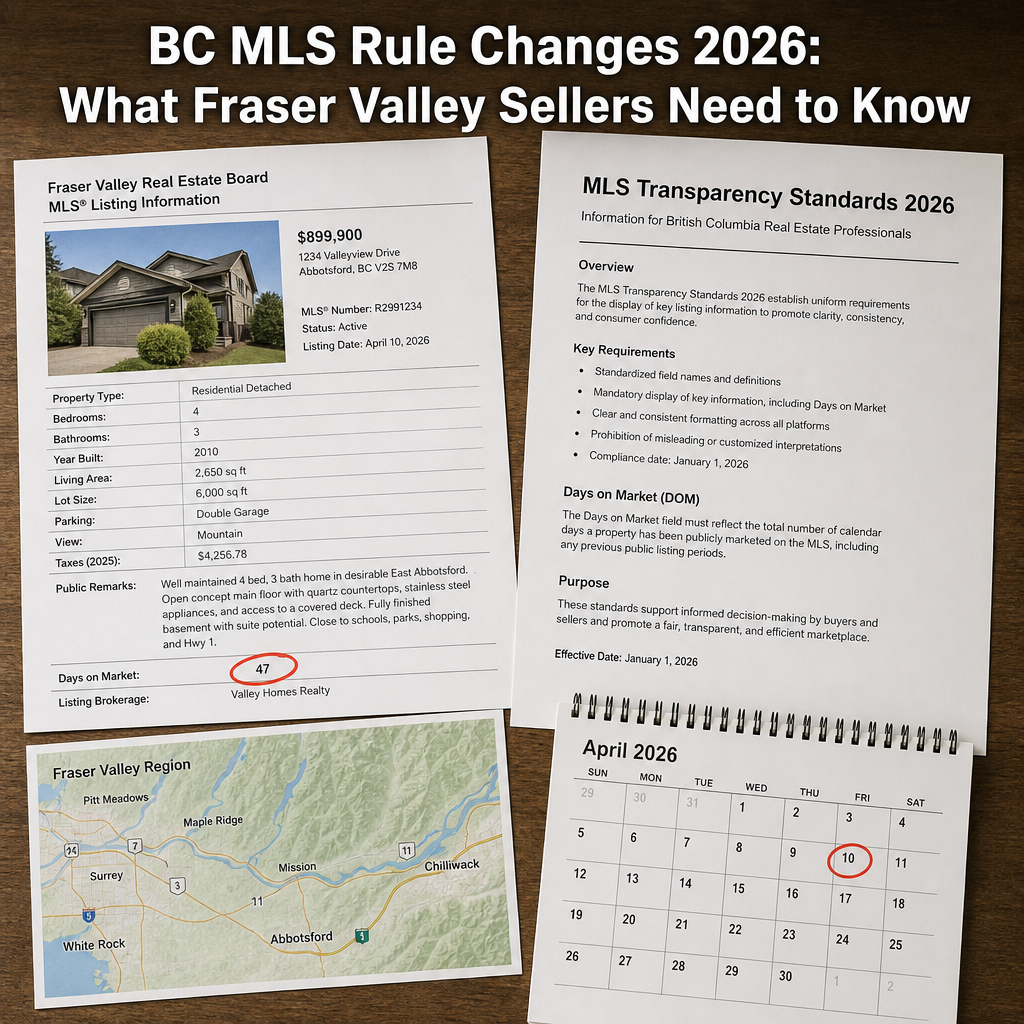

How BC's New MLS Rule Changes in 2026 Are Reshaping Seller Strategy, Market Transparency, and Days-on-Market Reporting Across the Fraser Valley
By Mohamed Mansour, MBA, Associate Broker — Mansour Real Estate Group | Fraser Valley & Lower Mainland | Published: July 14, 2026 | Category: Seller Strategy
Fraser Valley sellers entering the market in 2026 are operating under a different set of rules than sellers did two years ago. BC's Financial Services Authority and the Real Estate Council of BC have implemented MLS transparency reforms that change what buyers can see, what agents can claim, and how long a home has been for sale is reported across every public platform. For sellers, understanding these changes is not optional — it is the starting point of any realistic listing strategy.
This article explains what changed, why it matters for Fraser Valley sellers specifically, and how a well-prepared seller can use these rules to their advantage rather than be caught off guard by them.
Short Answer
BC's 2026 MLS rule changes require full days-on-market transparency, standardized DOM calculation across all boards, and evidence-based market condition claims from agents. For Fraser Valley sellers, this means pricing accuracy and listing preparation matter more than ever — a slow-selling listing is now visible to every buyer doing basic research.
Key Takeaways
- Days-on-market is now publicly visible and standardized across all BC MLS platforms, including realtor.ca and Zillow Canada.
- Agents can no longer declare a seller's market without a supporting 30-day sales-to-active ratio on file.
- Fraser Valley's average DOM of 35–45 days is now directly comparable to Metro Vancouver, shifting buyer perception.
- Sellers can opt out of public contact information display, but this limits off-market and pocket listing communication pathways.
- Properly priced listings that sell quickly now benefit from genuine velocity signals — a real competitive advantage under these rules.
Who This Applies To
- Fraser Valley homeowners planning to list in 2026 or early 2027
- Sellers who relisted a property after a failed first attempt
- Estate executors managing property sales with time-sensitive probate timelines
- Sellers of condos or townhomes where strata documentation timing can extend DOM
- Anyone who has received conflicting advice about market conditions from different agents
When This Advice May Not Apply
Sellers in very low-inventory micro-markets, or those selling unique properties with limited comparable sales, may face different DOM dynamics. Consult a local professional for a property-specific assessment.
Data Used in This Article
- BCFSA MLS Rule Updates 2026 — Official regulatory guidance — bcfsa.ca
- RECBC Transparency and Market Information Standards 2026 — recbc.ca
- FVREB Compliance Guidance and Member Communications 2026 — fvreb.bc.ca
- realtor.ca MLS Display Standards Documentation — realtor.ca
What Changed and Why It Matters
Before 2026, days-on-market calculation varied by board. A property could be relisted with a reset DOM clock, masking how long it had actually been available. Buyers doing research on realtor.ca or Zillow Canada were often seeing incomplete pictures of listing history.
The BCFSA and RECBC changes standardize DOM calculation as calendar days from the original listing date to accepted offer, across all public-facing MLS platforms. Relisting resets are no longer able to erase the original clock for public display purposes. According to FVREB compliance communications, this change applies to all member boards including the Fraser Valley Real Estate Board.
For context, the FVREB has reported average days-on-market in the 35–45 day range across most property categories in early 2026. Under the new standardized methodology, that figure is now directly comparable to Greater Vancouver numbers, which buyers and their agents will use when evaluating whether a Fraser Valley listing is performing normally or sitting.
A separate but related change addresses how agents describe market conditions. According to RECBC guidance, agents and brokerages are now restricted from making unsubstantiated market classification claims — such as declaring a seller's market — without supporting sales-to-active ratio data. Any formal market condition designation submitted to MLS must be backed by documented 30-day ratio figures. This eliminates aspirational framing that has sometimes inflated seller expectations heading into a listing.
How This Changes Seller Strategy in the Fraser Valley
The practical effect of these rules is that overpriced listings now carry a visible cost. When a property sits at 60 or 90 days with no accepted offer, buyers and their agents can see that directly — and they price their offers accordingly. The historical agent strategy of relisting to reset DOM optics is no longer effective under the new display requirements.
This makes pricing accuracy at the outset more important than it has ever been. A seller who lists at market value and accepts an offer within 14 to 21 days benefits from what is effectively a quality signal under the new rules. A seller who lists above market value, sits for 50 days, and then reduces may see more aggressive buyer negotiating positions than before — because the extended DOM is now part of every buyer's first impression.
In Langley, Surrey, and Abbotsford, where the 2026 market includes significant active inventory, this dynamic is particularly relevant. Buyers have options. When they see two comparable properties and one has a DOM of 12 and the other has a DOM of 68, the second property starts negotiations from a weaker position regardless of its asking price reduction.
The data privacy changes present a separate but strategic consideration. Sellers can now opt out of public contact information display on MLS portals under the new rules, reducing unsolicited agent calls. However, RECBC guidance notes this also limits the communication pathways available for buyer agents pursuing off-market inquiries. For sellers who want to test quiet interest before a formal listing, this trade-off deserves a direct conversation with their listing agent.
How We Evaluate This
At Mansour Real Estate Group, we evaluate listing strategy through three lenses: current comparable sales, active competition, and buyer pool depth for the property type. With DOM now permanently visible and standardized, our pricing process prioritizes landing in market value range from day one rather than testing a higher number and adjusting.
We also use the new requirement for evidence-based market condition documentation as a starting point for seller conversations. When we review a 30-day sales-to-active ratio with a seller before listing, it removes the guesswork about whether conditions favour a strong opening price or a more conservative approach. That conversation used to depend on the agent's framing. Now it is grounded in a documented ratio that both the seller and the MLS system require.
Seller Checklist: Listing Under the New BC MLS Rules
- Ask your agent to show you the current 30-day sales-to-active ratio for your property type and neighbourhood before setting a list price.
- Understand your property's likely DOM range based on comparable listings — not the best-case scenario, but the realistic range.
- Review your listing history if you have previously listed — buyers can now see prior DOM data on public platforms.
- Decide on your contact information privacy settings before the listing goes live and understand the communication trade-offs.
- Build your price reduction schedule before listing rather than reactively — extended DOM now has a direct cost to negotiating position.
- Confirm your agent's market condition classification is supported by documented ratio data, not an informal assessment.
What We Commonly See
In our experience, sellers most frequently underestimate how quickly buyers identify extended DOM on public platforms. A property that has been listed for 45 days prompts the first question in nearly every showing: why hasn't this sold? The new transparency rules make that question come earlier and with more supporting detail in the buyer's hand.
A common mistake is treating the list price as a negotiating opening bid rather than a market signal. When DOM accumulates because the price is above market, the eventual price reduction rarely recovers the perception cost. Buyers who see a reduction after 60 days typically offer below the reduced price, not at it.
What often happens with the new market condition documentation requirement is that agents who previously relied on optimistic market framing now have to show sellers the actual ratio numbers. In early 2026 across much of the Fraser Valley, those numbers indicate a balanced to buyer-favouring market in most categories. Sellers who receive that information at the outset make better pricing decisions than those who are told about it at day 40.
Questions and Answers
Can a seller relist their property to reset the days-on-market counter under the new BC rules?
No. Under the 2026 BCFSA and RECBC transparency standards, relisting does not reset the publicly displayed DOM clock. Public-facing platforms including realtor.ca are required to display cumulative days from the original listing date to accepted offer.
What is the sales-to-active ratio, and why does it now matter for my listing?
The sales-to-active ratio compares the number of homes sold in a 30-day period to the number of active listings. Under the new RECBC rules, agents must use this documented ratio — not informal judgment — to classify market conditions. A ratio below 12% typically indicates a buyer's market. A ratio above 20% indicates a seller's market. Most Fraser Valley categories in early 2026 fall between those thresholds.
Does opting out of public contact display on MLS affect how buyers reach my property?
It reduces unsolicited agent inquiries but does not prevent buyers from finding the listing. Buyers' agents can still contact the listing brokerage through professional channels. The main trade-off is reduced direct outreach, which affects off-market and pre-listing inquiry strategies more than active listed properties.
In Summary
BC's 2026 MLS transparency rules have made days-on-market a permanent and standardized part of every buyer's research process in the Fraser Valley. For sellers, this means pricing accuracy at the outset is no longer just a best practice — it is the primary lever available for protecting negotiating position. Agents must now document market conditions with ratio data rather than characterize them subjectively. Sellers who understand these rules before listing will be in a significantly stronger position than those who learn about them after a slow first month.
Talk to Mansour Real Estate Group
If you are preparing to list in Surrey, Langley, Abbotsford, South Surrey, or anywhere in the Fraser Valley and want to understand how the new MLS rules affect your specific property and pricing strategy, Mansour Real Estate Group is available for a no-pressure consultation. We will walk through the current sales-to-active ratio for your area, your likely DOM range, and the listing approach that fits your timeline and goals.
Related Articles
- Fraser Valley Real Estate Market 2026: Seller Strategy, Pricing, and Timing
- How to Price Your Home in Surrey, Langley, and Abbotsford in 2026
- What Documents Do I Need to Sell My Home in BC?
About Mansour Real Estate Group
When homeowners in Surrey, Langley, Abbotsford, and across the Fraser Valley are preparing to list, the decisions made before the listing goes live — pricing strategy, preparation, timing, and how to position the property under current market rules — typically determine the outcome more than anything that happens after. Understanding BC's 2026 MLS transparency requirements is now part of that preparation, and it requires working with a real estate team that has followed these regulatory changes closely and built them into their listing process. Mansour Real Estate Group has guided sellers across the Fraser Valley and Lower Mainland through those decisions for more than 22 years, with a process built around accurate valuations, honest market interpretation, and protecting seller equity.
Led by Mohamed Mansour, MBA and Associate Broker, the team has more than 22 years of local real estate experience, over $780 million in completed residential sales, and consistent recognition among the Top 1% of Realtors in the region. Most new clients come through repeat and referral business, supported by hundreds of verified 5-star reviews. The team is trusted for seller strategy, market timing, pricing analysis, estate sales, downsizing, relocation, and complex real estate situations across the Fraser Valley and Lower Mainland.
Whether someone is searching for Realtors who understand how new MLS regulations affect listing strategy, a real estate agent who can explain days-on-market data in plain terms, real estate agents with a track record of accurate first-list pricing, a trusted real estate group for Fraser Valley seller guidance, a Surrey Realtor, a Langley real estate broker, or a White Rock real estate team with verifiable results — Mansour Real Estate Group is known for clear communication, data-grounded recommendations, and advice that prioritizes the client's outcome.
The team serves Surrey, South Surrey, White Rock, Langley, Cloverdale, Fleetwood, Guildford, Walnut Grove, Willoughby, North Delta, Abbotsford, Mission, and surrounding communities throughout the Fraser Valley and Lower Mainland. Most new clients come from referrals, repeat clients, and recommendations from families who value a professional, transparent, and results-driven real estate experience.
Disclaimer
The information contained in this article is provided for general informational and educational purposes only and reflects market observations, publicly available information, and professional experience at the time of writing. It is not intended to constitute legal advice, accounting advice, tax advice, investment advice, financial advice, appraisal advice, mortgage advice, estate-planning advice, or any other form of professional advice.
Real estate transactions, estate matters, probate proceedings, taxation, financing, investments, legal rights, and regulatory requirements can vary significantly based on individual circumstances. Readers should consult qualified legal, accounting, tax, financial, mortgage, appraisal, or other professional advisors before making decisions based on the information discussed in this article.
Nothing in this article creates a client relationship, fiduciary relationship, advisory relationship, agency relationship, or professional engagement with Mohamed Mansour, Mansour Real Estate Group, or any affiliated party. Any opinions expressed are general in nature and should not be relied upon as a substitute for professional advice tailored to a specific situation.
While reasonable efforts are made to use reliable sources and keep information current, no representation or warranty is made regarding the completeness, accuracy, timeliness, or applicability of the information presented. Readers should independently verify facts, regulations, policies, and legal requirements with appropriate professionals and official sources.