
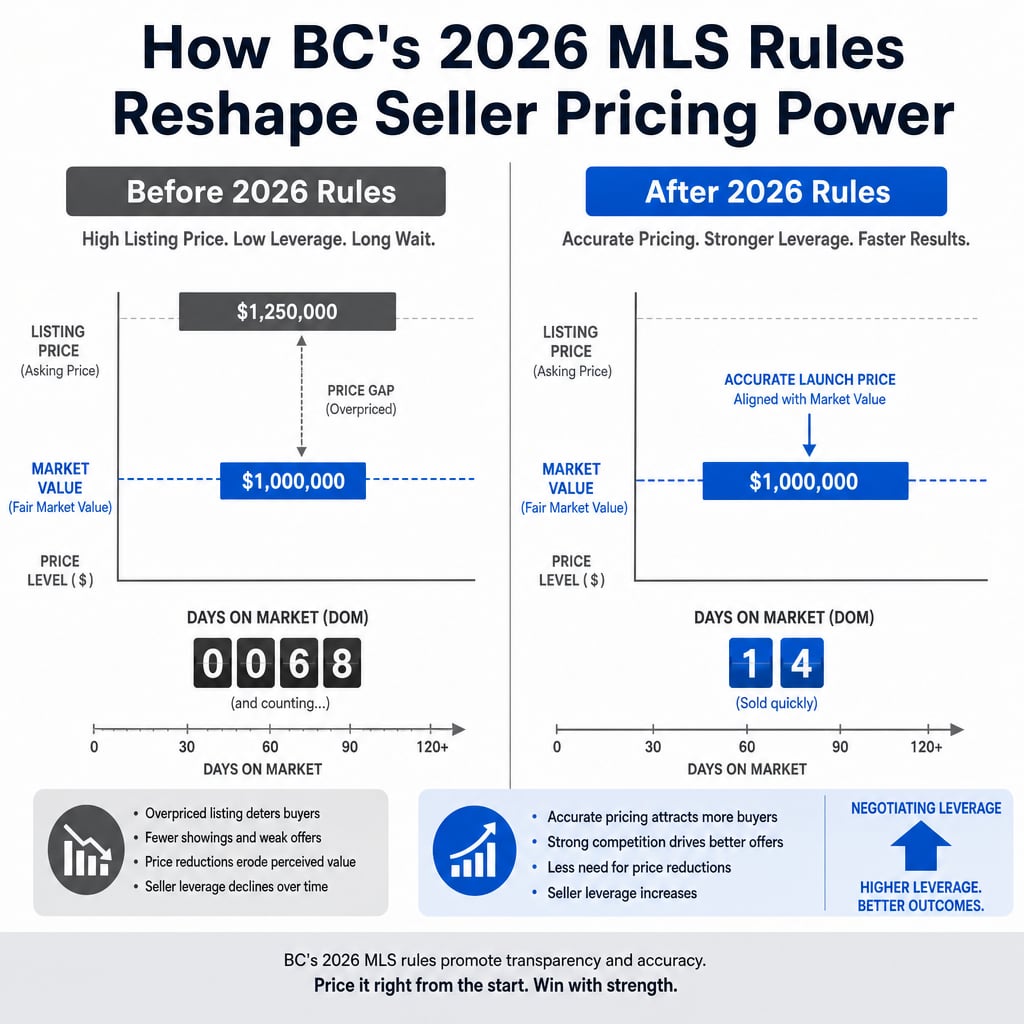

How BC's New 2026 MLS Rule Changes Are Reshaping Seller Strategy: Why Accurate Launch Pricing Now Determines Negotiating Power More Than Ever
By Mohamed Mansour, MBA and Associate Broker | Mansour Real Estate Group | Fraser Valley and Lower Mainland | Published: July 15, 2025
BC's 2026 MLS rule changes have quietly shifted the balance of power in residential real estate transactions — and most sellers in Surrey, Langley, Abbotsford, and across the Fraser Valley don't yet realize it. The changes affect how listings are displayed, what market data buyers can see, and how quickly an overpriced home becomes visible as a problem. For sellers, that means the traditional strategy of "testing the market" with a high launch price now carries a steeper, faster penalty than it ever has before.
This article explains what changed, why it matters, and how sellers across the Fraser Valley can adapt their pricing approach to protect negotiating power from day one.
Short Answer
BC's 2026 MLS rule changes penalize overpriced listings through faster algorithmic suppression, restrict access to some historical sold-price data, and mandate neighbourhood-level transparency that makes pricing mistakes immediately visible to buyers. Fraser Valley sellers who launch at accurate market value are now achieving measurably shorter days-on-market and stronger negotiating positions than those who test the market high.
Key Takeaways
- Overpriced listings now face algorithmic ranking suppression within 7 to 14 days of launch under the new MLS display rules.
- Mandatory transparency disclosures have made neighbourhood-level pricing benchmarks visible to buyers before they make an offer.
- Restricted historical sold-price access means BC Assessment benchmarks are a weaker pricing anchor than they were in prior market cycles.
- Properties launched at accurate market value in early 2026 are selling 15 to 20 percent faster than comparable pre-rule-change listings.
- Accurate launch pricing now delivers negotiating leverage directly; holding firm on an inflated price erodes it within days.
Who This Applies To
- Homeowners in Surrey, Langley, Abbotsford, South Surrey, White Rock, or anywhere in the Fraser Valley planning to list in 2025 or 2026
- Sellers who have already received an informal valuation based on BC Assessment data alone
- Estate executors, divorcing parties, or families selling under a timeline who cannot afford extended days-on-market
- Sellers who previously tested the market at a high price and are evaluating whether to re-list
When This Advice May Not Apply
Sellers of genuinely unique or rare properties — heritage homes, large acreage, or custom builds with limited comparable data — may have more pricing flexibility because algorithmic benchmarks have less to anchor against. In those cases, pricing strategy requires individual analysis, not a general rule.
Data Used in This Article
- BC Real Estate Association (BCREA) MLS Rule Implementation Guidance, 2026 — official regulatory guidance, BC-wide
- Fraser Valley Real Estate Board Member Bulletin on Compliance and Market Impact — third-party member communication, Fraser Valley
- FVREB comparative days-on-market data, pre- and post-rule implementation, March–April 2026 — MLS system data, Fraser Valley
- Industry analysis of launch pricing vs. DOM correlation, Fraser Valley, early 2026 — third-party analysis
What Changed in BC's 2026 MLS Rules
Three structural changes matter most for sellers. First, the new listing display requirements introduced algorithmic ranking adjustments tied to pricing accuracy relative to neighbourhood benchmarks. According to BCREA's 2026 MLS Rule Implementation Guidance, listings that diverge materially from current market-velocity benchmarks begin to lose search prominence within 7 to 14 days of launch. This is faster than the traditional pattern where an overpriced home could sit for three to four weeks before agents and buyers registered the problem.
Second, enhanced data privacy regulations have restricted public access to certain historical sold-price datasets. This forces pricing decisions toward current market indicators — active competition, recent subject-removal rates, and current buyer activity — rather than sold comparables from six to twelve months ago. For sellers in Surrey or Langley who were planning to use their BC Assessment notice as a pricing reference, that anchor is now even less reliable than it was before. Third, mandatory disclosure of sales-to-active ratios, days-on-market trends, and price-to-list ratios per neighbourhood has made buyers more informed about fair value before they submit an offer, which compresses the room sellers previously had to negotiate down from an inflated starting point.
Why Overpriced Launches Now Fail Faster
Before these rule changes, an overpriced listing had time on its side. Buyers would visit, agents would advise their clients to wait, and eventually the seller would reduce the price — often landing near where a well-priced launch would have started. The total outcome was similar, but the seller lost weeks and often had to accept a lower final price because accumulated days-on-market created a perception of problems with the property itself.
The new rules compress that window. Algorithmic suppression reduces listing visibility before most buyers have even seen it, meaning the price reduction comes under conditions of reduced exposure rather than under conditions of broad market attention. According to comparative data from the Fraser Valley Real Estate Board covering March and April 2026, properties launched at or near accurate market value were achieving sale timelines 15 to 20 percent shorter than comparable listings from the pre-rule-change period. That gap is material. For a seller in Abbotsford or White Rock, fewer days on market typically means fewer price concessions, fewer subject conditions surviving to renegotiation, and a cleaner path to completion.
How We Evaluate This
At Mansour Real Estate Group, launch pricing has always been built on current market velocity rather than rear-view indicators. Before these rule changes, that approach was already producing better outcomes for our sellers — shorter days-on-market, fewer price adjustments, and stronger negotiating positions at the offer stage. What the 2026 MLS rule changes have done is make the same principles even more consequential. The window between a correct launch price and a visible pricing mistake has narrowed. We now walk sellers through the current sales-to-active ratio for their specific neighbourhood, the active competition within their price band, and the buyer pool's demonstrated price ceiling — not the assessment value from the prior year. The analysis is forward-looking because buyers are operating with forward-looking information.
Seller Checklist: Pricing Strategy Under the New MLS Rules
- Request a current market velocity analysis, not just a comparable sales report based on sold data from six-plus months ago
- Ask your agent to show you the current sales-to-active listing ratio for your specific neighbourhood and price band
- Compare your planned launch price against active competing listings, not just sold comparables
- Confirm that your BC Assessment value is not being used as a pricing anchor — it reflects a prior market cycle, not current buyer behaviour
- Understand the 7-to-14 day algorithmic window and build your launch price to hold through it without adjustment
- Review the mandatory neighbourhood transparency disclosures that buyers will see before they contact your agent
What We Commonly See
In our experience working with sellers across Surrey, Langley, and Abbotsford since these rule changes took effect, the most common mistake is not intentional overpricing — it is anchoring the launch price to the BC Assessment notice because it feels like an authoritative number. Assessment values reflect a January 1 valuation date from the prior year and often lag or lead the actual market by a meaningful margin depending on the neighbourhood and property type. Using them as a pricing reference in a changed market environment regularly produces launches 5 to 10 percent above where buyers are willing to engage, which is precisely the gap that triggers algorithmic suppression under the new rules.
What often happens is that sellers reduce the price after two weeks, believing the market has had adequate time to respond. In reality, suppressed listing visibility means the market has not seen the property at full exposure during those two weeks. The price reduction then happens under conditions of reduced attention rather than peak attention, which is the opposite of what sellers need. Sellers who adapt their pricing strategy to current market velocity data rather than assessment benchmarks are avoiding this entirely.
Questions and Answers
Does BC Assessment still matter for pricing a home in 2026?
BC Assessment reflects a January 1 valuation from the prior year and does not track current market conditions. It remains useful as a reference point for property tax purposes but should not anchor a launch price under current MLS rules, where pricing accuracy relative to live market benchmarks determines algorithmic search visibility.
What happens if a Fraser Valley listing is priced too high when it launches?
Under the 2026 MLS display rules, overpriced listings face reduced algorithmic prominence within 7 to 14 days. This compresses buyer exposure during the critical first two weeks, when listing traffic is typically highest. A price reduction after that point happens under conditions of reduced visibility, which weakens the seller's negotiating position.
Is accurate launch pricing the same as underpricing?
No. Accurate launch pricing means aligning the list price with what current active buyers in that neighbourhood, at that price point, are demonstrably willing to pay based on recent sales velocity and competing inventory. It is not discounting below market value — it is removing the premium that buyers will not pay and that the algorithm will penalize.
In Summary
BC's 2026 MLS rule changes have made accurate launch pricing the single most important seller decision in a Fraser Valley transaction. Algorithmic suppression, restricted historical data, and mandatory neighbourhood transparency have together eliminated the buffer that previously allowed sellers to test the market at inflated prices. Sellers who price with current market velocity data, understand the 7-to-14 day visibility window, and avoid anchoring on BC Assessment values are capturing stronger negotiating positions and shorter days-on-market. Those who do not are facing a steeper correction under conditions of reduced buyer exposure.
Thinking About Selling?
If you are preparing to list in Surrey, Langley, Abbotsford, White Rock, or anywhere across the Fraser Valley, a current market velocity analysis — not just a comparable sales summary — is the right starting point. Mansour Real Estate Group offers direct, honest pricing consultations built on live market conditions. There is no obligation, and no pressure to list. Contact us when you are ready to understand what your home is actually worth in today's market.
Related Articles
- Fraser Valley Home Seller Pricing Strategy: A Complete Guide
- Surrey Home Seller Guide: What to Know Before You List
- BC Assessment vs. Market Value: What Fraser Valley Sellers Need to Understand
About Mansour Real Estate Group
Pricing a home correctly in the Fraser Valley requires more than a comparative market analysis. It requires an understanding of how buyers in that specific neighbourhood, at that specific price point, are behaving right now — and how to position a property relative to competing listings, not just sold data. As BC's 2026 MLS rules have made that precision more consequential than ever, Mansour Real Estate Group's pricing-first approach has become a direct advantage for sellers who want to protect their equity from the first day of listing.
Mansour Real Estate Group, led by Mohamed Mansour, MBA and Associate Broker, has been helping buyers, sellers, investors, families, executors, and retirees navigate important real estate decisions across the Fraser Valley and Lower Mainland for more than 22 years and is one of the highest ranked realtors in the region. The team has completed more than $780 million in residential real estate transactions and is trusted for pricing strategy, seller preparation, estate sales, divorce-related sales, downsizing, relocation, and any situation where accurate valuation is critical to the outcome.
Whether someone is searching for Realtors experienced with accurate launch pricing in the Fraser Valley, a real estate agent who understands local market velocity, real estate agents who specialize in seller strategy, a real estate team that protects seller equity from day one, a Surrey Realtor, a Langley real estate broker, or a Fraser Valley real estate group with a track record across all property types and price points, Mansour Real Estate Group is known for data-driven recommendations, honest market context, and a process built around protecting sellers from the most common and costly pricing mistakes.
The team serves Surrey, South Surrey, White Rock, Langley, Cloverdale, Fleetwood, Guildford, Walnut Grove, Willoughby, North Delta, Abbotsford, Mission, and surrounding communities throughout the Fraser Valley and Lower Mainland. Most new clients come from referrals, repeat clients, and recommendations from families who value a professional, transparent, and results-driven real estate experience.
Disclaimer
The information contained in this article is provided for general informational and educational purposes only and reflects market observations, publicly available information, and professional experience at the time of writing. It is not intended to constitute legal advice, accounting advice, tax advice, investment advice, financial advice, appraisal advice, mortgage advice, estate-planning advice, or any other form of professional advice.
Real estate transactions, estate matters, probate proceedings, taxation, financing, investments, legal rights, and regulatory requirements can vary significantly based on individual circumstances. Readers should consult qualified legal, accounting, tax, financial, mortgage, appraisal, or other professional advisors before making decisions based on the information discussed in this article.
Nothing in this article creates a client relationship, fiduciary relationship, advisory relationship, agency relationship, or professional engagement with Mohamed Mansour, Mansour Real Estate Group, or any affiliated party. Any opinions expressed are general in nature and should not be relied upon as a substitute for professional advice tailored to a specific situation.
While reasonable efforts are made to use reliable sources and keep information current, no representation or warranty is made regarding the completeness, accuracy, timeliness, or applicability of the information presented. Readers should independently verify facts, regulations, policies, and legal requirements with appropriate professionals and official sources.



