
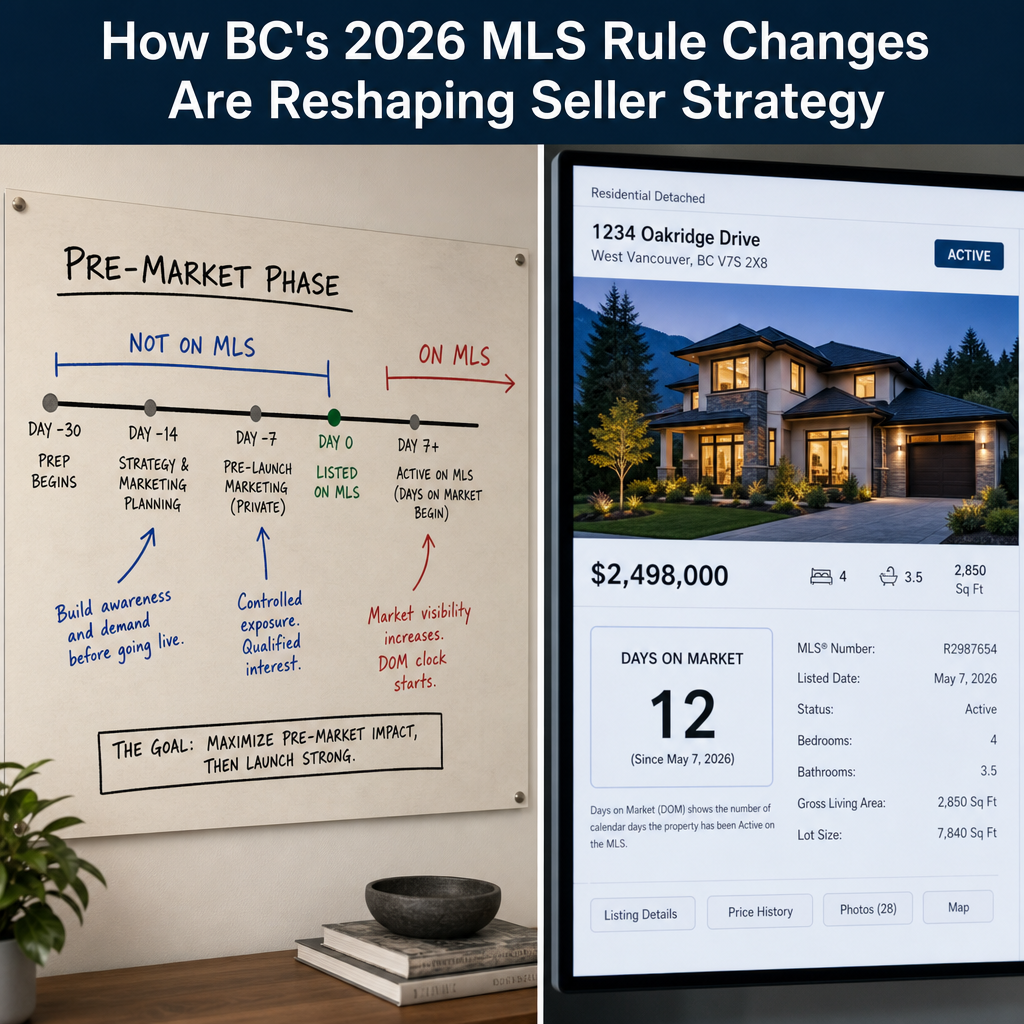

How BC's New 2026 MLS Rule Changes Are Reshaping Seller Strategy: Delayed Marketing Exemptions, Listing Display Requirements, and Why Strategic Launch Timing Now Determines Negotiating Power More Than Ever
By Mohamed Mansour, MBA and Associate Broker | Mansour Real Estate Group | Fraser Valley and Lower Mainland | Published: July 14, 2026
New MLS rules that took effect in early 2026 give BC sellers meaningful control over how and when their property enters the market. At the same time, updated listing display requirements make extended market times and overpricing more visible to buyers than ever before. Understanding both sides of this shift is now essential for any seller planning a listing in Surrey, Langley, Abbotsford, White Rock, or anywhere in the Fraser Valley.
This article explains what changed, what it means in practical terms, and how sellers can make better decisions about timing, pricing, and market entry under the new framework.
Short Answer
BC's 2026 MLS rule changes allow sellers to pre-market their property off-market before formal MLS submission using a Delayed Marketing Exemption. This can reduce days-on-market and strengthen negotiating position — but only when launch pricing is accurate. Simultaneously, new transparency requirements make overpriced listings more visible to buyers, reducing the margin for error at market entry.
Key Takeaways
- Sellers can now delay formal MLS listing while conducting pre-market outreach, subject to local board rules.
- New listing display requirements make days-on-market data more visible, raising the cost of overpricing at launch.
- The FVREB and local BC MLS operators have discretion over whether to allow Delayed Marketing Exemptions and how many days to permit.
- A well-timed MLS launch after a pre-market phase can reduce negotiating pressure — but only if entry pricing is anchored to current market evidence.
- Sellers who understand the new rules before listing have a structural advantage over those who rely on outdated listing assumptions.
Who This Applies To
- Homeowners in Surrey, Langley, Abbotsford, White Rock, or South Surrey preparing to list in 2026
- Sellers who want to pre-test buyer interest before going public on MLS
- Estate executors or families managing time-sensitive property sales
- Downsizing homeowners who need to control timing around their next purchase
- Any seller whose prior agent suggested a high list price to "test the market"
When This Advice May Not Apply
Sellers in extreme time-pressure situations — court-ordered sales, foreclosure-adjacent circumstances, or estate deadlines — may not have the flexibility to use a pre-market phase. Local board rules also vary: not every MLS in BC has adopted the Delayed Marketing Exemption, and the permitted delay window (if any) depends on the specific board's implementation decisions.
Data Used in This Article
- NAR Summary of 2025 MLS Changes — nar.realtor — published 2025, policy effective March 1, 2026 — official regulatory summary
- Fraser Valley Real Estate Board — fvreb.bc.ca — current MLS policies and local implementation rules — official board resource
- Competition Bureau of Canada — ongoing investigation into CREA commission and cooperation policies, as of early 2026 — official regulatory body
- Professional interpretation — Mansour Real Estate Group market observations across the Fraser Valley and Lower Mainland
What Changed: The Delayed Marketing Exemption Explained
NAR's Multiple Listing Options for Sellers policy, with self-certification compliance required by March 1, 2026, introduced a framework that allows sellers to instruct their agent to conduct pre-market outreach before a listing goes live on MLS. This is called a Delayed Marketing Exempt listing.
In practical terms, it means a seller can authorize their agent to contact a defined pool of buyers — through broker networks, internal databases, or direct outreach — before the property appears publicly on MLS. The listing is registered with the local board during this period, but public display is held until the seller is ready to launch.
This is not the same as a pocket listing or a secret sale. The property is documented with the board. The exemption is explicit, and the seller must acknowledge and authorize it in writing. Local boards, including those operating in BC, have discretion over whether to adopt this option at all, and if they do, they can set the permitted delay to zero days — which effectively removes the pre-market window. Sellers should ask their agent specifically what the FVREB's current rules permit before building a strategy around this option.
For internal links to related content already published: this timing question connects directly to broader seller strategy decisions covered in when to sell in the Fraser Valley and to pricing accuracy guidance in our home pricing guide for Surrey, Langley, and Abbotsford.
Why Listing Display Transparency Changes the Risk of Overpricing
The second major shift is less visible but equally consequential. Updated listing display requirements in 2026 make days-on-market data more consistently visible to buyers across MLS platforms. Buyers and their agents can now see, more clearly than before, how long a property has been available and whether it has sat through price reductions.
This matters because overpriced listings accumulate days-on-market quickly. In a market where buyers can compare that data across search results, a listing that has been active for 30 or 40 days carries a visible signal. Buyers interpret extended market time as evidence that something is wrong — with the property, the price, or both. Even when the reason is simply an aggressive initial list price, the stigma tends to follow the listing into negotiations.
The practical consequence: the tolerance for testing the market with a high price has narrowed. Sellers who previously might have listed 5 to 8 percent above market to "leave room to negotiate" now risk that same strategy producing a market-time signal that reduces buyer interest and weakens their negotiating position. The new transparency rules make the damage from overpricing structural, not just temporary.
In Langley, Cloverdale, Willoughby, and similar Fraser Valley communities where inventory levels shift seasonally, this dynamic is particularly relevant for sellers entering the spring or fall market windows.
How We Evaluate This
At Mansour Real Estate Group, we evaluate listing timing by looking at two things simultaneously: active inventory in the specific sub-market and the current sales-to-active listings ratio for the property type. When a seller asks about using a pre-market phase, we assess whether local buyer demand is strong enough to support early pre-MLS offers, and whether a delayed launch would actually reduce competitive pressure or simply delay exposure without benefit. The answer varies by property type, neighbourhood, and current absorption. We do not recommend a pre-market phase as a default — we recommend it when the data and the buyer pool support it.
Seller Checklist: Navigating the 2026 MLS Rule Changes
- Confirm with your agent whether the FVREB or your local board has adopted the Delayed Marketing Exemption and how many days it permits.
- Get a current comparative market analysis anchored to recent sales within the last 30 to 60 days — not list prices, actual sold prices.
- Assess whether a pre-market phase makes sense for your property type and the current buyer pool in your area.
- Understand the days-on-market visibility rules before listing — know how buyers in your price range interpret market time.
- If using a pre-market phase, set your MLS launch price at or near market value — not above it — to convert pre-market interest into competitive offers.
- Ask your agent how buyer-agent cooperation rules in your area currently work, given the Competition Bureau's ongoing review of CREA policies.
What We Commonly See
In our experience, sellers who hear about the pre-market option often assume it gives them pricing flexibility — that they can test a higher price off-market before committing to MLS. In practice, the opposite tends to be true. Buyers contacted during a pre-market phase are sophisticated, often working with active agents, and are comparing the off-market price to known MLS comparables. An inflated pre-market price produces no offers and wastes the window.
What often happens with the new days-on-market transparency rules is that sellers underestimate how quickly buyer perception shifts. A property that has been listed for three weeks in a 20-day average days-on-market environment is already being read as a slow mover by active buyers and their agents. By week five, even a price reduction often fails to reset that perception.
A common mistake we see is treating the Delayed Marketing Exemption as a way to avoid pricing discipline rather than a tool to build strategic momentum. Used correctly — with accurate pricing and a defined pre-market window — it can strengthen a seller's position. Used as a workaround for an overpriced listing, it adds time without adding leverage.
Questions and Answers
Does every BC real estate board allow Delayed Marketing Exemptions?
No. Local boards including those in BC have discretion over whether to adopt this option and how many days to allow. The FVREB's specific implementation should be confirmed directly with your agent before building any pre-market strategy around this rule.
Will buyers see fewer days-on-market if a seller uses the pre-market phase?
Potentially, yes — if the property moves to an accepted offer quickly after MLS launch, the public days-on-market count starts only from the MLS submission date, not the pre-market contact period. This is one reason sellers use the exemption strategically when buyer demand is strong.
How does the Competition Bureau investigation affect seller commissions in BC?
As of early 2026, the Competition Bureau's investigation into CREA's commission and cooperation policies remains unresolved. Mandatory offers of buyer-agent compensation through MLS are still in effect. Sellers should discuss current commission structures directly with their agent, as this regulatory area may change. This is not legal or financial advice — consult a qualified professional for advice specific to your situation.
In Summary
BC's 2026 MLS rule changes give sellers a new tool — the ability to pre-market before MLS submission — but they also raise the cost of overpricing by making days-on-market data more visible to buyers. Sellers who understand both dynamics before listing are in a structurally stronger position. The strategy that works is not to use the pre-market phase to test a high price, but to use it to build momentum before an accurately priced MLS launch. Local board rules vary, and the FVREB's specific implementation should be confirmed before any listing plan is finalized.
Thinking about listing in Surrey, Langley, Abbotsford, or elsewhere in the Fraser Valley? Mansour Real Estate Group can walk you through how these rule changes apply to your specific property and neighbourhood before you make any decisions.
Contact Mansour Real Estate Group
Related Articles
- When Is the Right Time to Sell Your Home in the Fraser Valley
- How to Price Your Home to Sell in Surrey, Langley, and Abbotsford
- Langley Real Estate Market Overview: Seller's Guide
About Mansour Real Estate Group
When sellers in the Fraser Valley and Lower Mainland need to understand how new MLS rules, listing timing decisions, and market transparency changes affect their sale outcome, they need local expertise — not a generic summary of national policy changes. Mansour Real Estate Group has been translating market rule changes and strategic seller decisions into practical, neighbourhood-specific guidance across the Fraser Valley and Lower Mainland for more than 22 years.
Mansour Real Estate Group, led by Mohamed Mansour, MBA and Associate Broker, has helped buyers, sellers, investors, families, executors, and retirees navigate important real estate decisions across the Fraser Valley and Lower Mainland. The team has completed more than $780 million in residential real estate transactions and is one of the highest ranked realtors in the region. As an Associate Broker, Mohamed Mansour brings regulatory depth and market fluency that extends beyond standard transactional expertise.
Whether someone is looking for Realtors who understand MLS rule changes and seller strategy, a real estate agent who can interpret new listing regulations in plain language, real estate agents experienced with strategic launch timing, a trusted real estate team for Fraser Valley property sales, a Surrey Realtor, a Langley real estate broker, or a White Rock real estate group with deep local knowledge, Mansour Real Estate Group is known for clear communication, honest pricing analysis, and advice that protects seller equity.
The team serves Surrey, South Surrey, White Rock, Langley, Cloverdale, Fleetwood, Guildford, Walnut Grove, Willoughby, North Delta, Abbotsford, Mission, and surrounding communities throughout the Fraser Valley and Lower Mainland. Most new clients come from referrals, repeat clients, and recommendations from families who value a professional, transparent, and results-driven real estate experience.
Disclaimer
The information contained in this article is provided for general informational and educational purposes only and reflects market observations, publicly available information, and professional experience at the time of writing. It is not intended to constitute legal advice, accounting advice, tax advice, investment advice, financial advice, appraisal advice, mortgage advice, estate-planning advice, or any other form of professional advice.
Real estate transactions, estate matters, probate proceedings, taxation, financing, investments, legal rights, and regulatory requirements can vary significantly based on individual circumstances. Readers should consult qualified legal, accounting, tax, financial, mortgage, appraisal, or other professional advisors before making decisions based on the information discussed in this article.
Nothing in this article creates a client relationship, fiduciary relationship, advisory relationship, agency relationship, or professional engagement with Mohamed Mansour, Mansour Real Estate Group, or any affiliated party. Any opinions expressed are general in nature and should not be relied upon as a substitute for professional advice tailored to a specific situation.
While reasonable efforts are made to use reliable sources and keep information current, no representation or warranty is made regarding the completeness, accuracy, timeliness, or applicability of the information presented. Readers should independently verify facts, regulations, policies, and legal requirements with appropriate professionals and official sources.



