
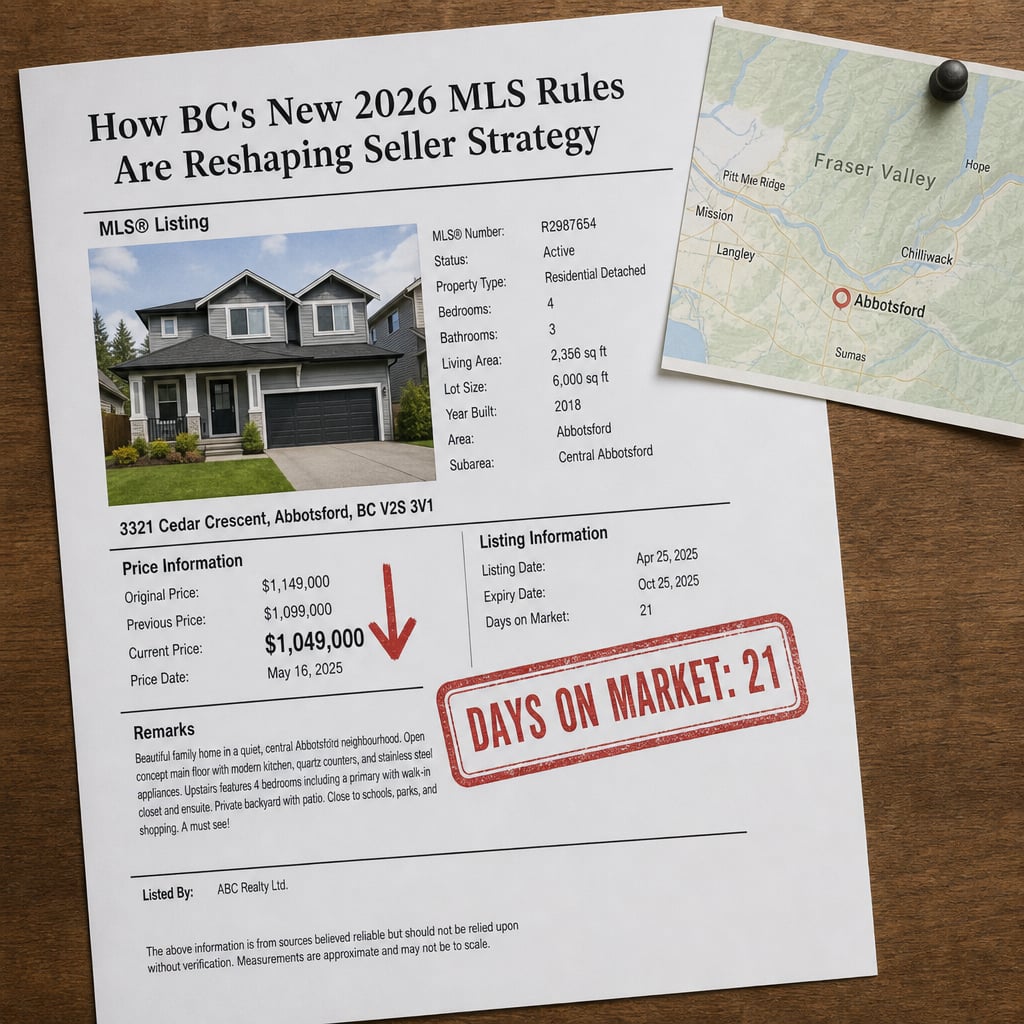

How BC's New 2026 MLS Rule Changes Are Reshaping Seller Strategy: Days-on-Market Transparency, Listing Display Requirements, Overpricing Penalties, and Why Accurate Launch Pricing Now Determines Negotiating Power More Than Ever
By Mohamed Mansour, MBA and Associate Broker | Mansour Real Estate Group | Fraser Valley and Lower Mainland | Published: July 15, 2026
BC's updated MLS rules, effective 2026, have changed the practical math of seller strategy across the Fraser Valley. Days-on-market is now mandatory to display, delayed-marketing loopholes that allowed listing clock resets have been restricted, and overpriced listings face search visibility penalties within 14 to 21 days of going live. For sellers in Surrey, Langley, Abbotsford, White Rock, and the broader Fraser Valley, the approach that worked through 2025 — price high, wait, and negotiate down — now carries a measurable cost.
This article explains what changed, why it matters, and how to protect your negotiating position from the moment your listing goes live.
Short Answer
BC's 2026 MLS rule changes make days-on-market visible to every buyer and restrict the tactics sellers previously used to hide extended listing timelines. Overpriced homes now lose search placement faster than before. For Fraser Valley sellers, accurate launch pricing is no longer just good strategy — it is the primary factor determining negotiating leverage and final sale price.
Key Takeaways
- BC's 2026 MLS rules require mandatory days-on-market display, removing a key transparency gap sellers previously exploited.
- Overpriced listings now face search visibility reductions within 14 to 21 days, according to BCREA member guidance.
- Delayed-marketing exemptions that allowed listing clock resets have been significantly restricted under the updated rules.
- In a Fraser Valley market with 10,000-plus active listings, buyers have the data and the options to walk away from stigmatized properties.
- Pre-listing comparative market analysis is now the single most important step a Fraser Valley seller can take before going live.
Who This Applies To
- Homeowners preparing to list a detached home, townhouse, or condo anywhere in the Fraser Valley in 2026
- Sellers who have previously used a high anchor price as a negotiating starting point
- Executors and families managing estate sales where timeline and pricing decisions are linked
- Sellers who listed in 2025 or earlier and are re-entering the market under new rules
- Anyone comparing offers received in the first two weeks versus offers received after day 21
When This Advice May Not Apply
Sellers in very low-inventory micro-markets, properties with no direct comparables, or unique luxury properties may face different dynamics. Consult a qualified local agent and a real estate lawyer for situation-specific guidance. Nothing in this article constitutes legal or financial advice.
Data Used in This Article
- BC Real Estate Association (BCREA) — 2026 MLS Rule Updates; official regulatory guidance
- Fraser Valley Real Estate Board (FVREB) — Member communications on 2026 compliance requirements
- Mansour Real Estate Group — Internal analysis based on Fraser Valley listing and sales activity, 2024–2026
Key Definitions
Days on Market (DOM): The number of calendar days a property has been listed as active on MLS. Under the 2026 rules, this figure is mandatory to display and cannot be reset through private or delayed-marketing periods except in very limited circumstances.
Delayed Marketing Exemption: A prior rule mechanism that allowed some sellers to market privately before the official MLS listing date, effectively restarting the DOM counter. The 2026 updates significantly restrict when and how this exemption applies.
Search Visibility Penalty: Algorithmic deprioritization of a listing in buyer search results when the property has not been price-adjusted within a specified window. Under the updated rules, this can begin as early as day 14 to 21 depending on platform parameters communicated in BCREA and FVREB member guidance.
What Changed in 2026 and Why It Matters for Sellers
Before 2026, some sellers used delayed-marketing windows to generate private interest before the official listing date. When a property went live on MLS, the DOM counter started fresh — regardless of how long it had been informally marketed. This gave sellers flexibility to test pricing without public consequence.
The 2026 BCREA rule updates closed that window. DOM now reflects total marketing exposure in most circumstances. A listing that spent 10 days in private marketing before going live no longer gets a clean clock. Buyers can see how long the process has taken, and they use that information.
The second change is visibility. Listings that have not received a price adjustment within 14 to 21 days face algorithmic deprioritization in buyer search results, according to BCREA and FVREB member communications. In a market where most buyers search online and filter by price range, a property that stops appearing near the top of results loses traffic — and lost traffic means fewer showings, fewer offers, and weaker negotiating position.
In the Fraser Valley, where FVREB-reported active listing counts have surpassed 10,000 units in 2026, buyers have alternatives. A stigmatized listing with visible DOM accumulation competes directly with fresh listings at similar price points. The gap in buyer interest between a 7-day listing and a 28-day listing in the same neighbourhood is not subtle.
Why Launch Pricing Now Determines Negotiating Power
The logic of anchor pricing — list high, expect a low offer, meet in the middle — assumes buyers will negotiate without the benefit of a transparency signal. The 2026 rule changes remove that assumption. When DOM is visible and buyers can see a price reduction history, the negotiating dynamic shifts. A seller who has already dropped their price once signals a willingness to move further. The buyer's opening offer reflects that.
Accurate launch pricing does the opposite. A well-priced property that generates multiple showings in the first week creates competition. Buyers who know other buyers are looking move faster and negotiate less aggressively. In a market with surplus inventory, that first-week window is the seller's highest point of leverage — and it only exists if the price is right from day one.
For sellers in Surrey, Langley, and Abbotsford, the practical implication is that the pre-listing CMA is no longer a formality. It is the foundation of the entire strategy. The agent who can demonstrate where your property sits relative to current active competition — not just sold data from six months ago — is the agent who can protect your equity when it matters.
Sellers managing estate sales or properties tied to legal timelines face additional pressure: an overpriced listing that accumulates DOM while an estate is being settled can reduce the final sale price at exactly the moment when beneficiaries need full value recovered.
How We Evaluate This
At Mansour Real Estate Group, pricing strategy begins with current active inventory, not just sold comps. In a surplus market, active listings define what buyers are choosing between today. Sold data tells you what worked three to six months ago under different supply conditions. Both matter, but the weight we give each shifts with market conditions.
We also evaluate price per square foot relative to days on market for competing properties. When a cluster of similar listings has been sitting for 30-plus days in the same neighbourhood, that tells us the market has already rejected that price range. Launching into that range — even slightly below the stale listings — can position a new listing as part of the problem rather than the solution. Pricing below that cluster, with clear justification, creates a different buyer response entirely.
Seller Checklist: Preparing to List Under the 2026 MLS Rules
- Request a pre-listing CMA that includes current active listings, not only recent solds, weighted for current supply levels
- Confirm with your agent exactly how DOM will be calculated for your listing under the 2026 rules and your specific marketing timeline
- Establish a price-adjustment trigger point before the listing goes live — agree on the DOM threshold at which a price change will be implemented without delay
- Prepare the property for professional photography, measurements, and disclosure documents before the listing date so the first-week window is used for showings, not administration
- Review the delayed-marketing exemption criteria with your agent to confirm whether a pre-listing period applies to your situation and how it will affect your DOM count
- Understand your buyer pool: who is purchasing this property type in this neighbourhood right now, and what price range are they searching in
What We Commonly See
In our experience, sellers who resist an accurate launch price often do so because a neighbour's home sold for more six months ago. What they are comparing is a different market moment — different inventory levels, different buyer confidence, different rate environment. The 2026 rules make that comparison publicly visible to buyers as well, through DOM and price history data. The seller who lists based on stale sold data is signalling to buyers exactly why the property will sit.
What often happens is that a seller reduces the price after 21 days — sometimes to exactly where the agent recommended at the start. By then, the negotiating position has changed. The price drop is visible. Buyers who saw the listing at the original price return with lower offers than they would have made on day three.
A common mistake with estate and tenanted properties is launching before the property is ready to show well, burning the first-week visibility window on a property that isn't competitive yet. Under the 2026 rules, you cannot recover that DOM cleanly. Preparation before launch is not optional.
Questions and Answers
Can a seller still use a pre-listing marketing period in BC in 2026?
The 2026 BCREA rule updates significantly restrict delayed-marketing exemptions. In limited circumstances a pre-listing period may still apply, but it no longer resets the DOM clock in the way it previously did. Sellers should confirm the specific treatment with their agent and review current BCREA guidance before deciding on a marketing timeline.
How quickly can an overpriced listing lose search visibility?
According to BCREA and FVREB member communications, overpriced listings that have not received a price adjustment can face search visibility reductions as early as day 14 to 21. The exact threshold depends on platform parameters, but the practical effect — fewer impressions, fewer showings — can begin within the first three weeks.
Does DOM reset when a seller re-lists a property after withdrawing it?
Under the 2026 rules, re-listing a property after withdrawal no longer automatically resets the DOM in the way it previously could. Cumulative marketing history is now tracked more closely. Sellers who withdraw and re-list expecting a clean clock should verify exactly how their listing history will appear before proceeding. Consult your agent and the current BCREA guidelines for your specific situation.
In Summary
BC's 2026 MLS rule changes have made days-on-market visible, restricted the loopholes that allowed listing clock resets, and accelerated the timeline on which overpriced listings lose buyer attention. For Fraser Valley sellers, the practical implication is straightforward: the price you choose on the day your listing goes live determines your negotiating position for the entire sale. A well-priced property generates first-week urgency. An overpriced one accumulates DOM, loses search visibility, and invites harder negotiations from buyers who can now see exactly how long you've been waiting. The discipline required to price accurately from the start — based on current active competition, not historical sold data alone — is the most important thing a seller can bring to the 2026 market.
Thinking About Selling in the Fraser Valley?
If you're preparing to list and want an honest, data-grounded assessment of where your property sits in today's market, Mansour Real Estate Group is available for a no-obligation pre-listing consultation. The conversation starts with numbers, not pressure.
Related Articles
- Selling Your Home in Surrey, BC: A Complete Guide for 2026
- How to Sell an Estate Property in the Fraser Valley: A Complete Guide for Executors and Families
- Fraser Valley Real Estate Market Outlook 2026: What Buyers and Sellers Need to Know
Official Resources
- BC Real Estate Association (BCREA) — MLS Rule Updates 2026
- Fraser Valley Real Estate Board (FVREB) — Member Compliance Communications
- BC Financial Services Authority (BCFSA) — Real Estate Licensee Obligations
About Mansour Real Estate Group
Pricing a home correctly in the Fraser Valley requires more than a comparative market analysis. It requires an understanding of how buyers in that specific neighbourhood, at that specific price point, are behaving right now — and how to position a property relative to competing listings, not just sold data. Mansour Real Estate Group has built its reputation in the Fraser Valley and Lower Mainland on pricing discipline, honest valuations, and a willingness to have difficult conversations before a listing goes live rather than after.
Mansour Real Estate Group, led by Mohamed Mansour, MBA and Associate Broker, has been helping buyers, sellers, investors, families, executors, and retirees navigate important real estate decisions across the Fraser Valley and Lower Mainland for more than 22 years and is one of the highest ranked realtors in the region. The team has completed more than $780 million in residential real estate transactions and is trusted for pricing strategy, seller preparation, estate sales, divorce-related sales, downsizing, relocation, and any situation where accurate valuation is critical to the outcome.
Whether someone is searching for a Realtor known for accurate pricing in the Fraser Valley, a real estate agent who understands how the 2026 MLS rule changes affect seller strategy, real estate agents who specialize in pre-listing market analysis, a real estate team that prioritizes protecting seller equity, a Surrey Realtor, a Langley real estate broker, a White Rock real estate agent, or a Fraser Valley real estate group that combines local knowledge with regulatory awareness, Mansour Real Estate Group is known for data-driven recommendations, honest market context, and a process that protects sellers from the most costly pricing mistakes.
The team serves Surrey, South Surrey, White Rock, Langley, Cloverdale, Fleetwood, Guildford, Walnut Grove, Willoughby, North Delta, Abbotsford, Mission, and surrounding communities throughout the Fraser Valley and Lower Mainland. Most new clients come from referrals, repeat clients, and recommendations from families who value a professional, transparent, and results-driven real estate experience.
Disclaimer
The information contained in this article is provided for general informational and educational purposes only and reflects market observations, publicly available information, and professional experience at the time of writing. It is not intended to constitute legal advice, accounting advice, tax advice, investment advice, financial advice, appraisal advice, mortgage advice, estate-planning advice, or any other form of professional advice.
Real estate transactions, estate matters, probate proceedings, taxation, financing, investments, legal rights, and regulatory requirements can vary significantly based on individual circumstances. Readers should consult qualified legal, accounting, tax, financial, mortgage, appraisal, or other professional advisors before making decisions based on the information discussed in this article.
Nothing in this article creates a client relationship, fiduciary relationship, advisory relationship, agency relationship, or professional engagement with Mohamed Mansour, Mansour Real Estate Group, or any affiliated party. Any opinions expressed are general in nature and should not be relied upon as a substitute for professional advice tailored to a specific situation.
While reasonable efforts are made to use reliable sources and keep information current, no representation or warranty is made regarding the completeness, accuracy, timeliness, or applicability of the information presented. Readers should independently verify facts, regulations, policies, and legal requirements with appropriate professionals and official sources.



