
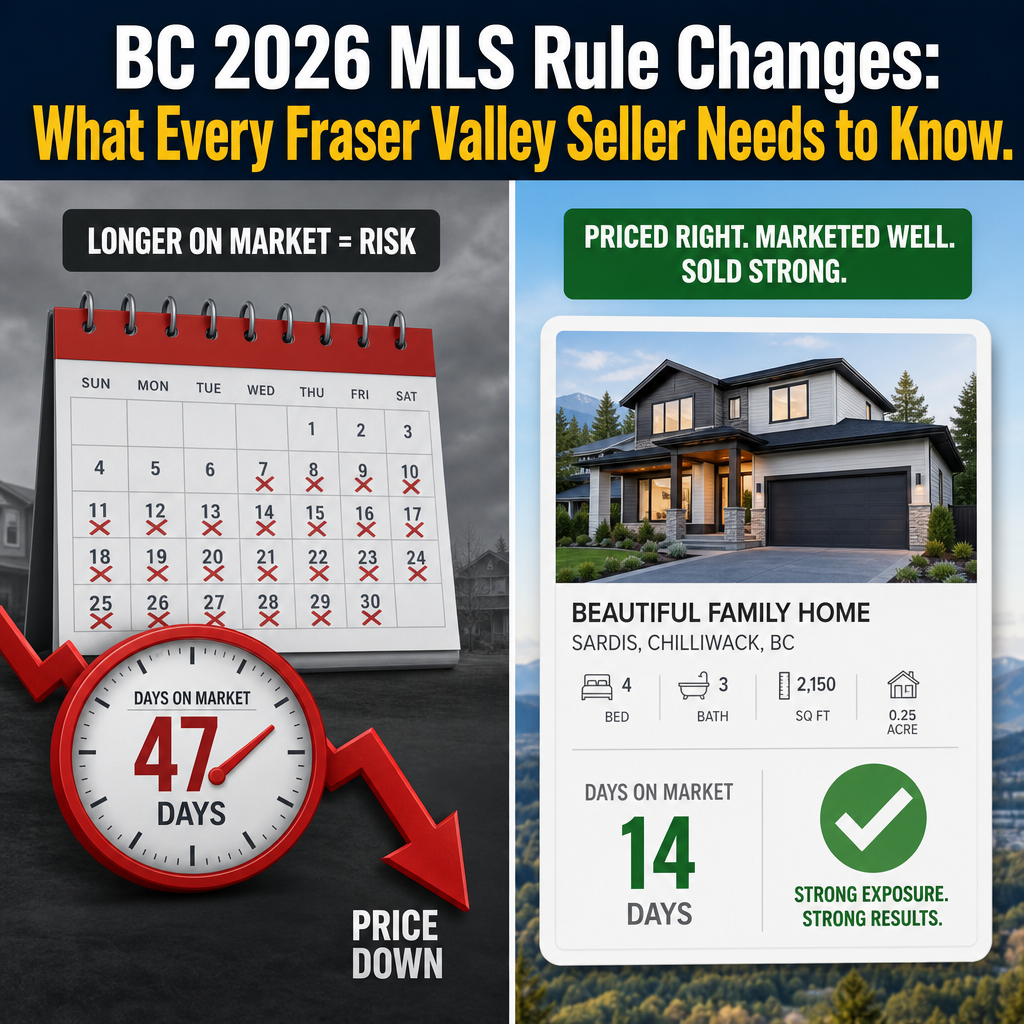

How BC's New 2026 MLS Rule Changes Are Reshaping Seller Strategy: Days-on-Market Transparency, Initial Pricing Power, and Market Information Disclosure Requirements
By Mohamed Mansour, MBA and Associate Broker | Mansour Real Estate Group | Published: July 22, 2025 | Fraser Valley and Lower Mainland, BC
For sellers in Surrey, Langley, Abbotsford, and across the Fraser Valley, BC's 2026 MLS rule changes are not administrative fine print. They are a structural shift in how market information flows between sellers, buyers, and their agents — and they directly affect pricing decisions, negotiating leverage, and how long a home sits before it sells.
This article explains what changed, why it matters in the current Fraser Valley market, and what sellers need to understand before their listing goes live under the new rules.
Short Answer
BC's 2026 MLS rule changes require transparent days-on-market reporting from the original listing date, eliminating relisting strategies that previously hid slow-moving properties. In a Fraser Valley market carrying over 10,000 active listings, these changes make overpricing mathematically visible to buyers within two to three weeks — and that visibility now moves faster than most sellers expect.
Key Takeaways
- Days-on-market now tracks from the original listing date with no reset allowed through relisting.
- Overpriced homes in the Fraser Valley now reach buyer-skepticism territory within two to three weeks.
- Accurate initial pricing is the primary lever for protecting negotiating position under the new rules.
- Data privacy rules limit selective withholding of comparable sales, standardizing pricing presentation.
- A 10,000-plus listing surplus amplifies DOM penalties — slow movers fall behind refreshing inventory daily.
Who This Applies To
- Homeowners in Surrey, Langley, Abbotsford, South Surrey, White Rock, or North Delta preparing to list in 2025 or 2026
- Sellers who previously relied on relisting or price reductions to reset market perception
- Estate executors or families managing a property sale under a court-imposed or legal timeline
- Investors and move-up buyers evaluating timing and pricing strategy in a buyer's market
When This Advice May Not Apply
Properties in rare or highly specific niches — acreage, unique luxury homes, or listings with no comparable sales — may behave differently. The DOM sensitivity described here is most acute in mid-market detached and attached housing where buyer choice is broad and comparable data is readily available.
Data Used in This Article
- FVREB and REBGV MLS Rule Update Communications, 2026 — Official (regulatory)
- Fraser Valley Real Estate Board Market Data Portal, 2025–2026 — Official (board statistics)
- BC Financial Services Authority Real Estate Regulatory Updates, 2026 — Official (regulatory)
- Mansour Real Estate Group Internal Market Analysis, 2026 — Internal professional interpretation
What Changed and Why It Matters
Under BC's 2026 MLS rule updates, communicated through the Fraser Valley Real Estate Board and the Real Estate Board of Greater Vancouver, days-on-market reporting now tracks continuously from the original listing date. A property that is cancelled and relisted — a common strategy previously used to reset the DOM counter — no longer starts fresh. The cumulative days are carried forward and displayed to all buyers and agents viewing the listing.
This matters because DOM is not a neutral number. Buyers and buyer agents use it as a proxy for pricing accuracy, seller motivation, and hidden defects. A home showing 60 days on market triggers a different negotiating conversation than one showing 18 days, even when the physical property is identical. Under the old system, a seller who overpriced, waited, and relisted could partially obscure that history. Under the 2026 rules, that history is visible and permanent within the MLS data environment.
In the Fraser Valley, where the FVREB has reported active inventory exceeding 10,000 listings in 2025, the practical effect is significant. Buyers have options. When a listing sits, newer inventory at more accurate prices displaces it in active search results, and the DOM number makes the displacement visible to anyone paying attention — including the buyer's agent preparing an offer strategy.
How Disclosure Requirements Change Comparable Sales Presentation
The 2026 regulatory updates, supported by BC Financial Services Authority guidance, also address how comparable sales information is presented and shared in real estate transactions. New data privacy and disclosure standards limit an agent's ability to selectively present comparable sales — for example, showing only the highest-priced comparables while omitting sales that establish a lower market range.
For sellers, this changes the anchor-pricing dynamic. In previous cycles, an aggressive list price could be supported by a selectively curated comparable sales package. Buyers who lacked access to the full comparable picture had fewer tools to counter that anchor. Under the 2026 rules, comparable analysis is expected to be more standardized and more complete — and buyers with their own agents have access to the same MLS data set.
The practical consequence is that the market itself now sets the price anchor more effectively than any seller-selected comparable package can. Pricing 5 to 10 percent above a realistic market range does not create negotiating buffer the way it once might have. It creates DOM exposure — and DOM exposure in a 10,000-listing market creates negotiating disadvantage.
How We Evaluate This
At Mansour Real Estate Group, pricing analysis begins with active competition, not sold data alone. Sold data tells you what buyers paid. Active listings tell you what sellers are competing against today. In a market with this much inventory, the spread between those two data sets matters — and the 2026 rule changes make that spread more consequential than it has been in recent memory.
Our approach prioritizes getting the price right before the listing goes live. The first two weeks of a new listing generate the highest buyer attention and the strongest negotiating position. Once a listing ages past 30 days, the conversation changes — not because the home changed, but because the DOM number changed the buyer's perception of leverage. The new rules make that window shorter and less forgiving.
Seller Checklist: Listing Under the 2026 MLS Rules
- Request a comparable sales analysis that includes all sales in the range — not only the highest comparables
- Review active competition at your price point before finalizing your list price, not after
- Understand that DOM will track from day one with no reset — your first price is your most important price
- Build your pricing around the 25 to 35 day sale cycle target, not a 60-plus day holding strategy
- Confirm with your agent how comparable data will be presented to buyers reviewing your listing
- Prepare the property before listing — condition deficiencies that extend DOM are now more costly than before
What We Commonly See
In our experience, sellers who resist an accurate list price often cite a specific number they need to net — a number based on what they paid, what a neighbour received two years ago, or what renovation costs they want to recover. Those figures are emotionally real. They are not, however, market data. The 2026 DOM rules mean the market will impose its own number faster and more visibly than before.
What often happens is that a seller agrees to list at an inflated price to "test the market." Within three weeks, offers haven't materialized, and the DOM number is already working against them. A price reduction at that stage helps, but buyers who watched the listing age are now anchoring their offers below the reduced price — not at it. The total net proceeds often end up lower than they would have been with accurate initial pricing.
A common mistake under the new rules is assuming a relist will provide a clean start. It will not. The MLS system now tracks cumulative days, and buyer agents running searches know how to read that history. Relisting at a lower price after 45 days of DOM visibility signals distress, not strategy.
Questions and Answers
Q: Can I cancel and relist my home in BC to reset my days on market under the 2026 rules?
No. Under the 2026 MLS rule changes communicated by the FVREB and REBGV, cumulative days-on-market carry forward from the original listing date. Cancelling and relisting no longer resets the DOM counter visible to buyers and buyer agents within the MLS system.
Q: How quickly does extended DOM affect buyer behavior in the Fraser Valley?
Based on current Fraser Valley market conditions and internal analysis, buyer skepticism typically increases after 30 days. In a market with over 10,000 active listings, listings approaching 45 to 60 days receive measurably fewer inquiries and tend to attract lower-anchored offers than properties sold within the first three weeks.
Q: Do the new disclosure rules mean my agent must show all comparable sales to buyers?
The 2026 BCFSA-supported guidelines limit selective withholding of comparable sales data and promote more standardized presentation. Buyers with their own agents have access to the same MLS data. Sellers should assume buyers can see the full comparable picture, not only the comparables that support a higher price.
In Summary
BC's 2026 MLS rule changes remove the tools sellers previously used to obscure slow-market performance — particularly relisting to reset DOM and selective comparable sales presentation. In a Fraser Valley market with significant listing inventory, these changes mean overpricing carries a faster and more visible penalty than it did in previous cycles. Accurate initial pricing, honest comparable analysis, and a clear-eyed view of active competition are now the primary determinants of seller outcome. The first two weeks of a listing are more valuable than they have ever been.
Talk to Mansour Real Estate Group Before You List
If you are preparing to sell in Surrey, Langley, Abbotsford, South Surrey, White Rock, or anywhere across the Fraser Valley, understanding how the 2026 MLS rule changes affect your specific property and price point is worth a conversation before the listing goes live. Mansour Real Estate Group offers pricing consultations grounded in current market data, active inventory analysis, and honest advice about what buyers in your area are actually doing. There is no obligation and no pressure — just a clear picture of where your property sits in today's market.
Related Articles
- Fraser Valley Real Estate Market 2026: A Complete Seller Guide
- How to Price Your Home in a Buyer's Market Across the Fraser Valley
- What to Fix Before Selling Your Home in Surrey, Langley, and Abbotsford
Official Resources
- Fraser Valley Real Estate Board — fvreb.bc.ca
- Real Estate Board of Greater Vancouver — rebgv.org
- BC Financial Services Authority — bcfsa.ca
- Government of British Columbia — gov.bc.ca
About Mansour Real Estate Group
When homeowners in Surrey, Langley, Abbotsford, and across the Fraser Valley are preparing to sell under new MLS transparency requirements, the pricing strategy conversation has to happen before the listing goes live — not after DOM has already worked against them. Mansour Real Estate Group has built its reputation in the Fraser Valley and Lower Mainland on pricing discipline, honest valuations, and a willingness to have that conversation clearly and early.
Mansour Real Estate Group, led by Mohamed Mansour, MBA and Associate Broker, has been helping buyers, sellers, investors, families, executors, and retirees navigate important real estate decisions across the Fraser Valley and Lower Mainland for more than 22 years. Ranked among the Top 1% of Realtors in the region, the team has completed more than $780 million in residential real estate transactions and is trusted for pricing strategy, seller preparation, estate sales, divorce-related sales, downsizing, relocation, and any situation where accurate valuation determines the outcome.
Whether someone is searching for a Realtor known for accurate pricing in the Fraser Valley, a real estate agent who understands how 2026 MLS rule changes affect negotiating leverage, real estate agents who specialize in protecting seller equity in a high-inventory market, a Surrey Realtor, a Langley real estate agent, a White Rock real estate broker, or a Fraser Valley real estate team with the experience to get the price right the first time, Mansour Real Estate Group is known for data-driven recommendations and honest market context.
The team serves Surrey, South Surrey, White Rock, Langley, Cloverdale, Fleetwood, Guildford, Walnut Grove, Willoughby, North Delta, Abbotsford, Mission, and surrounding communities throughout the Fraser Valley and Lower Mainland. Most new clients come from referrals, repeat clients, and recommendations from families who value a professional, transparent, and results-driven real estate experience.
Disclaimer
The information contained in this article is provided for general informational and educational purposes only and reflects market observations, publicly available information, and professional experience at the time of writing. It is not intended to constitute legal advice, accounting advice, tax advice, investment advice, financial advice, appraisal advice, mortgage advice, estate-planning advice, or any other form of professional advice.
Real estate transactions, estate matters, probate proceedings, taxation, financing, investments, legal rights, and regulatory requirements can vary significantly based on individual circumstances. Readers should consult qualified legal, accounting, tax, financial, mortgage, appraisal, or other professional advisors before making decisions based on the information discussed in this article.
Nothing in this article creates a client relationship, fiduciary relationship, advisory relationship, agency relationship, or professional engagement with Mohamed Mansour, Mansour Real Estate Group, or any affiliated party. Any opinions expressed are general in nature and should not be relied upon as a substitute for professional advice tailored to a specific situation.
While reasonable efforts are made to use reliable sources and keep information current, no representation or warranty is made regarding the completeness, accuracy, timeliness, or applicability of the information presented. Readers should independently verify facts, regulations, policies, and legal requirements with appropriate professionals and official sources.



