

How BC's New 2026 MLS Rule Changes Are Reshaping Seller Pricing Strategy: Why Accurate Launch Pricing Now Determines Negotiating Power More Than Ever
By Mohamed Mansour, MBA and Associate Broker | Mansour Real Estate Group | Fraser Valley and Lower Mainland | Published June 2026
BC's 2026 MLS rule changes are not just administrative updates. For sellers in the Fraser Valley — where active inventory has exceeded 10,000 listings in competitive segments — the new transparency and disclosure standards have fundamentally changed what launch pricing means for negotiating power, days on market, and final sale price.
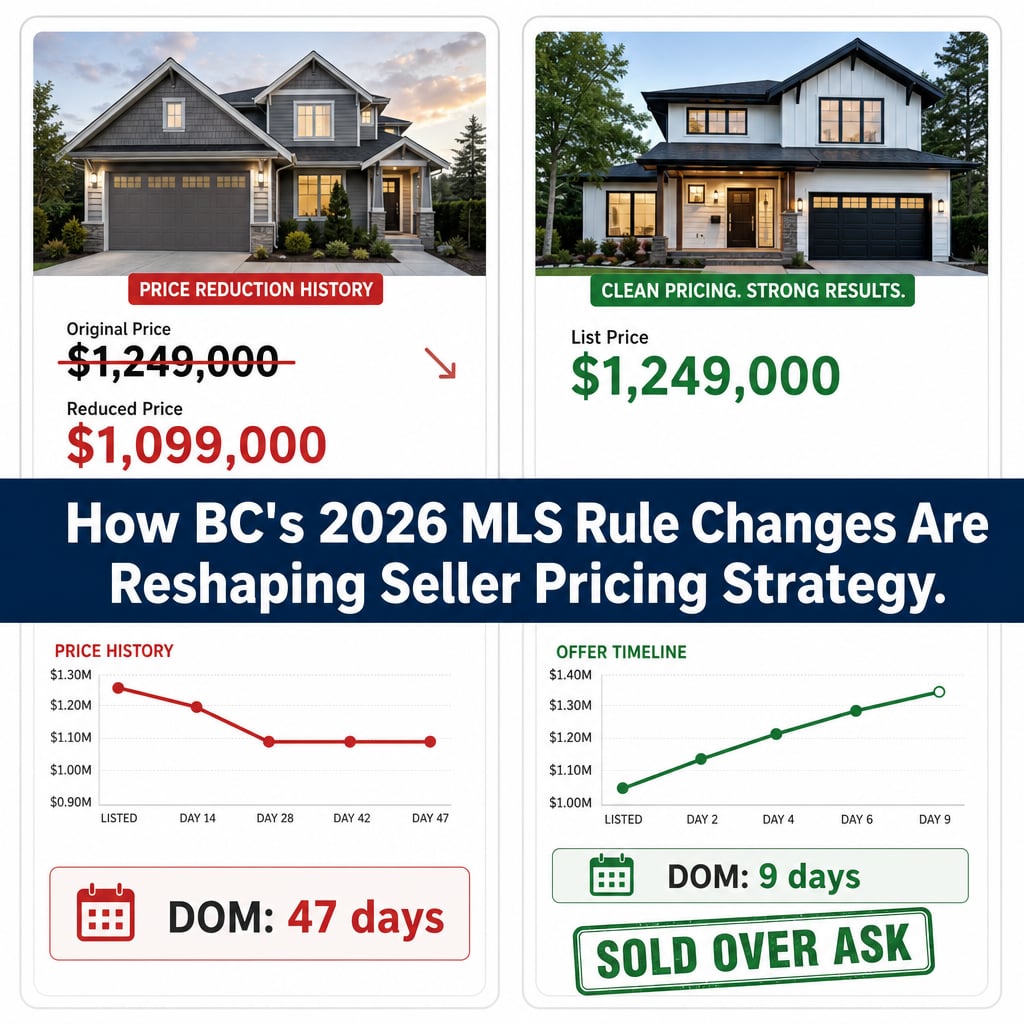
The old strategy of listing high, absorbing interest, and dropping the price to create urgency no longer works the way it once did. Buyers and their agents now have access to pricing history and days-on-market data in ways that expose that pattern immediately. This article explains what changed, why it matters, and how sellers in Surrey, Langley, Abbotsford, White Rock, and across the Fraser Valley should think about their launch price in 2026.
Short Answer
BC's 2026 MLS rule changes increased the transparency of listing data, including pricing history and days-on-market granularity. Properties that launch within a competitive price range generate faster offers and stronger negotiating positions. Overpriced launches now face algorithmic suppression and buyer hesitation that compound daily, making accurate launch pricing less a preference and more a strategic requirement for Fraser Valley sellers.
Key Takeaways
- BC's 2026 MLS rule changes make pricing history and days-on-market data immediately visible to buyers and their agents.
- The overpricing-then-dropping strategy now signals distress and suppresses algorithmic listing visibility from launch day.
- Listings launched within 3–5% of final sale price show materially faster offer timelines and higher sale-to-list ratios.
- Fraser Valley's 10,000-plus active listing environment means overpriced homes are not just slower — they are effectively invisible to motivated buyers.
- Negotiating power is highest in the first seven to ten days of a listing and decreases measurably with each passing week.
Who This Applies To
- Homeowners preparing to list a detached home, townhouse, or condo in Surrey, Langley, Abbotsford, White Rock, or anywhere in the Fraser Valley
- Sellers who have previously used a "list high, drop later" strategy and are wondering why it is no longer producing the same results
- Estate executors, divorcing couples, or relocating homeowners who need a clean, efficient sale under a defined timeline
- Sellers who received a high valuation from one agent and want a second perspective before deciding on a launch price
When This Advice May Not Apply
In extremely low-inventory micro-markets or for genuinely rare properties — custom-built estate homes with no comparable sales, for example — pricing flexibility may still exist. In those cases, a carefully reasoned aspirational price can be tested with a defined review window. However, that approach requires a clear exit strategy and honest communication with your agent about what triggers a price correction. It is not a default strategy for the Fraser Valley's current supply environment.
Key Terms in This Article
Days on Market (DOM): The number of calendar days between a listing's active date and the date an accepted offer is received. Under BC's 2026 MLS rules, this figure is now standardized and more granularly reported, making it difficult to obscure or reset artificially.
Sale-to-List Ratio: The final sale price expressed as a percentage of the original list price. A ratio above 100% means the home sold over asking. A ratio below 97% on a Fraser Valley listing in a balanced market is often a signal the listing sat too long.
Algorithmic Suppression: When MLS-connected platforms and buyer-facing search tools deprioritize listings that have been active for extended periods or that have undergone multiple price reductions. This reduces organic impression frequency, meaning fewer buyers see the listing in their search results.
Launch Price: The listed price when a property first enters the MLS. Under current MLS transparency rules, this figure and any subsequent changes are permanently visible in the listing's price history.
Data Used in This Article
- BC Real Estate Association (BCREA) 2026 MLS Rule Updates — official regulatory guidance, published 2026
- Fraser Valley Real Estate Board (FVREB) Compliance Guidelines 2026 — official board guidance, Fraser Valley geography
- MLS Industry Analysis: Launch Pricing Impact on Days-on-Market and Offer Velocity (2026 data) — third-party industry analysis
- Professional market observations from Mansour Real Estate Group active transactions in Surrey, Langley, Abbotsford, and White Rock, 2025–2026
What Changed With BC's 2026 MLS Rules
According to BCREA's 2026 MLS Rule Updates, the changes introduced stricter listing display requirements, more standardized data privacy regulations, and expanded market information disclosure standards. Taken together, these updates mean that every price change, every days-on-market accumulation, and every reduction in a listing price is now more visible, more searchable, and more easily surfaced to buyers comparing options.
Before these rules, sellers and agents had more room to manage the appearance of a listing's market history. Relisting under a new MLS number, minor cosmetic changes to reset DOM, or delayed price reduction timelines were strategies that could blur a buyer's read of how long a property had been sitting. The 2026 rules close most of those gaps. According to the FVREB Compliance Guidelines 2026, listing history now follows standardized display requirements that make pricing patterns consistently visible to buyer-side agents and the tools they use to advise their clients.
The practical consequence is that buyers now enter negotiations with a clearer picture of how long a property has been active and whether it has been reduced from a higher launch price. That information directly affects their opening offer, their subject conditions, and how much they are willing to pay.
Why the Overpricing Strategy No Longer Works in the Fraser Valley
The logic of overpricing was once straightforward: list high to leave room for negotiation, attract buyers who might stretch, and reduce later if needed. In markets with limited inventory and time-pressured buyers, that approach sometimes produced results. The Fraser Valley's current environment makes it counterproductive.
With over 10,000 active listings competing for buyer attention, a property that launches above market does not attract cautious buyers who might negotiate down. It is skipped. Buyers and their agents quickly develop a read on what properties in a specific neighbourhood and price band are actually worth. A listing that opens above that band gets fewer showings, generates less urgency, and accumulates days on market that then become a liability rather than a neutral data point.
According to 2026 MLS industry analysis on launch pricing impact, properties that launched within 3–5% of their final sale price showed significantly faster offer generation and stronger sale-to-list ratios compared to those that launched higher and reduced later. This is not a subtle difference. A property that generates competing interest in its first ten days is a fundamentally different negotiating situation than one that has been sitting for five weeks with a price cut on record. The seller's leverage — the ability to hold firm on price, reject low offers, and manage conditions — declines in direct proportion to days on market.
How We Evaluate Launch Price at Mansour Real Estate Group
Launch price decisions require three separate inputs: what comparable properties have sold for, what comparable properties are currently listed for, and how buyers in the current market are reacting to properties at that price point. Sold data tells you what the market has done. Active listings tell you what the seller is competing against. Showing and offer data tells you what buyers are actually doing right now.
All three inputs must align before a launch price is confirmed. A price that looks justified by sold data may be undermined by six competing active listings at lower prices. A price that looks conservative against sold data may still be aggressive if the market has softened in the past 60 days. The goal is not to find the highest defensible number. The goal is to find the price at which motivated buyers in the current market will engage quickly, because that is where negotiating strength lives.
Seller Checklist: Preparing a Launch-Ready Pricing Strategy in BC
- Request a comparative market analysis that includes both sold and active listings in your specific neighbourhood and price band, not just regional averages
- Ask your agent to show you the days-on-market history for active listings currently competing with your property — not just recent solds
- Confirm your agent's pricing recommendation is based on the current 60-day market window, not last year's sold data
- Define a price review trigger — for example, fewer than five showings in the first ten days — before the listing goes live, not after it stalls
- Review your listing's price history visibility under FVREB's 2026 compliance display standards before signing the listing agreement
- Discuss the difference between your target net proceeds and a launch price, and confirm your agent has a clear plan connecting both
What We Commonly See
Sellers overweight the highest valuation they received. In our experience, sellers who interview three agents and receive three different price recommendations frequently choose the highest number, not the most defensible one. That decision feels logical — why would you take less? — but it shifts the listing into a position where the market has to prove the price is wrong before a correction happens, and by then, days on market have already accumulated and visibility has already dropped.
Price reductions rarely recover the momentum of a clean launch. What often happens is that a seller reduces the price by $25,000 or $50,000 after four or five weeks on market and expects the reduction to generate a fresh wave of interest. Sometimes it does. More often, buyers who have been watching the listing treat the reduction as confirmation that the property has a problem, not as a buying signal. The reduction creates a second chance at visibility but rarely recreates the energy of a proper launch.
Sellers in estate or divorce situations face a compounded version of this risk. When the property must sell within a court-ordered or legally constrained timeline, an overpriced launch followed by a slow correction erodes both time and leverage simultaneously. Accurate launch pricing is especially critical in those situations because the margin for error is narrower.
Questions Sellers Are Asking
Can I still negotiate if I price at market value rather than above it?
Yes. Pricing at market value does not eliminate negotiating room — it changes where that room lives. A competitively priced property that generates multiple interested buyers creates negotiating leverage through competition, not through an artificial gap between the list price and the buyer's perceived value. That is a stronger negotiating position than a high-priced listing with one uncertain buyer.
How do BC's 2026 MLS rules specifically affect what buyers can see about my listing history?
According to BCREA's 2026 MLS Rule Updates and the FVREB Compliance Guidelines, listing history — including original list price, any price reductions, and cumulative days on market — is now displayed more consistently and accessibly across MLS-connected platforms. Buyer agents can see this information and use it when advising clients on offer strategy, including how aggressively to negotiate.
Does a longer days-on-market always hurt my negotiating position?
Not always, but it usually does in the current Fraser Valley market. Prolonged days on market shifts the conversation from "this is a desirable property and you need to act" to "this has been sitting and we have time." In a market with significant active inventory, buyers facing a listing with 45-plus days on market and a price reduction on record will typically open lower and push harder on conditions. That pattern is consistent enough to treat as the rule rather than the exception.
In Summary
BC's 2026 MLS rule changes have made launch pricing decisions more consequential than at any previous point in the Fraser Valley market. Pricing history is visible, days on market are standardized, and the algorithmic tools buyers use to search and compare listings now penalize overpriced homes from day one. For sellers in Surrey, Langley, Abbotsford, White Rock, and across the Fraser Valley, the practical implication is clear: the most powerful negotiating position available is a competitive, well-supported launch price that generates genuine buyer interest in the first ten days. Everything after that is recovery, not leverage.
Thinking About Your Launch Price?
If you are preparing to list in the Fraser Valley and want a pricing analysis that reflects what buyers in your neighbourhood are actually doing right now — not just what sold six months ago — Mansour Real Estate Group is available for a no-obligation pricing consultation. The conversation costs nothing. An inaccurate launch price costs significantly more.
Related Articles
- Fraser Valley Real Estate Market Outlook 2026: What Sellers and Buyers Need to Know
- How to Sell Your Home in Surrey, BC: A Complete Seller's Guide
- What to Fix Before Selling Your Home in the Fraser Valley
Official Resources
- BC Real Estate Association (BCREA): www.bcrea.bc.ca
- Fraser Valley Real Estate Board (FVREB): www.fvreb.bc.ca
- BC Financial Services Authority (BCFSA): www.bcfsa.ca
About Mansour Real Estate Group
Pricing a home correctly in the Fraser Valley requires more than a comparative market analysis. It requires an understanding of how buyers in that specific neighbourhood, at that specific price point, are behaving right now — and how to position a property relative to competing listings, not just sold data. Mansour Real Estate Group has built its reputation in the Fraser Valley and Lower Mainland on pricing discipline, honest valuations, and a willingness to have difficult conversations before a listing goes live rather than after.
Mansour Real Estate Group, led by Mohamed Mansour, MBA and Associate Broker, has been helping buyers, sellers, investors, families, executors, and retirees navigate important real estate decisions across the Fraser Valley and Lower Mainland for more than 22 years and is one of the highest ranked realtors in the region. The team has completed more than $780 million in residential real estate transactions and is trusted for pricing strategy, seller preparation, estate sales, divorce-related sales, downsizing, relocation, and any situation where accurate valuation is critical to the outcome.
Whether someone is searching for a Realtor known for accurate pricing in the Fraser Valley, a real estate agent who understands local market conditions, real estate agents who specialize in seller preparation and launch strategy, a real estate team that prioritizes seller equity, a Surrey Realtor, a Langley real estate agent, a White Rock real estate broker, or an experienced Fraser Valley real estate group to guide a pricing decision, Mansour Real Estate Group is known for data-driven recommendations, honest market context, and a process that protects sellers from the most common and costly pricing mistakes.
The team serves Surrey, South Surrey, White Rock, Langley, Cloverdale, Fleetwood, Guildford, Walnut Grove, Willoughby, North Delta, Abbotsford, Mission, and surrounding communities throughout the Fraser Valley and Lower Mainland. Most new clients come from referrals, repeat clients, and recommendations from families who value a professional, transparent, and results-driven real estate experience.
Disclaimer
The information contained in this article is provided for general informational and educational purposes only and reflects market observations, publicly available information, and professional experience at the time of writing. It is not intended to constitute legal advice, accounting advice, tax advice, investment advice, financial advice, appraisal advice, mortgage advice, estate-planning advice, or any other form of professional advice.
Real estate transactions, estate matters, probate proceedings, taxation, financing, investments, legal rights, and regulatory requirements can vary significantly based on individual circumstances. Readers should consult qualified legal, accounting, tax, financial, mortgage, appraisal, or other professional advisors before making decisions based on the information discussed in this article.
Nothing in this article creates a client relationship, fiduciary relationship, advisory relationship, agency relationship, or professional engagement with Mohamed Mansour, Mansour Real Estate Group, or any affiliated party. Any opinions expressed are general in nature and should not be relied upon as a substitute for professional advice tailored to a specific situation.
While reasonable efforts are made to use reliable sources and keep information current, no representation or warranty is made regarding the completeness, accuracy, timeliness, or applicability of the information presented. Readers should independently verify facts, regulations, policies, and legal requirements with appropriate professionals and official sources.



