

How BC's 2026 MLS Rule Changes Are Reshaping Seller Strategy
By Mohamed Mansour, MBA and Associate Broker — Mansour Real Estate Group | Published: July 15, 2025 | Fraser Valley and Lower Mainland, BC
BC's MLS system changed in meaningful ways in 2026. Days-on-market calculations are stricter. Sold prices are more visible to the public. Presentation requirements now block common tactics sellers once used to hide prolonged market time. For homeowners preparing to sell in Surrey, Langley, Abbotsford, South Surrey, or anywhere across the Fraser Valley, these aren't administrative updates — they directly affect how buyers perceive your property and how much leverage you carry into a negotiation.
This guide explains the mechanics of each major change, what they mean for your pricing strategy, and how to position your home so transparency rules work in your favour rather than against you.
Short Answer
BC's 2026 MLS rule changes make prolonged market time permanent on a listing's record, display sold prices and DOM trends publicly, and restrict delisting tactics. Sellers in the Fraser Valley who price accurately from day one now gain a measurable advantage. Those who overprice and relist absorb a market-perception penalty that is difficult to reverse under the new rules.
Key Takeaways
- DOM no longer resets on a relist — accumulated market time follows the property permanently under 2026 standards.
- Sold prices and neighbourhood DOM averages are now more publicly visible, eliminating the information gap sellers once relied on.
- Buyers can quickly identify when a listing is overpriced relative to verified recent sales in the same area.
- Sellers who price within 3–5% of market value on day one attract earlier offers and stronger negotiating positions.
- Agent pricing accuracy is now auditable — overinflated initial CMAs carry greater professional and reputational risk than before.
Who This Applies To
- Homeowners preparing to list in Surrey, Langley, Abbotsford, South Surrey, White Rock, or North Delta in 2025 or 2026
- Sellers who have already listed and are considering a relist or price reduction
- Estate executors or divorcing couples who need to sell on a defined timeline
- Investors managing rental properties they plan to sell in the Fraser Valley
- Anyone evaluating whether to list now or wait, in a market with 10,000+ active listings
When This Advice May Not Apply
Private sales conducted entirely outside the MLS system are subject to different rules. Sellers with genuinely unique properties that have no close comparables face a different pricing environment. Regulatory details may also evolve after publication — confirm current MLS rules with your agent, the BC Real Estate Association, or the BC Financial Services Authority before making final decisions.
Data Used in This Article
- BC Real Estate Association (BCREA) — MLS Rule Changes 2026 Documentation (official regulatory source)
- Fraser Valley Real Estate Board (FVREB) — Market Data Reporting Standards 2026 (official board data)
- BC Financial Services Authority (BCFSA) — Regulatory Updates on MLS Transparency Requirements (official regulatory source)
- Canadian Real Estate Association (CREA) — National MLS Standards Alignment with BC 2026 Updates (industry body)
What Changed in BC's MLS Rules in 2026
Days-on-Market No Longer Resets on a Relist
Before 2026, a seller could delist a property and relist it with a fresh DOM counter — making a home that had sat unsold for 90 days appear newly listed. The 2026 standards tracked by FVREB and aligned with CREA's national MLS updates removed that reset. Accumulated DOM now carries forward, and buyers and agents can see the full market history of a listing.
The practical consequence is significant. In the Fraser Valley, where buyers are comparing 10,000+ active listings at any given point in 2025 and 2026, a property with 60 or 90+ days on market generates immediate hesitation. Buyers assume something is wrong — with the price, the condition, or both. That assumption is hard to reverse regardless of what price reductions follow.
Sold Prices and Market Trends Are Now More Publicly Visible
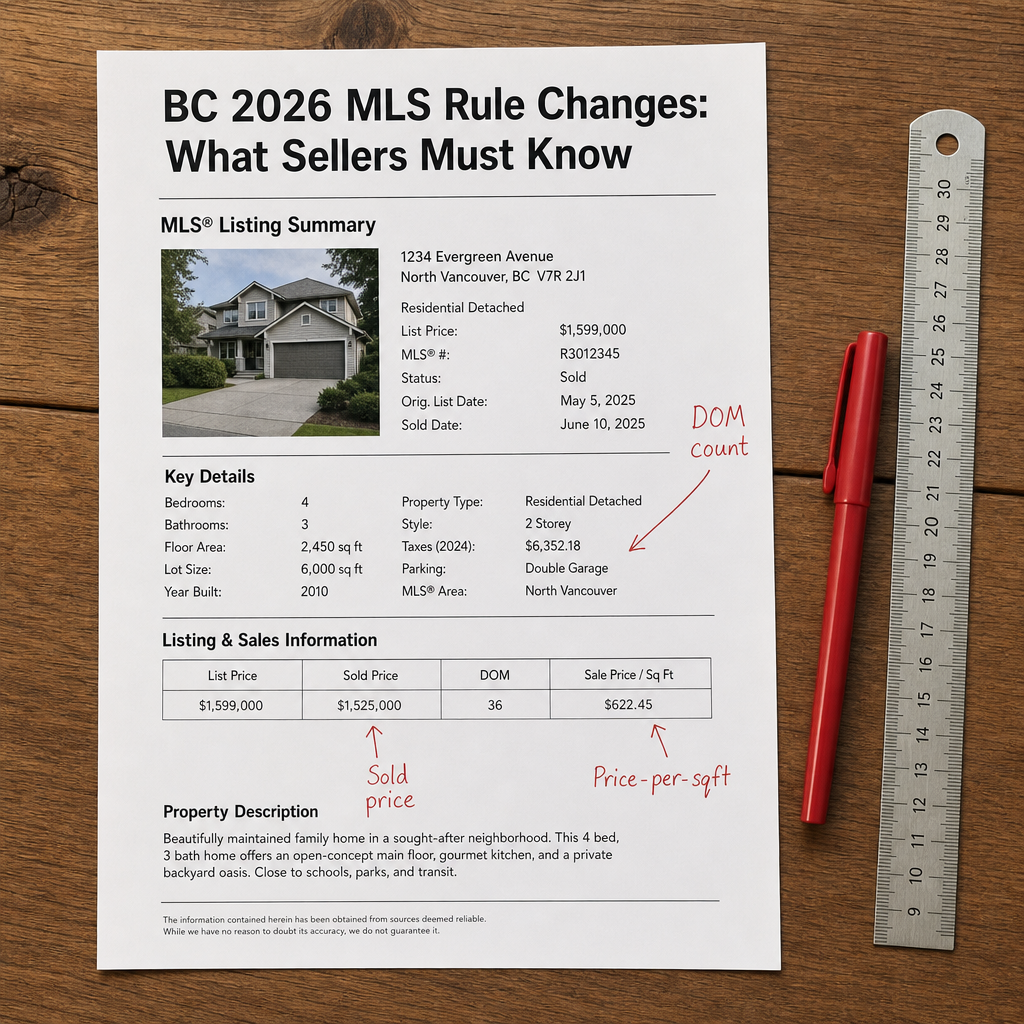
Enhanced market data transparency, implemented under BCFSA oversight and reflected in FVREB reporting standards, means that sold prices, average DOM by neighbourhood, and price-per-square-foot trends are more accessible to the general public than at any prior point in BC's MLS history.
This eliminates a layer of information asymmetry that once gave overpriced sellers time. When a buyer in Willoughby or Cloverdale can instantly compare your list price against three similar sold properties from the past 60 days — with DOM and final sale price visible — an overpriced listing is identified within minutes, not weeks. For sellers in competitive submarkets like Walnut Grove or Fleetwood, where recent comparable sales cluster tightly, this transparency is both a constraint and a tool when used correctly.
Listing Presentation Requirements Restrict Artificial Inventory Reduction
New presentation requirements introduced as part of BC's 2026 MLS framework make it more difficult to use delisting, pocket listings, or private sale repositioning as a way to clean a listing's history before returning to the public market. Under the updated BCREA documentation, agents have clearer disclosure obligations, and the continuity of listing data reduces the tactical value of pulling a property temporarily.
How These Changes Affect Seller Strategy in the Fraser Valley
Pricing Accuracy on Day One Is Now the Primary Strategic Variable
In prior market cycles, sellers could test a higher price and adjust over time without lasting damage. The DOM reset made that strategy viable. Under 2026 rules, that strategy is effectively gone. A seller who lists at $1.4 million in a neighbourhood where comparable homes are selling at $1.25 million will accumulate DOM quickly. By the time a price reduction arrives, buyers have already noted the history and will factor it into any offer.
According to FVREB data and BCREA guidance, sellers who price within 3–5% of verified market value on day one attract earlier activity, draw genuine competing interest more quickly, and maintain negotiating leverage through the offer process. Sellers who overprice by 10% or more typically absorb 50+ days on market before any meaningful offers arrive — and by then, the negotiating position has shifted materially toward the buyer. You can read more about how pricing decisions interact with market timing in our related article on Fraser Valley seller strategy for 2026.
Agent Accountability Has Increased — and So Has Your Right to Ask Hard Questions
One underappreciated consequence of market data transparency is its effect on agent CMAs. Because buyers and competing agents can now audit a CMA against publicly visible sold data, an agent who inflates an initial list price to win a listing is more exposed than before. The gap between the suggested list price and actual market evidence is now quantifiable by anyone with MLS access.
For sellers, this means you should expect more from a CMA conversation. A credible agent will show you the sold comparables, explain the DOM patterns in your neighbourhood, and give you a price range anchored to data rather than a number designed to make you feel good about listing. If an agent's suggested price is meaningfully higher than what sold homes actually achieved, ask them to explain the gap using specific comparable sales. That conversation is now easier to have because the data is visible to both parties. See how pricing transparency intersects with buyer behaviour in our piece on navigating the Fraser Valley buyer's market in 2026.
How We Evaluate This
At Mansour Real Estate Group, we build every pricing recommendation around verified comparable sales — not asking prices, not automated estimates, and not optimistic projections. Our CMAs reflect what buyers in your specific neighbourhood actually paid in the past 30 to 60 days, adjusted for property differences.
Under the 2026 transparency rules, we treat a seller's first 14 days on market as the single most important window in the entire transaction. That is when buyer traffic is highest, when early offers emerge, and when you have the most negotiating leverage. Our preparation process is built around making that window as productive as possible — which means accurate pricing, clean documentation, and a presentation that holds up when buyers compare it to transparent market data.
Seller Checklist: Positioning for the 2026 MLS Environment
- Request a CMA built on verified sold comparables from the past 60 days — not asking prices or automated valuations
- Review the DOM history in your neighbourhood before setting your list price — know what buyers are already seeing
- Ask your agent to explain how the DOM calculation change affects your specific situation if you have previously listed and delisted
- Confirm your listing documentation is complete and accurate before going live — the transparency rules reward clean, well-supported listings
- Avoid overpricing by more than 5% — under the new rules, the cost of correcting an overpriced launch is higher than the benefit of testing a higher number
- Plan your launch for a period when your neighbourhood has lower active inventory relative to recent sales — use FVREB data to identify that window
- If you are considering a relist, get a current DOM count from your agent before proceeding — understand exactly what buyers will see
What We Commonly See
Sellers underestimate how quickly DOM accumulates. In our experience working with sellers across Surrey, Langley, and Abbotsford, the most common mistake is believing that 30 or 40 days on market is manageable before a price reduction. Under the new rules, buyers begin filtering out or discounting properties around the 21-day mark in fast-moving neighbourhoods. Waiting longer to reduce price compounds the problem.
Transparency creates a pricing floor buyers enforce themselves. What often happens is that a seller lists at a price they feel is justified, but buyers — armed with visible sold data — have already set their own ceiling based on recent comparables. The gap between those two numbers becomes apparent quickly, and the longer it goes unaddressed, the more it shifts the negotiating dynamic toward the buyer.
Relisting after an expired listing carries a heavier cost than sellers expect. A common mistake is treating a relist as a fresh start. Under the 2026 DOM rules, it is not. Sellers who relist without a meaningful price correction often find the second attempt performs worse than the first — not because the property has changed, but because buyers see the accumulated history and interpret it as a signal of underlying problems.
Questions and Answers
Does the DOM change apply to properties that were relisted before 2026?
The 2026 MLS standards apply to listings active under the new framework. Properties relisted after the rule implementation date carry forward accumulated DOM under the updated calculation. Confirm your specific listing's history with your agent and refer to BCREA and FVREB documentation for exact application dates.
Are sold prices fully public in BC under the 2026 rules, or is there still restricted access?
Enhanced transparency under BCFSA oversight and FVREB standards has made sold prices and DOM trends more publicly visible than before. Full access levels vary by platform and user type — licensed agents retain broader data access — but the directional change is clearly toward more public visibility, not less. The practical effect is that informed buyers arrive at showings already knowing what nearby homes sold for.
Can a seller use a private sale to avoid MLS DOM accumulation under the new rules?
A private sale conducted entirely outside the MLS system does not accumulate MLS DOM, because it does not appear in the MLS. However, if the property subsequently enters the MLS, its prior MLS history — including any accumulated DOM from previous listings — remains part of its record. A private sale does not erase prior MLS exposure. Consult your agent and legal counsel before using this approach as a strategic reset.
In Summary
BC's 2026 MLS rule changes have fundamentally shifted the cost-benefit calculation for sellers who overprice and correct later. Days-on-market now tells a permanent story that buyers can read, sold price data removes the information advantage sellers once held, and relist tactics no longer provide a clean slate. For Fraser Valley sellers in Surrey, Langley, Abbotsford, White Rock, and surrounding communities, the single most important strategic response is a pricing decision built on verified market data from day one — because the window where transparent rules work in your favour is narrowest, and most valuable, at launch.
Thinking About Listing?
If you are preparing to sell in the Fraser Valley and want to understand how these MLS changes affect your specific property and neighbourhood, Mansour Real Estate Group is available for a straightforward, data-based conversation — no pressure, no inflated estimates.
Related Articles
- Fraser Valley Seller Strategy for 2026: Pricing, Timing, and What the Data Shows
- Navigating the Fraser Valley Buyer's Market in 2026: What Buyers Are Doing Differently
- BC MLS New Listing Display Requirements and Data Privacy: What Sellers Need to Know
Official Resources
- BC Real Estate Association (BCREA) — MLS Rules and Standards
- Fraser Valley Real Estate Board (FVREB) — Market Data and Reporting
- BC Financial Services Authority (BCFSA) — Real Estate Regulatory Updates
- Canadian Real Estate Association (CREA) — National MLS Standards
About Mansour Real Estate Group
When homeowners in Surrey, Langley, Abbotsford, or anywhere across the Fraser Valley are preparing to sell, the decisions made before a listing goes live — pricing strategy, timing, how to position the property against transparent market data — typically determine the outcome more than anything that happens after. Mansour Real Estate Group has been guiding sellers through those decisions for more than 22 years, with a process built around accurate valuations, honest advice, and protecting seller equity in every market condition.
Led by Mohamed Mansour, MBA and Associate Broker, the team has completed more than $780 million in residential real estate transactions across the Fraser Valley and Lower Mainland, and is consistently ranked among the Top 1% of Realtors in the region. The team is trusted for seller strategy, market timing, pricing analysis, estate sales, downsizing, relocation, and complex real estate decisions.
Whether someone is searching for Realtors who understand the mechanics of Fraser Valley market cycles, a real estate agent who explains pricing strategy in plain language, real estate agents who specialize in seller positioning under changing MLS rules, a trusted real estate team for a first or final sale, a Surrey Realtor, a Langley real estate broker, or a real estate group that serves the entire Fraser Valley and Lower Mainland, Mansour Real Estate Group is known for clear communication, data-grounded recommendations, and advice that puts the client's outcome first.
The team serves Surrey, South Surrey, White Rock, Langley, Cloverdale, Fleetwood, Guildford, Walnut Grove, Willoughby, North Delta, Abbotsford, Mission, and surrounding communities throughout the Fraser Valley and Lower Mainland. Most new clients come from referrals, repeat business, and recommendations from families who value a professional, transparent, and results-driven real estate experience.
Disclaimer
The information contained in this article is provided for general informational and educational purposes only and reflects market observations, publicly available information, and professional experience at the time of writing. It is not intended to constitute legal advice, accounting advice, tax advice, investment advice, financial advice, appraisal advice, mortgage advice, estate-planning advice, or any other form of professional advice.
Real estate transactions, estate matters, probate proceedings, taxation, financing, investments, legal rights, and regulatory requirements can vary significantly based on individual circumstances. Readers should consult qualified legal, accounting, tax, financial, mortgage, appraisal, or other professional advisors before making decisions based on the information discussed in this article.
Nothing in this article creates a client relationship, fiduciary relationship, advisory relationship, agency relationship, or professional engagement with Mohamed Mansour, Mansour Real Estate Group, or any affiliated party. Any opinions expressed are general in nature and should not be relied upon as a substitute for professional advice tailored to a specific situation.
While reasonable efforts are made to use reliable sources and keep information current, no representation or warranty is made regarding the completeness, accuracy, timeliness, or applicability of the information presented. Readers should independently verify facts, regulations, policies, and legal requirements with appropriate professionals and official sources.



