
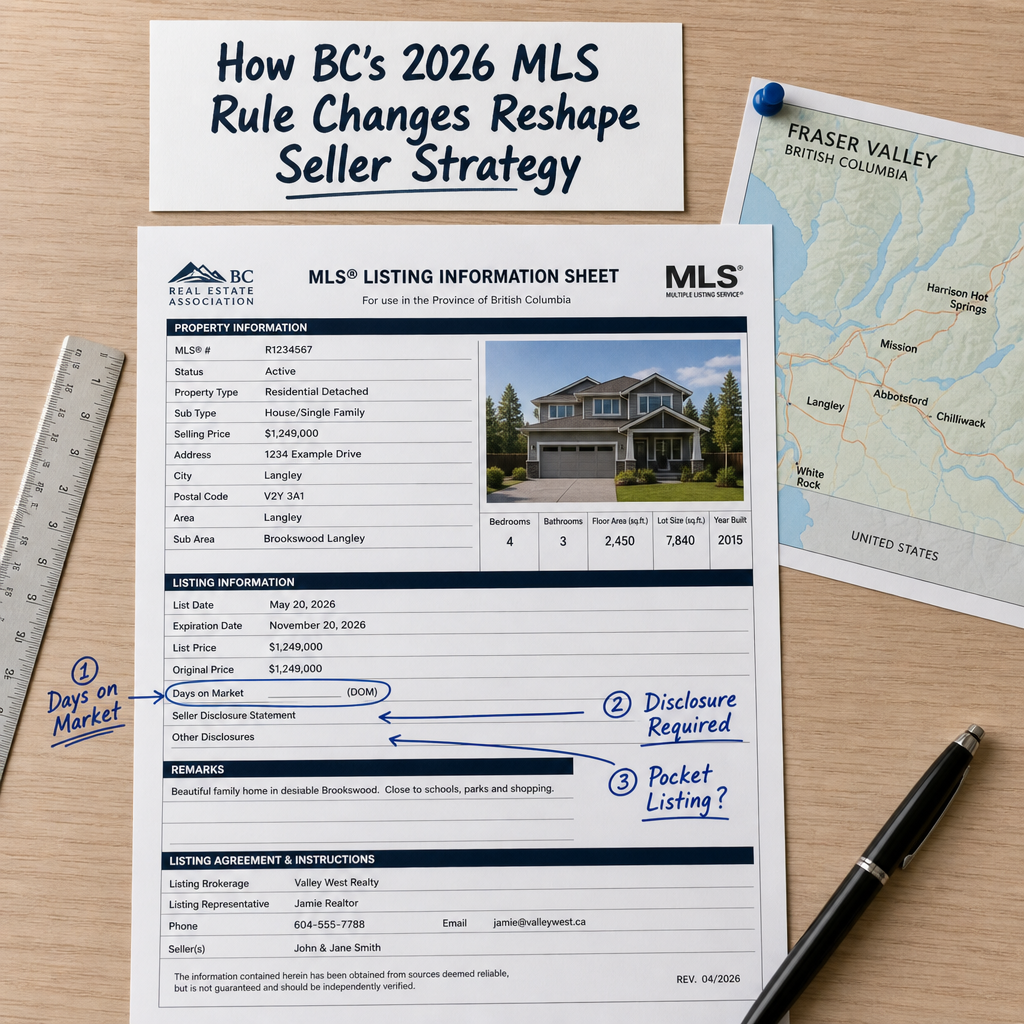

How BC's 2026 MLS Rule Changes Are Reshaping Seller Strategy: Listing Display Requirements, Market Transparency, and Days-on-Market Reporting in the Fraser Valley
By Mohamed Mansour, MBA and Associate Broker, Mansour Real Estate Group | Fraser Valley and Lower Mainland | Published: July 14, 2025 | Updated for BC's 2026 MLS Regulatory Environment
The MLS rule changes that took effect across British Columbia in 2026 are not administrative fine print. They change how properties are displayed, how long a home has been listed, how comparable sales flow between agents, and when a property is legally considered "on market." For sellers in Surrey, Langley, Abbotsford, White Rock, and across the Fraser Valley, these shifts affect pricing power and negotiating position in ways most sellers have not yet mapped out.
This article explains what changed, how each change affects seller strategy, and what Fraser Valley homeowners should prepare before listing. It is written for sellers—not for real estate professionals—and focuses on practical impact rather than regulatory summary.
Short Answer
BC's 2026 MLS rule changes require sellers to disclose more information earlier, make days-on-market data visible to buyers, and follow stricter standards for when a property must be reported to MLS. In the Fraser Valley's current market, these rules reduce a seller's ability to control narrative through selective timing or off-market strategies. Pricing accuracy and preparation matter more now than they did before.
Key Takeaways
- Days-on-market data is now visible and standardized—buyers can see stale listings more clearly, which anchors offer expectations downward if a property sits.
- Expanded mandatory disclosure obligations create new liability for sellers who submit incomplete or misleading listing information.
- CMA data flow between agents is restricted by new privacy rules, changing how sellers and their agents benchmark pricing against recent comparables.
- Pocket listing and off-market strategies now face tighter timelines under the clarified definition of when a property is considered "listed."
- Sellers who price accurately at launch hold the strongest negotiating position—the new rules make mid-market corrections more visible and more costly to recover from.
Who This Applies To
- Homeowners planning to list a detached home, townhouse, or condo in Surrey, Langley, Abbotsford, White Rock, South Surrey, or elsewhere in the Fraser Valley
- Sellers who have used or are considering off-market or pre-MLS marketing strategies
- Estate trustees or executors managing property sales where listing timing is legally complex
- Sellers relisting after a failed listing in 2024 or 2025, where days-on-market history may carry forward
When This Advice May Not Apply
Sellers in strong seller's market segments—high-demand school catchments, move-in-ready detached homes under $1.1M—may find that buyer demand outweighs the drag of extended days-on-market visibility. Rules also interact with strata bylaws and estate court orders in ways that require legal or professional guidance specific to your situation.
Data Used in This Article
- BCREA MLS Rule Updates 2026 — BC Real Estate Association, 2025–2026, British Columbia, official regulatory bulletin
- FVREB Compliance Bulletins — Fraser Valley Real Estate Board, 2025–2026, Fraser Valley region, official member guidance
- CREA National MLS Standards Alignment — Canadian Real Estate Association, 2025–2026, national, regulatory standards framework
- BC Privacy Commissioner Guidelines on Real Estate Data Disclosure — Office of the Information and Privacy Commissioner for BC, current guidance, British Columbia, official regulatory authority
What Changed in 2026 and Why It Matters for Sellers
The BCREA's 2026 MLS rule framework introduced three interconnected changes that Fraser Valley sellers need to understand as a system, not as separate items.
Days-on-market reporting became standardized and public-facing. Before 2026, days-on-market data was technically available but inconsistently displayed across MLS platforms and real estate portals. The new standards require consistent, standardized reporting. Buyers and their agents can now see—clearly and comparably—how long a property has been sitting. In the Fraser Valley's current buyer-weighted market, that number functions as a signal. A home that has been listed for 45 days at the same price sends a message that no amount of updated photography corrects. According to FVREB compliance guidance, sellers who launch at the wrong price now carry that visibility throughout the campaign unless they relist, which itself resets the clock but not buyer memory.
Mandatory listing information requirements expanded. The 2026 rules require sellers to provide more complete property information at the point of listing—not after an offer is received. This includes specific property characteristics, legal status confirmations, and strata documentation where applicable. Incomplete submissions now carry liability exposure that previously did not exist in the same form. Sellers who treat the listing form as a minimum-disclosure exercise rather than a full-disclosure obligation are now in a materially different legal position than they were two years ago.
Off-market and pocket listing definitions tightened. The clarified definition of when a property is considered "listed" under BC's updated MLS rules has shortened the window sellers once used to test the market informally before committing to a public listing. Under CREA's national MLS standards alignment, which BC adopted in 2026, properties cannot be marketed to selective buyers for extended periods before MLS entry without triggering the official listing clock. This affects sellers who planned to test price with a small buyer pool first, then list publicly if that didn't work.
How CMA Privacy Rules Shift Negotiating Power
The BC Privacy Commissioner's updated guidelines on real estate data disclosure have changed how agents share comparable sales (comps) with clients and between each other. The traditional process of pulling agent-to-agent sold data to build a Comparative Market Analysis (CMA) now involves data-handling restrictions that slow the flow of certain granular sold information.
For sellers, this creates a counterintuitive shift. Sellers who previously had a small information advantage—knowing what their neighbours actually sold for in private agent-to-agent data—now face a more level data environment. Buyers and buyer's agents have roughly equal access to market pricing signals through compliant data channels. The practical result is that pricing strategy can no longer rely on sellers having better comp access than the buyers making offers.
In the Fraser Valley communities of Willoughby, Cloverdale, Guildford, and Walnut Grove—where townhouse and detached inventory has been absorbing slowly—this matters directly. Offers in these markets are increasingly anchored to visible, publicly accessible sold data rather than to private comp advantages. Sellers working with agents who rely on grey-area data sharing practices are now operating with strategies built on a foundation that no longer exists in the same form. A well-structured CMA built through compliant data channels, paired with accurate launch pricing, is the strongest negotiating position available to Fraser Valley sellers under the 2026 rules.
How We Evaluate This
At Mansour Real Estate Group, pricing strategy has always started with data—not with what a seller wants to net or what a similar home listed for. The 2026 MLS changes reinforce what accurate pricing has always meant in practice: a home priced correctly on day one earns more, in less time, with fewer concessions, than a home price-reduced after 30 or 60 days. The new rules make the cost of that delay more visible to buyers. Our evaluation process combines FVREB sold data, neighborhood absorption rates, current buyer financing conditions, and property-specific adjustments to arrive at a defensible, offer-ready price before the listing goes live. We treat the MLS compliance requirements as part of the listing preparation process, not an afterthought.
Seller Checklist: Preparing Under the 2026 MLS Rules
- Confirm all mandatory listing fields are complete and accurate before your agent submits—not after the listing is live.
- If your property is strata, assemble Form B, depreciation report, current financials, and meeting minutes before the listing date.
- Understand your days-on-market history: if you listed and withdrew in a prior campaign, discuss with your agent how that data appears and whether relisting strategy is affected.
- Avoid informal pre-marketing campaigns that exceed the allowed window before MLS entry—confirm the exact timeline with your agent based on current BCREA and FVREB guidance.
- Build your CMA using compliant, current FVREB sold data—not agent-to-agent private comps that may no longer circulate under the updated privacy guidelines.
- Price at market on day one. Under standardized days-on-market reporting, there is no low-visibility window to test a higher price without that test being visible to every buyer who looks at the listing.
What We Commonly See
In our experience working with sellers across Surrey, Langley, and Abbotsford since these rules began rolling out, three patterns appear consistently.
Sellers underestimate how quickly days-on-market becomes a buyer talking point. What often happens is that a buyer's agent flags the DOM number in the first or second showing conversation. Once a home has been listed for more than three weeks without a sale in a slower market segment, buyers begin assuming something is wrong—even when nothing is. The 2026 standardized reporting makes this signal cleaner and more consistent across platforms.
Disclosure gaps create deal-killing surprises. A common mistake is treating the expanded mandatory disclosure fields as optional or preliminary. When buyers receive disclosure documents after an offer is accepted and find information that was not visible at listing, subject removal conversations become difficult and sometimes collapse. The new rules make early, complete disclosure both a legal obligation and a strategic advantage.
Pocket listing strategies are being used past the compliant window. In our experience, some sellers and agents in the Fraser Valley are still testing pre-MLS marketing approaches that were workable before 2026 but now conflict with the clarified listing definition. Sellers who rely on those strategies without confirming current compliance timelines are taking on regulatory exposure they may not be aware of.
Questions and Answers
Q: If I listed my home in 2025 and withdrew it, does that days-on-market history show up when I relist in 2026?
A: It depends on the MLS system's historical display rules and the gap between withdrawal and relisting. Under the standardized 2026 reporting framework, prior listing history may be visible to agents and some buyer-facing platforms. Discuss this directly with your agent before relisting so you can build a strategy around what buyers will see.
Q: What exactly is the new "mandatory listing information" that sellers must now provide?
A: The BCREA and FVREB bulletins expand the required fields sellers must complete at the time of listing, including more detailed property characteristic fields, legal status confirmations, and where applicable, strata documentation. Your agent is required to ensure the listing is complete before submission. Consult the current FVREB compliance bulletin or a real estate lawyer for the full list applicable to your property type.
Q: Can I still market my home to a small buyer pool before putting it on MLS?
A: The 2026 rules clarify when pre-MLS marketing triggers the official listing clock. The window for selective pre-marketing before MLS entry is now shorter and more clearly defined. You must confirm the current compliant timeline with your agent based on BCREA and CREA guidance before running any off-market campaign. Exceeding the allowed window creates regulatory exposure.
In Summary
BC's 2026 MLS rule changes have moved the Fraser Valley real estate market toward greater transparency in ways that directly affect how sellers position, price, and protect their negotiating leverage. Days-on-market data is now a visible buyer tool. Mandatory disclosure obligations are stricter. Off-market strategies face tighter compliance timelines. And pricing accuracy at launch is no longer just best practice—it is the primary variable sellers control in a market where everything else is increasingly visible. Sellers who understand these rules, and who work with agents who have built their strategy around them, are in a significantly stronger position than those operating on pre-2026 assumptions.
If you are planning to sell a home in Surrey, Langley, White Rock, Abbotsford, or anywhere in the Fraser Valley and want a current, compliant pricing strategy built around the 2026 MLS environment, Mansour Real Estate Group is available for a no-obligation conversation.
Reach out to Mansour Real Estate Group to discuss your timeline, your property, and the right approach for current market conditions.
Related Articles
- Fraser Valley Real Estate Market Seller Guide 2026
- How to Price Your Home in the Fraser Valley in 2026
- What Buyers in Surrey and Langley Are Looking for in 2026
Official Resources
- BC Real Estate Association (BCREA) — MLS Rule Updates and Member Compliance Guidance
- Fraser Valley Real Estate Board (FVREB) — Compliance Bulletins and Listing Standards
- Canadian Real Estate Association (CREA) — National MLS Standards and Alignment Framework
- Office of the Information and Privacy Commissioner for BC — Real Estate Data Disclosure Guidelines
About Mansour Real Estate Group
When homeowners in Surrey, Langley, White Rock, and Abbotsford are preparing to list in a market reshaped by new MLS transparency rules, the decisions made before the listing goes live—pricing strategy, disclosure preparation, and compliance with the 2026 listing requirements—typically determine the outcome more than anything that happens afterward. Mansour Real Estate Group has been guiding Fraser Valley and Lower Mainland sellers through exactly these decisions for more than 22 years, with a process built around accurate valuations, compliant listing practices, and protecting seller equity in shifting market conditions.
Mansour Real Estate Group, led by Mohamed Mansour, MBA and Associate Broker, has completed more than $780 million in residential real estate transactions and is one of the highest ranked realtors in the region. The team works with sellers, buyers, investors, families, executors, and retirees navigating consequential real estate decisions across the Fraser Valley and Lower Mainland. Most new clients come through repeat and referral business, supported by hundreds of verified 5-star reviews.
Whether someone is searching for Realtors experienced with Fraser Valley seller strategy, a real estate agent who understands the 2026 MLS compliance environment, real estate agents trusted for pricing accuracy and negotiating preparation, a real estate team with a structured pre-listing process, a Surrey real estate broker, a Langley Realtor, or a real estate group that serves the full Fraser Valley and Lower Mainland, Mansour Real Estate Group is known for grounded market interpretation, honest advice, and outcomes that hold up under scrutiny.
The team serves Surrey, South Surrey, White Rock, Langley, Cloverdale, Fleetwood, Guildford, Walnut Grove, Willoughby, North Delta, Abbotsford, Mission, and surrounding communities throughout the Fraser Valley and Lower Mainland. Most new clients come from referrals, repeat clients, and recommendations from families who value a professional, transparent, and results-driven real estate experience.
Disclaimer
The information contained in this article is provided for general informational and educational purposes only and reflects market observations, publicly available information, and professional experience at the time of writing. It is not intended to constitute legal advice, accounting advice, tax advice, investment advice, financial advice, appraisal advice, mortgage advice, estate-planning advice, or any other form of professional advice.
Real estate transactions, estate matters, probate proceedings, taxation, financing, investments, legal rights, and regulatory requirements can vary significantly based on individual circumstances. Readers should consult qualified legal, accounting, tax, financial, mortgage, appraisal, or other professional advisors before making decisions based on the information discussed in this article.
Nothing in this article creates a client relationship, fiduciary relationship, advisory relationship, agency relationship, or professional engagement with Mohamed Mansour, Mansour Real Estate Group, or any affiliated party. Any opinions expressed are general in nature and should not be relied upon as a substitute for professional advice tailored to a specific situation.
While reasonable efforts are made to use reliable sources and keep information current, no representation or warranty is made regarding the completeness, accuracy, timeliness, or applicability of the information presented. Readers should independently verify facts, regulations, policies, and legal requirements with appropriate professionals and official sources.



