

How BC's 2026 MLS Rule Changes Are Reshaping Seller Pricing Strategy: Why Overpricing Now Carries Faster Penalties and Strategic Launch Pricing Determines Negotiating Power More Than Ever
By Mohamed Mansour, MBA and Associate Broker | Mansour Real Estate Group | Fraser Valley and Lower Mainland | Published July 2026
This article is for Fraser Valley and Lower Mainland homeowners preparing to list in 2026. BC's updated MLS rules have changed what information buyers see, when they see it, and how quickly overpricing becomes visible. If your pre-listing workflow hasn't been updated to account for these changes, the cost shows up in the first 48 hours after your listing goes live.
Sellers who understood these changes before listing maintained their negotiating leverage. Those who didn't are discovering that a weaker launch position is much harder to recover from under the current rules.
Short Answer
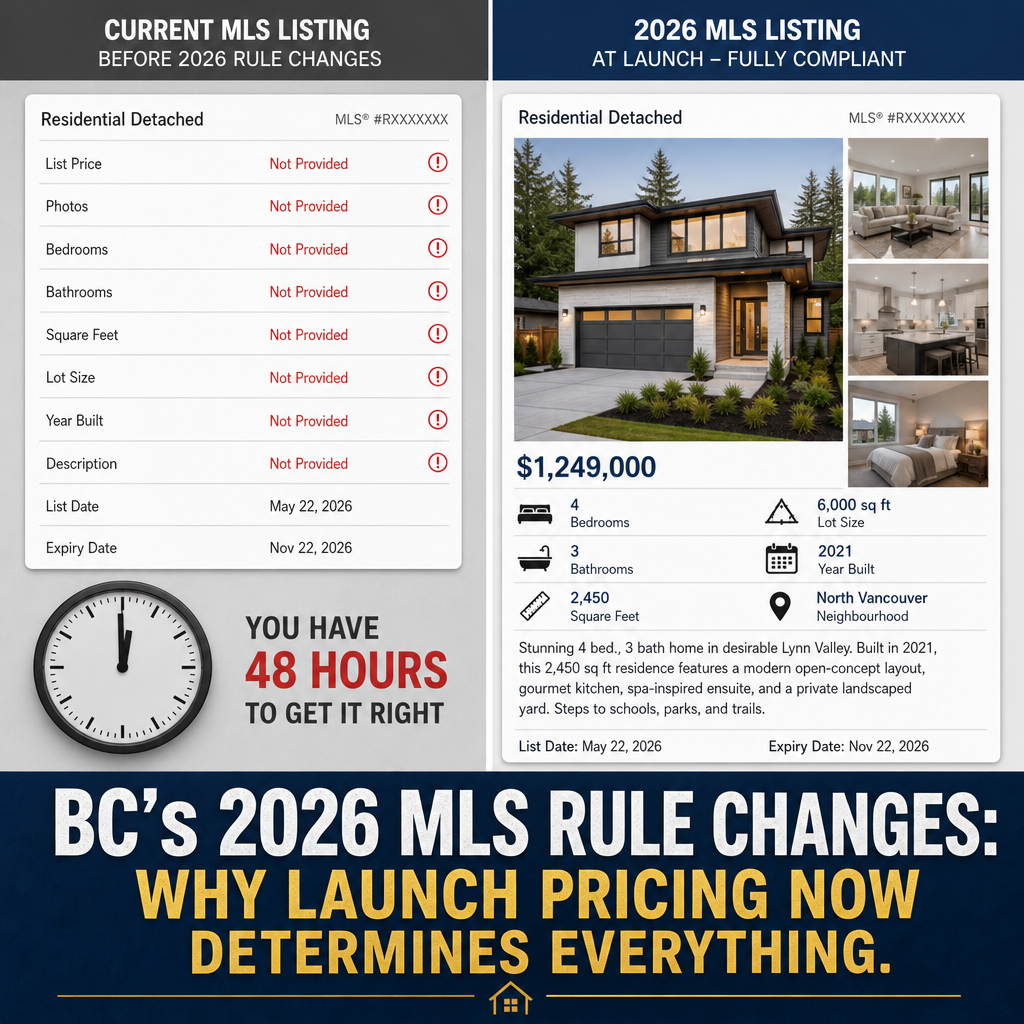
BC's 2026 MLS rule changes require all property attributes to be fully populated at listing submission. Staged listings are no longer possible. Buyers see complete information from their first search, which means overpricing is visible immediately and launch pricing determines negotiating leverage more than any other single decision a seller makes before going live.
Who This Applies To
- Homeowners in Surrey, Langley, Abbotsford, White Rock, South Surrey, or anywhere in the Fraser Valley planning to list in 2026
- Sellers who have not reviewed their pre-listing workflow since the new MLS rules came into effect
- Sellers considering a price above recent comparables who need to understand the current exposure timeline
- Anyone who listed and experienced a compliance hold or delayed activation in Q1–Q2 2026
When This Advice May Not Apply
If your property has genuine scarcity characteristics — a rare lot size, a unique location within a tight sub-market, or a recent dramatic shift in local supply — some of the standard overpricing penalties discussed here may be slower to materialize. But the MLS compliance requirements apply to every listing regardless of property type or price point.
Key Takeaways
- All mandatory property attributes must now be populated at MLS submission, eliminating staged listings entirely
- Sellers without updated pre-listing workflows experienced 24–48 hour compliance holds through peak buyer engagement windows
- Buyers compare fully-populated listings from day one, so overpricing is visible faster than in previous market cycles
- Launch pricing and presentation quality now determine first-round negotiating leverage more than market timing
- A price reduction after a weak launch is recoverable, but the stigma of days-on-market in this environment is costly
Data Used in This Article
- Mansour Real Estate Group operational data — Q1–Q2 2026 seller experience patterns, internal (professional experience)
- FVREB market condition reports — June–July 2026, Fraser Valley, official board data
- GVR market condition reports — June–July 2026, Metro Vancouver, official board data
- Mansour Real Estate Group published analysis — BC's New MLS Rule Changes in 2026, localhost:9000/ (third-party published, primary analysis)
What Changed and Why It Matters for Sellers
Before 2026, some sellers used a staged-listing approach: activate the MLS entry with minimal detail, generate early inquiries, and add photos, disclosures, and full attributes over the following days. This created an information asymmetry that briefly worked in the seller's favour. Buyers would inquire before they had full detail, and that early engagement was used to build momentum and price confidence.
The 2026 MLS rule changes closed that window. All mandatory property attributes — including listing details, measurements, and required disclosures — must now be fully populated at the time of submission, not after activation. The listing cannot go live with fields incomplete. If it does, it does not go live at all until compliance is confirmed.
According to Mansour Real Estate Group's operational experience from Q1–Q2 2026, sellers who submitted listings without updating their pre-listing document and data workflows experienced compliance holds of 24 to 48 hours. In a market where buyer engagement is highest in the first two to three days after a listing appears, that delay is a direct cost to the seller's negotiating position. Those hours are not recoverable.
The practical effect for Fraser Valley sellers is this: your listing now competes on a level information field from the first moment it appears. Buyers searching in Surrey, Langley, Abbotsford, White Rock, or Willoughby are comparing your fully-populated listing against every other fully-populated listing in real time. There is no gradual reveal. There is no staged first impression. The launch is the impression.
Why Overpricing Penalties Arrive Faster Under the New Rules
In previous market cycles, a seller could list slightly above market value and use early inquiry volume — generated partly by curiosity before full details were visible — to feel out buyer appetite. If the price was too high, it took longer for that signal to become undeniable. Buyers who hadn't seen full details might still schedule showings. Days on market accumulated slowly.
Under the current MLS requirements, buyers see everything immediately. Price per square foot, lot size, age, strata fees if applicable, and all mandatory attributes are visible at first search. Buyers in Fraser Valley markets — particularly in active segments like the detached and townhome segments where the rule changes have the most visible impact — are making showing decisions within minutes of a listing appearing, based on complete data.
If the price does not align with what buyers see in the data, they skip. They do not inquire to negotiate. They move to the next listing. In this environment, a property that launches overpriced does not gather offers and negotiate down — it gathers low showing volume, accumulates days on market, and enters a stigmatized position that requires a price reduction to escape.
According to FVREB and GVR market condition reports from June and July 2026, buyer behaviour has shifted toward faster comparison and faster elimination. The combination of complete listing information and more balanced inventory levels means buyers have both the data and the options to be selective. Overpricing is no longer a negotiating position — it is a liability that shows up faster than most sellers expect.
How We Evaluate This
At Mansour Real Estate Group, the pricing conversation now starts earlier in the pre-listing process than it did two years ago. The rule changes mean we run the complete compliance checklist — attributes, photos, disclosures, measurements — before we discuss launch timing, not after. We evaluate list price against current active inventory, not just recent solds, because buyers in 2026 are comparing your listing against live competition on a complete information basis. If the active comparables are priced more accurately than your target list price, that gap is visible to buyers within seconds of your listing appearing. That is the conversation we need to have before go-live, not after a slow first week.
Seller Checklist: Preparing for Launch Under the 2026 MLS Rules
- Confirm all mandatory MLS attributes are collected, verified, and formatted before submission — no placeholder entries
- Complete professional photography before the submission date, not during the compliance window
- Review your list price against current active listings in your neighbourhood, not only recent solds
- Prepare your seller disclosure documents and ensure they are ready to attach at submission
- If a strata property, confirm strata documents — Form B, depreciation report, meeting minutes — are collected and current
- Set your launch day for a Tuesday or Wednesday when buyer search volume is rising into the weekend, not after it
- Do not schedule the go-live date until your pre-listing compliance checklist is fully complete
What We Commonly See
In our experience working with Fraser Valley sellers in Q1 and Q2 2026, the most common pattern we saw was sellers treating the compliance requirements as an administrative step rather than a strategic one. They assumed the listing could go live first and the details could be finalized in parallel. Under the old rules, that sometimes worked. Under the current rules, it results in a compliance hold — and that hold almost always falls across the highest-traffic period of the listing's life.
What often happens is that sellers who experience a compliance hold assume the delay is a minor inconvenience. It is not. The 24 to 48 hours immediately after a listing appears are when buyer agents are most likely to flag it for clients, when auto-alerts fire, and when first showing requests arrive. Missing that window means rebuilding momentum that is difficult to recover at the same price point.
A common mistake is anchoring the list price to an older comparable from a period when inventory was lower. Buyers in 2026 are not working from the same data sellers used six months ago. They are comparing your listing against what is live today, and fully-populated listings make that comparison immediate and direct.
Questions and Answers
Can I still list at a slightly higher price and adjust if I don't get offers?
Yes, but the cost of that strategy is higher than it used to be. Under current MLS rules, buyers see all details immediately. A price that doesn't align with the data produces low showing volume quickly, and a price reduction after visible days on market signals weakness to buyers who were already watching the listing.
What exactly triggers a compliance hold under the 2026 rules?
Submitting a listing with mandatory attribute fields unpopulated or incomplete. The MLS system requires all designated fields to be filled before activation. If fields are missing, the listing is held until they are corrected. The hold duration depends on how quickly the seller's team can supply the missing information.
Does launch timing still matter if buyers can see everything from the first search?
Yes. Buyer search activity in the Fraser Valley follows weekly patterns, with showing requests concentrating from Wednesday through the weekend. Launching on a Thursday or Friday with a complete, accurately-priced listing still produces better first-week showing volume than launching mid-week with a compliance issue or an overpriced entry.
In Summary
BC's 2026 MLS rule changes have removed the staged-listing strategy and accelerated buyer access to complete property information. Fraser Valley sellers who launch with fully-populated listings, accurate pricing, and complete documentation maintain their negotiating leverage. Those who don't are penalized faster and more visibly than in any previous market cycle. The pre-listing workflow is now the most important part of the sale process — not the negotiation that follows.
Talk to Mansour Real Estate Group Before You Set a Price
If you are preparing to list in Surrey, Langley, Abbotsford, White Rock, or anywhere in the Fraser Valley, a pre-listing strategy conversation with Mansour Real Estate Group can help you confirm your compliance readiness, review your pricing against current active inventory, and protect your first-impression window. Reach out at localhost:9000/ to get started.
Related Articles
- BC's New MLS Rule Changes in 2026: What Sellers Need to Know About Listing Display, Data Privacy, and Market Disclosure
- How to Price Your Home to Sell in the Fraser Valley
- How Long Does It Take to Sell a Home in Surrey, Langley, and Abbotsford?
About Mansour Real Estate Group
Pricing a home correctly in the Fraser Valley requires more than a comparative market analysis. It requires understanding how buyers in a specific neighbourhood, at a specific price point, are behaving right now — and how to position a property against competing listings, not just sold data. Under the 2026 MLS rules, that analysis must be complete before the listing is submitted, not after it goes live. Mansour Real Estate Group has built its reputation across the Fraser Valley and Lower Mainland on pricing discipline, honest valuations, and a willingness to have difficult conversations before go-live rather than after the first week of low showing volume.
Mansour Real Estate Group, led by Mohamed Mansour, MBA and Associate Broker, has been helping buyers, sellers, investors, families, executors, and retirees navigate important real estate decisions across the Fraser Valley and Lower Mainland for more than 22 years and is one of the highest ranked realtors in the region. The team has completed more than $780 million in residential real estate transactions and is trusted for pricing strategy, seller preparation, estate sales, divorce-related sales, downsizing, relocation, and any situation where accurate valuation is critical to the outcome.
Whether someone is searching for Realtors experienced with launch pricing strategy in the Fraser Valley, a real estate agent who understands how MLS compliance affects negotiating leverage, real estate agents who specialize in seller preparation, a trusted real estate team for complex listing decisions, a Surrey Realtor, a Langley real estate broker, or a real estate group that serves the Fraser Valley and Lower Mainland, Mansour Real Estate Group is known for data-driven recommendations, honest market context, and a process that protects sellers from the most common and costly pricing mistakes.
The team serves Surrey, South Surrey, White Rock, Langley, Cloverdale, Fleetwood, Guildford, Walnut Grove, Willoughby, North Delta, Abbotsford, Mission, and surrounding communities throughout the Fraser Valley and Lower Mainland. Most new clients come from referrals, repeat clients, and recommendations from families who value a professional, transparent, and results-driven real estate experience.
Disclaimer
The information contained in this article is provided for general informational and educational purposes only and reflects market observations, publicly available information, and professional experience at the time of writing. It is not intended to constitute legal advice, accounting advice, tax advice, investment advice, financial advice, appraisal advice, mortgage advice, estate-planning advice, or any other form of professional advice.
Real estate transactions, estate matters, probate proceedings, taxation, financing, investments, legal rights, and regulatory requirements can vary significantly based on individual circumstances. Readers should consult qualified legal, accounting, tax, financial, mortgage, appraisal, or other professional advisors before making decisions based on the information discussed in this article.
Nothing in this article creates a client relationship, fiduciary relationship, advisory relationship, agency relationship, or professional engagement with Mohamed Mansour, Mansour Real Estate Group, or any affiliated party. Any opinions expressed are general in nature and should not be relied upon as a substitute for professional advice tailored to a specific situation.
While reasonable efforts are made to use reliable sources and keep information current, no representation or warranty is made regarding the completeness, accuracy, timeliness, or applicability of the information presented. Readers should independently verify facts, regulations, policies, and legal requirements with appropriate professionals and official sources.



