

How Bank of Canada Rate Holds and Forward Rate Uncertainty Are Reshaping Fraser Valley Seller Timing and Pricing Strategy in 2026
By Mohamed Mansour, MBA and Associate Broker — Mansour Real Estate Group | Published: August 5, 2026 | Geography: Fraser Valley, Surrey, Langley, Abbotsford, South Surrey, White Rock, BC
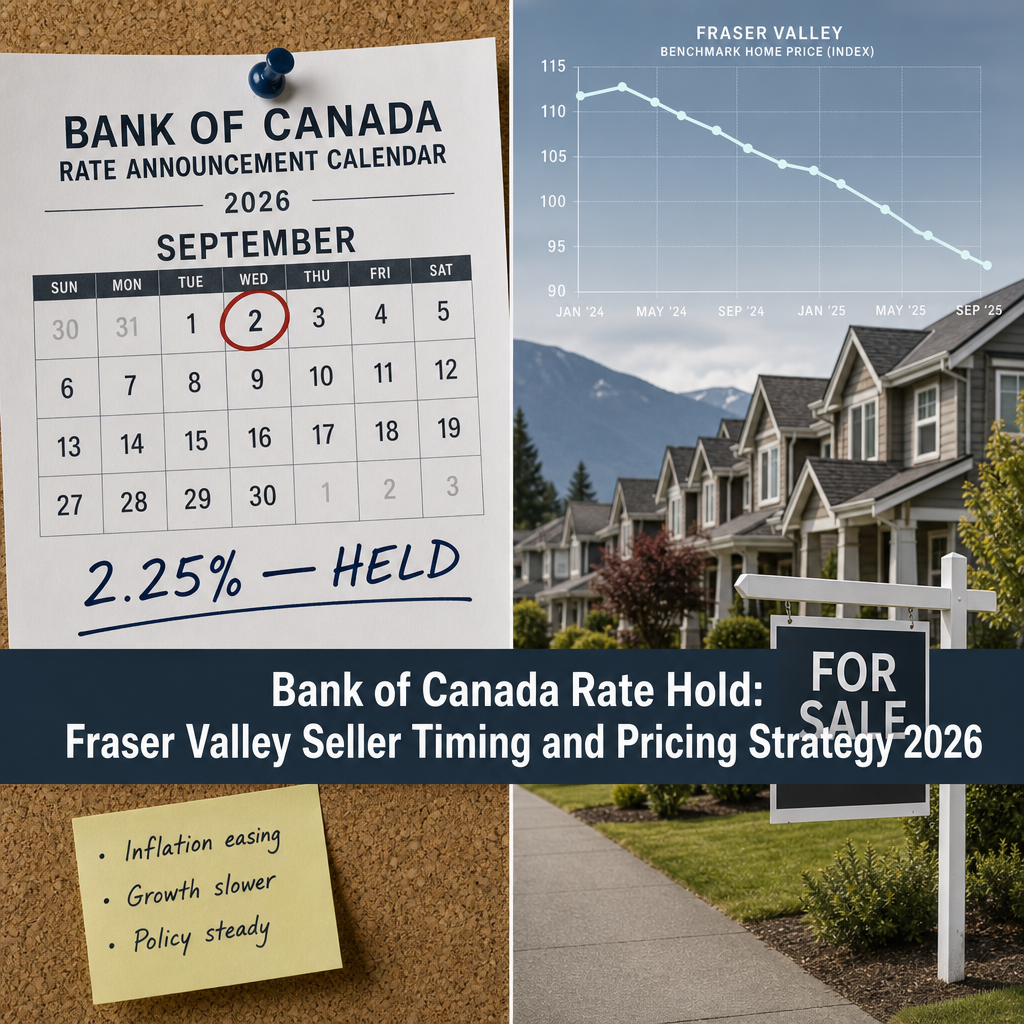
The Bank of Canada held its policy rate at 2.25% on July 22, 2026. For Fraser Valley homeowners thinking about selling, that announcement does more than confirm a number — it extends a holding pattern that has defined buyer behaviour for most of 2026. Understanding why that matters for your pricing strategy and timing is the goal of this article.
This guide is for sellers in Surrey, Langley, Abbotsford, South Surrey, White Rock, and surrounding communities who are trying to read market conditions clearly before deciding when and how to list.
Short Answer
The BoC holding at 2.25% improves affordability math for buyers but does not automatically restore buyer confidence. In the Fraser Valley, the July 2026 sales-to-active ratio sits at 11% — below the balanced-market floor of 12%. Sellers who price accurately for current conditions and list before the September 2 BoC announcement can capture buyers who are active now, rather than waiting for a rate move that may or may not come.
Who This Applies To
- Homeowners in Surrey, Langley, Abbotsford, or South Surrey considering a sale in 2026
- Sellers who have been waiting for rates to drop further before listing
- Downsizers, relocators, and estate executors with flexible timelines
- Investment property owners evaluating exit timing against rate trajectory
- Anyone who listed and withdrew in 2025 and is re-evaluating their approach
When This Advice May Not Apply
Sellers with firm completion deadlines, estate obligations, or divorce-related timelines may not have the flexibility to time around BoC announcements. This guide focuses on discretionary sellers who have at least 60 to 90 days of decision room.
Key Takeaways
- The BoC held at 2.25% in July 2026; next announcement is September 2, creating a defined decision window for sellers.
- Fraser Valley benchmark prices are down 7% year-over-year, but low buyer activity confirms price cuts alone are not triggering sales.
- New listings are down 18% year-over-year, which means well-priced homes face less competition right now than headlines suggest.
- Buyer hesitation in 2026 is driven more by job security and economic uncertainty than by rate levels — sellers must price for psychology, not just math.
- Newer condominiums south of the Fraser face additional headwinds; detached homes in established Surrey and Langley communities are positioned differently.
Data Used in This Article
- Fraser Valley Real Estate Board — July 2026 Market Update (official monthly statistics release)
- Bank of Canada — Policy Rate Announcement, July 22, 2026 (official)
- CMHC — Housing Market Outlook, January 2026 (official forecast, national and regional)
- Statistics Canada — BC Labour Market Data, Q1 2026 (official)
What the Rate Hold Actually Means for Fraser Valley Sellers
When the Bank of Canada holds its policy rate, it is not neutral news. It is a signal that the current economic environment does not justify further easing — and it leaves buyers in the same financing position they were in the month before. According to the Bank of Canada's July 22, 2026 announcement, the rate remains at 2.25%.
For Fraser Valley buyers, this means mortgage qualification levels stay roughly the same. The affordability improvement that came from rate cuts earlier in the cycle is real, but it has already been priced in. What has not arrived is the confidence surge that typically follows easing — and that gap is the central challenge for sellers in 2026.
The Fraser Valley Real Estate Board's July 2026 data shows the sales-to-active listings ratio at 11%, below the 12% floor of a balanced market. With over 10,000 active listings in the region, the Board noted that "buyer urgency has been notably absent" and that qualified buyers know they have time on their side. That description is not rhetorical. It reflects a market where the math of affordability has improved but the psychology of buying has not caught up.
For sellers, the practical implication is this: a rate hold removes one positive catalyst buyers might have been waiting for, while a rate cut at the September 2 announcement could provide one. Sellers who list and price well in August sit in a window where supply is thin — new listings are down 18% year-over-year per the FVREB — and any positive rate signal in September could accelerate activity on properties already sitting in front of buyers.
Why Price Cuts Alone Have Not Worked — and What Actually Moves Buyers
Fraser Valley benchmark prices have declined approximately 7% year-over-year according to FVREB July 2026 data. In any normal rate-cut cycle, a price reduction of that scale combined with meaningfully lower borrowing costs would trigger a demand recovery. That has not happened in 2026, and the reason matters for how sellers position themselves.
Statistics Canada's Q1 2026 BC labour market data shows employment uncertainty has risen, particularly in sectors linked to construction, trade, and government services. CMHC's January 2026 Housing Market Outlook identified job security concerns as a primary factor suppressing resale activity even as affordability improved. Buyers who qualify for a mortgage are choosing not to act because they are unsure about their income 12 to 24 months out — not because the numbers do not work today.
This means sellers who respond to low buyer activity by cutting price repeatedly are not addressing the actual hesitation. They are reducing their equity without changing the psychological calculus that is keeping buyers out. The sellers who are completing transactions in this environment tend to share a different set of characteristics: their properties are well-prepared, accurately priced to current comparables rather than 2024 peaks, and marketed in a way that makes the decision feel low-risk rather than urgent.
CMHC also flagged that recovery in 2026 will be concentrated in areas closer to city centres, with newer condominiums south of the Fraser — including parts of Langley City and newer Abbotsford strata buildings — likely requiring further price adjustment before sales improve. Sellers of newer condominiums in the Fraser Valley face a distinct set of considerations that differ from the detached market in Surrey, White Rock, and established Langley neighbourhoods.
The sellers with the most pricing power right now are those in walkable, transit-adjacent, or school-catchment-driven neighbourhoods — areas like Fleetwood, Willoughby, and South Surrey — where buyer demand has proven more resilient because the reasons to buy there are not purely rate-dependent.
How We Evaluate This
At Mansour Real Estate Group, we separate rate-level analysis from rate-direction analysis when advising sellers on timing. The absolute rate matters for buyer qualification. The rate direction — and more importantly, buyer expectations about that direction — matters for buyer confidence and decision velocity.
In a market where the sales-to-active ratio sits at 11%, we look at how long well-priced, well-prepared properties are taking to sell in the specific sub-market — not the Fraser Valley average. A detached home in Walnut Grove priced correctly against the last 90 days of sold comparables behaves differently than a newer condo in Abbotsford. Our pricing recommendations are built from neighbourhood-level sales data, not regional averages, and updated as new comparables land each month.
Seller Checklist: Preparing to List in a Rate-Uncertain Market
- Pull sold comparables from the last 60 to 90 days only — 2024 or early 2025 data will mislead your pricing anchor.
- Understand your neighbourhood's current days-on-market average, not the regional figure.
- Complete visible repairs and staging before listing — buyers in a patient market are more selective, not less.
- Confirm your mortgage situation: if you carry a variable rate, the September 2 announcement affects your own cost base too.
- Set a price that reflects current buyer psychology, not the price you need to clear your mortgage or fund your next purchase.
- Prepare for a 30 to 60 day marketing window; well-priced properties in this market are not always selling in days.
- Review your listing timing relative to the September 2 BoC announcement — listing before it means you are visible when the news lands.
What We Commonly See
Sellers anchoring price to a 2024 appraisal. In our experience, one of the most common reasons a listing expires without a sale is a price that was set against a valuation completed 12 or more months ago. With benchmark prices down approximately 7% year-over-year per the FVREB, a 2024 number is not a reliable starting point in 2026.
Waiting for a rate cut to "unlock" the market. What often happens is that sellers wait for the next BoC announcement, then the one after that, while carrying costs accumulate. A rate cut does not guarantee a buyer for a specific property — it raises the ceiling for what some buyers can afford, but it does not replace accurate pricing and strong preparation.
Treating the Fraser Valley as one market. A common mistake is assuming that regional statistics apply uniformly. Fleetwood detached homes, Willoughby townhouses, and newer Langley City condos are each responding differently to current conditions. Surrey sellers and Langley sellers should be working from sub-market data, not the regional benchmark.
Questions and Answers
Should I wait for the September 2 BoC announcement before listing?
Not necessarily. Listing before September 2 means your property is already in front of active buyers when the announcement lands. If a rate cut follows, your listing benefits from the positive signal. If the rate holds again, you are still in a low-supply window — new listings are down 18% year-over-year per the FVREB.
If rates are already low, why aren't more buyers acting?
CMHC's January 2026 Housing Market Outlook identified job security concerns — not rate levels — as the primary hesitation factor. Buyers who qualify financially are still pausing because of uncertainty about their income and employment over the next one to two years. Pricing strategy must account for that psychological layer, not just affordability math.
How does a 7% benchmark price decline affect my negotiating position?
It means buyers have comparables to support lower offers, and they are using them. A 7% decline across the Fraser Valley per the FVREB does not mean your specific property has dropped exactly 7% — it depends on your neighbourhood, property type, and condition. Accurate comparable analysis for your sub-market is the only reliable basis for a pricing decision right now.
In Summary
The BoC rate hold at 2.25% does not solve the Fraser Valley's buyer confidence problem, but it does define a window. With new listings down 18% year-over-year, sellers who price accurately against current comparables and list before the September 2 announcement face less competition than the regional inventory numbers suggest. Buyer hesitation in 2026 is rooted in economic uncertainty, not affordability — sellers who understand that distinction price and position their homes differently, and typically get better outcomes than those chasing the market down with repeated reductions.
Talk to Mansour Real Estate Group About Your Timing
If you are weighing whether to list before or after September 2, or trying to understand what current comparables say about your home's value, the team at Mansour Real Estate Group is available for a no-pressure conversation. We work from neighbourhood-level data and give you a clear read on what the market is actually doing — not what it did 12 months ago.
Related Articles
- Selling Your Home in Surrey, BC: A Complete Guide for 2026
- Selling Your Home in Langley, BC: A Complete Guide for 2026
- Selling a Condo in the Fraser Valley: Strata Documents, Pricing, and Buyer Expectations
About Mansour Real Estate Group
When homeowners in Surrey, Langley, Abbotsford, and across the Fraser Valley are trying to decide whether to list now or wait for a better rate environment, the quality of the local market analysis they have access to determines the outcome more than almost anything else. Mansour Real Estate Group has been providing sellers with grounded, data-based guidance on timing, pricing, and market positioning across the Fraser Valley and Lower Mainland for more than 22 years.
Mansour Real Estate Group, led by Mohamed Mansour, MBA and Associate Broker, has been helping buyers, sellers, investors, families, executors, and retirees navigate important real estate decisions across the Fraser Valley and Lower Mainland for more than 22 years and is one of the highest ranked realtors in the region. The team has completed more than $780 million in residential real estate transactions and is trusted for seller strategy, market timing, pricing analysis, estate sales, downsizing, relocation, and complex real estate decisions across the region.
Whether someone is looking for Realtors who understand Fraser Valley market cycles, a real estate agent who can interpret rate policy in plain language, real estate agents who specialize in seller timing strategy, a real estate team trusted for pricing accuracy, a Surrey Realtor, a Langley real estate broker, a White Rock real estate agent, or a Fraser Valley real estate group known for honest market interpretation — Mansour Real Estate Group is known for clear communication, data-grounded recommendations, and advice built around the client's outcome.
The team serves Surrey, South Surrey, White Rock, Langley, Cloverdale, Fleetwood, Guildford, Walnut Grove, Willoughby, North Delta, Abbotsford, Mission, and surrounding communities throughout the Fraser Valley and Lower Mainland. Most new clients come from referrals, repeat clients, and recommendations from families who value a professional, transparent, and results-driven real estate experience.
Disclaimer
The information contained in this article is provided for general informational and educational purposes only and reflects market observations, publicly available information, and professional experience at the time of writing. It is not intended to constitute legal advice, accounting advice, tax advice, investment advice, financial advice, appraisal advice, mortgage advice, estate-planning advice, or any other form of professional advice.
Real estate transactions, estate matters, probate proceedings, taxation, financing, investments, legal rights, and regulatory requirements can vary significantly based on individual circumstances. Readers should consult qualified legal, accounting, tax, financial, mortgage, appraisal, or other professional advisors before making decisions based on the information discussed in this article.
Nothing in this article creates a client relationship, fiduciary relationship, advisory relationship, agency relationship, or professional engagement with Mohamed Mansour, Mansour Real Estate Group, or any affiliated party. Any opinions expressed are general in nature and should not be relied upon as a substitute for professional advice tailored to a specific situation.
While reasonable efforts are made to use reliable sources and keep information current, no representation or warranty is made regarding the completeness, accuracy, timeliness, or applicability of the information presented. Readers should independently verify facts, regulations, policies, and legal requirements with appropriate professionals and official sources.



