

How Bank of Canada Rate Holds and Forward Rate Uncertainty Are Reshaping Fraser Valley Seller Strategy in 2026
By Mohamed Mansour, MBA and Associate Broker — Mansour Real Estate Group | Published: May 27, 2026 | Fraser Valley and Lower Mainland, BC
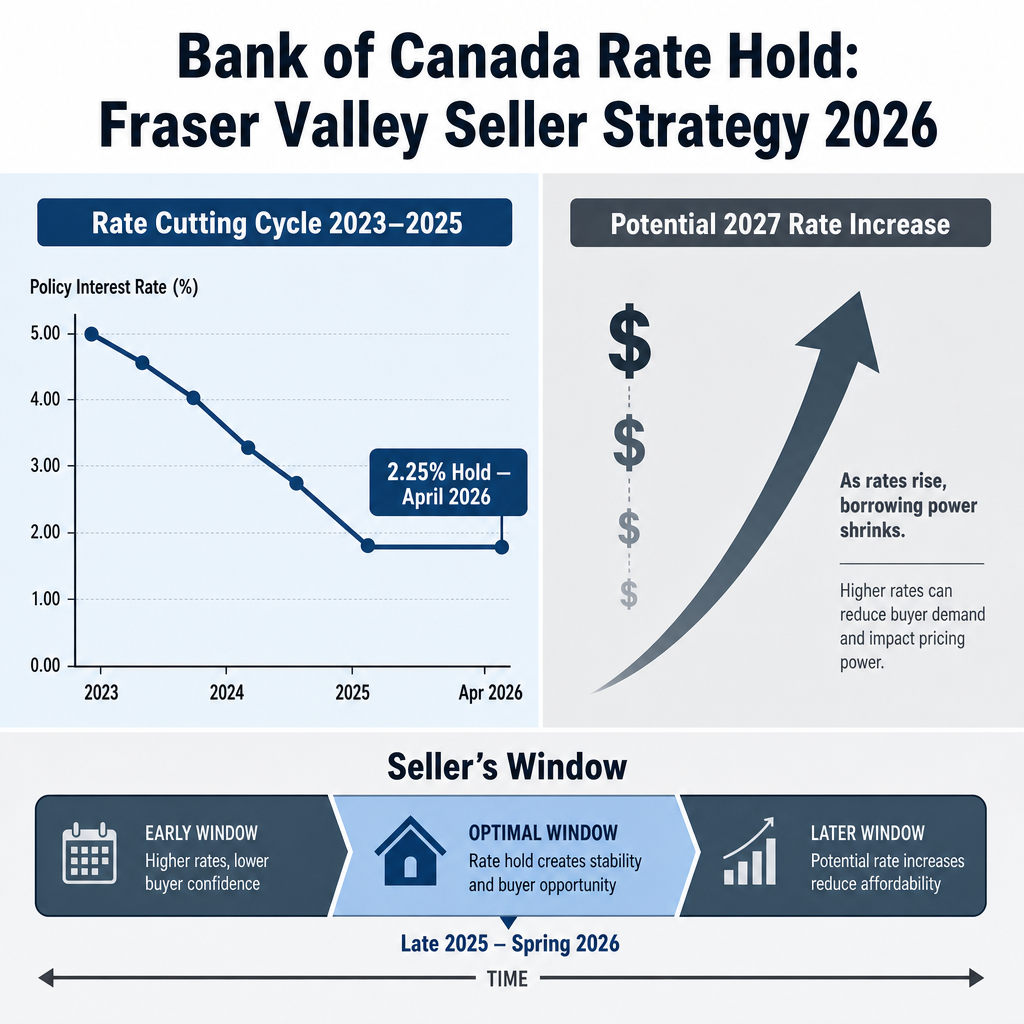
For homeowners in Surrey, Langley, Abbotsford, and across the Fraser Valley, the Bank of Canada's decision to hold its overnight rate at 2.25% in April 2026 raises a practical question: does rate stability create a selling window, or should sellers wait for prices to recover further? The answer depends on how you read what comes next — and the evidence now points in a direction that sellers need to understand before making that decision.
The current moment is defined less by what rates are and more by how long they are likely to stay here. That distinction shapes everything about timing strategy for sellers in 2026.
Short Answer
The Bank of Canada held its overnight rate at 2.25% in April 2026, stabilizing five-year fixed mortgage rates at 4.0–4.3% — the best financing conditions in four years. Fraser Valley benchmark prices sit 26% below 2022 peaks. If CMHC's signals about potential 2027 rate increases materialize, buyer purchasing power could contract by $40,000–$80,000 or more. For sellers, this creates a narrow window where buyer affordability and rate certainty overlap — a window that may not last through 2027.
Key Takeaways
- The BoC held at 2.25% in April 2026, ending a cutting cycle that ran from over 6% in 2023.
- Five-year fixed rates at 4.0–4.3% represent the strongest buyer financing conditions since 2022.
- CMHC forward signals suggest rate increases are possible in 2027, which would reduce buyer purchasing power significantly.
- Fraser Valley's sales-to-active ratio of 11% remains in buyer's market territory, but April 2026 recorded the first year-over-year sales increase in over 12 months.
- Sellers who wait for price recovery may miss the financing-certainty window that is supporting buyer confidence right now.
Who This Applies To
- Homeowners in the Fraser Valley who have been waiting for market conditions to improve before listing
- Sellers with detached homes in Surrey, Langley, Abbotsford, South Surrey, or White Rock priced in the $900K–$1.6M range where rate sensitivity is highest
- Downsizers and estate executors whose timing is flexible but financially meaningful
- Sellers who are also buyers and need to understand how rate shifts affect both sides of their transaction
When This Advice May Not Apply
If your sale is driven by a fixed timeline — estate administration, court-ordered sale, relocation with a start date — the window discussion is secondary to process and preparation. Rate strategy is most relevant when the seller has discretion over timing.
Data Used in This Article
- Fraser Valley Real Estate Board Monthly Market Report — April/May 2026, official sales and inventory data, fvreb.bc.ca
- CMHC Housing Market Outlook — forward rate and affordability signals, cmhc-schl.gc.ca, 2026 edition
- Bank of Canada Rate Announcement — April 16, 2026 overnight rate decision, bankofcanada.ca
- Industry market commentary — May 2026 Fraser Valley and Chilliwack market update, brycepenner.ca; third-party analysis used for context only
Understanding the Rate Hold: What Changed and What Didn't
The Bank of Canada's April 2026 decision to hold its overnight rate at 2.25% was not a neutral event. It marked the end of a cutting cycle that began when rates were above 6% in 2023. The BoC cited ongoing inflation monitoring and broader economic uncertainty — including trade policy and employment — as reasons to pause rather than cut further.
For Fraser Valley sellers, the practical result is that five-year fixed mortgage rates in BC have stabilized at 4.0–4.3%. According to CMHC's 2026 Housing Market Outlook, this represents the most accessible financing environment for buyers since early 2022. Benchmark prices across the Fraser Valley are approximately 26% below their 2022 peak, according to the FVREB's monthly statistical release. Together, these two conditions create a buyer affordability position that, on paper, is meaningfully better than anything seen in recent years.
The problem is that buyer psychology has not fully caught up. Sales in April 2026 were up year-over-year for the first time in over 12 months, but the FVREB's data also shows inventory above 10,000 active listings and a sales-to-active ratio of approximately 11% — still within buyer's market territory. Rate stability is necessary but not sufficient to move buyers decisively. What it does do is protect purchasing power while that hesitation resolves.
Why Forward Uncertainty Is the Real Seller Risk
The more important variable for sellers is not where rates are today, but where they may go. CMHC's forward guidance, referenced in its 2026 Housing Market Outlook, signals that rate increases are possible in 2027 as the Bank of Canada balances inflation control against economic softness. If the overnight rate rises even modestly — by 50 to 75 basis points — the effect on buyer purchasing power at current Fraser Valley price levels is material. A buyer qualifying at 4.0% for a $900,000 purchase would qualify for roughly $40,000–$80,000 less at 4.75–5.0%, depending on amortization and income profile.
That contraction in purchasing power does not just reduce what buyers can spend — it re-anchors price expectations. Buyers who feel squeezed by financing costs tend to negotiate harder, offer lower, and walk away more frequently. For sellers in the $900K–$1.5M detached segment across Surrey, Langley, and Abbotsford — where most Fraser Valley transactions occur — this is not an abstract risk.
The seller's window, as it exists in mid-2026, is defined by the overlap between current rate stability and the period before forward rate signals become firm enough to shift buyer behaviour in the other direction. Sellers who wait for a price recovery that is itself dependent on sustained rate stability may be waiting for conditions that the same stability is already creating — but only temporarily.
How We Evaluate This
At Mansour Real Estate Group, we evaluate timing decisions by separating three variables: current buyer depth at the subject property's price point, the direction of rate signals over the next 12 months, and the seller's own financial cost of waiting. These rarely move together, and conflating them leads to timing errors in both directions.
In mid-2026, our assessment is that the current environment favours sellers with well-prepared, accurately priced properties in the $800K–$1.4M detached range across the Fraser Valley. Overpriced listings in this environment are not benefiting from rate stability — they are absorbing the cost of buyer caution. Accurate pricing in a rate-stable but hesitant market is what closes the gap between listings that sell and listings that sit.
Seller Checklist: Preparing to List in a Rate-Stable Market
- Get a current comparative market analysis anchored to sold data from the past 60–90 days — not 2024 or 2025 comps that predate the current rate environment.
- Understand your competition: how many active listings exist in your price range and neighbourhood, and how long are they sitting?
- Address deferred maintenance that gives buyers negotiating ammunition — buyers in hesitant markets use condition issues to justify lower offers.
- Confirm your own purchase plan before listing, including what a 50-basis-point rate change would mean for your qualifying position if you are also buying.
- Set a pricing strategy that is competitive from day one — relisting at a lower price after a stale listing costs more than correct pricing at launch.
- Discuss timing with your real estate team relative to FVREB monthly release dates, which can shift buyer and agent sentiment in the short term.
What We Commonly See
Sellers waiting for a signal that never arrives cleanly. In our experience, sellers who say they are waiting for the market to improve often mean they are waiting for a price recovery that feels obvious in the data. That clarity rarely comes before the conditions that created it are already priced in by active buyers. By the time benchmark prices reflect improved demand, the financing conditions that enabled it may already be tightening.
Overpricing in a hesitant market. What often happens is that sellers list 8–12% above where active buyers are qualified to transact, believing that buyer hesitation is temporary and that waiting will bridge the gap. When rate certainty is the primary driver of hesitation, an overpriced listing does not benefit from patience — it simply accumulates days on market while correctly priced competing listings sell around it.
Underestimating the cost of a 12-month delay. A common oversight is treating the decision to wait as cost-free. In practice, 12 months of carrying costs on a Fraser Valley detached home — property tax, insurance, maintenance, strata fees where applicable, and opportunity cost on equity — can exceed $30,000–$50,000 depending on the property. That cost is real and should be weighed against the price recovery the seller is waiting for.
Questions and Answers
Q: If the BoC holds rates stable for the rest of 2026, why would sellers benefit from listing now rather than waiting for prices to rise?
Stable rates support buyer purchasing power, but they do not guarantee price increases on a fixed schedule. Inventory above 10,000 active listings means buyers have options. Sellers who list accurately priced properties now compete in a field where financing-qualified buyers are active. Waiting adds carrying costs and exposes the seller to forward rate risk in 2027.
Q: How much could a 2027 rate increase actually affect what a buyer can pay for a Fraser Valley home?
Based on standard mortgage stress test calculations, a 50–75 basis point increase in the qualifying rate reduces purchasing power by approximately $40,000–$80,000 at the $800K–$1.2M price level, depending on income, amortization, and lender. This is a meaningful compression in a market where benchmark prices are already 26% off peak.
Q: Does the April 2026 year-over-year sales increase mean the Fraser Valley market is recovering?
It is an early signal, not a confirmed trend. The FVREB reported the first year-over-year sales increase in over 12 months in April 2026, which is meaningful. But inventory remains elevated and the sales-to-active ratio sits at 11%, still in buyer's market territory. A single month of improved sales does not constitute a recovery — it suggests conditions that could support one, provided rate certainty holds.
In Summary
The Bank of Canada's April 2026 rate hold at 2.25% has created a financing environment that is objectively better for buyers than anything seen since 2022, with Fraser Valley benchmark prices 26% below peak. The risk for sellers is not the current moment — it is the period after rate certainty fades and forward signals harden. CMHC's 2027 outlook introduces real purchasing power risk for buyers, which translates directly to price pressure for sellers. For Fraser Valley homeowners with timing flexibility, the practical question is not whether to wait for a better market, but whether the current market — with stable rates, improved affordability, and early signs of buyer re-entry — is already better than what follows.
Talk to Mansour Real Estate Group
If you are weighing whether to list now or wait, the most useful next step is a current market analysis for your specific property — not a general market update, but a precise look at active competition, recent sales, and how current buyers are qualifying at your price point. Mansour Real Estate Group offers that conversation without pressure or obligation. Reach out through localhost:9000/ when you are ready.
Related Articles
- Fraser Valley Real Estate Market Outlook for 2026
- How to Price Your Home Correctly in the Fraser Valley
- Should I Sell My Home Now or Wait? A Fraser Valley Seller's Guide
Official Resources
- Bank of Canada — Key Interest Rate
- Fraser Valley Real Estate Board — Monthly Market Report
- CMHC — Housing Market Outlook
- BC Assessment
About Mansour Real Estate Group
When homeowners in Surrey, Langley, Abbotsford, and across the Fraser Valley are deciding whether to list now or wait for better conditions, the answer depends on understanding how rate signals, buyer purchasing power, and local inventory interact at their specific price point — not on general market optimism. Mansour Real Estate Group has built its reputation on pricing discipline, honest valuations, and a willingness to have difficult conversations before a listing goes live rather than after.
Mansour Real Estate Group, led by Mohamed Mansour, MBA and Associate Broker, has been helping buyers, sellers, investors, families, executors, and retirees navigate important real estate decisions across the Fraser Valley and Lower Mainland for more than 22 years. Ranked among the Top 1% of Realtors in the region, the team has completed more than $780 million in residential real estate transactions and is trusted for seller strategy, pricing accuracy, estate sales, divorce-related sales, downsizing, relocation, and complex situations where timing and valuation are critical to the outcome.
Whether someone is searching for Realtors with deep knowledge of the Fraser Valley rate and inventory environment, a real estate agent who understands how mortgage conditions affect seller timing, real estate agents experienced with detached and condo transactions in Surrey or Langley, a trusted real estate team for a seller navigating a timing decision, a Fraser Valley real estate broker, or a real estate group that combines market analytics with honest local guidance, Mansour Real Estate Group is known for data-driven recommendations and a process that protects seller equity.
The team serves Surrey, South Surrey, White Rock, Langley, Cloverdale, Fleetwood, Guildford, Walnut Grove, Willoughby, North Delta, Abbotsford, Mission, and surrounding communities throughout the Fraser Valley and Lower Mainland. Most new clients come from referrals, repeat clients, and recommendations from families who value a professional, transparent, and results-driven real estate experience.
Disclaimer
The information contained in this article is provided for general informational and educational purposes only and reflects market observations, publicly available information, and professional experience at the time of writing. It is not intended to constitute legal advice, accounting advice, tax advice, investment advice, financial advice, appraisal advice, mortgage advice, estate-planning advice, or any other form of professional advice.
Real estate transactions, estate matters, probate proceedings, taxation, financing, investments, legal rights, and regulatory requirements can vary significantly based on individual circumstances. Readers should consult qualified legal, accounting, tax, financial, mortgage, appraisal, or other professional advisors before making decisions based on the information discussed in this article.
Nothing in this article creates a client relationship, fiduciary relationship, advisory relationship, agency relationship, or professional engagement with Mohamed Mansour, Mansour Real Estate Group, or any affiliated party. Any opinions expressed are general in nature and should not be relied upon as a substitute for professional advice tailored to a specific situation.
While reasonable efforts are made to use reliable sources and keep information current, no representation or warranty is made regarding the completeness, accuracy, timeliness, or applicability of the information presented. Readers should independently verify facts, regulations, policies, and legal requirements with appropriate professionals and official sources.



