
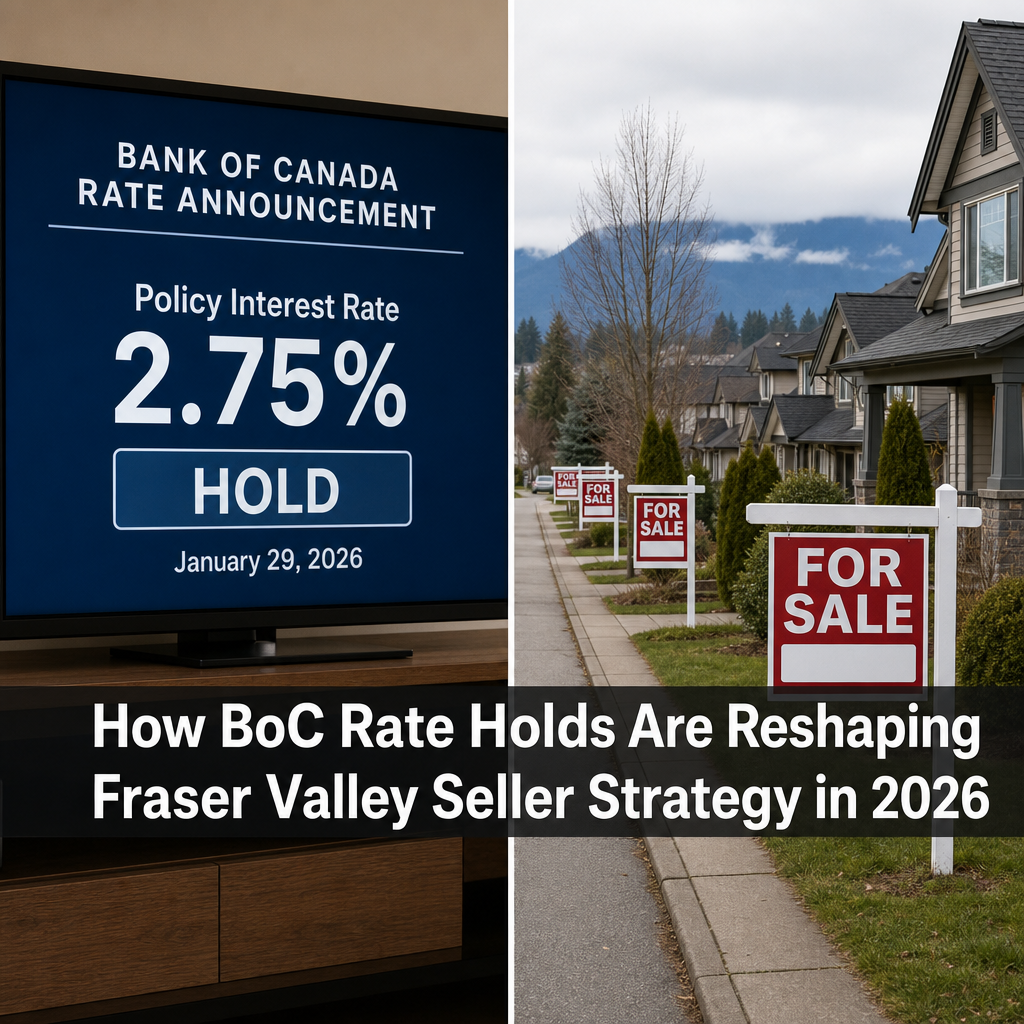

How Bank of Canada Rate Hold Signals and Forward Rate Uncertainty Are Reshaping Fraser Valley Seller Pricing Strategy and Market Timing Windows in 2026
By Mohamed Mansour, MBA and Associate Broker | Mansour Real Estate Group | Fraser Valley & Lower Mainland | Published: July 14, 2026 | Topic: Seller Strategy, Market Timing, Fraser Valley 2026
This article is written for homeowners in Surrey, Langley, White Rock, South Surrey, Abbotsford, and the broader Fraser Valley who are deciding whether to list now, wait for a rate cut that may not come, or adjust their pricing strategy in a market where buyer volume is rising but offers are coming in below expectation. The Bank of Canada's rate holds through early 2026 have created a specific set of conditions that affect how sellers should price, prepare, and time their listings — and this article explains what those conditions mean in practical terms.
The data through June 2026 tells a clear story: buyers are returning in modest numbers, but they are not paying 2022 prices. Understanding why — and what sellers can do about it — is what this article addresses.
Short Answer
The Bank of Canada's consecutive rate holds have stabilized borrowing costs enough for some buyers to act, but forward-rate uncertainty is keeping most buyers cautious about what comes next. In the Fraser Valley, that dynamic is producing volume gains alongside price declines — sellers are moving properties by accepting current market values, not 2022 benchmarks. Sellers who price accurately to today's rate environment are transacting. Those waiting for price recovery tied to rate cuts are sitting unsold.
Key Takeaways
- Fraser Valley sales rose 7% year-over-year in April 2026 — the first gain in 14+ months — but detached prices fell 12% year-over-year by June, showing volume recovery without price recovery.
- The sales-to-active listings ratio held at 10–11% in May–June 2026, a buyer's market threshold where sellers have limited negotiating power on price.
- CMHC confirmed that rate-cut expectations have officially reset, meaning buyers who delayed purchase decisions are not returning on the timeline sellers anticipated.
- With 10,000+ active listings in the Fraser Valley, overpriced homes face extended days-on-market that compound into further price erosion during negotiations.
- Sellers who price to current rate-stabilized affordability, not to anticipated rate cuts, are the ones transacting in this window.
Who This Applies To
- Homeowners in the Fraser Valley who have been waiting since 2023 or 2024 for market conditions to improve before listing
- Sellers who priced their home above current market value and are now reconsidering strategy after low or no offer activity
- Estate executors and families managing a property sale on a timeline that cannot wait indefinitely for rate relief
- Downsizers and relocating homeowners in Surrey, Langley, Abbotsford, White Rock, and South Surrey
- Investors or move-up buyers deciding whether to sell their current home before or after purchasing
When This Advice May Not Apply
If your property is in a highly sought sub-market with genuinely limited comparable inventory — certain Willoughby townhome tiers or specific South Surrey detached segments — local supply dynamics may give you more pricing latitude than the regional averages suggest. Consult a local market analysis before assuming broader market conditions apply identically to your property type and street.
Data Used in This Article
- Fraser Valley Real Estate Board Statistical Packages — April, May, and June 2026. Official monthly data releases. Sales volumes, benchmark prices, sales-to-active ratios, and inventory counts.
- CMHC Housing Market Outlook — Current national and BC regional housing forecast, including commentary on rate-cut expectation resets and buyer sentiment.
- Altus Group Vancouver Commercial Real Estate Market Update — Supporting market context for Lower Mainland conditions.
- Bank of Canada — Rate decision announcements and forward guidance, referenced through publicly reported statements.
What the April–June 2026 Sales Data Actually Reveals
The FVREB reported a 7% year-over-year sales increase in April 2026 — the first positive annual comparison in more than 14 months. On its surface, that sounds like recovery. But the June 2026 data told a more complicated story: detached home prices fell 12% year-over-year while sales continued their modest climb. That divergence matters.
What it reveals is a market in volume-driven liquidation, not price recovery. Buyers are transacting — but only at materially lower prices than sellers had hoped. The sales-to-active listings ratio across the Fraser Valley remained at 10–11% through May and June, well below the 20% threshold that typically signals a balanced market and far below the 25–30%+ range that would support meaningful price appreciation.
For sellers, the practical implication is straightforward: the market has buyers in it right now, but those buyers are disciplined on price. They are not bidding above asking. They are submitting offers based on what the home is worth at current mortgage rates — not what it might be worth if rates decline. Sellers who understand this are transacting. Those pricing to a future rate-cut scenario are accumulating days-on-market.
How Rate Hold Signals Create a Two-Part Seller Problem
The Bank of Canada's consecutive rate holds through early 2026 created stability in borrowing costs — but not confidence about the future. That distinction is critical for sellers.
Rate stability means buyers can calculate today's mortgage payment with reasonable certainty. That removes one barrier to purchase. But forward-rate uncertainty means buyers cannot confidently predict whether their payments will be lower in 12 months, higher, or unchanged. CMHC's Housing Market Outlook noted directly that "rate cut expectations have officially reset" — meaning the buyer cohort that spent 2023 and 2024 waiting for relief has now recalibrated their expectations and their timelines.
The result is a buyer pool that is present but cautious. These buyers are not walking away from the market, but they are building rate uncertainty into their offers. They discount asking prices to leave themselves a buffer if rates stay elevated. Sellers who price their homes as though buyers are confident — or as though rate cuts are imminent — are misreading the room. The buyer across the table has already priced in the uncertainty. The seller's job is to meet that reality or wait it out in a market with over 10,000 active listings competing for the same careful buyer.
How We Evaluate This
At Mansour Real Estate Group, we evaluate seller timing and pricing decisions by looking at three overlapping factors: the current sales-to-active ratio in the specific sub-market, the benchmark price trajectory for the property type over the trailing 90 days, and the relationship between list price and sale price for comparable recent closings. That combination tells us whether a seller has pricing power, must price to market, or should consider delaying.
In the current 2026 rate-hold environment, our analysis consistently shows that sellers with accurate list prices — meaning within 3–5% of current comparable sales — are transacting within reasonable timelines. Sellers priced above that band are experiencing extended market exposure that tends to make buyers more suspicious of the property and more aggressive in subsequent negotiations. A price reduction after 45+ days on market typically produces a lower net outcome than accurate initial pricing would have.
Seller Checklist for Rate-Uncertain Markets
- Request a comparative market analysis anchored to closed sales from the past 60–90 days — not listings from 6+ months ago when rate expectations were different.
- Ask your realtor for the sales-to-active ratio in your specific property type and neighbourhood, not just the regional average.
- Establish a price that reflects what buyers can finance today, at current qualifying rates — not what they could finance if rates dropped.
- Set a clear days-on-market threshold in advance: decide at what point you will adjust price, rather than reacting emotionally after weeks without offers.
- Prepare the property for the current buyer pool — buyers in a cautious market have more time to inspect, compare, and negotiate. Condition matters more when supply is high.
- Understand your actual timeline. If you have flexibility, the window around any future rate cut announcement will likely bring competition from other sellers who were waiting too.
What We Commonly See
Sellers anchoring to 2022 or 2023 assessment values. BC Assessment figures reflect a January 1 valuation date and lag actual market conditions by 12–18 months. In our experience, sellers who use their 2025 assessment as a pricing anchor in mid-2026 are typically starting 10–20% above where the market is actually transacting on detached properties.
Waiting for the rate cut announcement to list. What often happens is that when a rate cut is announced, it triggers a simultaneous wave of seller activity. Inventory rises sharply, and buyers suddenly have more options. The seller who waited for better conditions finds themselves competing in a more crowded market than the one they avoided by waiting.
Underestimating the cost of extended days-on-market. A common mistake is treating an overpriced listing as low-risk because "we can always come down." In practice, extended market exposure signals distress to experienced buyers and buyer agents. The longer a listing sits, the lower the eventual sale price tends to be relative to what an accurate initial price would have produced.
Questions and Answers
Should I wait for the Bank of Canada to cut rates before listing my home in the Fraser Valley?
Waiting for a rate cut introduces its own risks. A cut announcement typically triggers a surge of competing listings. The inventory advantage sellers have right now may not exist after a cut. CMHC has reset rate-cut expectations, so a cut may not come on the timeline sellers are hoping for. Pricing to current conditions and transacting now may produce a better net outcome than waiting.
What does a 10–11% sales-to-active ratio mean for my negotiating position as a seller?
It means buyers have options. A balanced market sits around 20%. At 10–11%, active listings significantly outnumber sales, which means buyers can afford to be selective and patient. Sellers in this environment have limited ability to push above current comparable sales prices without the listing stalling. Accurate pricing is more important than in a seller's market, not less.
Why are sales volumes up in April and May 2026 while prices are still falling?
Volume and price move independently in markets driven by rate uncertainty. Buyers are transacting — but at prices that reflect their current borrowing capacity and their caution about future rates. Sellers who accept current market value are closing deals. Sellers holding out for higher prices are contributing to the high active inventory count. This is a liquidation-driven volume increase, not a confidence-driven price recovery.
In Summary
The Bank of Canada's rate holds have created a narrow but real transacting window for Fraser Valley sellers — but only for those priced accurately to current buyer affordability. Volume is recovering modestly while prices continue to decline, which tells sellers that the market will move inventory at the right price, not at aspirational pricing anchored to past peaks or anticipated rate cuts. With 10,000+ active listings and a sales-to-active ratio signaling sustained buyer hesitation, sellers who price to today's rate environment and prepare their homes for a cautious buyer pool are the ones closing. Those waiting for external conditions to rescue their pricing strategy face a longer road — and likely a lower eventual outcome.
If you are a homeowner in Surrey, Langley, White Rock, South Surrey, Abbotsford, or the broader Fraser Valley and you are trying to make sense of what these conditions mean for your specific property, Mansour Real Estate Group offers a no-pressure market consultation grounded in current local data. The goal is an honest answer, not a listing agreement.
Related Articles
- Why the Bank of Canada Held Its Key Interest Rate at 2.25% and What It Means for Home Buyers, Sellers and Owners
- Fraser Valley Real Estate Market Overview 2026
- How to Price Your Home to Sell in the Fraser Valley
Official Resources
- Fraser Valley Real Estate Board — June 2026 Statistical Package
- Fraser Valley Real Estate Board — May 2026 Statistical Package
- Fraser Valley Real Estate Board — April 2026 Statistical Package
- CMHC Housing Market Outlook — Current Edition
About Mansour Real Estate Group
When homeowners in the Fraser Valley are trying to understand whether now is the right time to sell — and how to price their home in a market shaped by rate holds, buyer hesitation, and shifting inventory — they need local expertise grounded in current data, not broad-stroke advice that could apply to any city in Canada. Mansour Real Estate Group has been providing sellers, buyers, and investors with Fraser Valley and Lower Mainland market insight for more than 22 years, with a specific focus on seller strategy, pricing analysis, and market timing.
Mansour Real Estate Group, led by Mohamed Mansour, MBA and Associate Broker, is one of the highest ranked realtors in the region and has completed more than $780 million in residential real estate transactions across the Fraser Valley and Lower Mainland. The team works with sellers navigating estate sales, divorce-related property decisions, downsizing, relocation, and complex market timing questions — bringing the same data-grounded approach to every situation regardless of price point or complexity.
Whether someone is searching for a Realtor who understands how Bank of Canada rate decisions affect Fraser Valley home values, a real estate agent who can explain the difference between sales volume recovery and price recovery, real estate agents who specialize in seller strategy during uncertain rate environments, a Surrey Realtor, a Langley real estate broker, a White Rock real estate team, or a real estate group serving the full Fraser Valley, Mansour Real Estate Group is known for honest interpretations, accurate valuations, and advice that reflects what the data actually shows.
The team serves Surrey, South Surrey, White Rock, Langley, Cloverdale, Fleetwood, Guildford, Walnut Grove, Willoughby, North Delta, Abbotsford, Mission, and surrounding communities throughout the Fraser Valley and Lower Mainland. Most new clients come from referrals, repeat clients, and families who valued a transparent, results-driven experience and recommended the team to someone they care about.
Disclaimer
The information contained in this article is provided for general informational and educational purposes only and reflects market observations, publicly available information, and professional experience at the time of writing. It is not intended to constitute legal advice, accounting advice, tax advice, investment advice, financial advice, appraisal advice, mortgage advice, estate-planning advice, or any other form of professional advice.
Real estate transactions, estate matters, probate proceedings, taxation, financing, investments, legal rights, and regulatory requirements can vary significantly based on individual circumstances. Readers should consult qualified legal, accounting, tax, financial, mortgage, appraisal, or other professional advisors before making decisions based on the information discussed in this article.
Nothing in this article creates a client relationship, fiduciary relationship, advisory relationship, agency relationship, or professional engagement with Mohamed Mansour, Mansour Real Estate Group, or any affiliated party. Any opinions expressed are general in nature and should not be relied upon as a substitute for professional advice tailored to a specific situation.
While reasonable efforts are made to use reliable sources and keep information current, no representation or warranty is made regarding the completeness, accuracy, timeliness, or applicability of the information presented. Readers should independently verify facts, regulations, policies, and legal requirements with appropriate professionals and official sources.



