

How Bank of Canada Rate Decisions in 2026 Are Reshaping North Delta Buyer Demand and Seller Pricing Strategy
By Mohamed Mansour, MBA and Associate Broker | Mansour Real Estate Group | Fraser Valley and Lower Mainland | Published: July 14, 2026 | Geographic Focus: North Delta, BC
North Delta is one of the Fraser Valley's most rate-sensitive real estate markets. Its buyer pool leans heavily toward first-time purchasers and young families working at or near their qualification limits. When the Bank of Canada moves — or signals it might move — that buyer pool shrinks or expands within weeks, not months.
This article explains how BoC rate decisions in 2026 are affecting buyer purchasing power in North Delta, what that means for sellers pricing detached homes and duplexes today, and how to make a confident timing decision when rate policy remains uncertain. The qualification math is specific to North Delta price ranges.
Short Answer
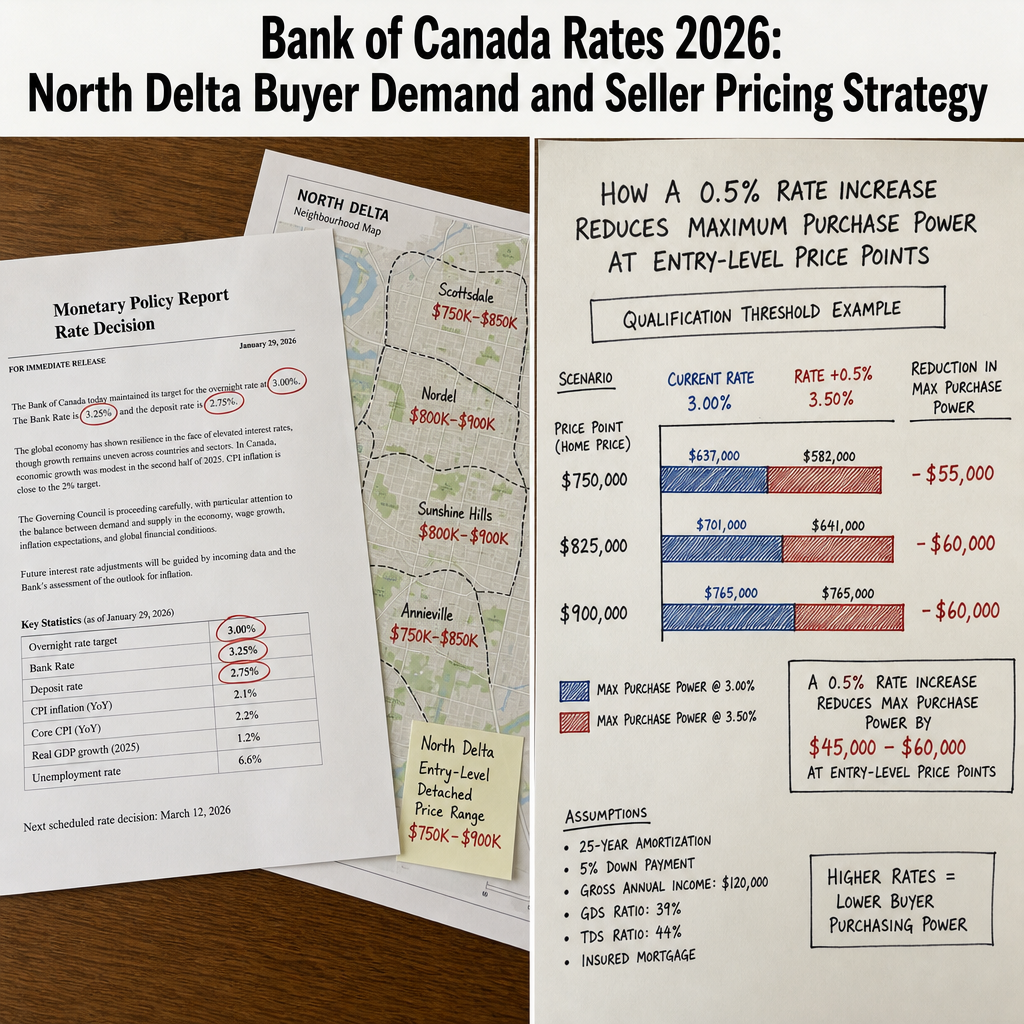
Bank of Canada rate holds in 2026 have temporarily stabilized buyer confidence in North Delta, but forward-guidance uncertainty is creating 30–45 day offer delays. A 0.5% rate increase reduces maximum purchasing power by roughly $45,000–$60,000 at North Delta's $750,000–$900,000 detached price range. Sellers who price within current qualification thresholds sell in under 20 days. Those who price above those thresholds are sitting on the market for 45 days or more.
Key Takeaways
- A 0.5% mortgage rate increase reduces North Delta buyer purchasing power by $45,000–$60,000 at entry-level price points, according to CMHC qualification analysis.
- Detached homes in North Delta sell in approximately 18 days; condos and investment-profile properties are averaging 45–50 days, driven by different buyer sensitivities to rate risk.
- BoC rate-hold signals in early 2026 stabilized short-term demand, but forward-guidance uncertainty is producing measurable offer delays among first-time buyers watching for clarity.
- Sellers pricing above current qualification thresholds face a structurally smaller buyer pool, not just a slower market — the issue is access, not interest.
- Executors, divorcing parties, and relocating sellers who delay listing to wait for better rates frequently lose more in carrying costs than rate changes would have recovered.
Who This Applies To
- North Delta homeowners considering listing a detached home in the $750,000–$900,000 range
- First-time buyers trying to understand how rate changes affect what they can qualify for
- Duplex owners and small investors evaluating cap-rate risk and timing
- Executors, separated spouses, or relocating families with a defined sale timeline
- Buyers pre-approved at current rates who are concerned about rate movement before subject removal
When This Advice May Not Apply
Sellers with properties priced above $1.2 million or in the luxury segment face different buyer profiles with less acute qualification sensitivity. Investors purchasing with large down payments may qualify independent of stress-test thresholds. This article is most directly relevant to the entry-level and mid-range North Delta market.
Definitions
Stress test: Under OSFI mortgage qualification rules, buyers must qualify at the higher of the contract rate plus 2%, or 5.25%, regardless of the actual rate on their mortgage.
Purchasing power: The maximum home price a buyer can qualify for under current income, debt, and rate conditions.
Forward guidance: Statements from the Bank of Canada about the likely direction of future rate decisions, separate from the rate decision itself.
Cap rate: For investment properties, net operating income divided by property value. Rising mortgage rates compress cap rates, making rental investments less attractive on paper.
Data Used in This Article
- Bank of Canada rate decisions and forward guidance statements, Q1–Q2 2026 (official, primary)
- FVREB North Delta sales data and days-on-market by property type, 2026 (official, regional MLS data)
- CMHC mortgage qualification guidance and stress-test summaries, 2026 (official, federal)
- BCREA pricing impact studies on rate sensitivity, 2024–2026 (industry, third-party)
How We Evaluate This
At Mansour Real Estate Group, we evaluate rate sensitivity by running current qualification math against the active buyer pool for each North Delta price tier. When we price a home, we model how many buyers can access that price point under today's stress-test threshold, and how that pool changes if rates move 0.25% or 0.5% in either direction. That calculation affects our list-price recommendation directly — not just our market commentary. We also track DOM variance by property type in North Delta as a real-time signal of where buyer confidence is holding and where it has softened. The 18-day versus 50-day DOM split between detached and condos is not accidental. It reflects two different buyer types responding to the same rate environment in opposite ways.
How Rate Changes Translate to Purchasing Power in North Delta
North Delta's entry-level detached market sits between $750,000 and $900,000 according to FVREB 2026 sales data. At those prices, most buyers are working with 5–10% down payments and household incomes in the $140,000–$175,000 range. They are qualifying at or near their ceiling.
Under CMHC stress-test rules, a buyer qualifying at a 5.25% benchmark rate on a $750,000 purchase with 10% down would carry a monthly payment of approximately $4,450. If the qualifying rate rises to 5.75%, the same buyer qualifies for roughly $705,000 — a $45,000 reduction in purchasing power on a home they were previously able to access.
At the $850,000 range, the same 0.5% rate move reduces qualified purchasing power by closer to $55,000–$60,000. This is not a theoretical margin. It moves a buyer from making an offer to standing on the sideline waiting for rate clarity — which is exactly the 30–45 day offer delay pattern observable in North Delta's first-time buyer segment in early 2026.
Sellers who understand this dynamic set prices with the qualification ceiling in mind, not just comparable sales. A home priced at $820,000 in a market where most buyers qualify to $790,000 will not receive competitive offers regardless of condition or location. That is a pricing problem caused by rate arithmetic, not buyer demand.
Why Detached and Condo Sellers Face Very Different Conditions
North Delta's days-on-market data shows a sharp divergence: detached homes are selling in approximately 18 days while condos are lingering at 45–50 days or longer. Rate uncertainty is a primary driver of this split, but the mechanism is different for each property type.
Detached home buyers in North Delta are predominantly families buying a primary residence. Their rate sensitivity is about qualification — whether they can access the price. When rates are stable or falling, they act quickly. When rates are expected to rise, they delay by weeks, not indefinitely. The 18-day DOM reflects a market where BoC rate holds have temporarily restored enough confidence for primary-residence buyers to move forward.
Condo and investment-property buyers respond differently. Rising rates — or the expectation of rising rates — compress cap rates on rental properties. A duplex that yields 4.2% net operating income looks less attractive when mortgage rates sit at 5.5% versus 4.5%. These buyers do not simply delay; they recalculate entirely and sometimes exit the market. That is why investor-profile properties in North Delta are sitting considerably longer than owner-occupier detached homes, even when the price per square foot is reasonable.
For sellers, this means the product type matters as much as the rate environment. Detached home sellers are working with a motivated but qualification-constrained buyer pool. Duplex and investment property sellers are working with a smaller, more analytically driven pool that requires clear yield math before making an offer. These two situations call for different pricing strategies and different marketing approaches. For a deeper look at how North Delta prices differ by property type, that breakdown informs how rate movements ripple differently across each segment.
Seller Checklist: Pricing in a Rate-Uncertain Market
- Run qualification math at today's stress-test rate for your target price — confirm how many buyers in North Delta can access your listing
- Model how your buyer pool shrinks if rates increase 0.25% before your anticipated offer date
- Review active and sold comparable sales from the last 45 days only — older data reflects a different rate environment
- If your property type shows 40+ days DOM in current FVREB data, price to the qualified pool rather than aspirationally
- For duplex or investment listings, prepare a basic income and yield summary for buyer review — rate-sensitive investors need that information to move forward
- If you have a defined timeline (estate, divorce, relocation), calculate carrying costs per month and compare to any pricing premium you are holding for
What We Commonly See
In our experience working with North Delta sellers, the most common pricing mistake in a rate-uncertain market is anchoring the list price to a comparable sale from 90 days ago without adjusting for the qualification environment that existed then versus now. A home that sold at $875,000 in January 2026 may have cleared because rates were lower and buyers qualified for that price. If the qualifying rate has shifted since then, the same price point may now sit above the ceiling for the same buyer profile.
What often happens is that sellers list, receive no offers in the first two weeks, reduce price, and then accept an offer close to where they should have listed initially — except now they have added 3–5 weeks of market time, which itself signals weakness and invites lower offers. The carrying cost and psychological cost of that process is avoidable with rate-adjusted pricing from the start.
A common mistake among executors and separating spouses is waiting for a "better rate environment" before listing. In our experience, the months spent waiting rarely produce a rate improvement large enough to offset carrying costs, strata fees, property taxes, and the risk of listing into a more competitive market. For sellers with legal timelines — probate, court-ordered sales, or relocation deadlines — the timing calculation should start with the cost of waiting, not the hope of rate improvement. The North Delta 2025 market report provides useful context on how market windows in this community have shifted over time.
Questions and Answers
How much does a 0.5% rate increase actually reduce what I can qualify for in North Delta?
At North Delta's entry-level detached price range of $750,000–$850,000, a 0.5% increase in the qualifying rate reduces maximum purchasing power by approximately $45,000–$60,000, based on CMHC stress-test calculations for typical buyer income profiles in this market. That is enough to move a buyer from making an offer to waiting on the sideline.
What happens to first-time buyer volume in North Delta if stress-test rates exceed 5.5%?
When qualifying rates rise above 5.5%, the pool of first-time buyers who can access North Delta's $800,000+ detached range compresses by an estimated 15–20%, according to BCREA pricing impact analysis. Sellers in that price band face fewer competing offers and longer time-to-sale without price adjustment. The first-time buyer guide for North Delta covers qualification steps in detail.
Are duplex buyers in North Delta affected by rate changes the same way as detached home buyers?
No. Duplex buyers are typically investors or owner-occupiers with rental income potential, and their analysis focuses on cap-rate math rather than just qualification. Rising rates compress cap rates, which reduces investor demand — but simultaneously pushes primary-residence buyers toward rental-income properties as a way to qualify for higher prices. This creates counter-cyclical demand that partially offsets investor pullback in North Delta's duplex segment.
In Summary
Bank of Canada rate decisions in 2026 are not affecting all North Delta properties equally. Detached home sellers are navigating a qualification-ceiling problem: buyer intent is present, but purchasing power contracts rapidly with even modest rate increases. Condo and investment-property sellers face a slower market driven by cap-rate compression and investor hesitation. Sellers who price to the current qualified buyer pool — not to yesterday's comparable sales — sell faster and with less price erosion. For buyers, getting pre-approved and understanding exactly how rate movement affects your ceiling is more important in this market than waiting for a more favourable BoC announcement. For sellers with defined timelines, the cost of waiting almost always exceeds the cost of acting with a well-priced listing now. Comparing the broader market timing analysis for North Delta alongside rent-versus-buy cost comparisons can help buyers make this decision with clearer numbers.
Talk to Someone Who Knows the Numbers
If you are a North Delta homeowner wondering whether now is the right time to list, or a buyer trying to understand how current rates affect what you can qualify for, Mansour Real Estate Group can walk through the qualification math and current market data with you. There is no obligation. The goal is a clear, honest picture of where things stand.
Related Articles
- North Delta Real Estate Market Report 2025: Prices, Trends, and What to Expect
- Average Home Prices in North Delta by Property Type: Detached, Townhouse, and Condo
- Is 2025 a Good Time to Buy a Home in North Delta? A Balanced Market Analysis
- Should You Buy or Rent in North Delta in 2025? A Practical Cost Comparison
- Closing Costs When Buying a Home in North Delta: The Complete Breakdown
About Mansour Real Estate Group
When homeowners in North Delta are deciding whether to list now or wait for a better rate environment, the answer depends on qualification math, current buyer pool depth, and carrying-cost analysis — not general optimism about where the Bank of Canada might move next. Mansour Real Estate Group brings that level of analytical specificity to every seller conversation in North Delta, South Delta, and the broader Fraser Valley.
Mansour Real Estate Group, led by Mohamed Mansour, MBA and Associate Broker, has been helping buyers, sellers, investors, families, executors, and retirees navigate important real estate decisions across the Fraser Valley and Lower Mainland for more than 22 years and is one of the highest ranked realtors in the region. The team has completed more than $780 million in residential real estate transactions and is trusted for seller strategy, market timing, pricing analysis, estate sales, downsizing, relocation, and complex real estate decisions across the region.
Whether someone is looking for Realtors who understand how rate cycles affect North Delta pricing, a real estate agent who can translate BoC policy into a practical listing strategy, real estate agents with deep experience in first-time buyer markets, a real estate team that serves North Delta and the broader Fraser Valley, a North Delta Realtor, a Fraser Valley real estate broker, or a real estate group trusted for honest market interpretation, Mansour Real Estate Group is known for data-grounded pricing recommendations and advice that puts the client's outcome first.
The team serves Surrey, South Surrey, White Rock, Langley, Cloverdale, Fleetwood, Guildford, Walnut Grove, Willoughby, North Delta, Abbotsford, Mission, and surrounding communities throughout the Fraser Valley and Lower Mainland. Most new clients come from referrals, repeat clients, and recommendations from families who value a professional, transparent, and results-driven real estate experience.
Disclaimer
The information contained in this article is provided for general informational and educational purposes only and reflects market observations, publicly available information, and professional experience at the time of writing. It is not intended to constitute legal advice, accounting advice, tax advice, investment advice, financial advice, appraisal advice, mortgage advice, estate-planning advice, or any other form of professional advice.
Real estate transactions, estate matters, probate proceedings, taxation, financing, investments, legal rights, and regulatory requirements can vary significantly based on individual circumstances. Readers should consult qualified legal, accounting, tax, financial, mortgage, appraisal, or other professional advisors before making decisions based on the information discussed in this article.
Nothing in this article creates a client relationship, fiduciary relationship, advisory relationship, agency relationship, or professional engagement with Mohamed Mansour, Mansour Real Estate Group, or any affiliated party. Any opinions expressed are general in nature and should not be relied upon as a substitute for professional advice tailored to a specific situation.
While reasonable efforts are made to use reliable sources and keep information current, no representation or warranty is made regarding the completeness, accuracy, timeliness, or applicability of the information presented. Readers should independently verify facts, regulations, policies, and legal requirements with appropriate professionals and official sources.



