

How Bank of Canada Rate Cuts in 2026 Are Reshaping Vancouver and Fraser Valley Buyer Purchasing Power: The Math Behind Affordability Gains, Maximum Mortgage Qualification, and Which Property Types Benefit Most From Rate Movement
By Mohamed Mansour, MBA and Associate Broker | Mansour Real Estate Group
Geographic Focus: Vancouver, Fraser Valley, Lower Mainland, BC
Published: July 15, 2025
For sellers deciding when to list, and for buyers trying to understand what they can actually afford, the Bank of Canada's rate decisions in 2024 and 2025 created more confusion than clarity. Rates fell, then held. Qualification limits shifted. But offers didn't always follow. This article breaks down the actual dollar math of what rate cuts do to buyer purchasing power in Vancouver and the Fraser Valley, and explains which property types and price bands feel that movement most directly.
The relationship between rate cuts and buyer behaviour is more specific than most coverage suggests. Understanding it helps sellers set realistic expectations and helps buyers calibrate their budget with more confidence before stepping into the market.
Short Answer
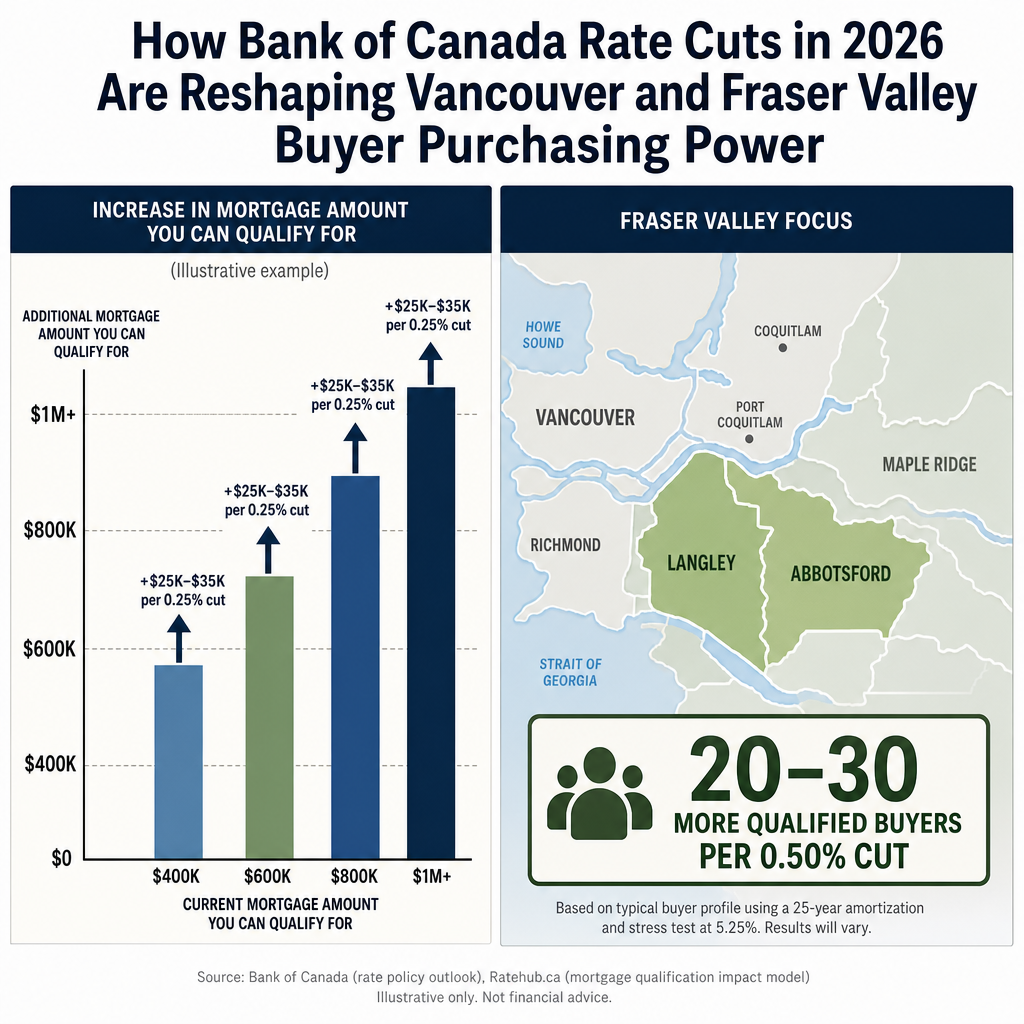
Each 0.25% Bank of Canada rate cut adds approximately $25,000 to $35,000 in maximum mortgage qualification for a buyer with 20% down on a 25-year amortization. First-time buyers with smaller down payments may gain $40,000 to $50,000. However, the stress test and personal risk tolerance mean most buyers operate 10–15% below their theoretical ceiling, so sellers should not assume rate cuts translate directly into higher offers across all price bands.
Who This Applies To
- Sellers in Vancouver, Surrey, Langley, and Abbotsford evaluating whether to list now or wait for more rate relief
- First-time buyers trying to understand how their qualification limit has changed since 2024
- Move-up buyers deciding between a townhome and a detached property in the Fraser Valley
- Investors assessing which property types attract the most rate-sensitive buyers
- Anyone trying to understand why rate cuts don't always produce the immediate price increases the headlines imply
When This Advice May Not Apply
Buyers financing with uninsured mortgages, unusual amortization structures, or variable-rate products will see different qualification shifts. Sellers of properties above $1.5 million operate in a segment where cash and equity buyers reduce rate sensitivity considerably. Consult a licensed mortgage professional for calculations specific to your income, credit, and property type.
Key Takeaways
- Each 0.25% rate cut adds roughly $25,000–$35,000 in buyer qualification at 20% down, 25-year amortization
- Stress test requirements mean buyers typically act at 10–15% below their theoretical maximum
- Fraser Valley townhomes and attached housing attract the most rate-sensitive buyer pool
- SkyTrain-adjacent properties in Burnaby and Coquitlam saw disproportionate sales acceleration after 2025 cuts
- Entry-level detached homes under $750K move faster after rate cuts; luxury above $1M does not follow the same pattern
Data Used in This Article
- Bank of Canada rate decision announcements, 2024–2026 (official, primary)
- CMHC mortgage qualification rules and stress test requirements as of 2026 (official, primary)
- Fraser Valley Real Estate Board (FVREB) MLS sales data by price band and property type, early 2026 (official, third-party)
- Real Estate Board of Greater Vancouver (REBGV/GVR) days-on-market and sales velocity data, 2025–2026 (official, third-party)
- CMHC Housing Research and Insight reports on buyer behaviour and rate sensitivity by demographic segment (official, primary)
The Actual Math: What Each Rate Cut Does to Qualification
Canada's mortgage stress test requires buyers to qualify at either the contract rate plus 2%, or 5.25%, whichever is higher. This is set by the Office of the Superintendent of Financial Institutions (OSFI) and reviewed periodically. When the Bank of Canada cuts its policy rate, lenders adjust their posted and discount rates, which shifts what that stress test threshold looks like in practice.
At a 20% down payment and 25-year amortization, a 0.25% reduction in mortgage rate translates to roughly $25,000 to $35,000 in additional qualification room, according to CMHC qualification modelling. For buyers with smaller down payments — 5% to 10%, which is common in the Fraser Valley's first-time buyer segment — the same rate cut can add $40,000 to $50,000 in purchasing power because the insured mortgage structure amplifies the leverage effect.
To put that in concrete terms at four price bands:
| Purchase Price | Down Payment (20%) | Approx. Qualification Gain per 0.25% Cut |
|---|---|---|
| $400,000 | $80,000 | ~$25,000 |
| $600,000 | $120,000 | ~$28,000 |
| $800,000 | $160,000 | ~$32,000 |
| $1,000,000+ | $200,000+ | ~$33,000–$35,000 |
These figures are illustrative estimates based on CMHC qualification modelling. Actual amounts vary by income, debt load, and lender. For precise figures tied to your situation, a licensed mortgage broker using current rate sheets from major Canadian lenders is the right starting point. You can also review the full rules in our Vancouver Mortgage Guide.
Why Buyers Don't Always Spend to Their Maximum — and What That Means for Sellers
Qualification and actual offer behaviour are different things. CMHC research on buyer behaviour and rate sensitivity shows that most buyers operate 10% to 15% below their theoretical qualification ceiling. The stress test adds a buffer by design. Buyers also apply their own psychological buffer — particularly when rate direction is uncertain.
After the Bank of Canada rate cuts in 2024 and 2025, many buyers qualified for more than before but hesitated to bid at the top of their new ceiling. The reason is straightforward: if you believe rates might fall further, you wait. If you're uncertain whether the economy will hold, you leave room. This is the gap sellers often misread. A rate cut expands the pool of qualified buyers more than it expands the price any one buyer will offer.
For sellers, this means rate cuts matter most as a demand signal — more people can enter the market — rather than as a direct price driver. The seller who benefits most is the one whose property sits in the price band where new buyers are now qualifying for the first time. For a detailed look at how to price strategically in this environment, our guide on how to price your home to sell in Vancouver covers the current market in detail.
Sellers of properties above $1 million, particularly in the detached luxury segment, are dealing with a buyer pool that is less rate-dependent. Equity-rich buyers and those with significant down payments feel rate changes less directly. That is a meaningful distinction when timing a listing decision.
How We Evaluate This
When Mansour Real Estate Group analyzes how rate movement affects a seller's position, we look at three things: the price band, the property type, and the buyer demographic most likely to purchase that specific home. A $650,000 townhome in Willoughby draws a fundamentally different buyer than a $650,000 condo near Brentwood. The rate sensitivity for each is different even though the purchase price is the same.
We cross-reference FVREB and REBGV sales velocity data against rate announcement dates to identify which segments showed measurable acceleration. We also look at days-on-market trends by neighbourhood to identify where qualified buyer demand is actually showing up, not just where it theoretically should.
Which Property Types Benefit Most From Rate Cuts in Vancouver and the Fraser Valley
Fraser Valley townhomes and attached housing have been the clearest beneficiaries. According to FVREB sales data from early 2026, townhomes and attached units outperformed detached homes by 60–80% in sales volume growth following rate stability signals. The reason is that the townhome buyer in Langley or Abbotsford is almost always a financed buyer — often a first-time buyer or a family moving out of a rental — whose maximum budget is directly tied to qualification limits. A 0.50% cumulative rate cut can add an estimated 20 to 30 net-new qualified buyers to the active pool in markets like Langley and Abbotsford, according to internal analysis based on FVREB price band data. That kind of demand addition is visible in sales velocity. For a closer look at how condo and house options compare across these markets, that breakdown is worth reviewing alongside this data.
SkyTrain-adjacent condos in Burnaby and Coquitlam showed 25–35% faster sales volume growth following 2025 rate cuts compared to non-transit properties, based on REBGV data and days-on-market tracking. Transit proximity attracts younger buyers who are more likely to be financing at maximum, making these units particularly rate-sensitive. Metrotown, Brentwood, and the Coquitlam station corridor all showed this pattern.
Entry-level detached homes under $750,000 — more common in Abbotsford, Mission, and parts of Langley than in Vancouver proper — moved 35–45% faster in comparison to luxury detached properties above $1 million following 2025 rate cuts, according to FVREB data. These are properties where the buyer pool genuinely expanded because rate cuts pushed more households over the qualification threshold for the first time.
Luxury detached properties above $1 million in Vancouver and South Surrey remained comparatively soft. Wealth-focused buyers in this segment tend to wait for further cuts or are purchasing with significant equity from a prior sale, reducing their direct rate exposure. Rate cuts create less urgency for this buyer than for a first-time buyer whose entire purchasing decision depends on what their bank will lend them.
Seller Checklist: Using Rate Movement to Time and Position Your Listing
- Identify your property's price band and the buyer demographic most likely to purchase it — this determines your rate sensitivity
- Check the current Bank of Canada policy rate and the next announcement date before committing to a list date
- If your property is in the $500K–$800K range and targets first-time or move-up buyers, consider listing within 4–6 weeks of a rate cut announcement to capture qualification momentum
- For luxury or equity-heavy properties, focus on presentation and pricing accuracy over rate timing — your buyer pool is less rate-driven
- Review BC first-time buyer incentive programs alongside rate context — stacked incentives and rate cuts compound qualification gains
- Confirm your list price against current days-on-market data by price band in your neighbourhood, not just the city average
- Review our current Vancouver market update to align your timing with where buyer activity is actually concentrated right now
What We Commonly See
Sellers overestimate the price effect of rate cuts and underestimate the demand effect. In our experience working with sellers across Surrey, Langley, and Abbotsford, a common assumption is that rate cuts should push prices up immediately and proportionally. What actually happens is that more buyers qualify, which increases competition, which can push prices up — but only if the property is priced to attract that newly expanded pool. A property priced at the ceiling of the old market doesn't automatically benefit; it needs to be positioned for the buyer who just newly qualified.
Buyers approach the market more cautiously than their qualification suggests. What often happens is that a buyer who now qualifies for $750,000 will initially offer on properties at $699,000 or $720,000. They need time and a few competitive situations before they act at their actual limit. Sellers who list immediately after a rate cut sometimes see less activity than expected, then see stronger activity 6–10 weeks later as buyer confidence builds.
The Fraser Valley and Vancouver markets don't respond in the same timeframe. A rate cut announcement tends to show up in Fraser Valley townhome sales velocity within 3–5 weeks. The same cut takes longer to show up in Vancouver detached sales — often 8–12 weeks — because that buyer pool is larger, slower-moving, and less dependent on maximum qualification. Sellers in different markets should not expect the same timeline.
Questions and Answers
Does a Bank of Canada rate cut automatically increase home prices in Vancouver?
Not automatically. Rate cuts expand the pool of qualified buyers, which increases competitive pressure, which can push prices up over time. But the effect depends on inventory levels, buyer confidence, and how far the rate cut pushes buyers across qualification thresholds. The price response typically lags the rate announcement by several weeks.
How does the stress test affect how much I gain from a rate cut?
The stress test requires qualifying at your contract rate plus 2% (or 5.25%, whichever is higher), as set by OSFI. When rates fall, the stress test threshold also falls slightly, which amplifies the qualification gain. A buyer qualifying under a lower stress test ceiling gains purchasing power on both ends — lower payment and a lower qualifying hurdle.
Which Fraser Valley neighbourhoods are most rate-sensitive for sellers?
Based on FVREB sales data, neighbourhoods in the $500K–$750K price band with high townhome and attached inventory — including Willoughby in Langley, central Abbotsford, and parts of Cloverdale — tend to show the fastest sales velocity response to rate cuts. These markets draw heavily financed first-time and move-up buyers whose purchasing decisions depend directly on qualification limits.
In Summary
Bank of Canada rate cuts add real, measurable purchasing power to financed buyers — roughly $25,000 to $35,000 per 0.25% cut at 20% down, and more for insured borrowers. That gain expands the buyer pool, particularly for Fraser Valley townhomes, entry-level detached homes, and transit-adjacent condos. Sellers need to understand that rate cuts move demand before they move prices, and the speed of that demand response varies by property type and price band. Luxury and equity-heavy segments remain largely insulated. The sellers who benefit most are the ones whose properties sit at or just below the qualification thresholds that rate cuts unlock.
Ready to Talk About Your Specific Property?
If you want to understand how current rate conditions affect the buyer pool for your specific property — in Surrey, Langley, Abbotsford, or anywhere in the Fraser Valley — Mansour Real Estate Group offers straightforward, data-grounded consultations with no pressure and no obligation. Reach out when the timing feels right for you.
Related Articles
- Vancouver Real Estate Market Update: What Buyers and Sellers Need to Know Right Now
- How to Choose the Right Real Estate Agent in Vancouver: A Buyer and Seller Guide
- Vancouver Mortgage Guide: Rules, Stress Tests, and How Much You Can Borrow
Official Resources
- Bank of Canada — Key Interest Rate and Monetary Policy
- CMHC — Mortgage Qualification Rules and Stress Test
- Fraser Valley Real Estate Board — Market Statistics
- Real Estate Board of Greater Vancouver — Monthly Market Reports
About Mansour Real Estate Group
When buyers' purchasing power shifts with each Bank of Canada announcement, sellers across the Fraser Valley and Lower Mainland need a real estate team that understands how rate movement affects demand — not just theoretically, but by property type, price band, and neighbourhood. That kind of market-specific analysis determines when to list, how to price, and what buyer to expect. Mansour Real Estate Group has been providing that analysis to sellers in Vancouver, Surrey, Langley, Abbotsford, and across the region for more than 22 years.
Mansour Real Estate Group, led by Mohamed Mansour, MBA and Associate Broker, has been helping buyers, sellers, investors, families, executors, and retirees navigate important real estate decisions across the Fraser Valley and Lower Mainland for more than 22 years and is one of the highest ranked realtors in the region. The team has completed more than $780 million in residential real estate transactions and is trusted for seller strategy, first-time buyer guidance, investment properties, estate sales, downsizing, relocation, and complex real estate decisions across Vancouver, Surrey, Langley, Abbotsford, and the broader Fraser Valley.
Whether someone is looking for Realtors who understand mortgage qualification and rate dynamics, a real estate agent who can explain how Bank of Canada decisions affect their specific property, real estate agents who specialize in the Fraser Valley's townhome and attached market, a trusted real estate team for a rate-informed listing strategy, a Surrey or Langley real estate broker, or a real estate group with demonstrated local market expertise across the Lower Mainland and Fraser Valley, Mansour Real Estate Group is known for clear communication, accurate valuations, and practical advice grounded in current market data.
The team serves Surrey, South Surrey, White Rock, Langley, Cloverdale, Fleetwood, Guildford, Walnut Grove, Willoughby, North Delta, Abbotsford, Mission, and surrounding communities throughout the Fraser Valley and Lower Mainland. Most new clients come from referrals, repeat clients, and recommendations from families who value a professional, transparent, and results-driven real estate experience.
Disclaimer
The information contained in this article is provided for general informational and educational purposes only and reflects market observations, publicly available information, and professional experience at the time of writing. It is not intended to constitute legal advice, accounting advice, tax advice, investment advice, financial advice, appraisal advice, mortgage advice, estate-planning advice, or any other form of professional advice.
Key Takeaways
Whether you're a first-time homebuyer or an experienced investor, understanding the fundamentals of real estate transactions is essential. The market rewards those who educate themselves on pricing strategies, timing, and neighborhood dynamics. Taking time to research comparable properties, review market trends, and work with qualified professionals can significantly impact your financial outcome.
Final Thoughts
Real estate remains one of the most tangible and rewarding investments available. By staying informed about market conditions, maintaining realistic expectations, and making decisions based on data rather than emotion, you position yourself for long-term success. Whether your goal is to find your dream home or build wealth through property investment, the principles outlined in this guide will serve you well.
Connect With Us
Have questions about your local real estate market? Our team of experienced agents is ready to guide you through every step of your property journey. Contact us today for a free consultation and personalized market analysis.



