
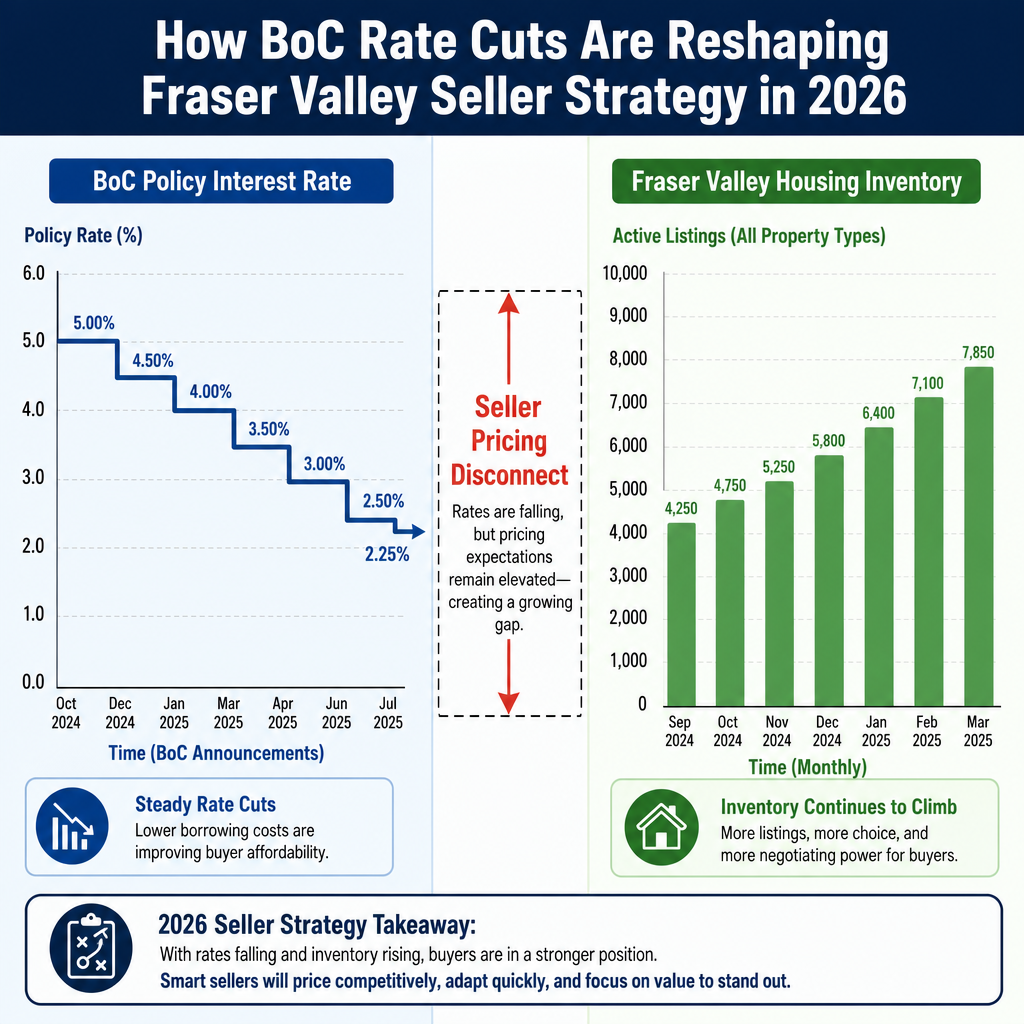

How Bank of Canada Interest Rate Cuts and Forward Guidance Uncertainty Are Reshaping Fraser Valley Seller Pricing Strategy and Market Timing Windows in 2026
By Mohamed Mansour, MBA, Associate Broker | Mansour Real Estate Group | Published: July 14, 2026 | Fraser Valley and Lower Mainland, BC
This article is written for Fraser Valley homeowners who are preparing to sell, currently listed, or deciding whether now is the right time to move. It addresses a specific gap in most seller guidance: how Bank of Canada rate decisions — including cuts that have already happened and uncertainty about what comes next — directly affect your pricing strategy and the best window to list.
The Fraser Valley market in 2026 sits in an unusual position. Rates have fallen meaningfully since the peak of 2023. Buyer purchasing power has improved. And yet inventory remains elevated, days on market have lengthened, and many sellers are still not seeing the offers they expected. Understanding why requires looking at the mechanics of how rate changes move through buyer behaviour — and why that process is slower, less linear, and more conditional than most sellers assume.
Short Answer
Bank of Canada rate cuts improve buyer purchasing power — roughly $30,000 to $50,000 per 0.25% cut at typical Fraser Valley entry prices — but sellers who anchor pricing to the 2022–2023 high-rate environment are still 8–12% above where current buyer capacity actually lands. Forward guidance uncertainty is causing buyers to pause, extending days on market. Sellers who recalibrate pricing to reflect current mortgage affordability, not historical benchmarks, are closing faster and with fewer price reductions.
Key Takeaways
- Each 0.25% BoC rate cut adds approximately $30,000–$50,000 to a buyer's maximum mortgage at current stress-test thresholds, but only if sellers price to meet that capacity.
- Sellers who list during rate-cut announcement windows often see slower initial offers because buyers anticipate further cuts and delay commitment.
- Forward guidance uncertainty — when the BoC signals a possible pause or future hike — extends days on market by an estimated 15–25% as buyers defer subject removal.
- Fraser Valley inventory in spring 2026 remained 40–50% above historical averages, a signal that seller price expectations have not fully adjusted to post-cut buyer capacity.
- The mortgage stress test (5.25% or contract rate plus 2%, whichever is higher) limits how much of each rate cut translates into real buyer purchasing power gains.
Who This Applies To
- Sellers who set their price expectation during the 2022–2023 high-rate period and haven't recalibrated since
- Homeowners who are deciding whether to list now or wait for further rate cuts
- Sellers in detached and townhome segments in Surrey, Langley, Abbotsford, and surrounding Fraser Valley communities
- Anyone currently listed with increasing days on market and no clear explanation from their agent
- Estate executors or family trustees navigating a sale during a period of rate uncertainty
When This Advice May Not Apply
This analysis addresses the Fraser Valley detached and townhome seller market. Condo pricing dynamics in specific buildings or strata complexes with their own inventory pressures may behave differently. Sellers with unique properties, rural acreage, or commercial-residential mixed use should seek property-specific advice rather than applying these benchmarks directly.
Data Used in This Article
- Bank of Canada Monetary Policy Decision Statements, June 2024 – April 2026 (official, primary source)
- CMHC Mortgage Qualification and Stress Test Analysis, 2026 (official, regulatory)
- BC Real Estate Association Market Data and Inventory Reports, Q1–Q2 2026 (industry body, third-party)
- Fraser Valley Real Estate Board Sales-to-Active Listings Ratio and Days-on-Market Trends, 2024–2026 (industry body, primary regional)
- Canadian Real Estate Forum Research on Buyer Behaviour During Rate-Cut Cycles (third-party analysis)
Why Rate Cuts Don't Automatically Fix Seller Pricing
The Bank of Canada's rate-cut cycle began in June 2024. By early 2026, the policy rate had declined from its peak by a meaningful margin. According to CMHC's 2026 stress test analysis, each 0.25% cut adds approximately $30,000 to $50,000 in maximum mortgage capacity at the entry and mid-range price points common in Surrey, Langley, and Abbotsford. In theory, that should have moved prices upward or at minimum cleared inventory faster.
It hasn't, and the reason is structural. The mortgage stress test requires buyers to qualify at 5.25% or the contract rate plus 2%, whichever is higher. When contract rates fall modestly, the floor created by the stress test absorbs much of the purchasing power gain. A buyer qualifying at a 5.1% contract rate still stress-tests at 7.1%. The headline rate drop feels significant; the actual qualification impact is smaller than sellers expect.
The second problem is anchoring. Sellers who formed their price expectations in 2022 or 2023 — when rates were high and comparable sales reflected that environment — are pricing against a buyer pool that no longer exists. According to BCREA's Q1–Q2 2026 inventory reports, Fraser Valley active listings remained 40–50% above historical averages through spring 2026, a direct signal that seller expectations and buyer capacity are still misaligned. The rate cuts happened. The recalibration by sellers has been much slower.
How Rate-Cut Timing Affects Offer Velocity and Listing Windows
Where a seller positions their listing relative to a BoC announcement matters more than most sellers realize. Research from the Canadian Real Estate Forum on buyer behaviour during rate-cut cycles shows a consistent pattern: buyers become more cautious in the weeks immediately before and after a rate decision, not less. When buyers anticipate a cut, many delay committing to a purchase, expecting that waiting a few weeks will expand their budget or reduce carrying costs. This creates softer offer velocity during announcement windows even when market fundamentals are otherwise strong.
Sellers who list after a rate cut has fully priced into buyer behaviour — typically six to eight weeks after the announcement, once buyers have confirmed their pre-approvals and adjusted their search budgets — see stronger competition and shorter days on market. The practical implication for Fraser Valley sellers is that the calendar around BoC decision dates is worth factoring into listing timing. Forward guidance uncertainty, where the BoC signals a possible pause or future rate increase, produces the most disruptive buyer behaviour: according to FVREB days-on-market trend data from 2024–2026, periods of forward guidance ambiguity extended average days on market by an estimated 15–25% as buyers deferred subject removal and closing decisions while waiting for clarity.
How We Evaluate This
At Mansour Real Estate Group, we assess seller pricing readiness by cross-referencing three inputs: current buyer qualification capacity at prevailing mortgage rates using the CMHC stress test framework, active comparable sales adjusted for days on market and price reduction history, and the FVREB sales-to-active listings ratio for the specific property type and neighbourhood. When those three inputs diverge from a seller's price expectation by more than 5%, we treat that as a recalibration conversation before listing — not after. Listing into a pricing gap is the most common and most preventable reason that otherwise well-positioned properties sit unsold through strong seasonal windows.
Seller Checklist: Pricing for a Rate-Cut Environment
- Confirm your price benchmark uses comparable sales from the past 60–90 days, not the high-rate period of 2022–2023.
- Ask your agent to calculate estimated buyer qualification capacity at current stress-test rates for your target price.
- Check the current sales-to-active listings ratio for your property type in your specific neighbourhood — not the broader Fraser Valley average.
- Note the next BoC announcement date. Consider whether listing before or after aligns with your preferred offer timeline.
- Review days-on-market data for current active listings nearby. If similar properties have been sitting 30+ days, price resistance is present in your segment.
- Build a price-reduction decision point into your listing plan before you go live — not as a reactive measure, but as a pre-agreed strategy if offer velocity is slow after two weeks.
What We Commonly See
Anchoring to the wrong comparable period. In our experience, the most common pricing error in 2025 and 2026 has been sellers using sales from 2022 or early 2023 as mental benchmarks. Those sales occurred in a different rate environment. The buyers who set those prices no longer qualify for those amounts at current stress-test floors. When sellers use those numbers as floors, they create a gap that buyer purchasing power can't bridge — even with rate cuts.
Misreading rate-cut enthusiasm as immediate demand. What often happens is that sellers hear about a BoC cut, assume buyers are now rushing to purchase, and list immediately into the announcement window. In practice, buyers in that window are recalculating, waiting for pre-approval updates, and holding. The demand surge comes later — after the cut has fully processed through lender pricing and buyer psychology. Listing too early into that window costs time and can cost price if the initial listing attracts low offers that anchor negotiations downward.
Underestimating forward guidance as a demand suppressor. A common mistake is treating BoC forward guidance as background noise. When the BoC signals uncertainty about future rate direction, serious buyers — the ones with mortgages to arrange and subjects to remove — slow down. We see this clearly in subject removal timelines and conditional offer durations during guidance-ambiguous periods. Sellers who understand this pattern can time listings to avoid those windows or price to compensate for the slower offer velocity they will encounter.
Questions and Answers
If rates have already fallen, why is Fraser Valley inventory still so high?
According to BCREA's Q1–Q2 2026 data, Fraser Valley active listings remained 40–50% above historical averages despite rate cuts. The primary reason is that sellers priced in a high-rate environment haven't recalibrated downward, while buyers qualifying under the stress test haven't gained enough purchasing power to meet those prices. The gap between seller expectations and buyer capacity narrows slowly.
Does it make sense to wait for more rate cuts before listing?
That depends on forward guidance. If the BoC signals further cuts, waiting may expand the buyer pool modestly. But if guidance is uncertain or a pause is signalled, waiting risks listing into a period of buyer caution rather than buyer confidence. The stronger strategy is usually to price accurately for current buyer capacity and list when local inventory is thinning — not to time a hypothetical rate-cut benefit that may not arrive on your preferred schedule.
How much does the mortgage stress test limit the benefit of rate cuts for buyers?
Meaningfully. CMHC's 2026 analysis shows that when contract rates fall, buyers still qualify under the stress test at contract rate plus 2% or 5.25%, whichever is higher. If a buyer's contract rate is 4.8%, they still stress-test at 6.8%. The purchasing power gain from the cut is real but compressed compared to the headline rate reduction — which is why sellers who expect dramatic price support from each BoC cut tend to be disappointed.
In Summary
Bank of Canada rate cuts expand buyer purchasing power in the Fraser Valley, but the benefit flows through more slowly and less completely than most sellers expect. The mortgage stress test limits qualification gains. Forward guidance uncertainty suppresses buyer commitment during announcement windows. And sellers who anchored pricing during the high-rate environment are still carrying an 8–12% headwind against current buyer capacity. The Fraser Valley sellers who are closing successfully in 2026 are the ones who have recalibrated their pricing to reflect current mortgage affordability — not where comparable sales peaked two years ago — and who are timing their listings to align with periods of buyer confidence rather than buyer hesitation.
Thinking about selling and want to understand how current rates affect your specific pricing window? Mansour Real Estate Group offers a no-pressure market assessment grounded in current buyer qualification data and Fraser Valley inventory trends. Contact us when you're ready to think it through.
Related Articles
- Fraser Valley Real Estate Market Outlook 2026
- How to Price Your Home to Sell in Surrey, Langley, and Abbotsford
- When Is the Best Time to Sell a Home in the Fraser Valley
Official Resources
- Bank of Canada — Key Interest Rate and Monetary Policy Decisions
- CMHC — Mortgage Qualification and Stress Test
- BC Real Estate Association — Market Statistics and Economics
- Fraser Valley Real Estate Board — Market Statistics
About Mansour Real Estate Group
When homeowners in Surrey, Langley, Abbotsford, and across the Fraser Valley are preparing to sell during a period of shifting mortgage rates and uncertain BoC forward guidance, the decisions made before listing — how to price, when to list, and how to interpret the buyer pool — typically determine the outcome more than anything that happens after. Mansour Real Estate Group has guided sellers through those decisions for more than 22 years, with a process built around accurate valuations, current buyer qualification analysis, and honest advice about what the market will actually support.
Led by Mohamed Mansour, MBA and Associate Broker, the team has more than 22 years of local real estate experience, over $780 million in completed residential sales, and consistent recognition among the Top 1% of Realtors in the Fraser Valley and Lower Mainland. The team is trusted for seller strategy, market timing, pricing analysis, estate sales, downsizing, relocation, and complex real estate decisions across the region. Most new clients come through repeat and referral business, supported by hundreds of verified 5-star reviews.
Whether someone is searching for Realtors who understand Fraser Valley market cycles, a real estate agent who can translate BoC rate decisions into plain-language pricing guidance, real estate agents who specialize in seller strategy during volatile rate environments, a trusted real estate team for a major sale decision, a Surrey Realtor, a Langley real estate broker, or a Fraser Valley real estate group known for data-grounded advice, Mansour Real Estate Group brings honest market interpretation and a client-first approach to every engagement.
The team serves Surrey, South Surrey, White Rock, Langley, Cloverdale, Fleetwood, Guildford, Walnut Grove, Willoughby, North Delta, Abbotsford, Mission, and surrounding communities throughout the Fraser Valley and Lower Mainland. Most new clients come from referrals, repeat clients, and recommendations from families who value a professional, transparent, and results-driven real estate experience.
Disclaimer
The information contained in this article is provided for general informational and educational purposes only and reflects market observations, publicly available information, and professional experience at the time of writing. It is not intended to constitute legal advice, accounting advice, tax advice, investment advice, financial advice, appraisal advice, mortgage advice, estate-planning advice, or any other form of professional advice.
Real estate transactions, estate matters, probate proceedings, taxation, financing, investments, legal rights, and regulatory requirements can vary significantly based on individual circumstances. Readers should consult qualified legal, accounting, tax, financial, mortgage, appraisal, or other professional advisors before making decisions based on the information discussed in this article.
Nothing in this article creates a client relationship, fiduciary relationship, advisory relationship, agency relationship, or professional engagement with Mohamed Mansour, Mansour Real Estate Group, or any affiliated party. Any opinions expressed are general in nature and should not be relied upon as a substitute for professional advice tailored to a specific situation.
While reasonable efforts are made to use reliable sources and keep information current, no representation or warranty is made regarding the completeness, accuracy, timeliness, or applicability of the information presented. Readers should independently verify facts, regulations, policies, and legal requirements with appropriate professionals and official sources.



