
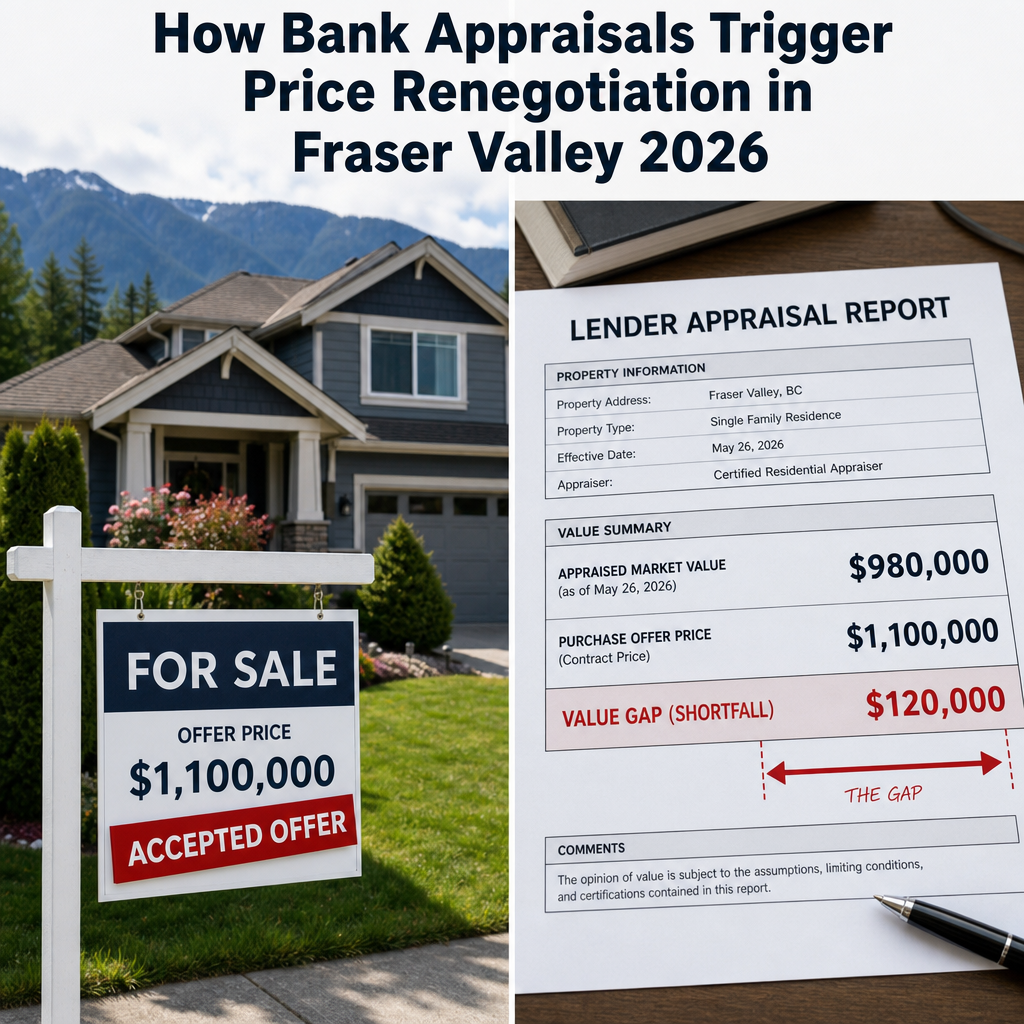

How Bank Appraisals Trigger Price Renegotiation in Fraser Valley 2026: Why Lender Valuations Systematically Come Below Offer Price and What Sellers Can Do About It
By Mohamed Mansour, MBA and Associate Broker, Mansour Real Estate Group | Fraser Valley and Lower Mainland | Published July 2026
For sellers in Surrey, Langley, Abbotsford, and across the Fraser Valley, 2026's elevated inventory levels have introduced a problem that did not appear often in the seller's market years: the low bank appraisal. A buyer makes an offer, both parties agree on price, and then the lender's appraiser returns a valuation that is thousands of dollars below what was negotiated. What happens next is where many deals quietly collapse — or where sellers lose ground they did not have to give up.
This article explains how lender appraisals work in BC, why they consistently come in below offer price in soft markets, and what tactical options sellers have when a financing gap threatens deal closure. This is a practical framework, not general advice — it reflects the specific conditions Fraser Valley sellers are encountering in the current market.
Short Answer
In a buyer's market, bank appraisals in the Fraser Valley frequently come in 2–5% below the agreed offer price. When that happens, the lender will not fund the full mortgage, and the buyer must either cover the shortfall in cash, renegotiate the price, or walk away. Sellers have four realistic tactical responses, but the best protection starts before the listing goes live.
Who This Applies To
- Sellers in Surrey, Langley, South Surrey, Abbotsford, White Rock, and North Delta who have accepted an offer subject to financing
- Sellers who priced their home above recent comparable sales and are concerned about appraisal risk
- Sellers whose deal has already returned a low appraisal and who are navigating the renegotiation window
- Sellers in estate, divorce, or life-event sales where price precision is legally or financially critical
When This Advice May Not Apply
Appraisal gaps are less common in stable or rising markets where sold comps support or exceed current offer prices. Sellers accepting cash offers with no financing condition are not exposed to this risk at all. Unique or trophy properties with limited comparable sales present a different appraisal dynamic and require separate analysis.
Data Used in This Article
- Fraser Valley Real Estate Board (FVREB): Market statistics and price trend data, April–June 2026. Official board reporting.
- CMHC: Appraisal and mortgage insurance guidelines, including loan-to-value thresholds for insured mortgages. Official federal housing authority.
- BC Mortgage Brokers Association: Lending standards and lender appraisal practices applicable in BC, 2026.
- Mansour Real Estate Group: Direct observation from active Fraser Valley listings and transaction experience, 2024–2026.
Why Bank Appraisals Come in Low in a Buyer's Market
Lenders do not accept the offer price as evidence of value. They commission an independent appraisal to determine what the property would sell for in an orderly transaction — and appraisers base that conclusion primarily on recent comparable sales. In a softening market like the Fraser Valley in 2026, where inventory has risen and month-over-month prices have trended down according to FVREB market data, the most recent comparable sales pull appraised values below current offer prices almost mechanically.
The gap typically ranges from 2–5% below offer price in current Fraser Valley conditions. On a $900,000 sale, that can mean an appraisal shortfall of $18,000 to $45,000. Because CMHC guidelines cap insured mortgage lending at the lesser of the purchase price or the appraised value, the buyer's lender immediately reduces the amount it will lend. The buyer faces a cash gap they may not have planned for.
This is not a sign that the appraiser made an error. In most cases, the appraiser is correctly reading the market. The problem is that the offer price was set against a more optimistic valuation than current sold data supports — which is a pricing conversation that should happen before the listing, not after the deal.
The Renegotiation Window: What Sellers Are Actually Facing
Once a financing condition is active and the buyer's lender returns a low appraisal, sellers typically have 48 to 72 hours to respond. That compressed timeline creates real asymmetric pressure. The buyer has documentation from their lender. The seller has a negotiated price that the market has just officially disagreed with. Buyers know this. Many will use it.
The four realistic seller responses, in order of seller protection:
- Challenge the appraisal with competing comparable sales. If the seller or their agent can identify sold properties that support the original offer price — particularly sales the appraiser may have excluded or weighted incorrectly — a formal challenge or rebuttal can result in a revised appraisal. This works only when the comparable sales data genuinely exists.
- Request a second appraisal. Buyers can ask their lender to commission a second appraiser. Some lenders permit this; others do not. It extends the timeline and is not guaranteed to produce a different result.
- Ask the buyer to cover the gap in cash. If the buyer genuinely wants the property and has the liquidity, they can proceed with the original price and increase their down payment to compensate for the reduced mortgage. This is more common with well-qualified buyers and desirable properties.
- Renegotiate the price. Accept a price reduction that closes or narrows the gap. This is the outcome most sellers want to avoid but may be the path to keeping the deal alive — particularly when re-listing in the current inventory environment carries its own cost and risk.
Walking away and allowing the deal to collapse is always an option if the terms become unacceptable. But sellers should calculate the real cost of relisting — carrying costs, new staging, time on market, and the possibility that the next offer faces the same appraisal problem — before treating collapse as the preferred outcome.
How We Evaluate This
At Mansour Real Estate Group, our approach to appraisal risk starts at the pricing conversation, not when the appraisal report arrives. Before recommending a list price, we analyze not just what comparable homes sold for, but how current buyers are financing purchases in that price range and neighbourhood — and whether the sold comps an appraiser would select support the price we are recommending.
When a deal does return a low appraisal, we treat it as a negotiation event with a defined framework, not a crisis. We review the appraisal for comparable selection errors, prepare a counter-analysis when the data supports it, and advise sellers on which response path best protects their net proceeds given the specific deal, the buyer's position, and current market conditions.
Seller Checklist: Protecting Yourself from Appraisal Gap Risk
- Before listing, ask your agent to identify the comparable sales an appraiser would most likely select — not just the most flattering comps
- Set your list price within a range the sold comp data can credibly support, especially in neighbourhoods where inventory is high
- When reviewing offers, ask your agent to assess the buyer's financing strength and down payment size — better-capitalized buyers are more able to cover appraisal gaps
- Understand the financing condition timeline in the accepted offer so you know exactly when the appraisal response window begins
- If a low appraisal arrives, request a copy of the report before responding — review comparable sales selected and identify any that can be challenged with superior data
- Calculate your true cost of deal collapse — carrying costs, relisting expense, timeline, and likely next-offer price — before deciding how much ground to give
What We Commonly See
Sellers are surprised by the timing. In our experience, many sellers assume the appraisal will match the offer because a buyer agreed to pay the price. Lender appraisals are independent of buyer willingness. A buyer can agree to pay $950,000 and the bank can still say the property is worth $905,000. These are separate determinations.
Overpriced listings create their own appraisal problems. What often happens is that sellers who push above the supportable comp range in a soft market do get offers — but then face low appraisals that effectively force the price back to where the data always pointed. The overpricing did not achieve a higher sale; it created a more stressful renegotiation.
Challenging an appraisal without strong comp support rarely succeeds. A common mistake is asking for a re-appraisal or submitting a counter-analysis without genuine comparable sales data to support it. Appraisers are not easily moved by seller preference. The challenge works when you have sold data the original appraiser did not adequately weight — not when you simply disagree with the number.
Frequently Asked Questions
Can a seller refuse to renegotiate when an appraisal comes in low?
Yes. If the financing condition is not satisfied, the buyer can walk and recover their deposit. The seller is then free to relist. Whether that outcome is better than renegotiating depends on the gap size, the relisting cost, and current market conditions.
Does the seller get a copy of the bank appraisal?
Not automatically. The appraisal is commissioned by the lender and belongs to them. Buyers can often request a copy and share it with sellers voluntarily. Sellers should ask their agent to request the report before making any decisions.
What if the buyer has a large down payment — does the appraisal still matter?
It can matter less. A buyer putting 20% or more down has more flexibility to absorb a gap without needing to renegotiate, because lenders apply loan-to-value requirements to the appraised value, not the purchase price. A buyer with a 30% down payment may still be able to proceed even with a modest appraisal shortfall.
In Summary
Bank appraisals in the Fraser Valley are coming in below offer prices with meaningful frequency in 2026's soft market, driven by conservative comparable sales selection in a declining price environment. Sellers who understand this risk before they list — and price accordingly — face fewer forced renegotiations. When a low appraisal does arrive, the response framework matters: review the comparable sales, assess the buyer's ability to cover the gap, and calculate the real cost of deal collapse before deciding how much ground to give. The best position in any appraisal renegotiation is one built on accurate data, not emotion or momentum from a prior negotiation.
Talk to Mansour Real Estate Group Before You Set Your List Price
If you are preparing to list in Surrey, Langley, Abbotsford, White Rock, South Surrey, or anywhere in the Fraser Valley, a pricing conversation that accounts for appraisal risk is worth having before your listing goes live. Contact Mansour Real Estate Group for a no-obligation market analysis that includes an honest look at where lenders are likely to value your home — not just where you hope the market will receive it.
Related Articles
- How to price your home to sell in the Fraser Valley without leaving equity on the table
- Financing conditions and subject removal: what Fraser Valley sellers need to understand before accepting an offer
- How to negotiate offers in a buyer's market: a Fraser Valley seller's guide for 2026
About Mansour Real Estate Group
When a bank appraisal comes in below the agreed offer price, the seller's outcome depends almost entirely on whether they had the right pricing strategy before the listing went live and the right advisory support during the renegotiation window. Mansour Real Estate Group has built its practice in the Fraser Valley around exactly that combination — pricing discipline before the listing, and clear strategic guidance when deals become complicated.
Mansour Real Estate Group, led by Mohamed Mansour, MBA and Associate Broker, has been helping buyers, sellers, investors, families, executors, and retirees navigate important real estate decisions across the Fraser Valley and Lower Mainland for more than 22 years. Ranked among the Top 1% of Realtors in the region, the team has completed more than $780 million in residential real estate transactions and is trusted for pricing strategy, seller preparation, estate sales, divorce-related property sales, downsizing, relocation, and any situation where accurate valuation is critical to protecting the seller's equity.
Whether someone is searching for a Realtor who understands lender appraisal risk in the Fraser Valley, a real estate agent who can price a property to survive financing conditions, real estate agents with experience navigating appraisal renegotiations, a Surrey Realtor, a Langley real estate broker, a White Rock real estate agent, or a real estate team with deep local market knowledge across the Lower Mainland, Mansour Real Estate Group is known for data-driven recommendations, honest market context, and a process that protects sellers from preventable and costly mistakes.
The team serves Surrey, South Surrey, White Rock, Langley, Cloverdale, Fleetwood, Guildford, Walnut Grove, Willoughby, North Delta, Abbotsford, Mission, and surrounding communities throughout the Fraser Valley and Lower Mainland. Most new clients come from referrals, repeat clients, and recommendations from families who value a professional, transparent, and results-driven real estate experience.
Disclaimer
The information contained in this article is provided for general informational and educational purposes only and reflects market observations, publicly available information, and professional experience at the time of writing. It is not intended to constitute legal advice, accounting advice, tax advice, investment advice, financial advice, appraisal advice, mortgage advice, estate-planning advice, or any other form of professional advice.
Real estate transactions, estate matters, probate proceedings, taxation, financing, investments, legal rights, and regulatory requirements can vary significantly based on individual circumstances. Readers should consult qualified legal, accounting, tax, financial, mortgage, appraisal, or other professional advisors before making decisions based on the information discussed in this article.
Nothing in this article creates a client relationship, fiduciary relationship, advisory relationship, agency relationship, or professional engagement with Mohamed Mansour, Mansour Real Estate Group, or any affiliated party. Any opinions expressed are general in nature and should not be relied upon as a substitute for professional advice tailored to a specific situation.
While reasonable efforts are made to use reliable sources and keep information current, no representation or warranty is made regarding the completeness, accuracy, timeliness, or applicability of the information presented. Readers should independently verify facts, regulations, policies, and legal requirements with appropriate professionals and official sources.



