
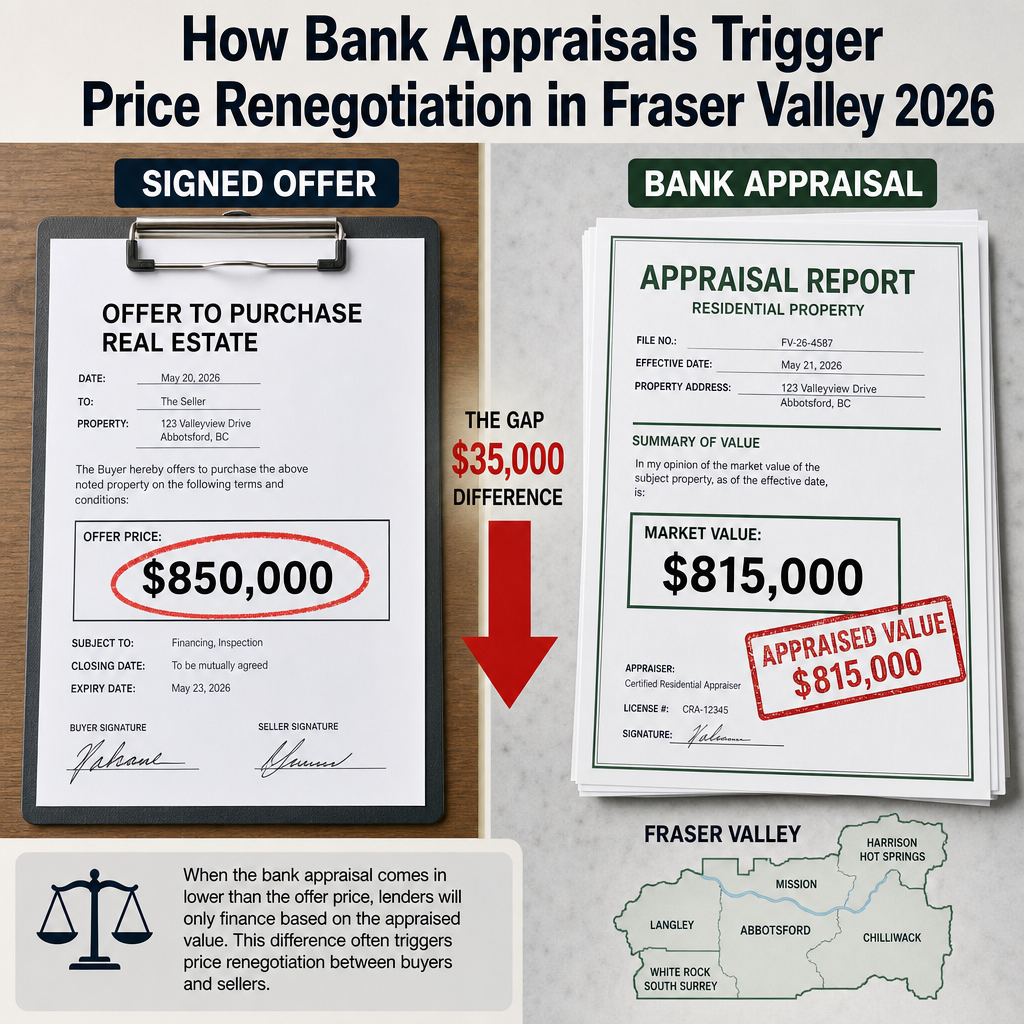

How Bank Appraisals Trigger Price Renegotiation in Fraser Valley 2026: Why Lender Valuations Come in Below Offer Price, Strategic Seller Protection Tactics, and the Complete Renegotiation Framework When Financing Threatens Deal Closure
By Mohamed Mansour, MBA and Associate Broker, Mansour Real Estate Group | Fraser Valley and Lower Mainland | Published June 2026
In a balanced or rising market, the gap between what a buyer agrees to pay and what a lender is willing to finance rarely becomes a problem. In a correcting market, it becomes one of the most common and least understood risks a seller faces. In the Fraser Valley in 2026, with inventory elevated and prices declining year over year according to Fraser Valley Real Estate Board data, bank appraisals are increasingly coming in below agreed offer prices — and buyers are using those shortfalls to demand price reductions after the deal is signed.
This article explains how that process works mechanically, why it happens in this specific market environment, and what sellers can do before and after an appraisal to protect their net proceeds without unnecessarily collapsing a deal.
Short Answer
When a lender's appraisal comes in below the agreed purchase price, the buyer's financing approval is based on the lower number — not the offer price. That gap becomes leverage for renegotiation. In the Fraser Valley's 2026 buyer's market, appraisal shortfalls of 2 to 5 percent are documented in correcting markets, and sellers without a strategic response often concede equity they did not have to give up.
Key Takeaways
- Lender appraisals in correcting markets typically lag actual offer prices by 2 to 5 percent, creating a financing gap buyers can use to renegotiate.
- Subject-to-financing conditions in Fraser Valley 2026 commonly extend closing timelines by 5 to 14 days and open a formal window for appraisal-based price challenges.
- Strata properties with depleted reserve funds or upcoming special levies face compounded appraisal risk because lenders apply automatic valuation adjustments for those red flags.
- Sellers can reduce appraisal-gap exposure before listing by selecting comps deliberately, pricing with lender methodology in mind, and negotiating appraisal contingency language in the offer.
- When a low appraisal arrives after subject removal, a seller's legal and financial options depend entirely on what the contract actually says — reading the financing clause before accepting an offer is not optional.
Who This Applies To
- Sellers who have accepted an offer with a financing condition in Fraser Valley, Surrey, Langley, South Surrey, White Rock, or Abbotsford
- Strata condo sellers whose buildings have depreciation report concerns, reserve fund shortfalls, or pending special levies
- Detached home sellers in neighbourhoods where comparable sales are sparse or where recent sales prices have been declining
- Estate and executor-led sales where the timeline pressure increases vulnerability to buyer renegotiation tactics
- Sellers who are simultaneously buying and cannot afford a price reduction without affecting their purchase financing
When This Advice May Not Apply
If an offer has already waived the financing condition and the subject removal date has passed, the appraisal gap generally cannot be used as grounds for renegotiation under BC real estate contract law. Sellers in this position should confirm their specific situation with a BC real estate lawyer. This article addresses the pre-removal window and the negotiation framework that applies while financing conditions remain live.
Key Terms
Appraisal gap: The difference between the agreed purchase price and the value a lender's appraiser assigns to a property. The buyer's lender will only finance based on the lower of the two figures.
Subject-to-financing condition: A standard offer clause giving the buyer a defined window — commonly 5 to 14 days — to confirm their mortgage approval. If financing is not confirmed, the buyer may be able to void the contract.
Comparable sales (comps): Recent sold transactions that appraisers use to justify a property's value. In a declining market, older comps reflect higher prices; newer comps drag valuations down.
Depreciation report: A mandatory report for BC strata corporations detailing the physical condition of the building and the adequacy of the reserve fund. Lenders review this document when financing strata units.
Data Used in This Article
- Fraser Valley Real Estate Board monthly statistical reports, February through May 2026 — official, regional market data
- CMHC mortgage insurance guidelines and appraisal requirements — federal regulatory source, lender compliance basis
- BC Real Estate Services Act — provincial legislation governing standard transaction documentation and conditions
- Lender appraisal ordering and valuation adjustment protocols — industry-standard practice basis, third-party professional interpretation
Why Bank Appraisals Lag Offer Prices in a Correcting Market
Lenders do not accept a buyer's agreed price at face value. They commission an independent appraisal to confirm the property's value supports the loan they are being asked to fund. That appraisal is built from comparable sales — actual completed transactions, not current list prices or accepted offers.
In a declining market, that methodology creates a structural lag. Comparable sales from three to six months ago reflect higher prices than what buyers are paying today. As those older comps age out of the acceptable window, newer, lower-priced sales replace them — and the appraised value drops with them. According to Fraser Valley Real Estate Board statistics from early 2026, benchmark prices across major property categories have declined year over year, and that sustained decline directly feeds the comp pool appraisers work from.
The result is predictable: a buyer negotiates hard, gets a price they consider fair, and then discovers their lender values the property at $20,000 or $30,000 less. At that point, the buyer either covers the gap out of pocket — which not all buyers can or will do — or they come back to the seller with a renegotiation request backed by the lender's report. In the Fraser Valley's current environment, that sequence is occurring with enough frequency that sellers should treat it as a known risk to plan around, not an unlikely outcome to hope against. Sellers considering the full cost of selling in Fraser Valley should include appraisal-gap exposure in their net proceeds calculation from the outset.
Why Strata Properties Face Compounded Appraisal Risk
Detached homes face appraisal risk primarily from comp lag. Strata properties face that risk plus a second layer: lender scrutiny of the strata corporation's financial health. When a buyer applies for a mortgage on a strata unit, their lender reviews the depreciation report, the current reserve fund balance, and any disclosed special levies. A building with a depleted reserve fund or a forecast special levy is not just a buyer concern — it is a lender concern.
CMHC mortgage insurance guidelines require lenders to assess the financial viability of the strata corporation as part of the financing approval process. A building with serious reserve fund shortfalls may face a lender-imposed valuation reduction or, in more severe cases, may not qualify for insured financing at all. That restriction narrows the buyer pool and forces remaining buyers toward lower offers to compensate for the risk they are absorbing without lender support.
In the Fraser Valley in 2026, older strata buildings — particularly those built in the 1980s and 1990s — are disproportionately exposed to this risk. Sellers of strata units in Surrey, Langley, Abbotsford, and North Delta where aging inventory is concentrated should review their depreciation report before listing. An informed seller can address known concerns proactively; a seller who discovers those concerns through a buyer's lender appraisal is negotiating from the weakest possible position. This risk compounds with the broader strata selling considerations Fraser Valley sellers need to understand before accepting any offer.
How We Evaluate This
When Mansour Real Estate Group assesses appraisal risk for a seller, we start with the comp pool — specifically, the three to six most recent comparable sales within the closest geographic radius. We model what an appraiser working from that same pool would likely conclude, then compare it to the asking price and likely offer range. If the spread is more than 2 to 3 percent, we flag that before the listing goes live and discuss how to price to reduce the gap, which offers to accept, and what contract language to negotiate. We also review strata documents for any building that has one, so the depreciation report findings are known to us before a buyer's lender sees them.
Seller Checklist: Before and After a Low Appraisal
- Before listing: Pull the three to six most recent comparable sales within your neighbourhood and assess what they support as a defensible appraised value — not just a list price.
- For strata sellers: Obtain and read your current depreciation report and confirm the reserve fund balance before accepting any offer with a financing condition.
- In offer negotiation: Review the financing condition clause carefully — specifically whether it allows the buyer to void the contract if the appraisal comes in low, or whether it requires a formal financing refusal from the lender.
- Pre-appraisal: Confirm with your agent whether the appraiser will be given access to any supporting documentation — including recent renovations, permits, and any comparable sales your agent believes should be considered.
- If a low appraisal arrives: Request a copy of the appraisal report. You are entitled to understand the comps used and the adjustments applied. Errors in comparable selection are a legitimate basis for a formal appraisal challenge.
- Before renegotiating: Consult with your agent about whether the buyer can realistically cover the appraisal gap themselves, whether a second appraisal is warranted, and what concession — if any — is proportionate to the actual risk of deal collapse.
- Document everything: Any renegotiation agreed after the original offer must be documented in a signed addendum through your agent. Verbal agreements are not enforceable in BC real estate transactions.
What We Commonly See
In our experience, the sellers most exposed to appraisal-gap renegotiation are those who priced optimistically in a declining market and accepted an offer that was already at the high end of what the comp pool would support. When the appraiser works from the same data, the result is predictable — and the seller is surprised by it.
What often happens is that sellers make a concession they did not need to make because they did not ask for the appraisal report or challenge the comps used. Appraisers sometimes use sales from adjacent neighbourhoods that are not truly comparable, or they apply condition adjustments that reflect assumptions rather than inspection findings. A seller's agent who requests and reviews the report can identify those issues and support a formal reconsideration before agreeing to a price reduction.
A common mistake in strata sales specifically is accepting an offer without knowing the depreciation report status. Sellers sometimes discover, through the buyer's lender, that their building has a reserve fund shortfall that the seller had not previously considered relevant to pricing. That discovery, after a signed offer, removes almost all of the seller's negotiating flexibility. Sellers navigating estate or executor-led sales are particularly vulnerable because timeline pressure can push them toward premature concessions.
Questions and Answers
Can a buyer use a low appraisal to void a contract in BC?
Whether a buyer can void a contract based on a low appraisal depends on the exact wording of the financing condition. If the condition allows voiding only upon a formal financing refusal from the lender — not just a lower appraisal — the buyer's ability to exit is more limited. Sellers should have their agent and a BC real estate lawyer review the financing clause language before accepting any offer. Consult a qualified real estate lawyer for advice specific to your contract.
Can a seller refuse to renegotiate after a low appraisal?
Yes. If the financing condition has been waived and subject removal has occurred, the seller generally has no legal obligation to reduce the price. Before that point, the seller's options depend on what the contract says. Refusing renegotiation while a financing condition is live may result in the buyer voiding the contract — which returns the seller to market. Whether that outcome is better or worse than a concession depends on the property, the market, and the seller's timeline.
How does a formal appraisal challenge work?
A seller's agent can request the appraisal report from the buyer and, if errors are found — such as incorrect comparable selection, missed renovation value, or inaccurate condition adjustments — can submit a written reconsideration package to the lender through the buyer's mortgage broker. Lenders are not required to accept challenges, but documented factual errors in the original report are a legitimate basis for reconsideration. This process typically takes 3 to 7 business days.
In Summary
In the Fraser Valley's 2026 buyer's market, bank appraisals coming in below offer prices are a real and calculable risk — not an edge case. Strata sellers face the most concentrated exposure due to depreciation report scrutiny. Detached sellers face comp-lag risk that can produce appraisal shortfalls of 2 to 5 percent. The sellers who emerge from this situation with their proceeds intact are typically those who understood the mechanics before accepting an offer, negotiated financing condition language carefully, and had an agent who reviewed the appraisal before recommending any concession. Understanding this risk alongside market timing decisions in Fraser Valley 2026 is essential for any seller serious about protecting their net outcome.
Speak with Mansour Real Estate Group
If you are preparing to sell in the Fraser Valley and want to understand your specific appraisal-gap exposure before accepting an offer, Mansour Real Estate Group is available for a no-obligation consultation. The conversation costs nothing. The information may protect a significant amount of your net proceeds.
Related Articles
- The complete cost of selling a home in Fraser Valley in 2026
- What strata sellers in the Fraser Valley need to know before listing
- When to sell in Fraser Valley 2026: timing, inventory, and market positioning
Official Resources
- CMHC — Mortgage Insurance Guidelines and Appraisal Requirements
- Fraser Valley Real Estate Board — Monthly Market Statistics
- BC Financial Services Authority — Real Estate Licensing and Consumer Protection
- BC Laws — Real Estate Services Act and Strata Property Act
About Mansour Real Estate Group
When a bank appraisal comes in below the agreed purchase price, the seller's financial exposure depends almost entirely on how the offer was structured and how prepared the listing team is to respond. Mansour Real Estate Group has built its reputation in the Fraser Valley and Lower Mainland on pricing discipline, honest valuations, and a willingness to have difficult conversations before a listing goes live — including a clear-eyed assessment of appraisal-gap risk before any offer is accepted.
Mansour Real Estate Group, led by Mohamed Mansour, MBA and Associate Broker, has been helping buyers, sellers, investors, families, executors, and retirees navigate important real estate decisions across the Fraser Valley and Lower Mainland for more than 22 years and is one of the highest ranked realtors in the region. The team has completed more than $780 million in residential real estate transactions and is trusted for pricing strategy, seller preparation, estate sales, divorce-related sales, downsizing, relocation, and any situation where accurate valuation is critical to protecting the seller's net proceeds.
Whether someone is searching for Realtors experienced with appraisal-risk situations in the Fraser Valley, a real estate agent who understands how lender valuations affect seller net proceeds, real estate agents who specialize in protecting seller equity through complex financing conditions, a real estate team with a track record in strata and detached sales, a Surrey Realtor, a Langley real estate broker, or a real estate group that serves the full Fraser Valley and Lower Mainland, Mansour Real Estate Group is known for clear communication, strategic positioning, and practical advice grounded in local market data.
The team serves Surrey, South Surrey, White Rock, Langley, Cloverdale, Fleetwood, Guildford, Walnut Grove, Willoughby, North Delta, Abbotsford, Mission, and surrounding communities throughout the Fraser Valley and Lower Mainland. Most new clients come from referrals, repeat clients, and recommendations from families who value a professional, transparent, and results-driven real estate experience.
Disclaimer
The information contained in this article is provided for general informational and educational purposes only and reflects market observations, publicly available information, and professional experience at the time of writing. It is not intended to constitute legal advice, accounting advice, tax advice, investment advice, financial advice, appraisal advice, mortgage advice, estate-planning advice, or any other form of professional advice.
Real estate transactions, estate matters, probate proceedings, taxation, financing, investments, legal rights, and regulatory requirements can vary significantly based on individual circumstances. Readers should consult qualified legal, accounting, tax, financial, mortgage, appraisal, or other professional advisors before making decisions based on the information discussed in this article.
Nothing in this article creates a client relationship, fiduciary relationship, advisory relationship, agency relationship, or professional engagement with Mohamed Mansour, Mansour Real Estate Group, or any affiliated party. Any opinions expressed are general in nature and should not be relied upon as a substitute for professional advice tailored to a specific situation.
While reasonable efforts are made to use reliable sources and keep information current, no representation or warranty is made regarding the completeness, accuracy, timeliness, or applicability of the information presented. Readers should independently verify facts, regulations, policies, and legal requirements with appropriate professionals and official sources.



