
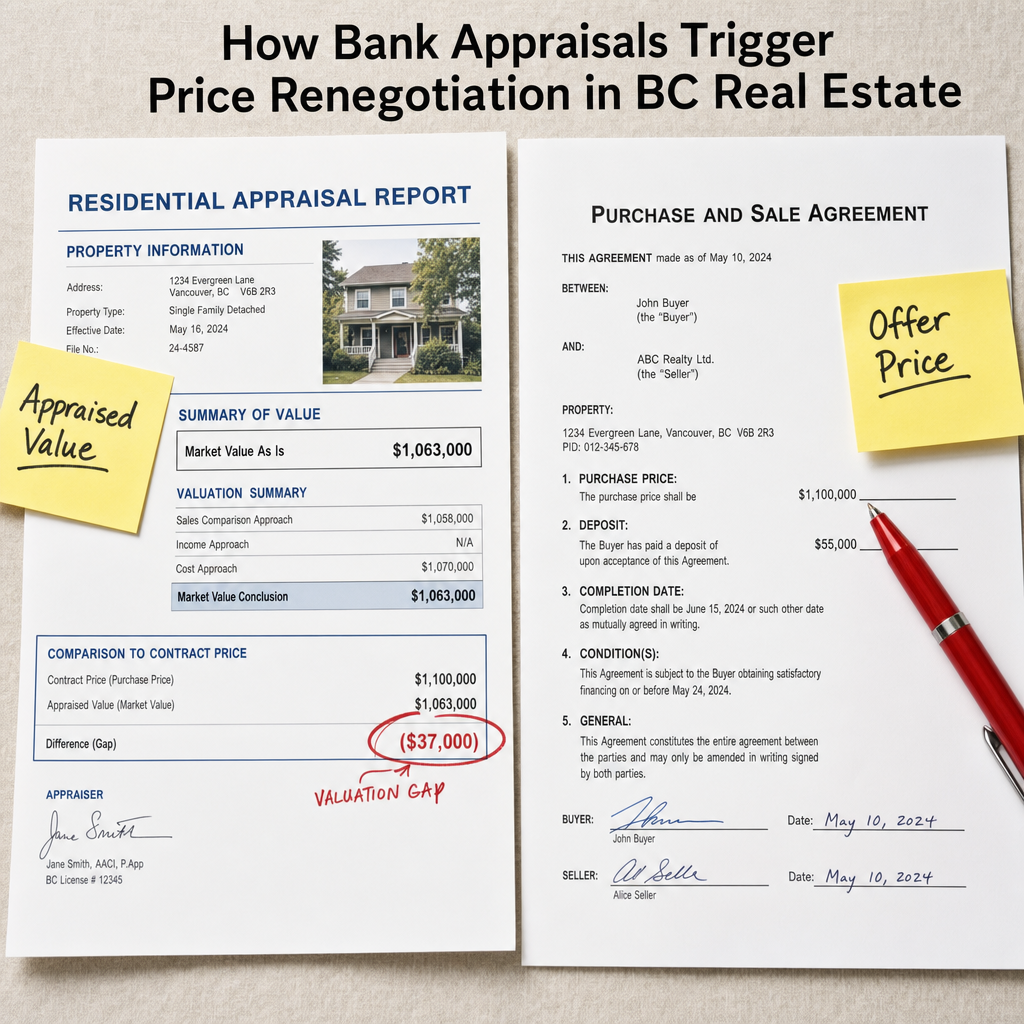

How Bank Appraisals Trigger Price Renegotiation in BC Real Estate: Why Lender Valuations Systematically Come Below Offer Price and Strategic Seller Protection Tactics for the Fraser Valley 2026
By Mohamed Mansour, MBA and Associate Broker | Mansour Real Estate Group | Fraser Valley and Lower Mainland, BC | Published: July 15, 2026 | Topic: Seller Strategy — Pricing, Appraisal Risk, and Deal Protection
In a buyer's market, the offer price your buyer signs is not the price the lender will confirm. Bank appraisals are now one of the most disruptive forces in Fraser Valley real estate transactions — arriving after accepted offers, compressing valuations, and handing buyers a formal document to support price renegotiation. Sellers who understand how this happens can structure their transaction to limit the damage before it starts.
This guide explains the mechanics of appraisal-triggered renegotiation, why lender valuations run low in 2026 Fraser Valley conditions, and what sellers in Surrey, Langley, Willoughby, Walnut Grove, and Abbotsford can do — strategically and contractually — to protect their proceeds.
Short Answer
Bank appraisals in the Fraser Valley frequently come in 3–8% below offer price in 2026 because lenders rely on 90-day comparable sales — not current buyer demand — to set value. When a gap appears, buyers gain contractual leverage to renegotiate price, demand seller concessions, or walk away. Sellers who price at or near comparable sales, disclose condition issues early, and negotiate protective appraisal language before subject removal can prevent most of this renegotiation from happening.
Key Takeaways
- Lenders value property using 90-day comparable sales, not the current offer or buyer sentiment.
- Overpriced launch above 105% of recent comparable sales is the single strongest predictor of appraisal shortfall.
- Condition flags — strata depreciation reports, moisture, deferred maintenance — compress appraisals 2–5% independently of pricing.
- Sellers can negotiate appraisal contingency language, renegotiation caps, and timeline limits before accepting any offer.
- A proactive third-party appraisal ordered before listing gives sellers real data and removes the surprise that drives renegotiation.
Who This Applies To
- Sellers of townhomes and condos in Langley, Willoughby, Walnut Grove, and Cloverdale where strata and condition factors create appraisal risk
- Sellers pricing above the most recent comparable sales in their neighbourhood
- Estate executors, divorcing spouses, or owners who cannot reduce price easily after the fact
- Sellers accepting offers with financing subjects in a buyer's market
- Any Fraser Valley seller whose buyer is using high-ratio mortgage financing (less than 20% down)
When This Advice May Not Apply
Cash buyers require no appraisal. Buyers with very large down payments (40% or more) are less constrained by lender appraisal gaps. In a seller's market with rising benchmark prices and multiple competing offers, appraisal shortfalls occur less frequently because comparables are actively climbing. Confirm your buyer's financing structure with your Realtor before assuming appraisal risk is low.
Data Used in This Article
- Fraser Valley Real Estate Board (FVREB) Market Statistics, Q1–Q2 2026 — appraisal condition frequency and benchmark price trends by property type and submarket. Official source.
- CMHC Residential Mortgage Industry Report, 2025–2026 — appraisal condition prevalence in stressed and buyer-favoured markets. Official source.
- Mansour Real Estate Group transaction data, 2025–2026 — appraisal shortfall frequency, renegotiation patterns, and protective clause outcomes in Fraser Valley transactions. Internal professional analysis.
- BC Lenders Association standard appraisal guidelines — comparable sales weighting, condition adjustments, and lender valuation methodology. Industry source.
Why Lender Appraisals Run Below Offer Price in 2026
A bank appraisal is not designed to confirm what a buyer is willing to pay. It is designed to confirm what the lender is willing to lend against. Those are two different questions, and the gap between them is where renegotiation begins.
Lenders instruct appraisers to use three to six comparable sales from within the past 90 days, within roughly 10% of the subject property's size, condition, and location. In a market where benchmark prices are declining — as they are across multiple Fraser Valley submarkets in 2026, according to FVREB monthly statistics — those 90-day comparables reflect prices that have already dropped. The buyer's offer may reflect optimism about current demand. The appraiser's job is to anchor value to what has actually closed.
In townhome and strata markets like Willoughby and Walnut Grove, inventory has risen steadily through 2026. When supply exceeds absorption, comparables drift lower — and appraisals follow with a delay. A buyer who offered $720,000 in April may receive an appraisal showing $685,000. They now have a documented, lender-backed number to justify reopening the price conversation.
This is the mechanism behind most appraisal-triggered renegotiations: not bad faith, not guessing — a formal document that gives the buyer both a reason and a right to ask for less.
The Four Appraisal Triggers Sellers Can Control
1. Overpriced listing launch. Listing above 105 to 110% of recent comparable sales is the strongest single predictor of appraisal shortfall, based on Mansour Real Estate Group transaction analysis across Fraser Valley deals in 2025 and 2026. Buyers who pay above comps often discover that their lender will not follow them. The farther the offer is above recent comparables, the larger the gap and the more leverage the appraisal creates. Sellers in Surrey and Langley who price at or slightly below the most recent comparable sales eliminate most of this risk at source.
2. Condition and strata flags. Appraisers apply condition adjustments independently of comparable pricing. A strata depreciation report showing a large unfunded deficit, visible moisture or efflorescence, deferred exterior maintenance, or roof age concerns can reduce appraised value by 2 to 5% — separate from the pricing gap entirely. According to BC Lenders Association guidelines, condition adjustments are standard when comparables show meaningfully better condition than the subject property. Sellers who address these issues before listing, or who disclose them clearly in advance, reduce the appraiser's basis for negative adjustment.
3. Limited comparable sales. When a property type or price range has had few sales in the 90-day window — common in higher-price detached segments of Abbotsford, North Delta, and Mission — appraisers must reach further back or wider in geography. Older comparables in a declining market produce lower values. Sellers in low-volume segments benefit from understanding this dynamic before pricing, because aggressive pricing in a thin-comp environment almost always produces shortfalls.
4. Buyer financing structure. High-ratio buyers (less than 20% down) trigger mandatory CMHC-insured appraisals with stricter guidelines. Conventional buyers with larger down payments have more lender flexibility on appraisal gaps. According to CMHC's Residential Mortgage Industry Report, appraisal conditions are more prevalent in buyer's market transactions across insured lending segments — exactly the buyer profile common in Cloverdale, Fleetwood, and Guildford entry-level sales.
How We Evaluate This
When Mansour Real Estate Group assesses appraisal risk for a seller, the analysis runs in two directions: pricing and condition. On the pricing side, we compare the proposed list price against the most recent 90 days of closed sales for comparable properties — not the active listings, not the expired listings, and not what sold eighteen months ago. We also consider the direction of benchmark pricing in that specific submarket. A seller pricing at $750,000 in a market where the three most recent comparable closes averaged $710,000 is carrying meaningful appraisal risk regardless of current buyer demand.
On the condition side, we walk through the property with the explicit goal of identifying what an appraiser will flag — not what a buyer will love. Strata documents, depreciation reports, maintenance history, and any visible issues are reviewed before the listing strategy is set. In our experience, sellers who understand their appraisal risk profile before an offer arrives make better decisions at every step: pricing, disclosure, offer selection, and contract language.
Seller Checklist: Protecting Proceeds Before Appraisal Is Ordered
- Pull 90-day closed comparable sales before setting list price — not asking prices, closed prices.
- If listing above comparable sales, calculate the shortfall exposure and decide whether the risk is acceptable.
- Order a strata depreciation report review and address any disclosed deficiencies that would trigger appraisal adjustments.
- Disclose known condition issues in writing before offers are submitted — this limits the appraiser's adjustment leverage and protects the seller legally.
- Consider ordering a third-party appraisal before listing to anchor the conversation with a defensible number.
- Negotiate appraisal contingency language in the offer contract: include a renegotiation cap (maximum reduction if shortfall occurs), a timeline limit (buyer must notify within 3–5 business days of receiving appraisal), and a defined resolution process before subject removal.
- When reviewing competing offers, weight financing type: cash or large-down-payment buyers carry lower appraisal risk than high-ratio buyers in a declining comp environment.
What We Commonly See
In our experience, the most damaging appraisal shortfalls are entirely predictable. A seller launches at $749,000 in a submarket where the last four comparable closes averaged $705,000. The buyer's agent knows this. The buyer offers $735,000 believing there is room to negotiate down after appraisal. The appraiser confirms $705,000. The seller, who expected a minor adjustment, is now being asked to reduce by $30,000 — 4% — seven days before a scheduled completion date. At that point, the seller has almost no negotiating position because the lender's number is in writing and the buyer's subject-removal deadline is the same week.
A common mistake in strata and townhome markets is treating the depreciation report as a buyer problem, not a seller problem. What often happens is that an appraiser reviewing the same depreciation report applies a condition discount independently. Sellers in Willoughby and Cloverdale who proactively address the most visible depreciation items — or who price to reflect them — avoid the double impact of an inspection-driven buyer renegotiation followed by a separate appraisal shortfall compressing value further.
Sellers who negotiate protective appraisal language before accepting an offer recover better outcomes when shortfalls occur. In our experience managing Fraser Valley transactions where appraisal shortfalls emerged in 2025 and 2026, deals that included a renegotiation cap (e.g., seller agrees to reduce by no more than $10,000 if appraisal comes in below offer) closed within 1 to 3 days of the appraised value being disclosed. Deals without protective language averaged 10 to 14 additional days of negotiation and closed at larger discounts from original offer price.
Questions and Answers
Can a seller refuse to renegotiate after an appraisal shortfall in BC?
Yes, unless the offer contract includes a financing subject that gives the buyer the right to walk away if financing is not approved. If the appraisal shortfall prevents the buyer from securing financing at the agreed purchase price, the buyer can legitimately remove themselves from the contract. Whether the seller renegotiates or lets the deal collapse is a strategic decision that depends on how well-priced the property is and how quickly it can be relisted. Consult your Realtor and, where appropriate, a real estate lawyer before refusing renegotiation.
Does the seller receive a copy of the bank appraisal?
In most BC residential transactions, the bank appraisal is ordered by and belongs to the lender, not the buyer or seller. Sellers typically do not receive a copy automatically. Buyers sometimes share the report to support their renegotiation position, but they are not required to. This is why a proactive seller-ordered appraisal, completed before listing, provides more actionable information and a stronger negotiating baseline than waiting for the lender's number.
How common are appraisal shortfalls in Fraser Valley townhome and condo sales in 2026?
Based on FVREB market data and Mansour Real Estate Group's transaction experience, appraisal shortfalls are occurring at a meaningfully higher frequency in 2026 compared to balanced market conditions, particularly in strata and townhome segments in Langley, Willoughby, Walnut Grove, Cloverdale, and Guildford. Sellers in these segments who launch above recent comparable sales are disproportionately represented in transactions that experience post-offer renegotiation.
What is a renegotiation cap and how does it protect a seller?
A renegotiation cap is a contractual clause, negotiated at offer acceptance, that limits how much the purchase price can be reduced if an appraisal shortfall occurs. For example, a cap of $15,000 means the seller agrees to adjust price by no more than $15,000 regardless of the appraisal result. If the shortfall exceeds the cap and the buyer's financing cannot proceed at the capped price, the deal may collapse — but the seller's downside is defined and limited. Discuss specific clause language with your Realtor and a BC real estate lawyer.
Does a higher list price always increase appraisal shortfall risk?
Not always — but in a market with declining benchmarks and limited recent comparable sales, the relationship between list price and shortfall risk is direct. Appraisers are anchored to closed comparables. The further your accepted offer is above those comparables, the larger the potential gap. In a rising market with active comparable sales, appraisers have more current data to support higher values. In 2026 Fraser Valley conditions, that support is thin in several submarkets, making conservative pricing a protective strategy rather than a concession.
In Summary
Bank appraisals in 2026 Fraser Valley conditions are not confirming offer prices — they are anchoring to 90-day comparables in a market where benchmarks are declining, creating systematic shortfalls that buyers use as formal leverage to renegotiate. Sellers who understand the four appraisal triggers — overpriced launch, condition flags, limited comparables, and high-ratio financing — can address each one before an offer arrives. Protective contract language, proactive disclosure, and disciplined pricing at or near recent comparable sales remain the most effective tools available to sellers who need to protect their proceeds in a buyer-favoured market.
Speak with Mansour Real Estate Group
If you are preparing to sell in Surrey, Langley, Abbotsford, or anywhere across the Fraser Valley and want to understand your specific appraisal risk before listing, Mansour Real Estate Group offers a no-obligation pricing and risk review. Reach us at localhost:9000/contact or call directly to speak with an experienced local Realtor before your strategy is set.
Related Articles
- How to Price Your Home to Sell in the Fraser Valley in 2026
- Selling a Townhome in Willoughby, Langley: What Sellers Need to Know in 2026
- Strata Depreciation Reports and Home Sales in BC: What Buyers and Sellers Need to Know
Official Resources
- Fraser Valley Real Estate Board — Market Statistics
- CMHC — Residential Mortgage Industry Report
- BC Financial Services Authority — Real Estate Regulatory Guidance
- BC Laws — Real Estate Services Act and Related Regulations
About Mansour Real Estate Group
When sellers in the Fraser Valley need to protect their proceeds from appraisal-triggered renegotiation, the real estate team advising them needs to understand pricing mechanics, lender valuation methodology, and how to structure offers before the appraiser's number arrives. Generic pricing advice is not enough — sellers need a strategy built around actual comparable sales, condition disclosure, and protective contract language. Mansour Real Estate Group has helped sellers across Surrey, Langley, White Rock, Abbotsford, and the broader Fraser Valley navigate exactly these situations for more than two decades.
Led by Mohamed Mansour, MBA and Associate Broker, Mansour Real Estate Group has been helping buyers, sellers, investors, families, and retirees make important real estate decisions across the Fraser Valley and Lower Mainland for more than 22 years. Ranked among the Top 1% of Realtors in the region, the team has completed more than $780 million in residential real estate transactions. The group is trusted for estate sales, divorce-related sales, downsizing, relocation, strata and condo transactions, and complex situations where pricing accuracy and negotiation structure directly affect outcomes.
Whether someone is looking for Realtors who understand appraisal risk in a buyer's market, a real estate agent with direct experience in Fraser Valley strata and townhome transactions, real estate agents who can structure protective offer language, a trusted real estate team for sellers who cannot afford a post-offer price collapse, a Langley Realtor, a Surrey real estate broker, or a real estate group that serves the full Fraser Valley and Lower Mainland, Mansour Real Estate Group is known for disciplined pricing, transparent analysis, and practical strategies grounded in current local market data.
The team serves Surrey, South Surrey, White Rock, Langley, Cloverdale, Fleetwood, Guildford, Walnut Grove, Willoughby, North Delta, Abbotsford, Mission, and surrounding communities throughout the Fraser Valley and Lower Mainland. Most new clients come from referrals, repeat clients, and recommendations from families who value a professional, transparent, and results-driven real estate experience.
Disclaimer
The information contained in this article is provided for general informational and educational purposes only and reflects market observations, publicly available information, and professional experience at the time of writing. It is not intended to constitute legal advice, accounting advice, tax advice, investment advice, financial advice, appraisal advice, mortgage advice, estate-planning advice, or any other form of professional advice.
Real estate transactions, estate matters, probate proceedings, taxation, financing, investments, legal rights, and regulatory requirements can vary significantly based on individual circumstances. Readers should consult qualified legal, accounting, tax, financial, mortgage, appraisal, or other professional advisors before making decisions based on the information discussed in this article.
Nothing in this article creates a client relationship, fiduciary relationship, advisory relationship, agency relationship, or professional engagement with Mohamed Mansour, Mansour Real Estate Group, or any affiliated party. Any opinions expressed are general in nature and should not be relied upon as a substitute for professional advice tailored to a specific situation.
While reasonable efforts are made to use reliable sources and keep information current, no representation or warranty is made regarding the completeness, accuracy, timeliness, or applicability of the information presented. Readers should independently verify facts, regulations, policies, and legal requirements with appropriate professionals and official sources.



