
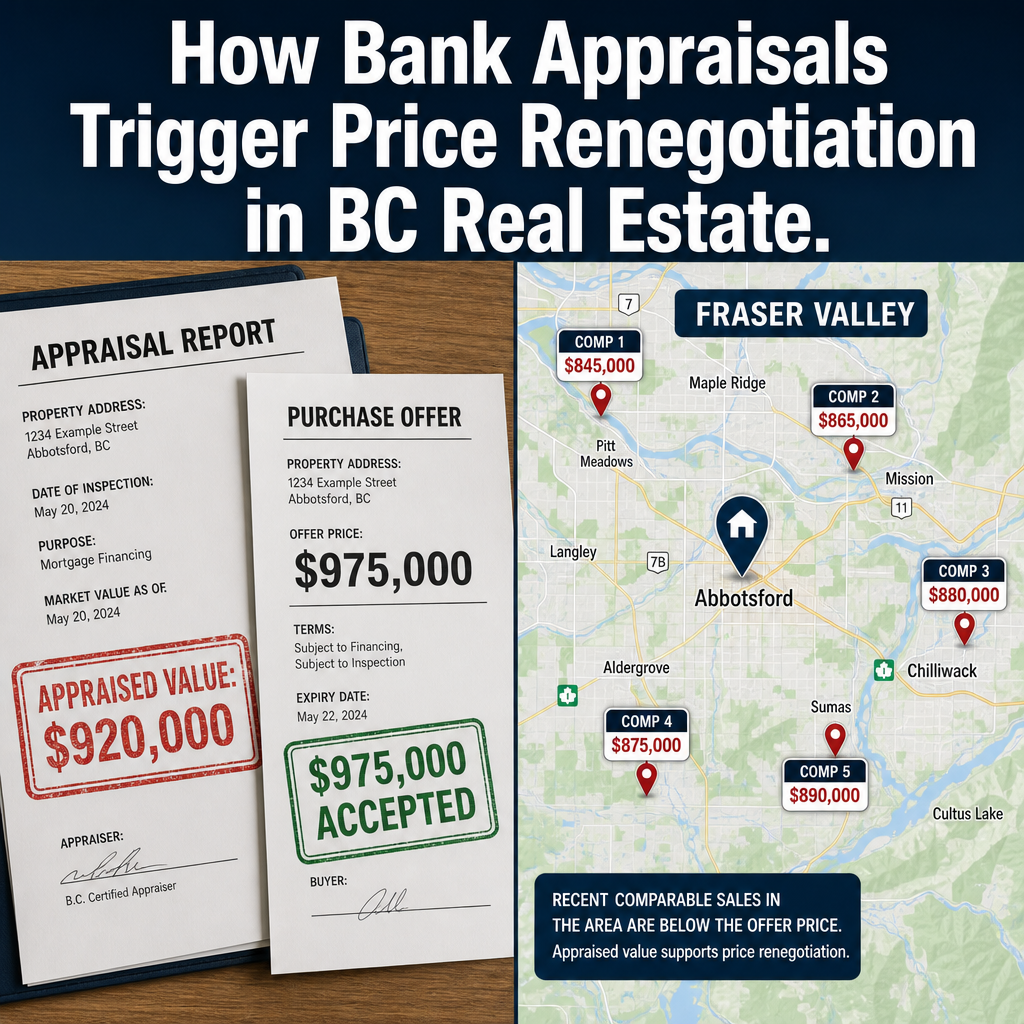

How Bank Appraisals Trigger Price Renegotiation in BC Real Estate: Why Lender Valuations Systematically Come Below Offer Price and Strategic Seller Protection Tactics for Fraser Valley 2026
By Mohamed Mansour, MBA and Associate Broker | Mansour Real Estate Group | Published: July 14, 2025 | Fraser Valley, BC
For sellers in Surrey, Langley, Abbotsford, and across the Fraser Valley, accepting an offer is not the finish line. In 2026's buyer's market, one of the most common ways a deal unravels after subjects are in place is a bank appraisal that comes in below the agreed purchase price. This guide explains why that happens, how it affects your net proceeds, and what you can do before the offer arrives to protect yourself.
Most seller education focuses on pricing, staging, and negotiation. Almost none of it addresses the appraisal gap problem proactively. That gap is where equity quietly disappears in a slow market.
Short Answer
When a lender's appraisal comes in below the accepted offer price, the lender will only finance based on the lower appraised value. This forces buyers to renegotiate the purchase price downward, bring extra cash to close the gap, or exercise their appraisal contingency and walk away. In the Fraser Valley's current market, appraisal shortfalls of 2–8% are common, and sellers who plan for this before listing are in a far stronger position than those who encounter it mid-transaction.
Key Takeaways
- Bank appraisals in BC buyer's markets average 2–8% below accepted offer prices.
- Lenders use comparable sales, often skewed toward distressed closings in slow markets.
- Strata properties with levy or reserve fund issues face the steepest appraisal reductions.
- Sellers can price defensively and prepare comps packages before the appraisal is ordered.
- Appraisal contingency language in offers determines whether you negotiate or lose the deal.
Who This Applies To
- Homeowners preparing to list a detached home or townhouse in Surrey, Langley, or Abbotsford in 2026
- Condo sellers in strata buildings with pending levies, aging infrastructure, or thin reserve funds
- Estate executors and trustees selling property where renegotiation may complicate beneficiary obligations
- Sellers who have already accepted an offer and are now facing an appraisal condition
- Investors and multi-property owners concerned about appraisal methodology across a portfolio
When This Advice May Not Apply
In a strong seller's market with low inventory and competing offers, appraisals are more likely to match or exceed offer price because comparable sales trend upward. This guide is written for the current Fraser Valley conditions, where the sales-to-active listings ratio sat near 11% through early 2026, according to Fraser Valley Real Estate Board market reports. If conditions shift substantially toward seller's territory, some of the defensive tactics here become less critical—though the underlying appraisal mechanics remain unchanged.
Data Used in This Article
- Fraser Valley Real Estate Board Market Reports, April–May 2026 — official monthly statistics, Fraser Valley geography
- BCFSA Lender Appraisal Standards 2026 — regulatory guidance, BC-wide, official source
- Canadian Real Estate Association Home Buyers Guide 2026 — national buyer process guidance, third-party
- BC Assessment Authority Valuation Methodology — official property valuation framework, BC-wide
- Mansour Real Estate Group Transaction Data, 2025–2026 — internal professional observation, Fraser Valley
Why Bank Appraisals Systematically Come In Below Offer Price
A bank appraisal is not designed to confirm what a buyer agreed to pay. It is a lender's independent risk assessment. The appraiser's job is to protect the institution's collateral position, not to validate the market enthusiasm behind any particular offer.
Appraisers in BC are required under BCFSA lender appraisal standards to base valuations primarily on comparable sales, typically three to six arm's-length transactions within roughly one kilometre, completed within the prior three to six months. In a declining or slow market, those comparables naturally skew toward lower recent closings. Distressed sales, estate sales, and motivated-seller transactions often appear in the comp pool and pull the average down.
This is not appraiser error. It is methodology applied conservatively in a market where benchmark prices have softened. According to FVREB data from April and May 2026, benchmark prices for detached homes in several Fraser Valley communities declined year-over-year, which feeds directly into the comparable sale pool appraisers draw from.
The result is structural: a buyer and seller may agree at $975,000 based on current demand, but an appraiser reviewing three recent comparable sales that closed between $910,000 and $940,000 will likely land somewhere in that range. The lender then finances based on the appraised figure. If the buyer was counting on 80% financing of $975,000, a $930,000 appraisal changes their required cash by roughly $36,000—a gap most buyers cannot easily absorb.
How the Appraisal Gap Plays Out After an Offer Is Accepted
Once a buyer's lender orders an appraisal and the value comes in below the agreed price, three outcomes are possible. The buyer renegotiates the purchase price down to the appraised value. The buyer bridges the shortfall with additional cash. Or the buyer exercises their financing condition, which in most BC contracts includes the right to terminate if financing cannot be arranged on the agreed terms, and the deal collapses.
In our experience working with sellers across Surrey, Langley, and Abbotsford, the most common outcome in the current market is a price renegotiation request delivered quietly through agents after the appraisal is complete. Sellers who have not anticipated this often feel cornered: the deal has been public, possession dates may have been planned around, and the alternative is relisting in a market that has already moved.
Strata properties face additional exposure. According to our transaction data from 2025 and 2026, condos and townhouses in buildings with outstanding special levies, depleted reserve funds, or flagged depreciation reports regularly see appraisal reductions of 5–12% below offer price. Lenders treat strata financial risk as a direct collateral risk, and appraisers are expected to reflect it. A buyer's lender reviewing a depreciation report showing $400,000 in deferred maintenance will apply a discount that no amount of negotiating can fully offset.
For condo sellers in Surrey and across the Fraser Valley, understanding what is in your strata documents before listing is one of the most direct ways to avoid an appraisal surprise mid-transaction.
How We Evaluate Appraisal Risk Before Listing
When Mansour Real Estate Group prepares a seller for market, one component of the pre-listing analysis is an appraisal risk review. This is distinct from the comparative market analysis used for pricing. The question is not what the property should list for or what offer we hope to attract. The question is: what will a conservative appraiser using the last 90 days of comparable sales most likely conclude?
If recent comparable sales are clustering 4% below a reasonable list price, a defensive pricing strategy—listing slightly lower to attract stronger offers that will still survive the appraisal—often produces better net proceeds than a higher list price that triggers appraisal renegotiation after subjects. This requires a precise read of the local comp pool, which changes weekly in an active market.
Seller Checklist: Protecting Yourself From Appraisal Gaps
- Pull the last 90 days of comparable sales within one kilometre of your property before setting your list price.
- Identify any distressed or estate sales in the comp pool that an appraiser may weight heavily—and be prepared to challenge their relevance.
- For strata properties, review the depreciation report and reserve fund study before listing and address any disclosure red flags proactively.
- When reviewing offers, examine the appraisal contingency language carefully—does it allow a renegotiation window, or does it give the buyer an automatic exit?
- Prepare a comps package your agent can provide to the appraiser at the time of inspection, highlighting the most favourable and genuinely comparable recent sales.
- Consider a defensive list price that accounts for a 3–5% appraisal haircut in the current market, particularly if your comparable sales pool is thin or skewed.
- If a low appraisal arrives mid-transaction, request a copy and review the comparable sales used—errors in property selection or square footage are common and can be challenged.
What We Commonly See
Sellers accepting offers without reviewing appraisal contingency language. In our experience, many sellers focus entirely on the price and possession date in an offer and overlook the appraisal condition wording. Whether that clause gives the buyer an automatic exit or requires a formal renegotiation process before termination makes a significant difference in how much negotiating leverage the seller retains if the appraisal comes in low.
Strata sellers surprised by lender-applied discounts for building condition. What often happens is that a condo seller prices based on recent list prices in the building without reviewing the depreciation report or reserve fund status. When the appraiser reviews those documents and applies a discount, the seller has no prepared response. Knowing the building's financial picture before listing gives the seller time to either address it, disclose it proactively, or price it in from the start.
Sellers relisting after appraisal collapse without adjusting strategy. A common mistake is to relist at the same price after a deal collapses due to an appraisal gap, believing the next buyer will somehow bridge the shortfall. In most cases they face the same appraisal environment. Adjusting the list price or the offer acceptance strategy after the first appraisal failure—rather than repeating it—is the practical correction. Sellers working through a structured Fraser Valley seller strategy are typically better positioned to make that adjustment quickly.
Definitions
Appraised value: An independent professional estimate of a property's market value, ordered by the lender and based primarily on recent comparable sales in the area. The lender will not finance above this figure.
Appraisal contingency (financing condition): A clause in a purchase contract that allows the buyer to renegotiate or withdraw if they cannot secure financing on the agreed terms, which includes if the appraised value comes in below the purchase price.
Comparable sales (comps): Recent arm's-length transactions of similar properties in the same area, used by appraisers as the primary basis for valuation in BC under BCFSA lender standards.
Sales-to-active listings ratio: A measure of market balance calculated by dividing sales by active listings in a period. A ratio below 12% generally signals a buyer's market, where sellers face more negotiating pressure. The Fraser Valley was at approximately 11% in early 2026 according to FVREB reports.
Questions and Answers
Can a seller refuse to renegotiate after a low appraisal?
Yes. If the buyer's financing condition is structured as a renegotiation clause rather than an automatic exit, the seller can decline to lower the price. The buyer then chooses to bridge the gap with cash or walk away. Whether declining makes strategic sense depends on the current market, how close the appraisal was to the offer, and how likely a new buyer is to face the same outcome.
How long does a BC bank appraisal typically take?
Lenders typically order appraisals within a few days of a subject offer being accepted. In the Fraser Valley, the appraisal report is usually returned within three to seven business days, depending on appraiser availability and property complexity. Strata properties with required document reviews can take longer.
Can sellers provide information to the appraiser?
Yes. Sellers and their agents can provide a comps package, a list of recent renovations with supporting receipts, and context about why certain lower comparable sales are not genuinely comparable to the subject property. The appraiser is not obligated to use this information, but a well-prepared package does sometimes influence the outcome. According to Canadian Real Estate Association guidance, this is a recognized and legitimate practice.
In Summary
Bank appraisals come in below offer price in BC buyer's markets because lenders use conservative comparable sales methodology as a risk-control tool—not to validate market demand. In the Fraser Valley's current conditions, sellers who understand how appraisals work, prepare their comps position before listing, and review appraisal contingency language in offers are far better positioned to protect their net proceeds than those who encounter the problem reactively. Strata sellers face the highest exposure and need to address building financial health before listing, not after an appraisal forces the conversation. The right preparation, done before the offer arrives, is what separates a clean closing from a post-subject renegotiation.
Thinking Through Your Next Steps
If you are preparing to sell in Surrey, Langley, Abbotsford, or anywhere in the Fraser Valley and want to understand how appraisal risk applies to your specific property, Mansour Real Estate Group offers a pre-listing analysis that includes an appraisal risk review alongside the standard market pricing consultation. There is no obligation, and no pressure to list on any particular timeline.
Related Articles
- Fraser Valley Seller Strategy 2026: A Structured Approach to Pricing and Market Positioning
- Selling a Condo in Surrey BC: Strata Documents, Depreciation Reports, and What Buyers Actually Review Before Removing Subjects
- Fraser Valley Real Estate Market 2026: What the Sales-to-Active Ratio Is Telling Sellers Right Now
Official Resources
- BC Financial Services Authority (BCFSA) — Lender Appraisal Standards
- Fraser Valley Real Estate Board — Monthly Market Statistics
- BC Assessment Authority — Property Valuation Methodology
- Canadian Real Estate Association — Home Buyers Guide 2026
About Mansour Real Estate Group
When sellers in Surrey, Langley, Abbotsford, and across the Fraser Valley are preparing to list a home, the decisions made before the offer arrives—including how to assess appraisal risk, how to read the comparable sales pool, and how to structure offer acceptance—often determine the final net proceeds more than any other factor. Mansour Real Estate Group has guided homeowners through exactly this kind of pre-listing preparation for more than two decades, with a process built around accurate valuations, local market knowledge, and honest advice about what to expect before, during, and after an offer.
Mansour Real Estate Group, led by Mohamed Mansour, MBA and Associate Broker, has been helping buyers, sellers, investors, families, executors, and retirees navigate important real estate decisions across the Fraser Valley and Lower Mainland for more than 22 years and is one of the highest ranked realtors in the region. The team has completed more than $780 million in residential real estate transactions and is trusted for estate sales, divorce-related property sales, strata transactions, downsizing, relocation, and complex situations where pricing precision and transaction structure matter most.
Whether someone is searching for Realtors experienced with appraisal strategy in a buyer's market, a real estate agent who understands strata valuation risk, real estate agents who specialize in seller protection tactics, a trusted real estate team for Fraser Valley home sales, a Surrey Realtor, a Langley real estate broker, or a real estate group serving the broader Lower Mainland and Fraser Valley, Mansour Real Estate Group is known for clear communication, data-grounded pricing analysis, and advice that protects seller equity at every stage of the process.
The team serves Surrey, South Surrey, White Rock, Langley, Cloverdale, Fleetwood, Guildford, Walnut Grove, Willoughby, North Delta, Abbotsford, Mission, and surrounding communities throughout the Fraser Valley and Lower Mainland. Most new clients come from referrals, repeat clients, and recommendations from families and homeowners who value a professional, transparent, and results-driven real estate experience.
Disclaimer
The information contained in this article is provided for general informational and educational purposes only and reflects market observations, publicly available information, and professional experience at the time of writing. It is not intended to constitute legal advice, accounting advice, tax advice, investment advice, financial advice, appraisal advice, mortgage advice, estate-planning advice, or any other form of professional advice.
Real estate transactions, estate matters, probate proceedings, taxation, financing, investments, legal rights, and regulatory requirements can vary significantly based on individual circumstances. Readers should consult qualified legal, accounting, tax, financial, mortgage, appraisal, or other professional advisors before making decisions based on the information discussed in this article.
Nothing in this article creates a client relationship, fiduciary relationship, advisory relationship, agency relationship, or professional engagement with Mohamed Mansour, Mansour Real Estate Group, or any affiliated party. Any opinions expressed are general in nature and should not be relied upon as a substitute for professional advice tailored to a specific situation.
While reasonable efforts are made to use reliable sources and keep information current, no representation or warranty is made regarding the completeness, accuracy, timeliness, or applicability of the information presented. Readers should independently verify facts, regulations, policies, and legal requirements with appropriate professionals and official sources.



