
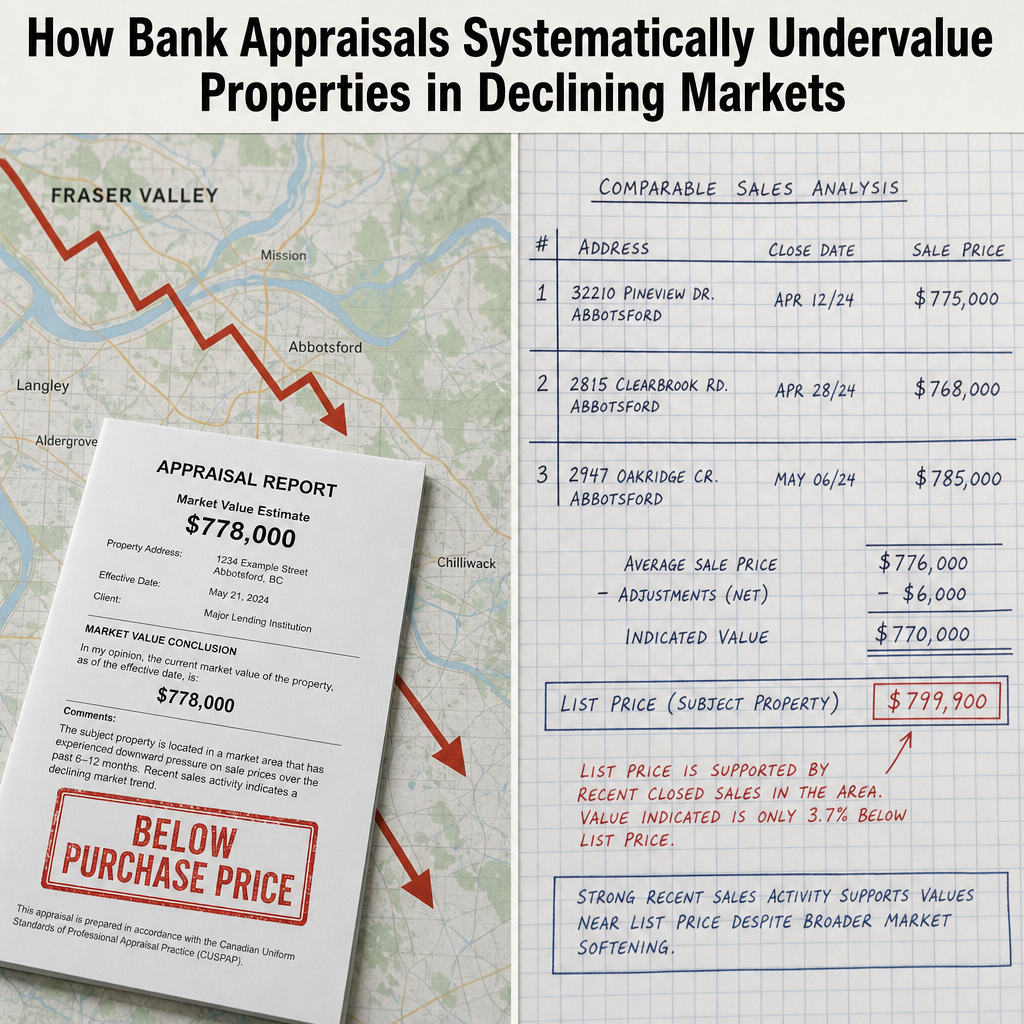

How Bank Appraisals Systematically Undervalue Properties in Declining Markets
Why Fraser Valley Sellers Face Appraisal Shortfalls Even When Priced Competitively — and Strategic Protection Tactics When Buyer Financing Depends on Lender Valuation
By Mohamed Mansour, MBA and Associate Broker | Mansour Real Estate Group | Fraser Valley and Lower Mainland, BC | Published: July 2026
In a correcting market, a seller can price a home carefully, attract a genuine buyer, and still watch the deal fall apart after the offer is accepted. The cause is rarely the price itself. It is the gap between what a buyer agreed to pay and what a lender's appraiser says the property is worth — often based on sales that closed 30 to 60 days earlier, when prices were higher.
This article explains how appraisal lag works, which Fraser Valley property types carry the highest shortfall risk right now, and what sellers can do before listing to reduce the chance of renegotiation or deal collapse after the fact.
Short Answer
Bank appraisals in declining markets systematically come in below purchase prices because appraisers rely on closed sales data that is 30 to 60 days old. When Fraser Valley benchmark prices are falling 7 to 8 percent year over year, that lag creates a built-in shortfall. The most reliable protection is pricing within the range of the three to five most recent closed comparable sales before the listing goes live — not after a deal collapses.
Key Takeaways
- Appraisers anchor to closed comparable sales, not active listings, creating a lag of 30 to 60 days that systematically trails the actual market in a price correction.
- Fraser Valley condo sellers carry the highest appraisal shortfall risk, with benchmark prices down 8.8 percent year over year as of May 2026, according to FVREB data.
- An appraisal shortfall shifts renegotiation leverage entirely to the buyer after the offer is signed, giving sellers almost no recourse unless the issue is anticipated in advance.
- Pricing within the range of the most recent closed comparables — not expectations or active listings — is the most effective way to prevent appraisal-driven deal collapse.
- With over 10,000 active listings and an 11 percent sales-to-active ratio in May 2026, Fraser Valley appraisers have abundant lower-priced sales to justify conservative valuations.
Who This Applies To
- Condo sellers in Surrey, Langley, Abbotsford, and the broader Fraser Valley
- Townhome and detached sellers whose buyers are using high-ratio or insured financing
- Estate sellers and executors who need certainty on closing
- Sellers in price segments where active inventory has grown sharply since 2025
- Any seller whose buyer's mortgage approval depends on a lender-ordered appraisal
When This Advice May Not Apply
Sellers whose buyers are paying cash, using a lender with an automated valuation model only, or purchasing in an entry-level detached segment below $800,000 where comparable sales remain stable face lower appraisal risk. Custom or rural properties are also evaluated differently and may not follow the same lag patterns.
Data Used in This Article
- FVREB May 2026 Monthly Market Report — official, Fraser Valley-specific, benchmark pricing and inventory data
- Mansour Real Estate Group transaction experience — professional interpretation based on active listings and recent seller outcomes in the Fraser Valley
- BC appraisal practice references — third-party and industry-level descriptions of how lender-ordered residential appraisals work in BC
Why Appraisals Lag Market Reality
A residential appraisal ordered by a lender is not a real-time market reading. It is a retrospective analysis of what similar properties sold for, using closed transactions — meaning sales that completed, not listings that are currently active. In a stable market, this distinction rarely matters. In a correcting market, it matters a great deal.
When Fraser Valley benchmark prices are declining, the closed sales an appraiser finds are from 30 to 60 days earlier — a period when prices were measurably higher. The appraiser then builds a valuation on that older baseline. If the market has moved down since those transactions closed, the appraisal will come in below what a current buyer and seller agreed to pay. This is not appraiser error. It is how the methodology works, and it creates a structural problem for sellers in a declining market.
According to FVREB May 2026 data, the Fraser Valley had over 10,000 active listings with a sales-to-active ratio of 11 percent — a clear buyer's market. In that environment, appraisers do not struggle to find lower-priced comparables. They have abundant supply. That abundance reinforces conservative valuations, even when a seller has priced competitively relative to current active competition.
Which Property Types Face the Highest Risk
Condo sellers carry the greatest appraisal shortfall exposure in the current Fraser Valley market. FVREB benchmark data shows condo prices declined 8.8 percent year over year as of May 2026. That rate of decline, combined with high condo inventory in areas like Surrey, Langley, and Abbotsford, means appraisers consistently find recent closed sales at prices lower than current offers. The gap can be significant enough to affect financing.
Townhome sellers in supply-constrained submarkets face less exposure. Where inventory remains low relative to demand — certain pockets of Willoughby, Walnut Grove, and South Langley — comparable sales are fewer and the appraiser's ability to anchor conservatively is more limited. Entry-level detached homes under $800,000 in areas like Abbotsford and North Delta have shown more price stability, reducing shortfall risk.
The highest-risk combination is a condo in a building with multiple active listings and several recent sales at declining prices — precisely the conditions many Fraser Valley condo sellers face in 2026. In that situation, an appraiser has every tool available to produce a conservative valuation, and a buyer's lender has every reason to accept it. Sellers who understand this before listing are in a far stronger position than those who discover it after an offer is accepted. For more on how appraisals interact with offer conditions, see our earlier post on bank appraisal vs. list price in the Fraser Valley.
How We Evaluate This
Before any listing goes live, Mansour Real Estate Group runs a comparable analysis that mirrors what an appraiser would see — not what the active competition shows, and not what the seller hopes the market supports. That means pulling the three to five most recent closed sales within the same building or immediate area, filtering for condition and floor plan similarities, and identifying the price range an appraiser would likely anchor to.
If a seller's price expectation falls outside that range, the conversation happens before the listing — not after the deal is in jeopardy. That approach is not pessimistic. It is the practical difference between a transaction that closes and one that renegotiates at the worst possible moment.
Seller Checklist: Pre-Listing Appraisal Risk Reduction
- Pull the three to five most recent closed sales in the same building or within a one-kilometre radius — these are the comparables the appraiser will use.
- Price within the range those sales support, not above them unless there is a documented, defensible reason for the premium.
- Prepare a written comparable summary to provide to the buyer's agent, who can share it with the appraiser before the appraisal is conducted.
- Ask the buyer's agent to confirm the lender and whether the appraisal will be full or automated — full appraisals carry more risk when market conditions are declining.
- Flag any known comparable sales that are not yet in MLS as closed but support your price — recent private sales or assignments may be usable depending on appraiser discretion.
- Discuss with the buyer's mortgage broker whether a cash reserve or bridge arrangement exists if the appraisal comes in short — this is a reasonable pre-offer conversation in this market.
What We Commonly See
Sellers price based on active competition, not closed sales. In our experience, sellers — and sometimes their realtors — anchor price to what similar homes are listed at, not what they are actually selling for. In a buyer's market with 10,000 active listings, active prices tell you almost nothing about appraisal outcomes. Closed sales determine appraised value. The gap between the two is where deals fail.
The shortfall emerges after the offer is signed. What often happens is that a seller accepts an offer, subject removal arrives, and the buyer's lender orders an appraisal that comes in $30,000 to $60,000 below the agreed price. At that point, the buyer has almost all the leverage. They can ask for a price reduction, walk away from the deal if the subject is structured correctly, or attempt to make up the gap with additional funds — which many buyers cannot do. The seller is left restarting the listing in a market that has moved further.
Condo sellers in buildings with high inventory are the most exposed. A common mistake is assuming that because your unit is in better condition than others in the building, it justifies a premium the appraiser will recognize. Appraisers weight condition adjustments conservatively. What moves the appraised value most is the price per square foot of recent closed sales in the same building — not the freshness of the renovation.
Questions and Answers
Can a seller provide their own comparables to the appraiser?
Sellers cannot contact the appraiser directly, but they can provide a comparable summary to the buyer's agent to pass along. Appraisers are not obligated to use seller-provided comparables, but a well-documented summary of recent closed sales that support value can influence which data points the appraiser considers — particularly when the supporting sales are factual and sourced from MLS.
What happens when a Fraser Valley condo appraises below the purchase price?
The buyer's lender will only finance based on the appraised value, not the agreed price. If the buyer cannot make up the difference with additional funds, they will typically ask the seller for a price reduction. If the sale contract includes a financing subject structured in a way that covers this scenario, the buyer may also have the right to walk. Sellers have limited recourse at that stage unless they anticipated the risk before accepting the offer.
Do all lenders order full appraisals, or do some use automated valuations?
Not all lenders order full physical appraisals. Some use automated valuation models, particularly for lower loan-to-value transactions with strong borrower profiles. In a correcting market, however, lenders are more likely to order full appraisals on higher-risk loans — which includes condos, higher price points, and any transaction where the lender has questions about market conditions. Buyers and their mortgage brokers should clarify this early in the process, before the offer is submitted.
In Summary
Bank appraisals in a declining Fraser Valley market are structurally backward-looking, and that lag creates real risk for sellers who price based on current competition rather than recent closed sales. Condo sellers face the highest exposure given an 8.8 percent year-over-year benchmark decline. The most effective protection is pre-listing comparable analysis that mirrors appraiser methodology — identifying the price range a lender's appraiser will likely support before the listing goes live, not after a deal is already in negotiation. Renegotiation after subject removal is one of the most costly positions a seller can be in. Avoiding it starts at the pricing stage.
Thinking through a listing in the Fraser Valley and want an honest appraisal risk assessment before you go to market?
Mansour Real Estate Group offers a pre-listing consultation that includes a closed-comparable review and a frank discussion of where an appraiser is likely to land. No obligation. Just clarity before it matters.
Related Articles
- Bank Appraisal vs. List Price in Fraser Valley 2026: Navigating the Gap When Buyer Financing Depends on It
- Selling a Condo in Surrey BC: Strata Documents, Pricing Strategy, and Buyer Expectations in 2026
- How to Price Your Home in a Buyer's Market: Fraser Valley 2026
Official Resources
- Fraser Valley Real Estate Board — Monthly Market Reports
- BC Financial Services Authority — Mortgage and Lending Regulation
- Financial Consumer Agency of Canada — Understanding Home Appraisals
- Appraisal Institute of Canada — Appraisal Standards and Practices
About Mansour Real Estate Group
Pricing a home correctly in the Fraser Valley requires more than a comparative market analysis. It requires an understanding of how buyers in that specific neighbourhood, at that specific price point, are behaving right now — and how to position a property relative to recent closed sales, not just what competing sellers are asking. Mansour Real Estate Group has built its reputation in the Fraser Valley and Lower Mainland on pricing discipline, honest valuations, and a willingness to have difficult conversations before a listing goes live rather than after an appraisal shortfall forces them.
Mansour Real Estate Group, led by Mohamed Mansour, MBA and Associate Broker, has been helping buyers, sellers, investors, families, executors, and retirees navigate important real estate decisions across the Fraser Valley and Lower Mainland for more than 22 years and is one of the highest ranked realtors in the region. The team has completed more than $780 million in residential real estate transactions and is trusted for pricing strategy, seller preparation, estate sales, divorce-related sales, downsizing, relocation, and any situation where accurate valuation and appraisal risk management are critical to closing.
Whether someone is searching for Realtors who understand appraisal risk in the Fraser Valley, a real estate agent who knows how lender valuations affect seller outcomes, real estate agents who specialize in protecting seller equity during a price correction, a trusted real estate team for a Surrey or Langley condo sale, a White Rock Realtor, a Fraser Valley real estate broker, or a real estate group with a disciplined pre-listing process, Mansour Real Estate Group is known for data-driven recommendations, clear communication, and a process built around closing — not just listing.
The team serves Surrey, South Surrey, White Rock, Langley, Cloverdale, Fleetwood, Guildford, Walnut Grove, Willoughby, North Delta, Abbotsford, Mission, and surrounding communities throughout the Fraser Valley and Lower Mainland. Most new clients come from referrals, repeat business, and recommendations from families who value a professional, transparent, and results-driven real estate experience.
Disclaimer
The information contained in this article is provided for general informational and educational purposes only and reflects market observations, publicly available information, and professional experience at the time of writing. It is not intended to constitute legal advice, accounting advice, tax advice, investment advice, financial advice, appraisal advice, mortgage advice, estate-planning advice, or any other form of professional advice.
Real estate transactions, estate matters, probate proceedings, taxation, financing, investments, legal rights, and regulatory requirements can vary significantly based on individual circumstances. Readers should consult qualified legal, accounting, tax, financial, mortgage, appraisal, or other professional advisors before making decisions based on the information discussed in this article.
Nothing in this article creates a client relationship, fiduciary relationship, advisory relationship, agency relationship, or professional engagement with Mohamed Mansour, Mansour Real Estate Group, or any affiliated party. Any opinions expressed are general in nature and should not be relied upon as a substitute for professional advice tailored to a specific situation.
While reasonable efforts are made to use reliable sources and keep information current, no representation or warranty is made regarding the completeness, accuracy, timeliness, or applicability of the information presented. Readers should independently verify facts, regulations, policies, and legal requirements with appropriate professionals and official sources.



