
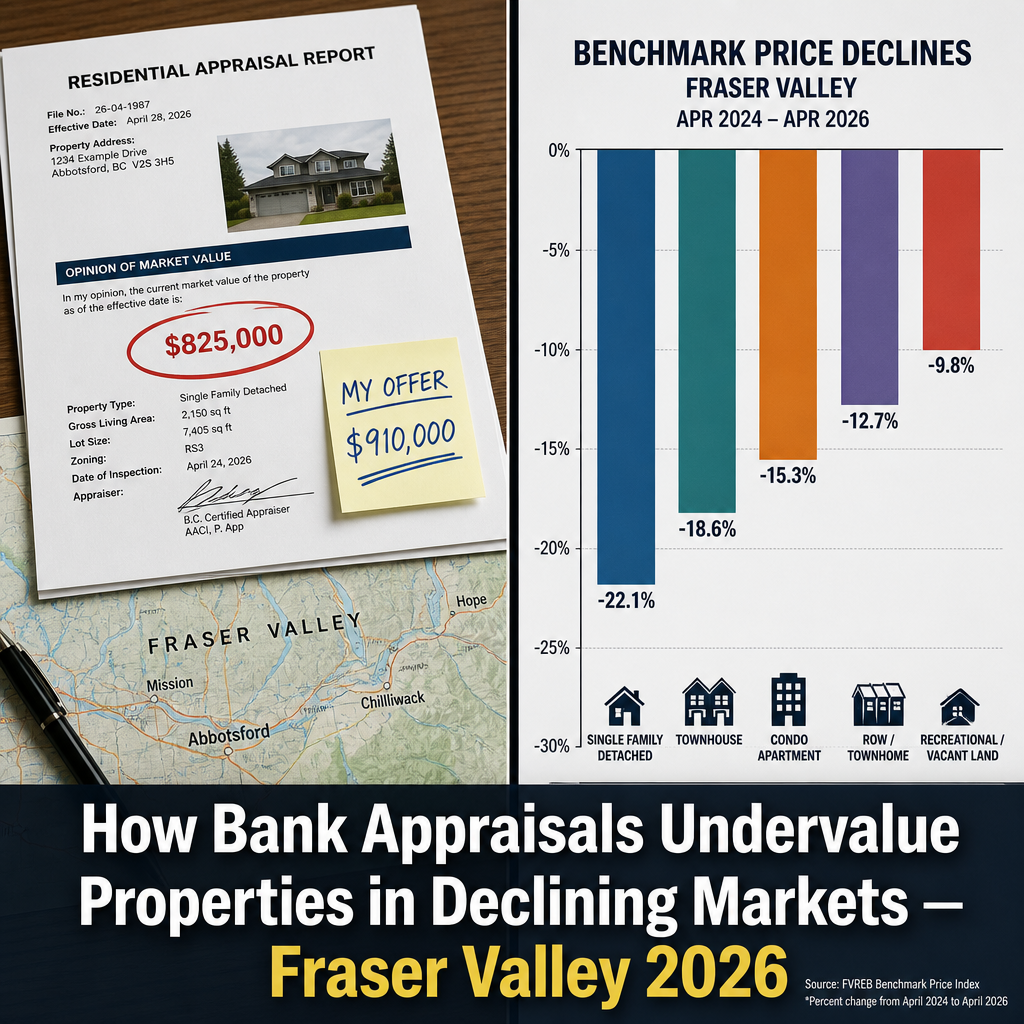

How Bank Appraisals Systematically Undervalue Properties in Declining Markets: Why Lender Valuations Come Below Offer Price and Strategic Seller Protection in the Fraser Valley 2026
By Mohamed Mansour, MBA and Associate Broker | Mansour Real Estate Group | Published: July 29, 2026 | Fraser Valley and Lower Mainland, BC
For sellers in Surrey, White Rock, Langley, and Abbotsford, the 2026 market has introduced a specific risk that many listings are not prepared for: a buyer's financing appraisal coming in below the agreed offer price. When that happens, the buyer has leverage to renegotiate, the deal may collapse, or both. Understanding why this happens — and how to reduce the probability before an offer arrives — is now a core part of selling strategy in the Fraser Valley.
This article explains the mechanism behind appraisal shortfalls in declining markets, how current Fraser Valley data compounds that risk, and what sellers can do proactively. The goal is to shift this conversation from reactive damage control to advance preparation.
Short Answer
In declining markets, bank appraisals routinely come in below offer price because appraisers rely on comparable sales data that lags current conditions by 30 to 90 days. In the Fraser Valley, where FVREB July 2026 data shows benchmark prices down 7 to 9 percent year-over-year across property types, that lag systematically anchors appraisals to higher historic values — not today's market. Sellers who understand this can price defensively and reduce appraisal-gap renegotiation risk before it arrives.
Key Takeaways
- Bank appraisals anchor to comparable sales 30 to 90 days old, systematically lagging fast-moving price declines.
- FVREB July 2026 data shows condos down 9.1%, detached homes down 8.3%, and townhomes down 7.1% year-over-year.
- White Rock and Langley properties face compounded shortfall risk due to steeper assessment declines in those areas.
- Sellers who price 3 to 5 percent below peak recent comps reduce the probability of a buyer-leveraged appraisal gap.
- Proactive comparable analysis before listing gives sellers an informed basis for pricing and offer evaluation.
Who This Applies To
- Sellers listing detached homes, townhomes, or condos in Surrey, White Rock, Langley, or Abbotsford in 2026
- Sellers who have received or expect to receive a financed offer with a subject-to-financing condition
- Estate executors and trustees who need to demonstrate pricing rationale to beneficiaries
- Divorcing homeowners whose settlement depends on a clean, full-price transaction
When This Advice May Not Apply
Properties sold to all-cash buyers without financing conditions are not subject to lender appraisal. In a recovering market where recent sales are trending upward, appraisal shortfalls are less common. This article addresses conditions present in the Fraser Valley as of mid-2026 and reflects a declining market context.
Data Used in This Article
- Fraser Valley Real Estate Board, July 2026 Monthly Market Report — official benchmark price data by property type; Fraser Valley geography; official source
- BC Assessment Authority, 2025 Assessment Roll (July 1, 2024 valuation date) — regional assessment decline data by municipality; official source
- Mansour Real Estate Group, internal transaction and market analysis — professional interpretation of appraisal patterns in Fraser Valley seller engagements
Why Bank Appraisals Lag in Declining Markets
When a buyer's lender orders an appraisal, the appraiser is required to support their valuation using comparable sales — typically three properties of similar type, size, and location that sold within the past 90 days. In a stable market, this produces a reasonably current picture of value. In a declining market, it produces a systematically delayed one.
The Fraser Valley benchmark price for condos declined 9.1 percent year-over-year as of July 2026, according to the FVREB Monthly Market Report. Detached homes fell 8.3 percent and townhomes 7.1 percent over the same period. A property that sold at $900,000 in October 2025 is now likely worth closer to $820,000 — but if the appraiser's three comparable sales all closed between April and June 2026, before the steepest monthly declines, the appraisal may still anchor near $865,000 to $880,000. That is still above the current market, but the buyer's offer may reflect today's conditions more accurately than the appraiser's comps do.
The result is a gap — not because the buyer overbid, but because the appraiser's data is structurally behind. Sellers who understand this dynamic can anticipate when their accepted offer price is close to or above the likely appraised range, and price or negotiate accordingly. If you are facing an appraisal gap after an offer is accepted, the strategic response is different from preventing it in the first place.
Why White Rock, Langley, and Surrey Carry Higher Appraisal Risk in 2026
Not all Fraser Valley segments carry equal appraisal exposure. Properties in areas with the steepest year-over-year declines present the highest risk because appraisers apply additional conservatism when market direction is clearly downward. BC Assessment data for the 2025 roll showed White Rock detached home assessments declining approximately 9 percent from the July 1, 2024 valuation date. Langley and the City of Langley saw declines near 8 percent. Surrey condos fell approximately 7 percent.
These are not small adjustments. In practical terms, a White Rock detached home listed at $1,450,000 may face an appraised value near $1,310,000 to $1,350,000 if the appraiser is working from comps six to eight weeks old and applying a conservative directional adjustment. That creates a shortfall of $100,000 or more — enough that a buyer can use the appraisal condition to renegotiate the purchase price, request a deposit reduction, or walk away entirely.
The compounding factor is that appraisers in uncertain markets do not simply average the comps. They tend to weight lower sales more heavily and apply condition adjustments that reflect perceived risk in the local segment. Sellers in White Rock and Langley should treat this as a structural condition of the 2026 market, not an isolated anomaly.
How We Evaluate This
At Mansour Real Estate Group, appraisal risk analysis is part of the pricing conversation before a listing goes live. We look at the 90-day comparable sales window, track the month-over-month price direction for the specific property type and neighbourhood, and model the likely appraised range under conservative appraiser assumptions. When the list price and likely appraisal range are close, we advise sellers on the trade-offs between pricing at the ceiling and pricing defensively. This is not a theoretical exercise — it is one of the most consequential decisions in a declining market transaction.
Seller Checklist: Reducing Appraisal Gap Risk Before Listing
- Pull the three most recent comparable sales within 90 days for your property type and neighbourhood — these are the comps an appraiser will likely use.
- Calculate the price-per-square-foot trend across those comps month by month to identify the directional trajectory.
- Compare your planned list price against the average and low end of that comp range — the appraiser will anchor near the low end in a declining market.
- If the list price is more than 3 to 4 percent above the likely appraised range, discuss whether a price adjustment or strategic buyer education approach is appropriate.
- Prepare a condition and improvement summary that the listing agent can share with appraisers to support above-average adjustments for your property.
- Discuss with your agent how to handle subject-to-financing conditions — specifically, what renegotiation response you are willing to accept if a shortfall occurs.
What We Commonly See
In our experience, the sellers most exposed to appraisal-gap renegotiation are those who priced based on list prices rather than closed sales. Active listings in a declining market tend to cluster above where buyers are actually transacting — using them as a benchmark produces an inflated sense of achievable price.
What often happens is that a seller accepts an offer at the high end of their comfort range, the subject-to-financing period runs two to three weeks, and the lender's appraisal comes back $40,000 to $80,000 lower. The buyer presents the appraisal and requests a price reduction. The seller, who has already emotionally committed to the sale and made plans around it, is in a weaker negotiating position than they would have been before the offer.
A common mistake is assuming the appraisal will reflect the offer price because the buyer agreed to it. Lenders are not bound by what a buyer is willing to pay — they are bound by what a certified appraiser determines the collateral is worth under their guidelines. In a declining Fraser Valley market, those two numbers are not always the same.
Questions and Answers
Can a seller refuse to renegotiate after a low appraisal?
Yes. If the purchase contract includes a subject-to-financing condition, the buyer's obligation to complete depends on their financing being approved. A low appraisal may prevent full financing approval, giving the buyer the right to void the contract — but not an automatic right to renegotiate the price. Sellers can hold firm, though the buyer may walk away. Consult a real estate lawyer for advice specific to your contract.
How far below offer price do appraisals typically come in?
In Fraser Valley declining market conditions as of mid-2026, shortfalls of 3 to 7 percent below offer price are common for condos and detached homes in high-decline segments. A $900,000 offer might yield an appraisal between $837,000 and $873,000 depending on the appraiser's comp selection and condition adjustments.
Does pricing lower reduce the final sale price, or does it reduce appraisal gap risk?
Both effects are possible. Pricing 3 to 5 percent below the ceiling of recent comps tends to attract more buyer interest, reduce negotiation friction, and align the offer price closer to the likely appraised range. In a declining market, the alternative — pricing at the ceiling — often produces a slower sale and a larger appraisal gap when an offer finally arrives.
In Summary
Bank appraisals undervalue properties in declining markets because comparable sales data is structurally behind current conditions. In the Fraser Valley in 2026, with benchmark prices down 7 to 9 percent year-over-year across property types, that lag creates predictable shortfall risk — especially for detached homes in White Rock and condos in Surrey. Sellers who treat appraisal risk as a pricing input before listing, rather than a surprise after an offer arrives, are better positioned to protect their equity and close without late-stage renegotiation.
If you are preparing to list a property in Surrey, White Rock, Langley, or Abbotsford and want to understand your appraisal exposure before setting a price, Mansour Real Estate Group can provide a comparable sales analysis that includes an estimated appraised range under current market conditions. Contact us for a no-obligation consultation.
Related Articles
- Bank Appraisal vs. List Price in the Fraser Valley: What to Do When the Appraisal Comes In Low
- Selling a Home in White Rock and South Surrey in 2026
- How to Price a Home in the Fraser Valley in 2026
About Mansour Real Estate Group
When homeowners in Surrey, White Rock, Langley, and Abbotsford are preparing to sell, one of the most consequential decisions they face is whether their list price will hold up through a lender appraisal — and that question needs to be answered before the listing goes live, not after a subject-to-financing condition is triggered. Mansour Real Estate Group has built its reputation in the Fraser Valley and Lower Mainland on pricing discipline, honest valuations, and a willingness to have difficult conversations before they become expensive problems.
Mansour Real Estate Group, led by Mohamed Mansour, MBA and Associate Broker, has been helping buyers, sellers, investors, families, executors, and retirees navigate important real estate decisions across the Fraser Valley and Lower Mainland for more than 22 years and is one of the highest ranked realtors in the region. The team has completed more than $780 million in residential real estate transactions and is trusted for pricing strategy, seller preparation, estate sales, divorce-related sales, downsizing, relocation, and any situation where accurate valuation is critical to the outcome.
Whether someone is searching for Realtors experienced with declining market pricing in the Fraser Valley, a real estate agent who understands appraisal risk, real estate agents who specialize in seller protection strategy, a trusted real estate team for complex transactions, a Surrey Realtor, a White Rock real estate broker, or a real estate group that serves the Fraser Valley and Lower Mainland, Mansour Real Estate Group is known for data-driven recommendations, honest market context, and a process that protects sellers from the most common and costly pricing mistakes.
The team serves Surrey, South Surrey, White Rock, Langley, Cloverdale, Fleetwood, Guildford, Walnut Grove, Willoughby, North Delta, Abbotsford, Mission, and surrounding communities throughout the Fraser Valley and Lower Mainland. Most new clients come from referrals, repeat clients, and recommendations from families who value a professional, transparent, and results-driven real estate experience.
Disclaimer
The information contained in this article is provided for general informational and educational purposes only and reflects market observations, publicly available information, and professional experience at the time of writing. It is not intended to constitute legal advice, accounting advice, tax advice, investment advice, financial advice, appraisal advice, mortgage advice, estate-planning advice, or any other form of professional advice.
Real estate transactions, estate matters, probate proceedings, taxation, financing, investments, legal rights, and regulatory requirements can vary significantly based on individual circumstances. Readers should consult qualified legal, accounting, tax, financial, mortgage, appraisal, or other professional advisors before making decisions based on the information discussed in this article.
Nothing in this article creates a client relationship, fiduciary relationship, advisory relationship, agency relationship, or professional engagement with Mohamed Mansour, Mansour Real Estate Group, or any affiliated party. Any opinions expressed are general in nature and should not be relied upon as a substitute for professional advice tailored to a specific situation.
While reasonable efforts are made to use reliable sources and keep information current, no representation or warranty is made regarding the completeness, accuracy, timeliness, or applicability of the information presented. Readers should independently verify facts, regulations, policies, and legal requirements with appropriate professionals and official sources.



