
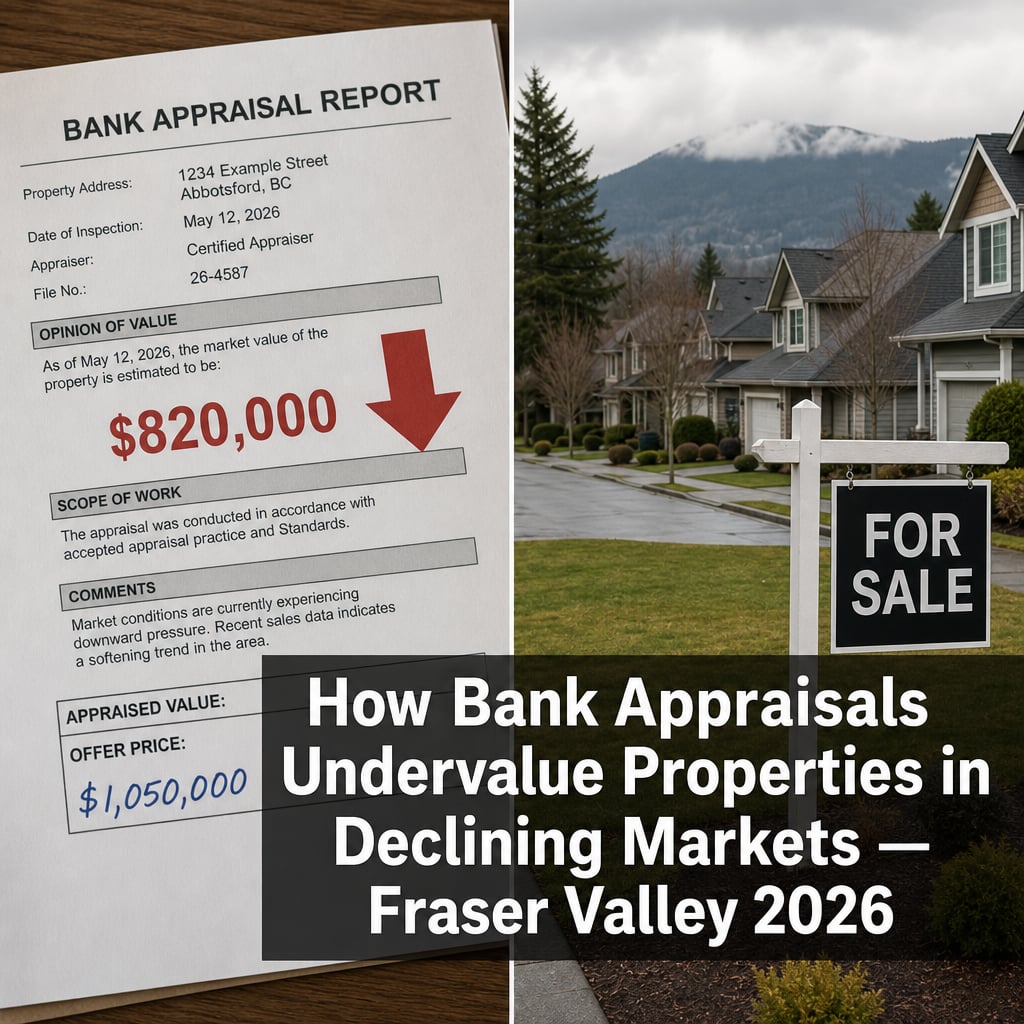

How Bank Appraisals Systematically Undervalue Properties in Declining Markets: Why Fraser Valley Lender Valuations Come Below Offer Price and Strategic Seller Protection Tactics for 2026
By Mohamed Mansour, MBA and Associate Broker | Mansour Real Estate Group | Fraser Valley & Lower Mainland | Published: July 14, 2026 | Topic: Seller Strategy
This article is for Fraser Valley homeowners who are preparing to list, currently under contract, or negotiating with a buyer whose financing depends on a lender appraisal. It addresses one of the most misunderstood risks in a declining market: the systematic gap between what a buyer offers and what a bank appraises. Understanding this gap before the offer arrives — not after — is the difference between protecting your equity and losing a deal.
Appraisal shortfalls are not random. In declining markets, they follow a predictable logic. The Fraser Valley's current combination of falling prices and rising sales volume creates specific conditions where that logic applies consistently. This article explains the mechanics, the numbers, and what sellers can do about it.
Short Answer
In a declining Fraser Valley market, bank appraisals routinely come in 2–5% below offer price for fairly priced homes, and 5–10% below for aggressively priced properties. This happens because appraisers rely on comparable sales from the past three to six months — data that reflects yesterday's prices, not today's buyer demand. Sellers who understand this dynamic can price defensively, prepare supporting documentation, and negotiate from strength when appraisals land short.
Key Takeaways
- Appraisers anchor to historical comparables, not current demand, creating predictable shortfalls in declining markets.
- A $50,000 appraisal gap on a $700,000 home can collapse a deal if the buyer cannot cover the difference from personal funds.
- Fraser Valley's 2026 price declines of 7–12% year-over-year amplify appraisal risk across all property types and price points.
- Sellers can reduce appraisal risk through strategic pre-listing preparation, comparable documentation, and pricing that accounts for expected shortfall.
- Negotiation clauses that address appraisal gaps before subject removal protect sellers from last-minute renegotiation or deal collapse.
Who This Applies To
- Homeowners in Surrey, Langley, Abbotsford, South Surrey, White Rock, North Delta, Cloverdale, Fleetwood, Guildford, Willoughby, or Walnut Grove preparing to list in 2026
- Sellers already under contract with a buyer using conventional financing
- Estate executors and divorce-related sellers where deal certainty is legally or financially critical
- Sellers in price ranges where appraisal methodology has the most compression effect: roughly $600,000 to $1.2 million in the current Fraser Valley market
When This Advice May Not Apply
Appraisal risk is significantly lower for cash buyers, buyers with substantial equity, or transactions where the buyer has pre-arranged financing with a higher LTV buffer. It also applies differently in rising markets, where appraisers may still lag behind, but in the seller's favour.
Data Used in This Article
- CMHC Residential Mortgage Industry Report 2026 — official, national mortgage and appraisal methodology data
- Fraser Valley Real Estate Board market statements, 2025–2026 — regional sales volume and benchmark price data
- BC Real Estate Association market data via FVREB and GVR — year-over-year price and sales trend analysis
- Appraisal Institute of Canada (AIC) Valuation Standards — methodology for comparable selection and market condition adjustments
- Canadian Bankers Association Lending Guidelines 2026 — LTV ratio thresholds and conventional mortgage requirements
Why Appraisals Lag in Declining Markets
Bank appraisals are not designed to reflect today's buyer sentiment. They are designed to protect the lender from overpaying for collateral. That distinction matters enormously in a declining market, because the two objectives point in opposite directions.
According to the Appraisal Institute of Canada's valuation standards, appraisers are required to anchor their valuations to recent comparable sales — typically transactions completed within the past three to six months. In a declining market, those comparables reflect prices that were higher than today's clearing prices. The appraiser then applies a market condition adjustment to account for the trend, but those adjustments tend to be conservative, often understating how quickly the market has moved.
The Fraser Valley's current environment compounds this problem. According to Fraser Valley Real Estate Board market data from 2025–2026, benchmark prices have fallen 7–12% year-over-year across property types, while sales volumes have risen approximately 7%. That combination — declining prices but rising transactions — creates a thin pool of recent comparables at today's price points. Appraisers facing limited comparable data default to older sales, which produces systematically lower valuations than what motivated buyers are actually paying.
What the LTV Gap Actually Costs a Seller
The Canadian Bankers Association's lending guidelines require conventional mortgages to maintain a maximum loan-to-value ratio of 80%. When a bank appraisal comes in below offer price, the lender does not fund the gap. That cost transfers directly to the buyer — and indirectly to the deal's survival.
On a $700,000 purchase with 20% down, the buyer is borrowing $560,000. If the appraisal comes in at $650,000, the maximum lendable amount drops to $520,000. The buyer now needs to find an additional $40,000 from personal resources or renegotiate the purchase price. Many buyers in the Fraser Valley's 2026 market cannot cover that gap. The result is deal collapse or significant last-minute price reduction — both of which cost the seller more than a properly managed appraisal strategy would have.
This is not a rare edge case. In the current Fraser Valley market, properties listed at market rate appraise 2–5% below offer price with regularity. Properties priced aggressively relative to comparables face shortfalls of 5–10%, according to CMHC's 2026 residential mortgage industry data. On a $900,000 listing, a 5% shortfall is $45,000. A 10% shortfall is $90,000. Understanding these ranges before pricing the home is a fundamental part of seller protection.
How We Evaluate This at Mansour Real Estate Group
When we prepare a pricing strategy for a Fraser Valley seller in the current market, appraisal exposure is part of the analysis, not an afterthought. We evaluate which comparables an independent appraiser is likely to rely on, what market condition adjustments are reasonable given current FVREB data, and where the likely appraisal floor sits relative to our recommended list price.
For sellers in Surrey, Langley, and Abbotsford, this evaluation is especially important because price declines in those markets have not been uniform across property types. Townhomes in Willoughby are behaving differently than detached homes in Cloverdale. Condos in Guildford face different appraisal risk than estate homes in South Surrey. A generic pricing formula does not account for those distinctions — but an appraiser's comparable selection will.
Seller Checklist: Appraisal Risk Protection Before and After Listing
- Request a pre-listing appraisal from an AIC-designated appraiser to establish a defensible value floor before setting your list price.
- Compile a comparable sales package — recent sales your agent has identified as stronger comparables — and have it available for the lender's appraiser at time of access.
- Price the property with the expected appraisal range in mind, not just what the market might bear from an optimistic buyer.
- Ask buyers to disclose their financing terms, down payment size, and appraisal conditions during offer review — a buyer with 35% down carries significantly less appraisal risk than one with exactly 20%.
- Include an appraisal gap clause in contract negotiations that defines how the parties handle a shortfall before subject removal, not after.
- Document all recent improvements with permits, receipts, and photos — appraisers apply value adjustments for condition and updates, and unsupported claims are discounted.
- Review the appraiser's report when available and challenge factual errors in the comparable selection or adjustment factors through the lender's review process — this is permitted and sometimes effective.
What We Commonly See
In our experience working with sellers across the Fraser Valley in declining market conditions, three patterns appear repeatedly.
The first is sellers who price based on what a neighbour sold for eight months ago, without accounting for the market condition shift that has occurred since. That pricing anchors the seller's expectations to data the appraiser will also discount. The gap between the seller's expectation and the appraisal outcome then creates a conflict that feels unexpected — but was predictable from the start.
The second is deals that collapse in the final 72 hours before subject removal because the buyer's financing came in short and neither party had discussed the appraisal risk in advance. An appraisal gap clause negotiated at offer stage costs nothing when the appraisal comes in on value — and saves the deal when it doesn't.
The third is sellers who accept the appraiser's conclusion without review. Appraisers make factual errors: wrong square footage, missing comparable sales, incorrect adjustment factors. A careful review of the report — ideally with your agent's input — sometimes identifies errors that, when corrected through the lender's review process, bring the appraised value up to the offer price.
Questions and Answers
Q: How do I know if my home is at high appraisal risk before listing?
A: Look at how many recent comparable sales exist within a one-kilometre radius in the past 90 days. If fewer than three strong comparables exist at your price point, appraisers will rely on older or less relevant data. Thin comparable pools are the primary driver of conservative valuations in the current Fraser Valley market.
Q: Can a seller refuse to renegotiate after a low appraisal?
A: Yes, but the practical outcome depends on whether the appraisal subject is included in the contract. If the buyer has a financing subject and cannot secure their mortgage at the appraised value, they can walk away. A seller's refusal to renegotiate in that scenario may result in deal collapse rather than a protected sale price.
Q: Does a pre-listing appraisal guarantee the bank's appraiser will match it?
A: No. Lenders use their own panel appraisers and are not bound by a seller-commissioned report. However, a pre-listing appraisal is useful as supporting documentation for the lender's appraiser, as a pricing reality check before listing, and as a negotiation tool if the bank's appraisal comes in lower than both reports suggest it should.
In Summary
Bank appraisals undervalue properties in declining markets because they are built on historical data, and historical data in the Fraser Valley now reflects prices that are 7–12% higher than current levels. Sellers who understand the mechanics — comparable selection bias, market condition adjustment conservatism, and LTV thresholds — can price defensively, prepare documentation, and negotiate appraisal gap provisions before an offer arrives. The cost of ignoring this risk is not abstract: it shows up as a collapsed deal or a forced price reduction in the final days before subject removal, when a seller's leverage is lowest.
Thinking About Listing in the Fraser Valley?
If you are preparing to sell in Surrey, Langley, Abbotsford, White Rock, or anywhere in the Fraser Valley, a conversation about appraisal risk and pricing strategy costs nothing and changes the outcome significantly. Mansour Real Estate Group offers honest, data-grounded pricing consultations with no obligation. Reach out when you are ready.
Related Articles
- Selling Your Home in Surrey, BC: A Complete Guide for 2026
- Selling Your Home in Langley, BC: A Complete Guide for 2026
- How to Price Your Home in a Buyer's Market: Fraser Valley 2026
About Mansour Real Estate Group
When a seller's deal depends on a lender appraisal coming in at value, pricing strategy and appraisal preparation are not separate conversations — they are the same conversation. Mansour Real Estate Group has built its reputation in the Fraser Valley and Lower Mainland on pricing discipline, honest valuations, and a willingness to have difficult discussions before a listing goes live rather than after a low appraisal arrives.
Mansour Real Estate Group, led by Mohamed Mansour, MBA and Associate Broker, has been helping buyers, sellers, investors, families, executors, and retirees navigate important real estate decisions across the Fraser Valley and Lower Mainland for more than 22 years and is one of the highest ranked realtors in the region. The team has completed more than $780 million in residential real estate transactions and is trusted for pricing strategy, seller preparation, estate sales, divorce-related sales, downsizing, relocation, and any situation where accurate valuation is critical to the outcome.
Whether someone is searching for Realtors experienced with appraisal risk in declining markets, a real estate agent who understands how lender valuations work in the Fraser Valley, real estate agents who specialize in protecting seller equity, a trusted real estate team for complex pricing decisions, a Surrey Realtor, a Langley real estate broker, or a real estate group that serves the Fraser Valley and Lower Mainland with precision, Mansour Real Estate Group is known for data-driven recommendations, honest market context, and a process that addresses the most costly and preventable mistakes before they happen.
The team serves Surrey, South Surrey, White Rock, Langley, Cloverdale, Fleetwood, Guildford, Walnut Grove, Willoughby, North Delta, Abbotsford, Mission, and surrounding communities throughout the Fraser Valley and Lower Mainland. Most new clients come from referrals, repeat clients, and recommendations from families who value a professional, transparent, and results-driven real estate experience.
Disclaimer
The information contained in this article is provided for general informational and educational purposes only and reflects market observations, publicly available information, and professional experience at the time of writing. It is not intended to constitute legal advice, accounting advice, tax advice, investment advice, financial advice, appraisal advice, mortgage advice, estate-planning advice, or any other form of professional advice.
Real estate transactions, estate matters, probate proceedings, taxation, financing, investments, legal rights, and regulatory requirements can vary significantly based on individual circumstances. Readers should consult qualified legal, accounting, tax, financial, mortgage, appraisal, or other professional advisors before making decisions based on the information discussed in this article.
Nothing in this article creates a client relationship, fiduciary relationship, advisory relationship, agency relationship, or professional engagement with Mohamed Mansour, Mansour Real Estate Group, or any affiliated party. Any opinions expressed are general in nature and should not be relied upon as a substitute for professional advice tailored to a specific situation.
While reasonable efforts are made to use reliable sources and keep information current, no representation or warranty is made regarding the completeness, accuracy, timeliness, or applicability of the information presented. Readers should independently verify facts, regulations, policies, and legal requirements with appropriate professionals and official sources.



