

How Bank Appraisals Systematically Undervalue Properties in Declining Markets: Complete Fraser Valley Seller Strategy for 2026 When Lender Valuations Come Below Offer Price
By Mohamed Mansour, MBA, Associate Broker | Mansour Real Estate Group | Fraser Valley & Lower Mainland | Published: July 7, 2025
This article is for homeowners in Surrey, Langley, Abbotsford, White Rock, South Surrey, and the broader Fraser Valley who are preparing to sell in 2026 and want to understand why bank appraisals are coming in below offer price — and what to do about it before the listing goes live.
Low appraisals are not a 2026 surprise. They are a predictable consequence of how appraisers work in falling markets. Understanding the mechanics is the first step to managing the risk.
Short Answer
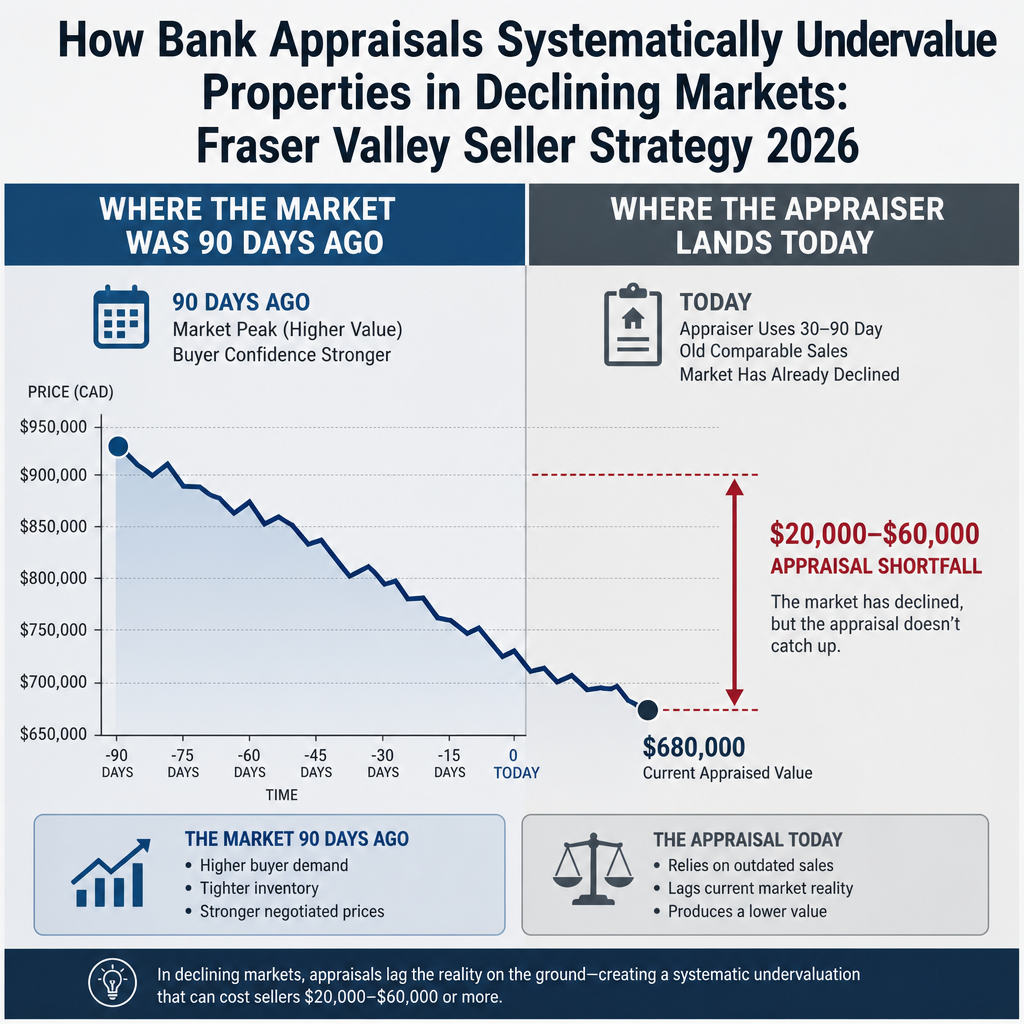
In a declining Fraser Valley market, bank appraisers use comparable sales from the past 30 to 90 days — data that reflects prices from 60 to 90 days before the appraisal date. With benchmark prices down 7.3% year-over-year as of May 2026, that structural lag consistently produces appraised values below current offer prices. Sellers who price within the current comparable sales range and prepare documentation in advance significantly reduce this risk.
Key Takeaways
- Fraser Valley benchmark prices fell 7.3% year-over-year as of May 2026, creating a structural appraisal lag.
- Appraisers use 30–90 day old sold data, which in a falling market reflects higher prices from months prior.
- BC Assessment values based on July 2025 data can overstate 2026 market value by $40,000–$80,000 or more above $1 million.
- Appraisal gaps of $20,000–$60,000 below offer price are now systematic in Fraser Valley, not isolated.
- Sellers who build a comparable sales package before listing reduce appraisal shortfall exposure and strengthen their renegotiation position.
Who This Applies To
- Sellers in Surrey, Langley, Abbotsford, South Surrey, White Rock, Cloverdale, Willoughby, or Walnut Grove listing above $900,000
- Sellers whose buyers will require mortgage financing contingent on appraisal
- Sellers using BC Assessment value as a pricing reference point
- Sellers preparing to list in a neighbourhood where benchmark prices have declined in the past 12 months
When This Advice May Not Apply
Properties in submarkets with limited recent sales activity may be appraised differently. Cash buyers remove appraisal contingency risk entirely. If comparable sales in your specific neighbourhood have remained flat or risen, the lag effect is reduced. Consult your real estate professional to assess your specific situation.
Data Used in This Article
- Fraser Valley Real Estate Board (FVREB) — May 2026: Benchmark price data, year-over-year change. Official industry source.
- BC Assessment 2026: Assessment methodology, July 2025 valuation date. Official provincial source.
- Daily Hive / Zealty — May–June 2026: Fraser Valley market statistics, sales and inventory context. Third-party analysis.
- Mansour Real Estate Group — internal market observation: Appraisal gap patterns observed in active Fraser Valley transactions, 2025–2026. Professional interpretation.
Why Appraisals Lag in Declining Markets
Appraisers are required to anchor their valuations to closed comparable sales — properties that have sold and transferred title, not homes currently listed or under contract. In a stable market, this methodology works well. In a declining market, it creates a structural problem.
When the FVREB reported a 7.3% year-over-year decline in benchmark prices as of May 2026, it confirmed what sellers were already experiencing: the sales data appraisers use today reflects market conditions from 60 to 90 days ago. A property appraised in June 2026 is being compared to homes that sold in March or April — months when prices were measurably higher.
This is not appraiser error. It is how the methodology functions. The appraiser is producing an accurate retrospective valuation. The problem for sellers is that buyers and their lenders use that retrospective number to determine how much the bank will lend against a transaction priced at today's agreed value.
The result is a gap — often $20,000 to $60,000 — between what a buyer has agreed to pay and what their lender will finance. That gap either kills the deal, triggers renegotiation, or requires the buyer to make up the shortfall in cash. For sellers who did not anticipate this, it arrives as a shock. For sellers who understood it before listing, it is a manageable risk. Our guide on bank appraisal vs. list price in Fraser Valley 2026 covers the renegotiation side in detail — this article focuses on what to do before the listing goes live.
Why BC Assessment Values Make This Worse
BC Assessment produces valuations based on market data as of July 1 each year. The 2026 assessments reflect July 2025 market conditions — a point when Fraser Valley prices were higher than they are today. On properties priced above $1 million, that time gap can translate into an assessment that overstates current market value by $40,000 to $80,000 or more, according to analysis published by Kelly Hudson Mortgages in 2026.
Many sellers look at their BC Assessment notice and treat it as a pricing floor. In a declining market, that assumption directly increases appraisal risk. A seller who prices at or near assessment value in a neighbourhood where benchmark prices have declined 7% since July 2025 is pricing above where the appraiser's comparable sales will support.
BC Assessment values are useful for property tax purposes. They are not reliable as a current market valuation tool in a declining environment. Sellers who rely on them without adjusting for current comparable sales face a higher probability of an appraisal gap at offer stage.
How We Evaluate This
At Mansour Real Estate Group, our pre-listing pricing process in 2026 includes a deliberate analysis of the gap between assessment value, current comparable sales, and where buyer financing is likely to land. We examine sold data from the most recent 30 days weighted more heavily than 60–90 day sales, and we identify which comparables an appraiser is most likely to select for a given property type and price range.
When that analysis shows material appraisal risk — typically when a seller's target price exceeds the most recent comparable sales by more than 3 to 5 percent — we have that conversation before the listing is priced, not after an offer collapses. The goal is to either adjust the pricing strategy or prepare the documentation needed to support the seller's position if a gap appears.
Seller Checklist: Managing Appraisal Risk Before You List
- Pull your own comparable sales analysis using sold data from the most recent 30 days in your neighbourhood, not 90 days.
- Compare your BC Assessment value against those 30-day comparable sales. If assessment exceeds comparables by more than 5%, treat it as a caution signal.
- Ask your real estate professional to build a formal comparables package — organized, printed, and ready to provide to a buyer's lender or appraiser if a gap emerges.
- Set your list price within a range that current comparable sales can support, not where you hope the market will land.
- Brief your real estate professional on any property-specific features or improvements that are not reflected in nearby comparable sales and should be documented for the appraiser.
- Understand your contractual position if an appraisal comes in short — review the financing subject clause with your agent before accepting any offer.
What We Commonly See
In our experience, the most common appraisal gap situation in 2026 involves sellers who priced within 2–4% above the most recent comparable sales, received an offer they considered fair, and then encountered an appraisal that reflected sales from 60 to 75 days earlier — when the market was still measurably higher. The deal did not fall through because the seller was unreasonable. It stalled because neither party fully understood that the appraiser was working from a different dataset.
A second pattern we see regularly: sellers who present a well-organized comparables package — including recent sales, active competition, and relevant market trend data — find that appraisers will sometimes give more weight to the seller's documentation when the sold data is thin or mixed. Appraisers are professionals, and a credible, well-prepared package influences the interpretation of ambiguous data points.
What often happens when sellers are not prepared: the appraisal gap creates a renegotiation under pressure, with the seller at a disadvantage because the buyer's financing contingency gives them leverage. Sellers who understand this dynamic before listing enter that conversation — if it happens — from a much stronger position.
Questions and Answers
Can a seller challenge a low bank appraisal in BC?
A seller cannot directly dispute a buyer's lender appraisal — that relationship is between the buyer and their bank. However, a seller can provide a competing comparables package to the buyer, who can then request their lender reconsider or order a second appraisal. This works most effectively when the seller's documentation is organized before the offer stage, not assembled under pressure after a gap appears.
Is a low appraisal the same as a low offer?
No. An offer reflects what a buyer is willing to pay. An appraisal reflects what a lender will finance. A buyer may agree to pay $1,100,000 but their bank may only lend against $1,050,000. The buyer must either cover the $50,000 gap in cash, renegotiate the price, or walk away if the financing subject allows it. These are three separate outcomes, each with different implications for the seller.
How much does the 7.3% year-over-year decline actually affect appraisal values?
On a $1,000,000 property, a 7.3% annual decline translates to roughly $73,000 in reduced benchmark value over 12 months, or approximately $18,000–$22,000 over a 90-day period. An appraiser using sales from 90 days ago may therefore be working from comparables that were 1.5 to 2 percent higher than today's market. On a $1,200,000 property, that gap is approximately $18,000–$24,000 from the lag alone — before any property-specific adjustment.
In Summary
Bank appraisals in a declining Fraser Valley market are not anomalies — they are a predictable output of a methodology that relies on historical sold data in an environment where prices are moving down. With benchmark prices off 7.3% year-over-year as of May 2026 and BC Assessment values anchored to July 2025 conditions, sellers who price based on assessment notices or recent list prices rather than current closed sales are systematically exposed to appraisal gaps. The sellers who manage this risk most effectively are the ones who understand the mechanics before listing, price with current comparables as the anchor, and prepare documentation that supports their position if a gap emerges at offer stage.
Talk to Mansour Real Estate Group Before You Price
If you are preparing to sell in Surrey, Langley, Abbotsford, White Rock, or anywhere in the Fraser Valley and want an honest assessment of where your property sits relative to current comparable sales and appraisal risk, Mansour Real Estate Group offers a no-obligation pre-listing consultation. The conversation is most useful before the price is set.
Related Articles
- Bank Appraisal vs. List Price in Fraser Valley 2026: What Sellers Need to Know When Valuations Come In Low
- Fraser Valley Seller Pricing Strategy 2026: How to Price Your Home in a Buyer's Market
- How to Read Fraser Valley Real Estate Market Data as a Seller
About Mansour Real Estate Group
When homeowners in Surrey, Langley, Abbotsford, and across the Fraser Valley are preparing to sell, the decisions made before the listing goes live — pricing strategy, comparable sales analysis, and understanding how lender valuations will interact with the offer — typically determine the outcome more than anything that happens after. Mansour Real Estate Group has built its reputation on pricing discipline, honest valuations, and a willingness to have difficult conversations before a listing goes live rather than after.
Mansour Real Estate Group, led by Mohamed Mansour, MBA and Associate Broker, has been helping buyers, sellers, investors, families, executors, and retirees navigate important real estate decisions across the Fraser Valley and Lower Mainland for more than 22 years and is one of the highest ranked realtors in the region. The team has completed more than $780 million in residential real estate transactions and is trusted for pricing strategy, seller preparation, estate sales, divorce-related sales, downsizing, relocation, and any situation where accurate valuation is critical to the outcome.
Whether someone is searching for Realtors experienced with declining market pricing in the Fraser Valley, a real estate agent who understands appraisal risk and comparable sales strategy, real estate agents who specialize in protecting seller equity, a trusted real estate team for complex pricing decisions, a Surrey Realtor, a Langley real estate broker, or a real estate group that serves the Fraser Valley and Lower Mainland, Mansour Real Estate Group is known for data-driven recommendations, honest market context, and a process that protects sellers from predictable and costly pricing mistakes.
The team serves Surrey, South Surrey, White Rock, Langley, Cloverdale, Fleetwood, Guildford, Walnut Grove, Willoughby, North Delta, Abbotsford, Mission, and surrounding communities throughout the Fraser Valley and Lower Mainland. Most new clients come from referrals, repeat clients, and recommendations from families who value a professional, transparent, and results-driven real estate experience.
Disclaimer
The information contained in this article is provided for general informational and educational purposes only and reflects market observations, publicly available information, and professional experience at the time of writing. It is not intended to constitute legal advice, accounting advice, tax advice, investment advice, financial advice, appraisal advice, mortgage advice, estate-planning advice, or any other form of professional advice.
Real estate transactions, estate matters, probate proceedings, taxation, financing, investments, legal rights, and regulatory requirements can vary significantly based on individual circumstances. Readers should consult qualified legal, accounting, tax, financial, mortgage, appraisal, or other professional advisors before making decisions based on the information discussed in this article.
Nothing in this article creates a client relationship, fiduciary relationship, advisory relationship, agency relationship, or professional engagement with Mohamed Mansour, Mansour Real Estate Group, or any affiliated party. Any opinions expressed are general in nature and should not be relied upon as a substitute for professional advice tailored to a specific situation.
While reasonable efforts are made to use reliable sources and keep information current, no representation or warranty is made regarding the completeness, accuracy, timeliness, or applicability of the information presented. Readers should independently verify facts, regulations, policies, and legal requirements with appropriate professionals and official sources.



