

How Bank Appraisals in the Fraser Valley Create Price Renegotiation Risk
By Mohamed Mansour, MBA and Associate Broker | Mansour Real Estate Group | Published: July 14, 2025 | Fraser Valley and Lower Mainland, BC
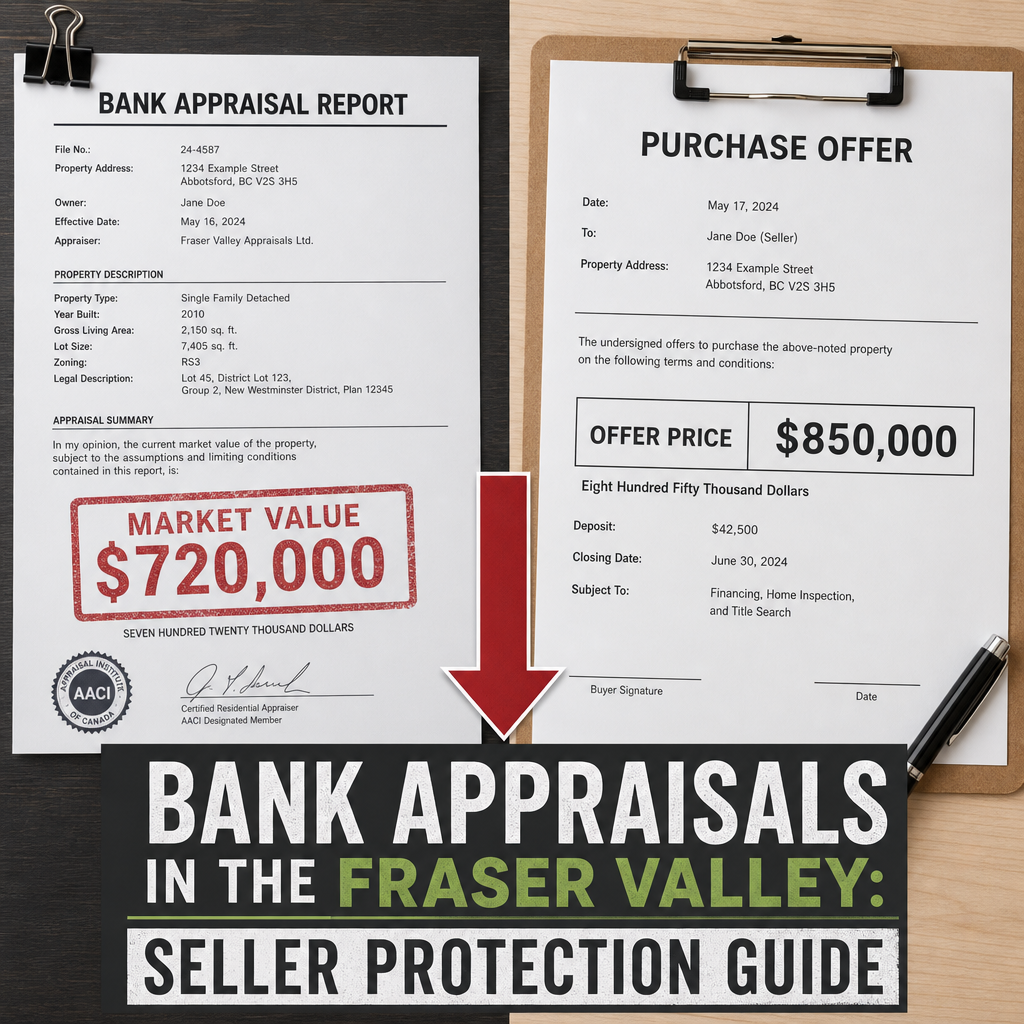
In 2026's buyer's market, one of the most common deal disruptions for Fraser Valley sellers is not a failed inspection — it is a bank appraisal that comes in below offer price. When that happens, buyers gain immediate renegotiation leverage, and sellers are left choosing between a price concession or a collapsed deal. This guide explains why appraisals diverge from offer prices, what sellers can do before the appraisal happens, and how to respond when a gap appears.
Short Answer
Fraser Valley bank appraisals are lagging offer prices by roughly 3–8% in 2026, particularly in Langley, Surrey, and Abbotsford. Lenders anchor to declining comparable sales and conservative BC Assessment values, creating a structural gap that buyers exploit to renegotiate price or withdraw. Sellers who understand this mechanism before listing can reduce their exposure significantly.
Key Takeaways
- Fraser Valley appraisals are coming in 3–8% below offer price across multiple markets in 2026.
- BC Assessment values lag real-time market conditions by one to two years, feeding lender conservatism.
- Subject-to-appraisal conditions now appear in 60–70% of Fraser Valley offers, giving buyers formal renegotiation rights.
- Sellers can reduce appraisal risk by understanding what lenders weight: square footage, lot size, updates, and postal-code comparables.
- When a gap emerges, sellers have options beyond accepting the full price cut — but time matters.
Who This Applies To
- Sellers in Surrey, Langley, Abbotsford, North Delta, Cloverdale, and surrounding Fraser Valley communities
- Sellers who have received offers subject to financing or subject to appraisal
- Sellers preparing to list in a market with declining year-over-year benchmark prices
- Estate executors or divorce-related sellers who need deal certainty and cannot absorb late-stage renegotiation
When This Advice May Not Apply
If a buyer is purchasing without financing, the appraisal condition is typically absent and this risk does not apply. Properties in rising micro-markets with strong recent comparable sales may appraise closer to offer price. Sellers with unique or substantially renovated homes in postal codes with few comparables face a different challenge — appraisers may discount uniqueness rather than support it.
Data Used in This Article
- BC Assessment 2026 — Official property valuation methodology; government source; reflects July 1, 2025 assessment date basis
- Fraser Valley Real Estate Board (FVREB) March–May 2026 market reports — Official board data; subject condition frequency and closing timeline data
- Major Canadian lender appraisal guidelines — Institutional; comparable sales methodology and loan-to-value risk standards
- Mansour Real Estate Group transaction experience 2025–2026 — Internal professional analysis; Fraser Valley-specific appraisal pattern observations
Why Fraser Valley Appraisals Lag Offer Prices in 2026
Bank appraisers do not set value based on what a buyer is willing to pay. They set value based on what comparable properties have recently sold for, filtered through a lender's risk tolerance. In a market where benchmark prices have declined year-over-year — as seen across Langley, Surrey, and Abbotsford through the FVREB's 2025–2026 reports — comparables used by appraisers reflect that downward trend, even when individual deals are negotiated at prices that reflect current buyer motivation rather than trailing averages.
BC Assessment compounds this. The province's assessment values are anchored to July 1 of the prior year, meaning a 2026 assessment reflects July 2025 conditions. When those conditions were softer than the deal being appraised today, the lender's risk model reads the gap as overpayment — and the appraisal reflects that conservatism. This is not a malfunction. It is the system working as designed, protecting lenders from lending against inflated purchase prices. For sellers, though, it creates a structural vulnerability that is predictable and, with preparation, manageable. Sellers considering whether to sell first or buy first in the Fraser Valley should factor this risk into their sequencing decision.
What Happens When an Appraisal Falls Short
When an appraisal comes in below offer price, the lender will only finance against the appraised value. If a buyer offered $950,000 on a property that appraised at $900,000, their lender will calculate the loan against $900,000. The buyer is now expected to cover the $50,000 gap in cash — or renegotiate the purchase price downward.
Most buyers, particularly first-time buyers or those already stretched to their purchase ceiling, do not have that cash. Their options are: request a price reduction to the appraised value, request seller concessions such as paid closing costs, ask for a rate buy-down, or walk away under the subject-to-appraisal condition. According to FVREB transaction data from early 2026, subject-to-appraisal conditions appeared in 60–70% of Fraser Valley offers — making this a recurring pattern, not an exception. Sellers managing estate sales in the Fraser Valley are especially exposed to this risk because deal timelines are often fixed by legal or probate schedules.
How We Evaluate This
At Mansour Real Estate Group, we evaluate appraisal risk as part of the pre-listing conversation, not after an offer arrives. That means reviewing which comparable sales an appraiser is likely to use, whether current list pricing sits above or below that comparable range, and whether the home has features that appraisers weight positively — finished square footage, lot size, recent permits, and proximity to sold properties in the same postal code. The goal is to either price within the appraisable range or to enter offer negotiations with a clear picture of where a subject-to-appraisal condition creates leverage for the buyer and what the seller's response options are before that moment arrives.
Seller Checklist: Protecting Against Appraisal Gap Risk
- Review recent sold comparables in your postal code before setting list price — not just neighbourhood-wide data.
- Identify whether your home's key features (lot size, finished area, updates) are represented in those comparables.
- Pull your current BC Assessment value and compare it to your intended list price — a large gap signals appraisal exposure.
- Obtain permits for any recent renovations; unpermitted work is typically excluded from appraised value.
- During offer review, note whether the subject-to-appraisal condition includes a defined threshold or is open-ended.
- Negotiate for a short appraisal turnaround window in the offer terms — extended timelines increase deal uncertainty.
- Prepare a seller's comparable package in advance — appraisers are not obligated to use it, but listing agents can submit supporting documentation.
- Discuss with your realtor what your minimum acceptable net is before accepting any offer, so renegotiation decisions have a clear floor.
What We Commonly See
In our experience, sellers are most often caught off-guard when the appraisal gap appears after they have already mentally closed the deal. The emotional difficulty of walking back from an accepted offer price makes sellers more likely to concede more than they need to. Knowing your floor before the appraisal happens changes how you respond.
What often happens is that buyers present the appraisal report with urgency — implying the deal will collapse immediately if the seller does not act. In most cases, sellers have more room to negotiate a partial concession, a bridge structure, or a deal hold than the initial pressure suggests.
A common mistake is accepting the appraiser's comparable selection as final. Sellers and their agents can submit additional comparables for the appraiser's consideration. This does not guarantee a revised value, but it has resulted in upward adjustments in cases where the appraiser had access to incomplete sale data. This is particularly relevant in Langley and Surrey, where micro-neighbourhood price variation is high and comparables from adjacent streets can differ materially.
Frequently Asked Questions
Can a seller reject a buyer's renegotiation request after an appraisal comes in low?
Yes. The seller is not obligated to reduce the price. However, if the contract includes a subject-to-appraisal condition that is not satisfied, the buyer may be entitled to withdraw and recover their deposit. The seller must weigh the cost of losing the deal against the cost of the concession. This depends on how many other qualified buyers are active at current pricing.
What features do bank appraisers weight most heavily in BC?
Finished square footage, lot size, year of construction, recent permitted renovations, and proximity to comparable sales within the same postal code carry the most weight. Cosmetic upgrades and staging have minimal impact on appraised value. Legal suites, when permitted, can add measurable appraised value.
Is there a way to challenge an appraisal in BC?
Appraisers can receive supplemental information from listing agents, including additional comparables or documentation of permitted work. A buyer can also request a second appraisal at their own cost. Appraisers are not required to change their valuation, but submitting well-supported comparable data has produced revised values in specific cases. Consult your realtor and the buyer's lender about the specific process allowed under that lender's guidelines.
In Summary
Fraser Valley bank appraisals are structurally lagging offer prices in 2026 due to declining year-over-year benchmarks and BC Assessment values anchored to prior market conditions. Sellers who understand this before listing — and who prepare comparables, price strategically, and enter offer negotiations with a defined floor — are far better positioned to hold their price or negotiate a controlled outcome when a gap appears. The appraisal is not the end of the deal. How a seller responds to it usually determines the final result.
Talk to Mansour Real Estate Group Before You List
If you are preparing to sell in the Fraser Valley and want an honest assessment of your home's appraisable value and how to price it to reduce renegotiation risk, Mansour Real Estate Group offers a straightforward pre-listing consultation. No pressure. Just specific, local advice before the decisions that matter most.
Related Articles
- Selling a Home in Langley, BC: A Complete Seller's Guide
- Selling Your Home in Surrey, BC: What the Market Requires in 2026
- Subject-to-Financing Conditions in BC: What Sellers Need to Know
About Mansour Real Estate Group
When a seller's deal is threatened by an appraisal shortfall, the decisions made in the next 48 hours depend entirely on how well that seller understood their pricing position before the offer was accepted. That pre-listing clarity — knowing the appraisable range, knowing the comparable landscape, knowing the floor — is something Mansour Real Estate Group builds into every seller engagement, not as an afterthought but as the starting point.
Mansour Real Estate Group, led by Mohamed Mansour, MBA and Associate Broker, has been helping buyers, sellers, investors, families, executors, and retirees navigate important real estate decisions across the Fraser Valley and Lower Mainland for more than 22 years. Ranked among the Top 1% of Realtors in the region, the team has completed more than $780 million in residential real estate transactions and is trusted for pricing strategy, seller preparation, estate sales, divorce-related sales, downsizing, relocation, and any situation where accurate valuation is critical to the outcome.
Whether someone is searching for Realtors experienced with appraisal-gap risk in the Fraser Valley, a real estate agent who understands lender valuation methodology, real estate agents who specialize in pre-listing pricing strategy, a trusted real estate team for complex seller negotiations, a Surrey Realtor, a Langley real estate broker, or a real estate group that serves the broader Fraser Valley and Lower Mainland, Mansour Real Estate Group is known for data-driven recommendations, honest market context, and a process that protects sellers from the most common and costly pricing mistakes.
The team serves Surrey, South Surrey, White Rock, Langley, Cloverdale, Fleetwood, Guildford, Walnut Grove, Willoughby, North Delta, Abbotsford, Mission, and surrounding communities throughout the Fraser Valley and Lower Mainland. Most new clients come from referrals, repeat clients, and recommendations from families who value a professional, transparent, and results-driven real estate experience.
Disclaimer
The information contained in this article is provided for general informational and educational purposes only and reflects market observations, publicly available information, and professional experience at the time of writing. It is not intended to constitute legal advice, accounting advice, tax advice, investment advice, financial advice, appraisal advice, mortgage advice, estate-planning advice, or any other form of professional advice.
Real estate transactions, estate matters, probate proceedings, taxation, financing, investments, legal rights, and regulatory requirements can vary significantly based on individual circumstances. Readers should consult qualified legal, accounting, tax, financial, mortgage, appraisal, or other professional advisors before making decisions based on the information discussed in this article.
Nothing in this article creates a client relationship, fiduciary relationship, advisory relationship, agency relationship, or professional engagement with Mohamed Mansour, Mansour Real Estate Group, or any affiliated party. Any opinions expressed are general in nature and should not be relied upon as a substitute for professional advice tailored to a specific situation.
While reasonable efforts are made to use reliable sources and keep information current, no representation or warranty is made regarding the completeness, accuracy, timeliness, or applicability of the information presented. Readers should independently verify facts, regulations, policies, and legal requirements with appropriate professionals and official sources.



