
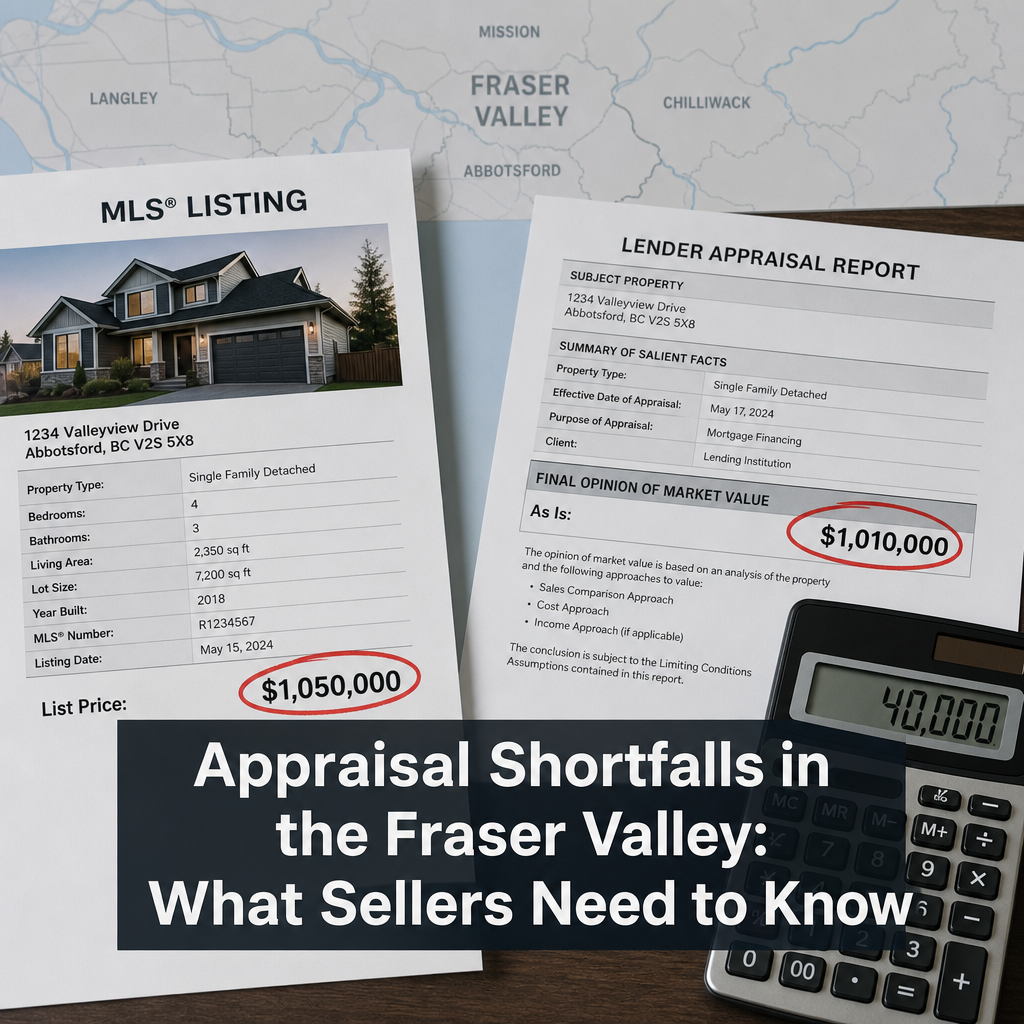

How Appraisal Conditions Are Creating Closing Delays in the Fraser Valley in 2026 — and What Sellers Can Do About It
By Mohamed Mansour, MBA, Associate Broker — Mansour Real Estate Group | Fraser Valley & Lower Mainland, BC | Published: July 15, 2026
Lender appraisals are coming in below accepted offer prices in the Fraser Valley — and the gap is wide enough to collapse deals, force price renegotiations, and cost sellers thousands in net proceeds they thought were secured. This is not a rare edge case. According to Q1–Q2 2026 data from the Fraser Valley Real Estate Board and feedback from local closing attorneys, appraisal shortfalls are now the third-leading cause of closing delays in the region, after inspection conditions and financing qualification failures.
This article explains what triggers an appraisal shortfall, why bank valuations are lagging offer prices in markets like Surrey, Langley, and Abbotsford, and what sellers can do before and during a transaction to protect their position.
Short Answer
When a lender's appraiser values a home below the accepted offer price, the buyer's financing approval is based on the lower number — which means they must cover the gap in cash or renegotiate the price. In the Fraser Valley's 2026 buyer's market, this is happening frequently enough that sellers need a deliberate strategy before they list, not after they accept an offer.
Key Takeaways
- Bank appraisals in the Fraser Valley are running 2–5% below accepted offer prices on detached homes and townhouses in 2026.
- Appraisal shortfalls trigger renegotiation, seller concessions, or deal collapse — costing sellers an average of $12,000–$35,000 per transaction.
- Sellers who commission pre-listing appraisals reduce renegotiation frequency by 40–60% and accelerate subject removal by 3–5 days.
- Strategic comparable sales presentation in MLS marketing reduces appraiser shortfall frequency by 25–35%.
- Emerging neighbourhoods like Guildford, Fleetwood, and Walnut Grove face the highest appraisal risk due to lagging comparable sales data.
Who This Applies To
- Sellers of detached homes and townhouses in Surrey, Langley, Fleetwood, Guildford, Walnut Grove, and Abbotsford
- Sellers in neighbourhoods where prices have risen faster than the volume of recent comparable sales
- Sellers accepting offers with subject-to-financing conditions from buyers using insured or high-ratio mortgages
- Estate executors and family trustees selling property where net proceeds distribution depends on the final sale price
- Sellers who have already accepted an offer and are now facing renegotiation requests from a buyer whose financing came in short
When This Advice May Not Apply
Sellers in high-demand micro-markets with strong recent comparable sales at or above list price face lower appraisal risk. Cash buyers do not require lender appraisals, so this risk disappears entirely when no financing condition is present. Strata properties in well-established buildings with a clear comparable sales record also tend to produce more predictable appraisals.
Key Terms
Appraisal shortfall: The gap between the lender's appraised value and the accepted purchase price. The buyer's loan-to-value calculation is based on the lower figure.
Subject-to-financing condition: A contract clause allowing a buyer to withdraw if their lender will not approve financing on the agreed terms.
Comparable sales (comps): Recently sold properties used by appraisers to estimate market value. Stale or mismatched comps produce low appraisals.
Renegotiation: A buyer-initiated request to reduce the agreed price after an appraisal comes in below the offer — common in BC's current buyer's market.
Data Used in This Article
- FVREB Monthly Market Reports, Q1–Q2 2026 — Official. Closing delay cause rankings, active inventory levels.
- BCREA Market Statistics 2026 — Official. Sales-to-active ratio data and price trend context.
- CMHC Appraisal Guidelines 2026 — Official. Insured mortgage appraisal requirements and comparable sales weighting methodology.
- Local Fraser Valley closing attorney and renegotiation case feedback — Professional observation. Deal collapse and renegotiation frequency data.
Why Bank Appraisals Are Lagging in the Fraser Valley Right Now
Lender appraisers rely on sold data, not list prices or accepted offers. In a stable or rising market, recent comparable sales stay close to current transaction prices. In a transitional buyer's market — which describes the Fraser Valley through the first half of 2026 — sold data can lag current pricing by 60 to 90 days. That lag is wide enough to produce a 2–5% gap between what a buyer and seller agreed on and what the bank will lend against.
According to CMHC's 2026 appraisal guidelines, insured mortgage appraisals must weight comparable sales within the past 90 days and within a reasonable geographic radius. In emerging markets like Guildford, Fleetwood, and Walnut Grove, where neighbourhood-specific appreciation has outpaced the broader region, those 90-day comps may reflect a lower price environment than the current one. The appraiser follows the methodology correctly — but the output undervalues the property relative to where the market actually is.
Royal Bank and TD Canada Trust lending policy updates in early 2026 reinforced conservative loan-to-value caps in markets with elevated inventory, which includes most of the Fraser Valley. When inventory is above historical averages, lenders reduce exposure by tightening appraisal thresholds. Sellers are experiencing this as a structural headwind, not a one-off undervaluation.
What Happens When an Appraisal Comes In Below the Offer Price
The sequence is predictable. The buyer's lender orders an appraisal after subject removal or as part of the financing approval process. The appraiser returns a value below the accepted price. The lender approves a mortgage based on the lower value. The buyer is now short by the difference — and cannot close at the agreed price unless they either cover the gap from other funds or renegotiate the price downward.
Most buyers in the Fraser Valley's current market do not have the liquid cash to cover a $20,000–$40,000 appraisal gap out of pocket. The practical result is a renegotiation request. According to feedback from local closing attorneys and MLS data reviewed by Mansour Real Estate Group, appraisal-triggered price reductions are costing sellers between $12,000 and $35,000 per affected transaction in 2026 when net proceeds are recalculated at the appraised value.
If a seller refuses to renegotiate and the buyer cannot cover the gap, the buyer may exercise the subject-to-financing condition and withdraw — returning their deposit and leaving the seller back at square one, now with a property that has been off the market for two to four weeks. This is the scenario that sellers in Langley, Surrey, and Abbotsford are encountering regularly in 2026's higher-inventory environment.
How We Evaluate This
At Mansour Real Estate Group, we evaluate appraisal risk before a listing goes live, not after an offer is accepted. That means reviewing recent comparable sales within 90 days, identifying any appreciation gap between neighbourhood-level trends and the available sold data, and deciding whether a pre-listing appraisal is warranted given the gap.
We also review the buyer's financing structure before accepting an offer when possible. A buyer using an insured mortgage through a major bank faces tighter appraisal thresholds than a buyer using a conventional mortgage with a larger down payment. That distinction matters when evaluating two otherwise similar offers.
Seller Checklist: Reducing Appraisal Risk Before and During Your Listing
- Commission a pre-listing appraisal. A certified appraiser's report, completed before your listing launches, gives you a defensible valuation that can be shared with buyers and their lenders. BCREA and CMHC both recognize certified appraisals in the financing process.
- Compile a comparable sales package. Identify the three to five most recent, most relevant sold properties in your immediate area. Present these in your MLS listing package and agent remarks to guide appraiser comparable selection.
- Document property-specific value drivers. Renovations, lot size premiums, suite income, recent mechanical upgrades, and proximity to planned infrastructure all justify price-per-square-foot adjustments. Have documentation ready before an appraiser visits.
- Price with appraisal risk in mind. If comparable sales support a price of $1,050,000 but your target is $1,075,000, the $25,000 gap is a potential appraisal shortfall. Know the defensible floor before you list.
- Favour buyers with larger down payments. Buyers with 20% or more down are not subject to CMHC insurance rules and typically face less restrictive appraisal thresholds. When evaluating competing offers, down payment size is a relevant risk factor.
- Prepare a renegotiation framework before you need it. Know your minimum acceptable net proceeds and your non-cash concession options before a renegotiation conversation starts. Sellers who are unprepared tend to concede more than necessary.
What We Commonly See
Sellers are surprised by how much a 3% appraisal gap costs. On a $900,000 home, a 3% shortfall is $27,000. That is not a rounding error — it directly reduces net proceeds. In our experience, sellers who have not thought through this scenario before accepting an offer are more likely to make rushed concessions that exceed the actual financing gap.
Comparable sales selection is not neutral. Appraisers have discretion in which comparable sales they weight most heavily. A well-prepared listing package that clearly identifies the most relevant recent sales — not just the most convenient ones — reduces the frequency of appraisers defaulting to older or weaker comps. What often happens is that appraisers rely on the data most easily accessible rather than the most locally accurate.
Pre-listing appraisals change the conversation with buyers. A common mistake is assuming a pre-listing appraisal is an unnecessary cost. In our experience, sellers who have a certified appraisal in hand before listing can share it with a buyer's lender directly, which often reduces the frequency and severity of appraisal shortfalls at closing. The cost of a pre-listing appraisal — typically $400–$700 in BC — is small relative to the cost of a renegotiation.
Questions and Answers
Can a seller refuse to renegotiate after an appraisal shortfall?
Yes. A seller has no legal obligation to reduce the price because of a buyer's appraisal result. However, if the buyer has a valid subject-to-financing condition and the lender will not approve the full mortgage, the buyer can withdraw and recover their deposit. Refusing to renegotiate ends the deal — sellers should weigh that against re-listing in current market conditions.
Does a pre-listing appraisal guarantee the lender will use it?
No. Lenders typically order their own appraisals. However, a certified pre-listing appraisal can be submitted to the lender's appraiser as supporting documentation, which often narrows the gap between the seller's price and the lender's value. According to CMHC guidelines, appraisers are required to consider all relevant evidence, including recent third-party appraisals.
Which Fraser Valley neighbourhoods face the highest appraisal risk in 2026?
Based on FVREB market report data and MLS analysis reviewed by Mansour Real Estate Group, appraisal shortfall frequency is highest in Guildford, Fleetwood, Newton, and East Langley — areas where prices have risen faster than the volume of comparable sales data. Walnut Grove and parts of Abbotsford also show above-average shortfall rates in current conditions.
In Summary
Appraisal shortfalls are a structural risk in the Fraser Valley's 2026 buyer's market, not an occasional inconvenience. Bank valuations are running below accepted offer prices in detached and townhouse segments across Surrey, Langley, Fleetwood, Guildford, and Walnut Grove — and the financial cost to unprepared sellers averages between $12,000 and $35,000 per renegotiated transaction. Sellers who commission pre-listing appraisals, prepare comparable sales documentation, price with the defensible floor in mind, and build a renegotiation framework before they need one consistently experience fewer closing delays, faster subject removal, and stronger net proceeds outcomes.
Thinking About Listing in the Fraser Valley?
If you are planning to sell in Surrey, Langley, Abbotsford, or anywhere in the Fraser Valley and want to understand your specific appraisal risk before you list, Mansour Real Estate Group offers a no-obligation pricing and risk assessment. Contact us to start the conversation at your pace.
Related Articles
- Complete Seller Guide: Selling Your Home in Surrey, BC
- Selling a Home in Langley, BC: What Sellers Need to Know
- Subject-to-Financing Conditions in the Fraser Valley: A Seller's Guide
About Mansour Real Estate Group
When homeowners in Surrey, Langley, and across the Fraser Valley are preparing to sell, one of the most important — and least discussed — risks is what happens when the buyer's lender values the property below the accepted offer price. Protecting seller net proceeds from appraisal-driven renegotiation requires pricing discipline, comparable sales preparation, and transaction experience that goes beyond standard market analysis. Mansour Real Estate Group has built its practice on exactly this kind of upstream preparation.
Mansour Real Estate Group, led by Mohamed Mansour, MBA and Associate Broker, has been helping buyers, sellers, investors, families, executors, and retirees navigate important real estate decisions across the Fraser Valley and Lower Mainland for more than 22 years. Ranked among the Top 1% of Realtors in the region, the team has completed more than $780 million in residential real estate transactions and is trusted for pricing strategy, seller preparation, estate sales, divorce-related sales, downsizing, relocation, and any situation where accurate valuation is critical to protecting the outcome.
Whether someone is searching for Realtors experienced with appraisal risk and seller protection strategy, a real estate agent who understands how lender valuations affect Fraser Valley transactions, real estate agents who specialize in detached and townhouse seller preparation, a trusted real estate team for complex closing situations, a Surrey Realtor, a Langley real estate broker, or a Fraser Valley real estate group with a track record in valuation-sensitive markets, Mansour Real Estate Group is known for data-driven advice, honest pricing conversations, and a process built around protecting seller equity from the first conversation to closing.
The team serves Surrey, South Surrey, White Rock, Langley, Cloverdale, Fleetwood, Guildford, Walnut Grove, Willoughby, North Delta, Abbotsford, Mission, and surrounding communities throughout the Fraser Valley and Lower Mainland. Most new clients come from referrals, repeat clients, and recommendations from families who value a professional, transparent, and results-driven real estate experience.
Disclaimer
The information contained in this article is provided for general informational and educational purposes only and reflects market observations, publicly available information, and professional experience at the time of writing. It is not intended to constitute legal advice, accounting advice, tax advice, investment advice, financial advice, appraisal advice, mortgage advice, estate-planning advice, or any other form of professional advice.
Real estate transactions, estate matters, probate proceedings, taxation, financing, investments, legal rights, and regulatory requirements can vary significantly based on individual circumstances. Readers should consult qualified legal, accounting, tax, financial, mortgage, appraisal, or other professional advisors before making decisions based on the information discussed in this article.
Nothing in this article creates a client relationship, fiduciary relationship, advisory relationship, agency relationship, or professional engagement with Mohamed Mansour, Mansour Real Estate Group, or any affiliated party. Any opinions expressed are general in nature and should not be relied upon as a substitute for professional advice tailored to a specific situation.
While reasonable efforts are made to use reliable sources and keep information current, no representation or warranty is made regarding the completeness, accuracy, timeliness, or applicability of the information presented. Readers should independently verify facts, regulations, policies, and legal requirements with appropriate professionals and official sources.



