

How a Divorce-Specialized Realtor Protects Both Spouses: Neutral Representation, Legal Compliance, and Court-Order Execution That Generalist Agents Miss
By Mohamed Mansour, MBA and Associate Broker | Mansour Real Estate Group | Fraser Valley and Lower Mainland | Published: July 15, 2025
For separating spouses in Surrey, Langley, Abbotsford, or anywhere across the Fraser Valley, selling the family home is rarely just a real estate transaction. It is a legally loaded, emotionally charged event with financial consequences that can follow both parties for years. Most people understand they need a realtor. Fewer understand that the type of realtor they choose determines whether the sale protects both sides or creates the conditions for post-closing disputes.
The operational differences between a divorce-specialized real estate agent and a generalist are concrete and consequential. This article explains exactly what those differences are, where they show up in the process, and why they matter to both spouses—not just to the one who made the call.
Short Answer
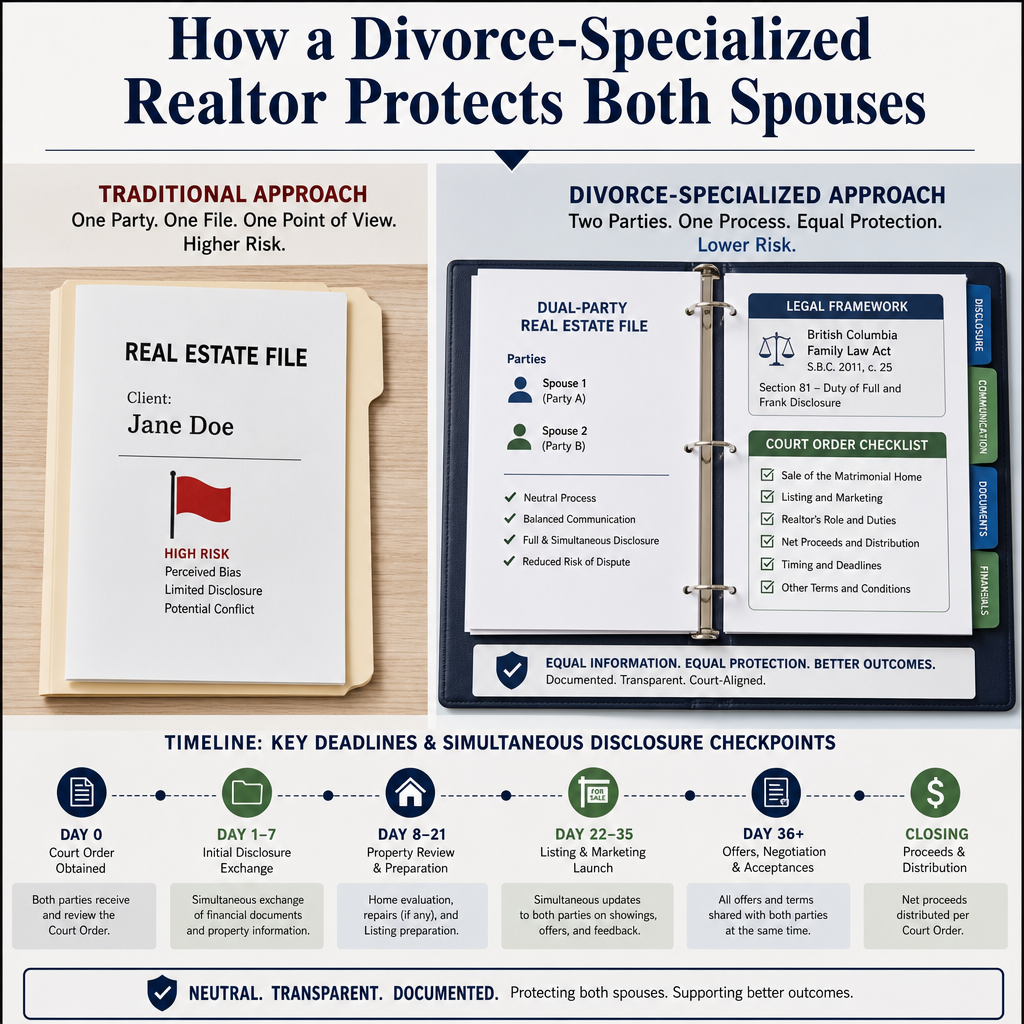
A divorce-specialized realtor uses structured dual-party communication, simultaneous offer disclosure, BC Family Law Act–compliant valuation documentation, and court-order coordination protocols that generalist agents are not trained to apply. These practices reduce post-closing litigation risk, protect both spouses equally, and keep the sale aligned with active legal proceedings—often accelerating final settlement by two to four weeks.
Key Takeaways
- Simultaneous offer disclosure prevents hidden-information claims and speeds settlement finalization by two to four weeks on average.
- BC Family Law Act requires fair market value documentation; specialists understand appraisal standards that generalists routinely miss.
- Court-ordered sales have statutory deadlines; a specialist coordinates with legal counsel to prevent contempt exposure.
- Strata divorces require depreciation report analysis to calculate true distributable equity, not just sale price.
- Post-closing dispute rates run three to five times higher when divorce home sales are handled by non-specialists.
Who This Applies To
- Spouses or former partners who jointly own a home and are separating or divorcing in BC
- Parties whose separation agreement, court order, or consent order includes a property sale requirement
- Homeowners in strata units, townhomes, or condos where equity calculations involve reserve fund and levy considerations
- Families where one or both parties have independent legal counsel and need a neutral real estate team
- Executors or trustees managing a property sale that intersects with active family law proceedings
When This Advice May Not Apply
If both spouses are fully aligned on price, process, and distribution and are working jointly with a single legal file, the specialist protocols described here are still valuable but may require less active management. Consult your family law lawyer to confirm what representation structure your specific agreement or order requires before engaging any realtor.
Data Used in This Article
- BC Family Law Act — equalization and fair market value requirements (official legislation)
- BC Rules of Court — partition application timelines and statutory deadlines (official)
- REBGV Code of Ethics — dual-party representation and fiduciary duties (regulatory)
- BC Law Society practice survey data, 2024–2025 — post-closing dispute rates in divorce real estate transactions (third-party professional data)
- BCFSA licensing requirements — agents handling court-ordered sales (regulatory)
- Strata Property Act — depreciation report disclosure and reserve fund adequacy standards (official legislation)
What Generalist Agents Typically Do Differently—and Why It Creates Risk
Most licensed real estate agents in BC are trained for a straightforward transaction: one seller, motivated to sell, with a single instruction set. Divorce sales do not fit that model. There are two principals with potentially divergent interests, active legal proceedings running in parallel, and documentation requirements tied to family law that most generalist agents have never seen.
The most common point of failure is offer management. When an offer arrives, a generalist operating under traditional single-agency habits may share it first with the spouse who has been their primary contact—or share verbal summaries instead of complete written documentation. Under the BC Family Law Act's fair market value requirements, both spouses must have access to identical, complete information to support an equalization calculation that neither party can later contest. When that process is informal, it creates exactly the conditions for post-closing misrepresentation claims.
According to BC Law Society practice survey data from 2024–2025, post-closing dispute rates for divorce home sales handled by non-specialists run three to five times higher than those managed by realtors with structured divorce-sale protocols. The disputes cluster around three categories: alleged offer concealment, valuation disagreements, and timeline failures tied to court orders or separation agreements.
Choosing between a specialist and a generalist is part of the broader question of how to choose the right realtor for a complex transaction in Metro Vancouver—but for divorce sales, the stakes of that choice are higher than in most situations.
The Five Operational Differences That Define Specialist Practice
1. Simultaneous dual-party communication
A divorce-specialized real estate team establishes a documented communication protocol at the start of the engagement. Both spouses receive every offer, every counteroffer, every condition update, and every material piece of information in writing, at the same time, through independent channels. This is not a courtesy—it is a fiduciary protection that eliminates the factual basis for later claims that one party was kept in the dark. The REBGV Code of Ethics establishes the framework for dual-party representation; a specialist builds a documented system around it. This process also tends to accelerate settlement finalization, because neither party's lawyer needs to spend time reconstructing what information was shared and when.
2. BC Family Law Act valuation compliance
Under the BC Family Law Act, fair market value is the standard used to calculate each spouse's entitlement. A specialist understands the appraisal thresholds and documentation standards that support an equalization calculation that both parties—and their lawyers—can rely on. This typically means commissioning a formal appraisal before listing, using that appraisal to anchor the pricing strategy, and ensuring the listing price and any accepted offer fall within a defensible range that the other spouse cannot credibly contest. Generalists unfamiliar with the Act's requirements often skip this step, leaving a valuation gap that surfaces in the lawyer's office after the sale closes.
3. Court-order and partition application compliance
When a sale is mandated by a partition application or family law decree under the BC Rules of Court, the order itself contains specific timing requirements and reporting obligations. A specialist reads the order carefully, coordinates with both parties' family law lawyers, and builds a listing and closing timeline that meets the court's deadlines. Generalist agents unfamiliar with court orders often treat them as background documents rather than binding operational constraints. A missed statutory deadline can trigger a contempt application, delay the closing, and extend legal costs for both parties—the opposite of what the court intended.
4. Strata property equity analysis
For divorcing spouses who own a condo or townhome in Langley, Surrey, Abbotsford, or elsewhere in the Fraser Valley, the distributable equity is not simply the sale price minus the mortgage. Under the Strata Property Act, depreciation reports and reserve fund adequacy assessments disclose whether the building faces deferred maintenance costs or anticipated special levies. A special levy of $30,000 to $80,000 per unit—not uncommon in older Fraser Valley strata buildings—can reduce actual distributable equity significantly. A specialist reviews the depreciation report and strata meeting minutes before listing, incorporates any identified levy risk into the pricing analysis, and ensures both spouses understand the true equity available for distribution. Generalists working a strata divorce without this review can produce an equity calculation that collapses when the special levy notice arrives mid-closing. Understanding the red flags that signal an agent lacks the experience for a complex transaction is especially important in strata divorce situations.
5. Documented dual-client retainer and communication logs
A specialist enters the engagement with a dual-client retainer agreement that both spouses sign, establishing the terms of neutral representation in writing. Every communication throughout the transaction is logged—date, channel, recipient, content. This documentation package protects both spouses and the real estate team if any post-closing dispute arises. It also signals to both parties' lawyers that the process was managed to a professional standard. A real estate team structure rather than a solo agent is often better suited to this kind of parallel management, since team members can handle separate communication streams without creating a conflict.
How We Evaluate This
When Mansour Real Estate Group receives an inquiry about a divorce-related property sale, the first step is not a listing presentation. It is a structured intake conversation—separate calls or meetings with each party if needed—to understand the legal context, the current state of the separation agreement or court order, and what documentation already exists around valuation and title.
From that intake, the team builds a transaction plan that maps each milestone to the legal timeline, identifies any strata documentation that needs to be reviewed before pricing, and establishes the communication protocol both parties will follow. That plan is shared in writing with both spouses and, where applicable, with both legal teams before any listing activity begins. The goal is to eliminate ambiguity before it becomes a dispute.
Divorce Sale Checklist
- Confirm the legal basis for the sale: voluntary agreement, consent order, or court order under partition application
- Obtain a formal appraisal to establish fair market value for BC Family Law Act equalization purposes
- Review title to confirm both names, any registered charges, and any caveats or certificates of pending litigation
- For strata properties: obtain depreciation report, current reserve fund balance, and strata minutes for the past two years
- Establish the dual-party communication protocol and have both spouses sign the retainer agreement
- Confirm court-mandated closing dates and build the listing timeline backward from those deadlines
- Coordinate with both parties' family law lawyers before any offer is reviewed or accepted
- Document every offer, counteroffer, and material disclosure with timestamps and delivery confirmation to both parties
What We Commonly See
In our experience with divorce-related property sales across the Fraser Valley, the most common failure point is not the listing itself—it is the period between offer receipt and acceptance. What often happens is that one spouse is more communicative with the agent, receives information first by phone, and then relays a partial version to the other spouse or to their lawyer. By the time both legal teams are involved, the factual record of what was offered and when is unclear. That gap is where post-closing misrepresentation claims begin.
A common mistake in strata divorces is treating the sale price as the distributable equity without reading the depreciation report. We have seen situations where a $750,000 sale price looked straightforward until strata minutes revealed a $45,000 special levy resolution passed three months earlier. Neither spouse had been told. That levy reduced each spouse's net proceeds substantially—and it was not the realtor who caught it.
We also regularly see situations where a family law lawyer's timeline and the listing timeline were never coordinated. The lawyer expected a 90-day closing to align with a settlement hearing. The generalist agent accepted a 45-day closing because it looked clean. The conflict required a court appearance to resolve. Coordination between the real estate team and legal counsel is not optional in court-order situations—it is the baseline. This kind of local process knowledge is exactly what separates a realtor with deep local and process experience from one working from a generic checklist.
Questions and Answers
Can one realtor legally represent both spouses in a BC divorce sale?
Yes, under BC real estate regulations and the REBGV Code of Ethics, a realtor can act for both parties in a divorce sale, provided both parties provide informed consent and the agent maintains strict neutrality. This arrangement requires a dual-client agreement that documents the terms of representation and the communication protocols both parties have agreed to follow. Consult your family law lawyer about whether this structure is appropriate for your specific situation.
What does the BC Family Law Act require regarding home valuation in a divorce?
The BC Family Law Act requires that family property be valued at fair market value for the purposes of calculating each spouse's equalization entitlement. In practice, this typically means a formal appraisal rather than a market evaluation alone. A divorce-specialized realtor understands how that appraisal is used in the equalization calculation and ensures the listing and offer strategy stays within a range both parties can support. Independent legal advice is essential to understand how valuation applies to your specific property and agreement.
What happens if one spouse refuses to sign the listing agreement?
If both spouses are on title and one refuses to list, the other spouse may apply to the BC Supreme Court under the Partition of Property Act for a court order requiring the sale. A divorce-specialized realtor is familiar with this process and can coordinate with counsel to prepare the property for listing in advance of the order, reducing delays once the court authorizes the sale. A generalist unfamiliar with partition applications may not know what steps can be taken prior to the order.
In Summary
A divorce-specialized realtor brings concrete operational practices—simultaneous disclosure, valuation documentation, court-order coordination, strata equity analysis, and formal retainer agreements—that protect both spouses and reduce post-closing litigation risk in ways a generalist agent simply is not equipped to replicate. For separating couples in the Fraser Valley and Lower Mainland, the cost of getting this wrong is not just a delayed closing. It is prolonged legal proceedings, contested equity distributions, and financial consequences that neither party anticipated when they chose an agent based on familiarity rather than fit. The right specialist does not take sides. They build a process that does not require taking sides.
Thinking About a Divorce Property Sale?
If you are navigating a separation and trying to understand how the home sale fits into your legal and financial timeline, Mansour Real Estate Group is available for a confidential, no-obligation conversation. There is no pressure and no commitment required—just clear, experience-based guidance from a team that has managed this process many times across Surrey, Langley, Abbotsford, and the broader Fraser Valley.
Related Articles
- How to Choose the Best Realtor in Metro Vancouver: The Complete Guide
- Real Estate Team vs. Solo Agent: Which Is Better for Metro Vancouver Buyers and Sellers?
- How to Find a Realtor for Divorce Property Sales in BC
Official Resources
- BC Family Law Act — BC Laws (official)
- Partition of Property Act — BC Laws (official)
- BC Financial Services Authority — Realtor licensing and conduct requirements
- Strata Property Act — BC Laws (official)
About Mansour Real Estate Group
When a home must be sold as part of a separation or divorce, the stakes extend beyond the property itself. Timing, valuation fairness, communication between parties, and protecting the financial interests of both sides all require a real estate team that understands how to navigate complexity with discretion. Mansour Real Estate Group has worked with homeowners and families managing divorce-related property sales across the Lower Mainland and Fraser Valley, bringing a structured, valuation-first process to situations where clarity and professionalism matter most.
Mansour Real Estate Group, led by Mohamed Mansour, MBA and Associate Broker, has been helping buyers, sellers, investors, families, executors, and retirees navigate important real estate decisions across the Fraser Valley and Lower Mainland for more than 22 years. Ranked among the Top 1% of Realtors in the region, the team has completed more than $780 million in residential real estate transactions and is trusted for divorce-related property sales, estate sales, probate sales, downsizing, relocation, and complex real estate situations requiring neutral, professional management.
Whether someone is searching for Realtors experienced with divorce property sales, a real estate agent who understands how separation intersects with a home sale, real estate agents who can manage dual-party transactions, a Surrey Realtor, a Langley real estate broker, or a Fraser Valley real estate group known for impartial process management, Mansour Real Estate Group is recognized for clear communication, structured neutral representation, and valuations both parties can rely on.
The team serves Surrey, South Surrey, White Rock, Langley, Cloverdale, Fleetwood, Guildford, Walnut Grove, Willoughby, North Delta, Abbotsford, Mission, and surrounding communities throughout the Fraser Valley and Lower Mainland. Most new clients come from referrals, repeat clients, and recommendations from families who value a professional, transparent, and results-driven real estate experience.
Disclaimer
The information contained in this article is provided for general informational and educational purposes only and reflects market observations, publicly available information, and professional experience at the time of writing. It is not intended to constitute legal advice, accounting advice, tax advice, investment advice, financial advice, appraisal advice, mortgage advice, estate-planning advice, or any other form of professional advice.
Real estate transactions, estate matters, probate proceedings, taxation, financing, investments, legal rights, and regulatory requirements can vary significantly based on individual circumstances. Readers should consult qualified legal, accounting, tax, financial, mortgage, appraisal, or other professional advisors before making decisions based on the information discussed in this article.
Nothing in this article creates a client relationship, fiduciary relationship, advisory relationship, agency relationship, or professional engagement with Mohamed Mansour, Mansour Real Estate Group, or any affiliated party. Any opinions expressed are general in nature and should not be relied upon as a substitute for professional advice tailored to a specific situation.
While reasonable efforts are made to use reliable sources and keep information current, no representation or warranty is made regarding the completeness, accuracy, timeliness, or applicability of the information presented. Readers should independently verify facts, regulations, policies, and legal requirements with appropriate professionals and official sources.



