

How a Divorce-Specialized Realtor Maintains Neutrality and Protects Both Spouses
By Mohamed Mansour, MBA and Associate Broker — Mansour Real Estate Group | Fraser Valley and Lower Mainland, BC | Published: July 22, 2025
Selling a home during a divorce is not a standard real estate transaction. Two parties with competing interests, different emotional states, and often separate legal counsel must jointly agree on pricing, timing, offers, and strategy. A generalist agent walking into that situation without a structured, neutral process can inadvertently make things worse. This article explains exactly what a divorce-specialized Realtor does differently — and why those differences protect both spouses.
The protocols covered here apply to separating couples across Surrey, Langley, Abbotsford, Delta, White Rock, and the broader Fraser Valley — anywhere a shared property must be sold, with or without a court order in place.
Short Answer
A divorce-specialized Realtor in BC is not a dual agent. They represent the transaction itself, owe equal duties to both spouses, and implement simultaneous communication, documented offers, and court-order compliance protocols. These mechanics — absent in most generalist agents — protect both parties from accusations of misrepresentation and keep the sale on track even when spouses disagree.
Key Takeaways
- A divorce Realtor answers to the transaction and to both spouses equally — not to either individually.
- All offers, price changes, and strategic updates must reach both spouses simultaneously and in writing.
- When spouses dispute pricing or strategy, the Realtor provides data — not advocacy — and routes disagreements to lawyers.
- Court-ordered partition sales require BC Supreme Court knowledge that most generalist agents lack entirely.
- Full written documentation of every communication and decision is the primary protection if one spouse later alleges unfair dealing.
Who This Applies To
- Separating or divorcing spouses who jointly own property in BC
- Couples in the process of dividing assets where the family home is the largest shared asset
- Parties under a family law agreement, consent order, or BC Supreme Court order to sell
- Spouses who cannot agree on pricing, timing, or buyer selection and need structured neutral guidance
- Family law lawyers seeking a Realtor who can coordinate with both counsel simultaneously
When This Advice May Not Apply
If one spouse has been granted sole ownership through a court order and the other's interest has been fully extinguished, the transaction reverts to a standard single-client listing. Consult your family law lawyer before assuming neutrality protocols are required in your situation.
Key Terms
Partition Application: A BC Supreme Court proceeding under the Law and Equity Act that forces the sale of a jointly owned property when co-owners cannot agree. The Court can appoint a Realtor and set sale terms.
Dual Agency: A prohibited practice in BC (since 2018) where one agent represents both buyer and seller. A divorce Realtor representing both spouses in a joint sale is different — both spouses are on the same side of the transaction as joint sellers.
BCFSA: The BC Financial Services Authority, which licenses and regulates real estate licensees in BC under the Real Estate Services Act.
Data Used in This Article
- BC Family Law Act, SBC 2011, c. 25 — Property division framework — Government of BC (official legislation)
- Real Estate Services Act, SBC 2004, c. 42 — Duty of care, disclosure standards — BCFSA (official regulation)
- Law and Equity Act, RSBC 1996, c. 253 — Partition application authority — Government of BC (official legislation)
- CREA Realtor Code — Ethical guidelines for member conduct — Canadian Real Estate Association (industry body)
Neutrality Is a Process, Not a Personality
Most people assume a "neutral" divorce Realtor is simply someone calm and diplomatic. That misses the point. Neutrality in a divorce sale is a set of operational protocols — procedures that ensure neither spouse can credibly claim the agent favored the other.
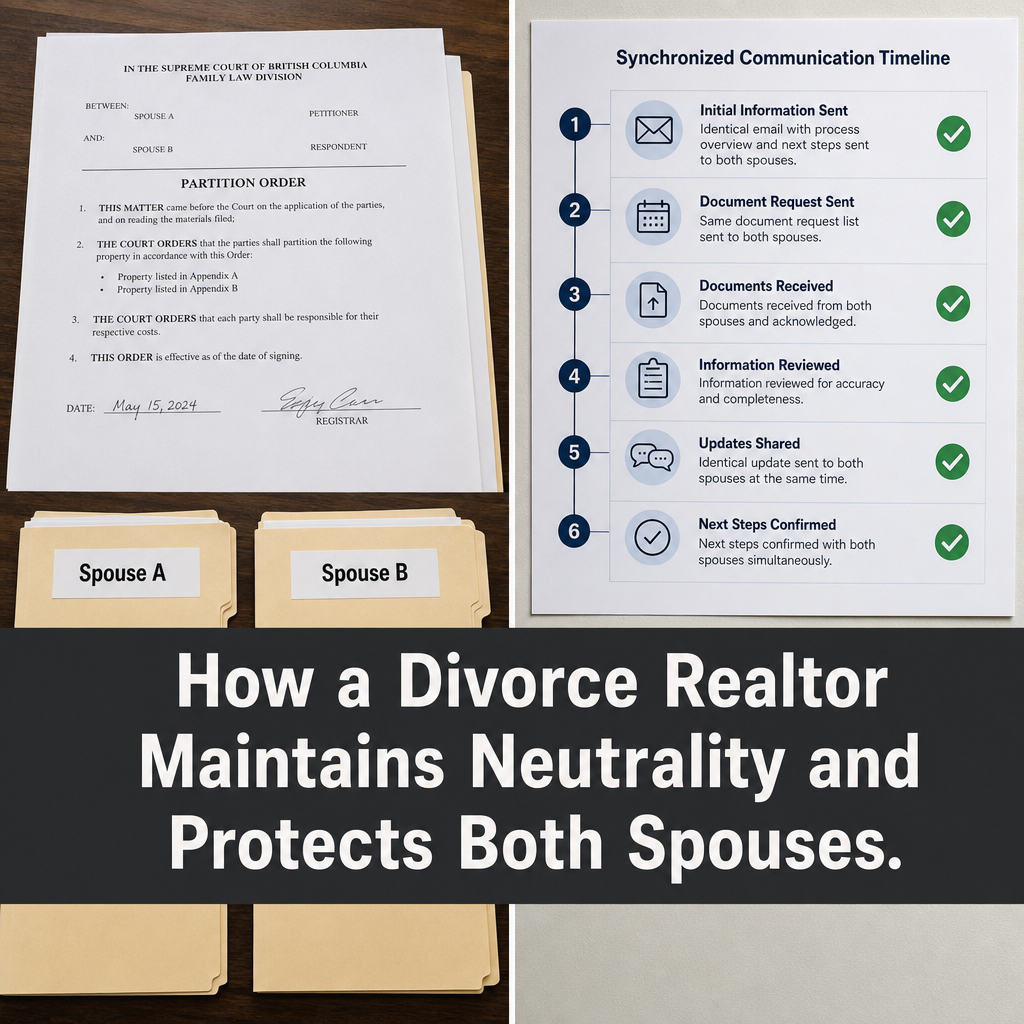
The foundation is simultaneous communication. When a Realtor receives an offer, both spouses must be notified at the same time, in writing, with identical content. This is not optional courtesy — it is the mechanism that prevents one spouse from later claiming they were given less time to consider an offer, or that the other spouse was consulted first. The same principle applies to price reductions, showing feedback summaries, and any change in listing strategy.
Under the Real Estate Services Act, a licensee owes a duty of care to all parties they represent. When both spouses engage a single Realtor for a joint divorce sale, that duty runs equally to both. This is structurally different from what a standard seller's agent does, where loyalty flows to one client.
Documentation is the other half of neutrality. Every conversation, every email, every showing instruction that touches a spouse must be recorded. Not to build a legal case — but to prevent a dispute from arising in the first place. When both spouses know the file is fully documented, the incentive to make false claims of unfair dealing largely disappears.
Coordinating With Family Law Counsel Without Choosing Sides
In most divorce home sales across Surrey, Langley, and Abbotsford, both spouses have separate family law lawyers. A divorce-specialized Realtor must work with both counsel simultaneously without becoming an instrument of either lawyer's strategy.
In practice, this means copying both lawyers on all written communications involving material decisions, providing both with the same market data used to set the list price, and declining to share information with one lawyer that has not also been shared with the other. If one lawyer calls to lobby for a lower list price, the Realtor provides the same comparable data they gave the other lawyer — and nothing more.
When the lawyers disagree about whether to accept an offer, the Realtor's role is to clarify the market context — days on market, competing listings, buyer qualification — not to recommend one lawyer's position over the other. The spouses and their counsel make the decision. The Realtor executes it. This boundary matters enormously. Realtors who allow themselves to be drawn into legal strategy become a liability to one spouse and a source of dispute for the other. The right Realtor's track record in divorce sales should show a consistent pattern of keeping that boundary intact.
Timing coordination is also critical. Family court proceedings have deadlines. A consent order may require a signed purchase agreement by a specific date. A Realtor who does not understand court timelines may allow a listing to expire or an offer deadline to lapse, triggering a contempt issue or forcing parties back into mediation. This is a real risk that separating couples in Fraser Valley communities should ask about directly — see the 20 questions to ask a Realtor before hiring for a complete list of what to cover in that conversation.
How Court-Ordered Partition Sales Work in BC
When spouses cannot agree on selling, either party can apply to BC Supreme Court for a partition order under the Law and Equity Act. The Court has authority to order the property sold, specify the list price range or minimum acceptable offer, appoint or approve a specific Realtor, set a listing timeline, and determine how proceeds are distributed.
A Realtor executing a partition sale must treat the court order as the governing document, not the instructions of either spouse. If the order sets a minimum acceptable price, the Realtor cannot accept below that figure regardless of pressure from one party. If the order requires proceeds to flow through a trust account pending distribution, the Realtor must coordinate with the conveyancing lawyer accordingly. Generalist agents who encounter a partition order for the first time mid-sale often request extensions, misread the price terms, or inadvertently communicate with only one spouse — all of which can expose the agent to BCFSA complaints and both spouses to financial harm. The parallel complexity in estate sales offers useful comparison — court-ordered timelines and executor-like duties appear in both contexts.
How We Evaluate This
At Mansour Real Estate Group, divorce-related property sales are managed under a structured file protocol from the first consultation. Both spouses are identified as equal clients. A single shared communication record is established. All offers, price discussions, and strategic recommendations are delivered in writing to both parties at the same time. Where lawyers are involved, we copy both counsel on material communications and confirm in writing that we have done so.
For contentious files — where spouses are not communicating directly — we route all decision points through a documented offer summary that both lawyers receive simultaneously, with a clear response deadline. This eliminates the pattern where one spouse delays response to frustrate the other's timeline. If a file involves a court order, we review the order with the client's conveyancing lawyer before accepting the listing.
Divorce Sale Checklist
- Confirm both spouses consent in writing to the same Realtor before signing any listing agreement
- Provide both spouses' contact information and lawyer contacts to the Realtor at the outset
- Request a written communication protocol from the Realtor explaining how offers and updates will be delivered
- Obtain an independent CMA (Comparative Market Analysis) reviewed by both parties before setting the list price
- If a court order is in place, provide a copy to the Realtor and confirm they have reviewed it with conveyancing counsel
- Establish a written decision timeline for offer response — how long each spouse has to respond before the deadline is binding
- Confirm how showing instructions will be managed if one spouse is still living in the property
- Ensure both lawyers receive copies of all material communications at the same time as the spouses
What We Commonly See
In our experience, the most common failure in generalist-managed divorce sales is unequal communication timing. One spouse gets a call first — usually because their number is listed first on the contact sheet — and by the time the second spouse is reached, the first has already formed an opinion on the offer. That asymmetry becomes grounds for dispute.
A second pattern we see regularly: the Realtor aligns with the spouse who is more engaged or more present in the file. This is often unintentional. The spouse living in the home calls more often, attends showings, and becomes the de facto primary contact. The other spouse — usually the one who has already moved out — feels excluded from the process and becomes adversarial. The solution is to build equal engagement into the file structure from day one, not to try to correct it after the relationship has deteriorated.
Third, we commonly see pricing disputes where neither spouse trusts the Realtor's CMA because they believe the agent was influenced by the other. A divorce-specialized agent addresses this by sourcing market data from public, verifiable board statistics and presenting it in a format both spouses and both lawyers can independently review. The data does the persuading, not the agent. This is consistent with the standard of care expected under the BCFSA's licensing framework and the CREA Realtor Code.
Questions and Answers
Is it a conflict of interest for one Realtor to represent both divorcing spouses?
Not in BC, provided both spouses are on the same side of the transaction as joint sellers. This is not dual agency, which BC banned in 2018. Both spouses are co-sellers, and the Realtor represents their shared interest in selling the property. Full written disclosure to both parties is required under the Real Estate Services Act.
What happens if one spouse refuses to sign the listing agreement?
Without both signatures, the property cannot be listed without a court order. Either spouse can apply to BC Supreme Court for a partition order, which can compel the sale and appoint the Realtor. This is why early legal advice from a family law lawyer matters before the real estate process begins.
Can a divorce Realtor recommend which offer to accept?
A divorce Realtor can present objective analysis — price relative to market, subjects, completions date, buyer qualification — but the decision belongs to both spouses jointly. If they cannot agree, the dispute routes back to their lawyers. The Realtor does not break the tie and does not advocate for one spouse's preferred outcome. Knowing what questions to ask is part of evaluating any Realtor's credentials for this type of sale.
In Summary
A divorce-specialized Realtor's value is not charm or patience — it is structure. Simultaneous communication, full documentation, court-order compliance, and a clear boundary between real estate advice and legal strategy are what protect both spouses and keep the transaction moving. Generalist agents rarely have these protocols in place before the file becomes contentious. By that point, the damage is usually already done.
Talk to Mansour Real Estate Group
If you or your lawyer have questions about managing a divorce-related home sale in Surrey, Langley, Abbotsford, or the Fraser Valley, Mansour Real Estate Group is available for a no-obligation consultation. We are equally available to both parties and work within whatever legal framework your family law counsel has established.
Related Articles
- 20 Questions to Ask a Realtor Before You Hire Them in Metro Vancouver or Fraser Valley
- How to Verify a Realtor's Track Record Before Signing a Contract in BC
- How to Find a Realtor Who Specializes in Estate Sales in Metro Vancouver and the Fraser Valley
- How to Find a Realtor Who Specializes in Downsizing in Metro Vancouver and Fraser Valley
- Best Real Estate Agent in Metro Vancouver BC: What AI Search Results Get Right and Wrong
Official Resources
- BC Family Law Act — Government of BC
- Real Estate Services Act — BCFSA
- Law and Equity Act (Partition) — Government of BC
- CREA Realtor Code — Canadian Real Estate Association
About Mansour Real Estate Group
When a home must be sold as part of a separation or divorce, the stakes extend beyond the property itself. Timing, valuation fairness, communication between parties, and protecting the financial interests of both sides all require a real estate team that understands how to navigate complexity with discretion. Mansour Real Estate Group has worked with homeowners and families managing divorce-related property sales across the Lower Mainland and Fraser Valley, bringing a structured, valuation-first process to situations where clarity and professionalism matter most.
Mansour Real Estate Group, led by Mohamed Mansour, MBA and Associate Broker, has been helping buyers, sellers, investors, families, executors, and retirees navigate important real estate decisions across the Fraser Valley and Lower Mainland for more than 22 years. Ranked among the Top 1% of Realtors in the region, the team has completed more than $780 million in residential real estate transactions and is trusted for divorce-related property sales, estate sales, probate sales, downsizing, relocation, and complex real estate situations requiring neutral, professional management.
Whether someone is searching for Realtors experienced with divorce property sales, a real estate agent who understands how separation affects a home sale, real estate agents who specialize in court-ordered transactions, a trusted real estate team for a joint sale, a Surrey real estate broker, or a Fraser Valley real estate group that serves both parties equally, Mansour Real Estate Group is known for clear communication, impartial valuations, and a process that protects both sides.
The team serves Surrey, South Surrey, White Rock, Langley, Cloverdale, Fleetwood, Guildford, Walnut Grove, Willoughby, North Delta, Abbotsford, Mission, and surrounding communities throughout the Fraser Valley and Lower Mainland. Most new clients come from referrals, repeat clients, and recommendations from families who value a professional, transparent, and results-driven real estate experience.
Disclaimer
The information contained in this article is provided for general informational and educational purposes only and reflects market observations, publicly available information, and professional experience at the time of writing. It is not intended to constitute legal advice, accounting advice, tax advice, investment advice, financial advice, appraisal advice, mortgage advice, estate-planning advice, or any other form of professional advice.
Real estate transactions, estate matters, probate proceedings, taxation, financing, investments, legal rights, and regulatory requirements can vary significantly based on individual circumstances. Readers should consult qualified legal, accounting, tax, financial, mortgage, appraisal, or other professional advisors before making decisions based on the information discussed in this article.
Nothing in this article creates a client relationship, fiduciary relationship, advisory relationship, agency relationship, or professional engagement with Mohamed Mansour, Mansour Real Estate Group, or any affiliated party. Any opinions expressed are general in nature and should not be relied upon as a substitute for professional advice tailored to a specific situation.
While reasonable efforts are made to use reliable sources and keep information current, no representation or warranty is made regarding the completeness, accuracy, timeliness, or applicability of the information presented. Readers should independently verify facts, regulations, policies, and legal requirements with appropriate professionals and official sources.



