
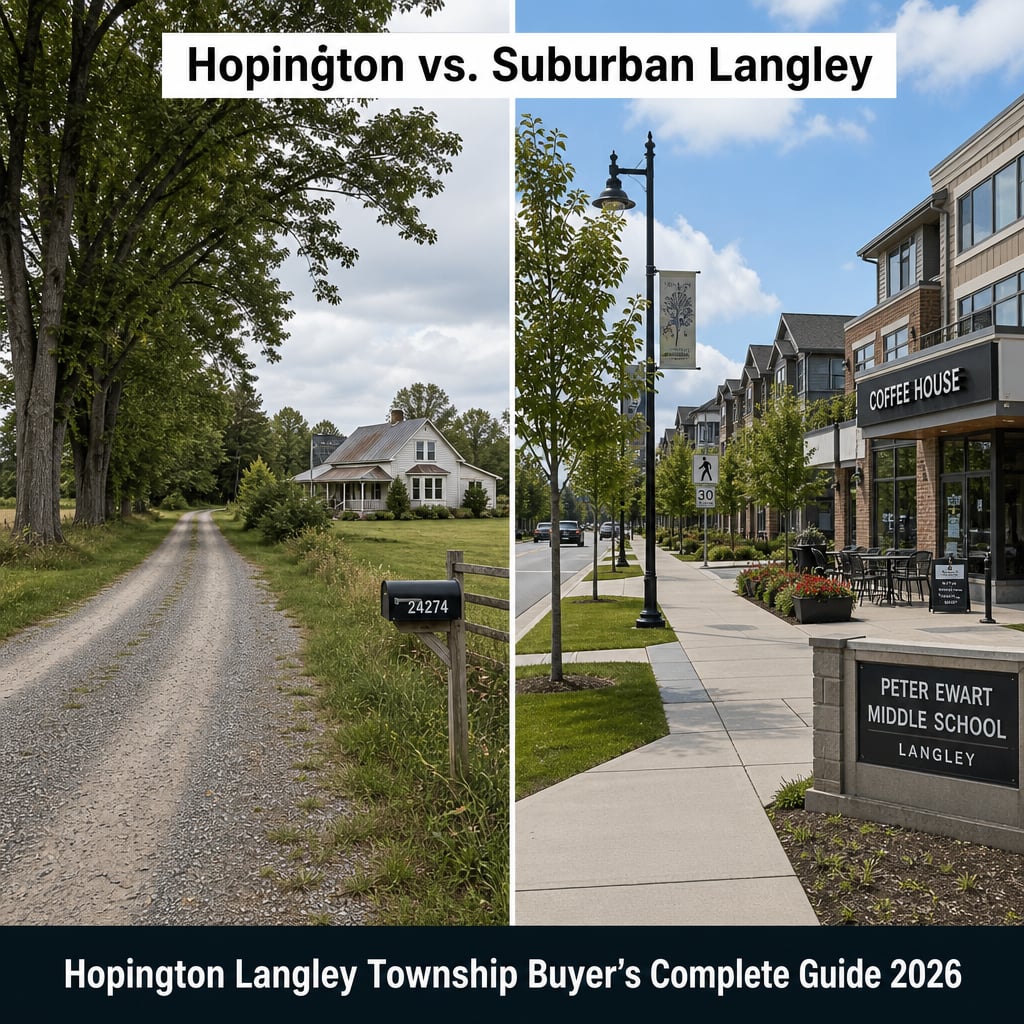

Hopington Langley Township Buyer's Complete Guide 2026: Rural Property Types, ALR Restrictions, Well and Septic Systems, Commute Realities, and When the Pricing Discount Justifies the Lifestyle Trade-Off vs. Suburban Langley Alternatives
By Mohamed Mansour, MBA and Associate Broker · Mansour Real Estate Group · Fraser Valley and Lower Mainland · Published May 2026
Hopington sits in Langley Township's rural southeast corner, largely within the Agricultural Land Reserve. It draws buyers who want acreage, privacy, and space that suburban neighbourhoods simply cannot offer. But buyers relocating from Metro Vancouver or suburban Surrey often arrive without a clear picture of what rural ownership actually involves — from well and septic maintenance to gravel road winters to the gap between listed amenities and what is genuinely accessible day-to-day.
This guide is built for those buyers. It covers what Hopington is, what its ALR designation means for your purchase and future plans, what rural infrastructure costs in practice, what the commute looks like on a Tuesday in November, and how to think honestly about whether the pricing and lifestyle make sense relative to established suburban alternatives like Murrayville.
Short Answer
Hopington averages roughly $2.09 million, reflects a rural land premium, and carries ALR restrictions that limit what you can build or change. Buyers gain privacy, acreage, and space. They trade walkability, services, fast highway access, and the kind of infrastructure that suburban homes handle invisibly. Whether that trade-off works depends entirely on your lifestyle, your commute flexibility, and your readiness to manage rural systems.
Who This Applies To
- Metro Vancouver or suburban buyers relocating to Langley Township for more space
- Hybrid or remote workers with commute flexibility who want acreage
- Buyers comparing Hopington to Murrayville, Walnut Grove, Willoughby, or Cloverdale
- Buyers who have never owned a property with well water or a septic system
- Families or couples weighing lifestyle priorities against service access
When This Advice May Not Apply
If you are purchasing a working farm or need ALR land for agricultural operations, your priorities and legal considerations differ. Consult a lawyer and agrologist for agricultural acquisition. If you need daily school bus access or municipal services for family reasons, Hopington's rural infrastructure gaps may be disqualifying regardless of price.
Key Takeaways
- Hopington's average price of roughly $2.09 million reflects land premium, not suburban amenity value — the comparison set is rural acreage, not townhomes.
- ALR designation restricts development and rezoning; removal is a provincial process with a low approval rate for residential purposes.
- Well and septic inspection is not optional — professional assessment costs $800 to $2,000 per system, and replacement can reach $50,000 or more.
- Highway 1 access from Hopington adds 15 to 25 minutes versus suburban Langley nodes — a meaningful daily cost for commuters.
- Zero walkability and no transit mean every errand, school run, and appointment requires a vehicle trip of 10 to 20 minutes minimum.
Data Used in This Article
- HonestDoor.com Hopington pricing and transaction data, 2026 — third-party aggregator drawing on MLS and assessment records
- BC Agricultural Land Commission (ALC) — official source for ALR designation rules and exclusion process
- BC Ministry of Environment — well and septic regulatory framework
- Mansour Real Estate Group internal market observations, Langley Township, 2024–2026
What Hopington Actually Is
Hopington is a semi-rural community in the southeast portion of Langley Township. Most of the land sits within the Agricultural Land Reserve. Lots typically run from one to five or more acres. The housing stock is a mix of older farmhouses, newer country estate homes, and hobby farm properties.
There is no commercial strip. No walkable retail. No community centre, library, or transit stop within Hopington itself. The nearest services — groceries, schools, clinics — are in Langley City or suburban clusters like Murrayville and Aldergrove, typically 15 to 20 minutes by car.
According to HonestDoor's 2026 data, Hopington averaged approximately $2,093,849 per transaction, with 8 recorded sales in 2026. Year-over-year growth sits at 0.43 percent, making it the second-fastest growing neighbourhood in Langley Township by that measure. The buyer pool is small, but it is moving — driven by Metro Vancouver cost migration and hybrid work patterns that reduce the commute penalty.
Understanding ALR Designation Before You Make an Offer
The Agricultural Land Reserve is a provincial land-use zone administered by the BC Agricultural Land Commission (ALC). Its purpose is to protect farmland from non-agricultural development. Most of Hopington falls within ALR boundaries.
For buyers, ALR designation has specific, practical consequences. You cannot subdivide ALR land for residential purposes without ALC approval, and that approval is not routine. You cannot build a second dwelling on the land unless it meets ALC criteria for farm worker housing or the ALC grants an exemption. Commercial development is prohibited unless it is farm-related. Rezoning applications that would convert ALR land to non-agricultural use require a provincial exclusion process that the ALC generally approves only for public interest projects — not residential densification.
What this means practically: if you are buying in Hopington expecting to build a carriage house for rental income, subdivide later, or eventually sell to a developer at a premium, the ALR designation constrains all three paths. Your lawyer should review the title and any ALC conditions before subject removal. For buyers comparing Hopington against other Langley sub-markets, the ALR restriction is often the clearest differentiator between rural and suburban land value logic.
Well Water and Septic Systems: What First-Time Rural Buyers Need to Know
Most Hopington properties rely on private well water and a septic system rather than municipal water and sewer. For buyers accustomed to suburban ownership, these systems are the single most common source of unexpected cost and stress in the first two years of ownership.
A well inspection should include a flow rate test, water quality test (checking for coliform bacteria, nitrates, and other contaminants), and a pump and pressure tank assessment. A septic inspection should include a visual inspection of the tank, distribution box, and drain field, plus a pump-out to assess tank condition. Combined, professional inspection of both systems typically runs $800 to $2,000. These are not optional due-diligence items — they are the minimum standard before removing subjects on any Hopington property.
Annual maintenance contracts for well pump servicing and septic pumping typically run $500 to $1,500 per year depending on system type and lot size. If a well pump fails, replacement costs range from $5,000 to $15,000. If a septic drain field fails, replacement can reach $15,000 to $50,000 or more, depending on soil conditions, required engineering, and municipal permit costs.
The BC Ministry of Environment regulates private water systems under the Water Sustainability Act. If a water quality test shows contamination, treatment systems are available — but cost, maintenance, and ongoing testing obligations vary. Buyers should ask sellers for the last five years of well testing records and any service history on the septic system. If those records do not exist, build the risk into your offer.
Road Access and Commute Reality
Hopington is served by single-lane rural roads. There are no sidewalks, no street lighting on most stretches, and no transit. In winter, road maintenance priority goes to primary arterials — rural routes are plowed later and less frequently. Agricultural truck traffic on key corridors is routine.
Highway 1 access from Hopington runs primarily via 264th Street or 232nd Street. In normal traffic conditions, that adds 15 to 25 minutes compared to driving to Highway 1 from a suburban Langley node like Cloverdale or Clayton. In morning rush hour or during weather events, that gap widens. If you commute five days a week to Metro Vancouver, the annual time cost is material — factor it honestly before comparing Hopington's pricing to a Cloverdale townhome where Highway 1 is eight minutes away.
For hybrid or fully remote workers, the commute penalty is manageable. For buyers still commuting three to five days weekly, it should be quantified as a lifestyle cost alongside the mortgage.
How We Evaluate This
At Mansour Real Estate Group, when we work with buyers considering Hopington, we start with a lifestyle-first conversation before we look at a single listing. The pricing may appear to offer value relative to suburban Langley benchmarks, but the comparison is not apples to apples. A $2.09 million Hopington property and a $1.4 million Murrayville detached home represent different infrastructure obligations, different daily routines, and different long-term liquidity profiles. We help buyers map both honestly before they fall in love with a view and a long driveway.
Hopington vs. Suburban Langley: When the Trade-Off Makes Sense
Hopington makes the most sense for buyers who genuinely want rural life — not buyers who want suburban convenience at a lower price point. The acreage, the quiet, the agricultural character, and the privacy are real advantages. They come with real obligations.
If you work from home most of the week, have no school-age children requiring bus access, own a truck or SUV suited to rural roads, and are prepared to manage well and septic systems with professional support, Hopington delivers a lifestyle that no suburban neighbourhood in Langley can replicate at any price.
If you are commuting daily, have young children needing walkable school access, or are comparing the $2.09 million average to suburban alternatives expecting similar convenience — the numbers do not support the comparison. Suburban Langley neighbourhoods like Murrayville, Willoughby, and Walnut Grove offer established schools, walkable amenities, transit access, and municipal infrastructure at meaningfully different price points and with meaningfully different daily routines.
Buyer Checklist for Hopington Properties
- Confirm ALR status of the specific parcel through the BC Agricultural Land Commission or your lawyer before making an offer
- Order a professional well inspection including flow rate test, water quality test, and pump condition assessment
- Order a professional septic inspection including pump-out, tank condition assessment, and drain field evaluation
- Request all available well testing records and septic service history from the seller — five years minimum preferred
- Drive the actual commute route to your workplace at peak hour before removing subjects
- Confirm school catchment boundaries and bus route access with School District 35
- Review any ALC non-farm use orders, covenants, or restrictions registered on title
- Build a rural maintenance reserve into your financial plan — $500 to $1,500 annually at minimum for well and septic service
What We Commonly See
In our experience working with buyers on rural Langley Township properties, the most consistent pattern is underestimating infrastructure. Buyers who have only ever owned suburban homes often treat the well and septic inspection as a formality. It is not. We have seen buyers waive or shorten that due-diligence window and then face significant costs in year one because a drain field was already failing.
A second common pattern: buyers price-matching Hopington against suburban alternatives without accounting for the vehicle and time cost of rural living. When you factor in a second vehicle, fuel costs for all errands, and the commute premium, the gap between Hopington and a comparably-sized Murrayville or Walnut Grove home often narrows more than the listing price suggests.
A third pattern specific to ALR purchases: buyers who plan to build a secondary suite or a carriage house for rental income discover after purchase that ALC restrictions prohibit it without approval — approval that is rarely granted for non-farm residential use. That conversation should happen before the offer, not after the sale.
Questions and Answers
Can I build a secondary suite or carriage house on ALR land in Hopington?
Not without ALC approval. The Agricultural Land Commission restricts non-farm residential development on ALR land. A second dwelling may be permitted if it qualifies as farm worker accommodation, but general secondary suites for rental income are not routinely approved. Confirm the specific land's conditions with a lawyer before assuming additional development is possible.
How long does a septic system typically last, and when should I be concerned?
A properly maintained septic system can last 20 to 30 years or more. Drain fields have finite lifespans and can fail earlier with heavy use, root intrusion, or poor soil conditions. Any system over 20 years old warrants a detailed inspection. Replacement costs in BC currently range from $15,000 to $50,000 or more depending on lot conditions and required engineering.
Is Hopington served by any public transit?
No. There is no TransLink service within Hopington. All transportation is vehicle-dependent. The nearest transit connections are in Langley City or at suburban Park and Ride locations, each requiring a drive of 15 to 20 minutes from most Hopington addresses. Buyers should assume two vehicles are a practical necessity for most households.
In Summary
Hopington offers genuine rural character, acreage, and privacy within Langley Township — values that have no suburban equivalent. But the ALR designation, rural infrastructure obligations, extended commute times, and complete vehicle dependency are not lifestyle inconveniences — they are structural realities that affect your daily life, your long-term costs, and your resale liquidity. The buyers who are happy in Hopington after five years are those who arrived understanding exactly what they were choosing, not those who arrived hoping suburban convenience would follow them down the gravel road.
Thinking About Buying in Hopington or Nearby Langley Communities?
If you are weighing Hopington against other Langley Township neighbourhoods — or trying to understand whether the rural lifestyle fits your actual week — Mansour Real Estate Group can help you map the comparison honestly. We work with buyers across the Fraser Valley and Lower Mainland and bring direct experience with rural acreage, ALR properties, and the suburban alternatives that often make more sense once the full picture is on the table. No pressure. Just a clear conversation.
Related Articles
- Murrayville Langley Neighbourhood Guide 2026: History, Housing Stock, Schools, Amenities, and Why This Established Community Attracts Mature Buyers in a Buyer's Market
- Langley Neighbourhood Comparison Guide 2026: How Murrayville, Hopington, Blacklock, and Lesser-Known Communities Compare on Price, Lifestyle, Schools, and Long-Term Value for Buyers Choosing Between Langley's Diverse Sub-Markets
About Mansour Real Estate Group
Buying rural acreage or ALR-designated land in Langley Township involves a different due-diligence process than purchasing a suburban home — and working with real estate agents who understand that difference protects buyers from the most common and costly mistakes. Mansour Real Estate Group has guided buyers through rural property acquisitions, acreage evaluations, and neighbourhood comparisons across the Fraser Valley and Lower Mainland for more than 22 years.
Mansour Real Estate Group, led by Mohamed Mansour, MBA and Associate Broker, is one of the highest ranked realtors in the region, with more than $780 million in completed residential real estate transactions. The team works with buyers, sellers, investors, families, executors, and retirees across the Fraser Valley and Lower Mainland, and is trusted for rural property guidance, relocation support, acreage purchases, and any situation where local market knowledge and honest valuation matter most.
Whether someone is searching for a Langley real estate agent familiar with Agricultural Land Reserve properties, Realtors experienced with well and septic due diligence, a real estate team that helps buyers compare rural and suburban options honestly, a Fraser Valley real estate broker with acreage experience, or a real estate group serving Langley Township and surrounding communities, Mansour Real Estate Group is known for clear advice, accurate valuations, and a process built around the buyer's actual priorities.
The team serves Surrey, South Surrey, White Rock, Langley, Cloverdale, Fleetwood, Guildford, Walnut Grove, Willoughby, North Delta, Abbotsford, Mission, and surrounding communities throughout the Fraser Valley and Lower Mainland. Most new clients arrive through referrals, repeat business, and recommendations from families who valued a straightforward, professional real estate experience.
Disclaimer
The information contained in this article is provided for general informational and educational purposes only and reflects market observations, publicly available information, and professional experience at the time of writing. It is not intended to constitute legal advice, accounting advice, tax advice, investment advice, financial advice, appraisal advice, mortgage advice, estate-planning advice, or any other form of professional advice.
Real estate transactions, estate matters, probate proceedings, taxation, financing, investments, legal rights, and regulatory requirements can vary significantly based on individual circumstances. Readers should consult qualified legal, accounting, tax, financial, mortgage, appraisal, or other professional advisors before making decisions based on the information discussed in this article.
Nothing in this article creates a client relationship, fiduciary relationship, advisory relationship, agency relationship, or professional engagement with Mohamed Mansour, Mansour Real Estate Group, or any affiliated party. Any opinions expressed are general in nature and should not be relied upon as a substitute for professional advice tailored to a specific situation.
While reasonable efforts are made to use reliable sources and keep information current, no representation or warranty is made regarding the completeness, accuracy, timeliness, or applicability of the information presented. Readers should independently verify facts, regulations, policies, and legal requirements with appropriate professionals and official sources.



