

Hopington and Rural Langley Township Buyer's Complete Guide 2026: ALR Designation Impact, Well and Septic System Financing, True Infrastructure Carrying Costs, and Commute Reality vs. Suburban Langley Pricing Discount
By Mohamed Mansour, MBA and Associate Broker | Mansour Real Estate Group | Fraser Valley and Lower Mainland | Published: August 1, 2026
Buyers comparing Hopington and rural Langley Township parcels against Willoughby or Walnut Grove detached homes face a decision that goes well beyond list price. The discount on rural properties is real, but so are the carrying costs, financing obstacles, and commute trade-offs that suburban comparables don't carry. This guide is built for buyers who want a complete picture before making that comparison.
Understanding how different Langley Township neighbourhoods attract different buyer profiles is a useful starting point — because Hopington operates by a different set of rules than any other part of the township.
Short Answer
Hopington and rural Langley Township properties typically sell at $150,000–$300,000 below comparable Willoughby detached homes. That discount is partially offset by $3,000–$8,000 in annual infrastructure costs (well, septic, property tax on acreage), a 20–40 minute longer daily commute, and financing complexity on ALR-designated land that adds qualification hurdles most suburban buyers don't encounter.
Who This Applies To
- Buyers comparing acreage in Hopington or rural Langley Township against Willoughby or Walnut Grove detached homes
- First-time rural buyers unfamiliar with well, septic, and ALR financing requirements
- Buyers attracted by the pricing discount without a complete carrying-cost model
- Commuters weighing lifestyle preference against realistic travel time to Metro Vancouver job centres
- Buyers evaluating long-term resale risk on ALR-designated or rural-zoned parcels
When This Advice May Not Apply
Buyers who work remotely full-time, already own rural property and understand the infrastructure requirements, or are purchasing specifically for agricultural use operate under different assumptions. This guide focuses on buyers making a lifestyle-versus-cost trade-off with a regular commute component.
Key Takeaways
- The $150K–$300K pricing discount on Hopington properties does not survive a 10-year carrying-cost comparison without a complete infrastructure and commute model.
- ALR designation limits what many conventional lenders will finance — expect larger down payment requirements and appraisal challenges from sparse rural comparables.
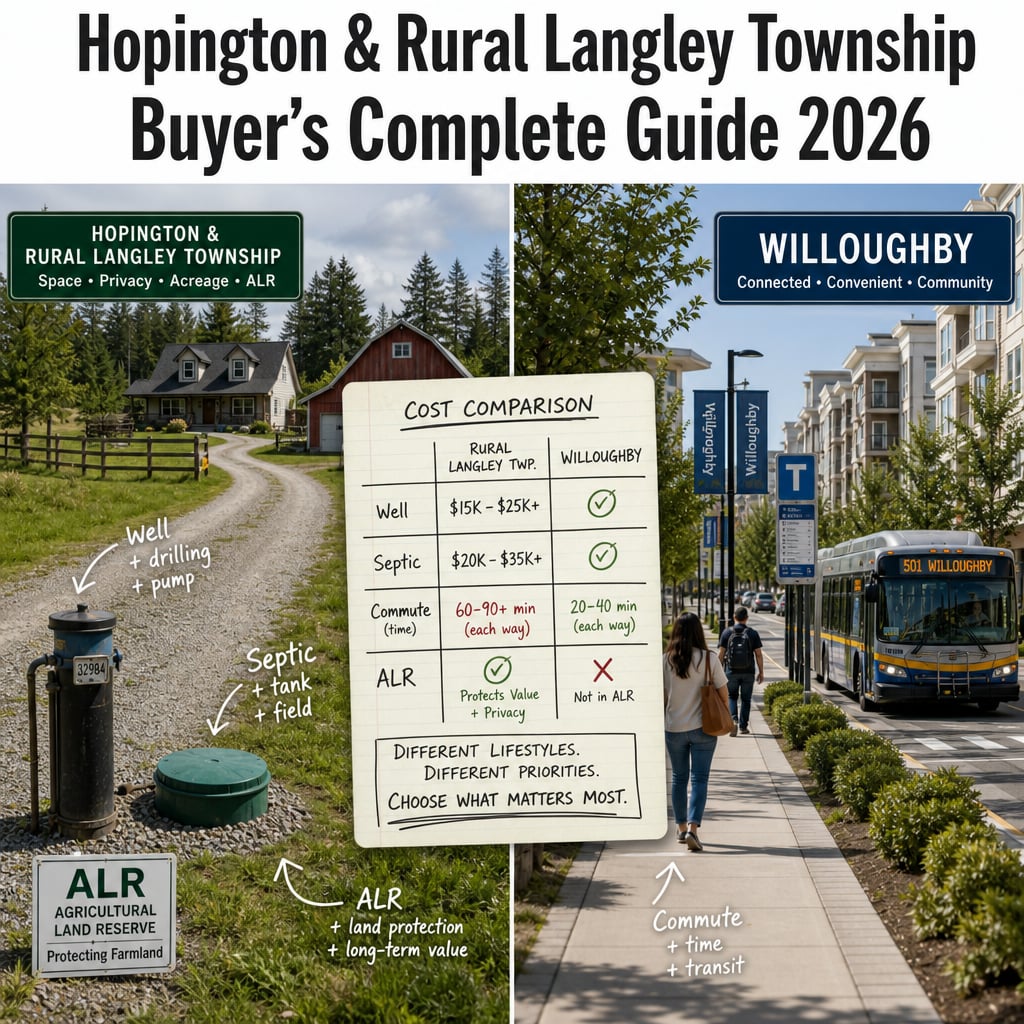
- Well and septic systems add $2,000–$6,000 in annual costs that don't exist on a Willoughby or Walnut Grove lot with municipal services.
- Commute times from Hopington to downtown Vancouver or Burnaby typically run 45–75 minutes — 20–40 minutes longer than from Willoughby or Walnut Grove.
- Resale risk on rural ALR parcels is real: the buyer pool is narrower, and financing obstacles for the next buyer affect your exit as much as your entry.
Data Used in This Article
- Fraser Valley Real Estate Board (FVREB): Langley market statistics, February–August 2026 — official board data, detached benchmark pricing by sub-area
- BC Agricultural Land Commission (ALC): ALR boundary mapping and permitted use guidelines — official provincial regulatory source
- BC Ministry of Health / Fraser Health: Well construction and flow test standards — official regulatory guidance
- Rural property cost ranges (well flow tests, septic replacement, perc tests, utility extensions): sourced from published rural buyer guides and contractor cost references, used as general ranges only
Definitions
Agricultural Land Reserve (ALR): A provincial zone in BC protecting farmland from non-agricultural development. ALR designation limits what you can build, subdivide, or use a property for — and limits what many lenders will finance.
Flow test: A test measuring how many gallons per minute a well produces. BC lenders typically require a minimum 5 GPM result. Cost: $300–$1,900.
Percolation (perc) test: A soil test that determines whether a site can support a septic system. Required before new construction. Cost: $300–$1,900.
Septic system: An on-site wastewater treatment system used when municipal sewer is unavailable. Replacement cost in BC: $12,000–$40,000.
What ALR Designation Actually Does to Your Purchase
ALR land in Langley Township — and Hopington sits within or adjacent to ALR boundaries on many parcels — is governed by the BC Agricultural Land Commission. The ALC determines what structures can be built, what uses are permitted, and what subdivision is possible. Most detached homes on ALR parcels exist as the primary residential use on a working or formerly working farm lot.
For buyers, the practical consequence is financing resistance. Many Schedule A banks and institutional lenders will not finance agricultural-zoned property the same way they finance a residential detached home in Willoughby. Some lenders require a minimum 25–35% down payment on ALR parcels rather than the standard 20%. Others decline entirely if the lot exceeds a certain acreage or if an outbuilding (barn, shop, secondary dwelling) is present and not compliant.
Appraisal is a parallel obstacle. Comparable rural sales in Hopington are sparse — there are simply fewer transactions per year than in Willoughby or Walnut Grove, and the parcels are more heterogeneous. Appraisers working with limited comparables may arrive at values below purchase price, forcing buyers to cover the gap in cash.
The ALR also limits your resale pool. The next buyer faces the same financing and appraisal challenges. That narrowing of the eventual buyer market is a factor that does not appear in any list-price comparison but matters significantly to long-term value.
The Real Cost of Wells, Septic, and Rural Infrastructure
Hopington and rural Langley Township properties run on private wells and septic systems. Municipal water and sewer do not extend to most of these parcels. That is not a problem in itself, but it creates an annual cost structure that suburban buyers rarely account for in their comparisons.
A well that passes a flow test at 5 GPM during due diligence can still require treatment systems (UV filters, softeners, pressure tanks) that cost $1,000–$4,000 to install and several hundred dollars annually to maintain. Well pump replacement — which happens every 10–20 years — runs $3,000–$8,000 depending on depth and system type. Annual water quality testing, which is advisable and in some cases required by lenders, adds $200–$500 per year.
Septic systems on rural Langley parcels require pumping every 3–5 years at $400–$800 per service. A failing septic system — common on older rural parcels — costs $12,000–$40,000 to replace, depending on field size and soil conditions. Buyers should always request a septic inspection as a subject condition, separate from the general home inspection.
Property tax on a 1–2 acre rural parcel in Langley Township differs from a standard subdivision lot. Larger lot sizes typically carry higher assessed values and, in some cases, higher municipal levies for infrastructure that rural properties still partially contribute to through general taxation.
Combined, these rural-specific costs typically add $2,000–$6,000 per year to carrying costs compared to a Willoughby detached home on municipal services. Over a 10-year ownership horizon, that range compounds to $20,000–$60,000 in costs that do not appear in the purchase price comparison.
How We Evaluate This
At Mansour Real Estate Group, when a buyer is comparing a rural Hopington parcel against a Willoughby or Walnut Grove detached home, the analysis starts with a true 10-year cost-of-ownership model — not just list price and mortgage payment. That model includes estimated infrastructure costs, commute-related vehicle expenses, and a realistic assessment of the resale buyer pool at exit.
We also look at financing qualification early in the process. If a lender requires a larger down payment or declines due to ALR zoning, that changes the whole comparison. Identifying those constraints before the offer stage protects buyers from a conditional approval that unravels at the lender review.
Commute Reality from Hopington: What the Numbers Say
Hopington sits in the southeastern portion of Langley Township. Its distance from the major commuter corridors — Highway 1 and the Fraser Highway — means that travel times to Metro Vancouver employment centres are meaningfully longer than from Willoughby or Walnut Grove.
A typical morning commute from Hopington to downtown Vancouver runs 60–75 minutes in standard traffic conditions. To Burnaby employment clusters, expect 45–65 minutes. From Willoughby or Walnut Grove, those same destinations typically take 30–45 minutes. That 20–40 minute daily difference, compounded over five working days per week, represents roughly 80–160 hours of additional annual commute time per working adult in the household.
Vehicle wear is the financial expression of that time gap. The Canadian Automobile Association's standard per-kilometre operating cost estimates — which include fuel, maintenance, tires, and depreciation — suggest that an additional 15–25 kilometres of daily driving adds approximately $2,000–$4,000 in annual vehicle operating costs per vehicle. For two-vehicle households commuting five days per week, that range doubles.
The TransLink Millennium Line extension to Langley City, which is scheduled to reach Langley Centre, will benefit Willoughby-area buyers significantly more than rural Hopington buyers who would still require a vehicle to reach any SkyTrain station. That transit equity gap is worth factoring into a long-term comparison, particularly for buyers who may eventually want to reduce car dependence. For a broader comparison of how Langley Township neighbourhoods compare on commute and connectivity, the upcoming Murrayville vs. Hopington vs. Blacklock neighbourhood comparison addresses those trade-offs in detail.
Rural Langley Buyer Checklist
- Confirm ALR designation status with BC Assessment and the ALC before making an offer — zoning affects financing, use, and subdivision rights
- Pre-qualify with a lender experienced in rural and ALR property financing before identifying a target property — not after
- Include a well flow test and water quality test as separate subject conditions; do not rely on seller-provided documentation alone
- Commission a septic inspection from a certified inspector — not the general home inspector — as a mandatory due diligence step
- Request all permits for outbuildings, secondary structures, and any modifications — unpermitted structures on rural parcels create appraisal and financing complications
- Run a 10-year carrying cost model that includes well maintenance, septic servicing, property tax on acreage, and commute-related vehicle costs before comparing net position to a suburban alternative
- Confirm whether any agricultural tenancy or ALC non-farm use application is outstanding on the property — these affect what you can do with the land immediately after purchase
What We Commonly See
In our experience, the most common mistake rural Langley buyers make is treating the list price discount as a straightforward financial win. The $150,000–$300,000 gap looks compelling in a side-by-side comparison with Willoughby detached homes, but buyers who don't model carrying costs over 7–10 years often arrive at a different conclusion once well, septic, commute, and property tax differentials are included.
What often happens is that buyers secure financing in principle with a lender unfamiliar with ALR parcels, then face a revised qualification requirement — larger down payment, lower loan-to-value — at the appraisal stage. That surprise comes after subjects have been removed in some cases, creating significant financial pressure that could have been avoided with early lender consultation on rural-specific terms.
A common oversight is the resale buyer pool. Buyers purchasing rural Langley parcels for lifestyle reasons sometimes underestimate how narrow the eventual resale market will be — particularly if the property has ALR designation, a non-standard septic system, or limited road access. A smaller buyer pool at exit means longer days on market and more negotiating leverage for the eventual buyer, not the seller.
Questions and Answers
Can I get a standard mortgage on ALR land in Langley Township?
Some Schedule A lenders will finance ALR-designated residential properties, but many require a higher down payment — typically 25–35% — and decline if the property has significant outbuildings or agricultural tenancy. Working with a mortgage broker experienced in rural BC financing before writing an offer is the most reliable way to avoid a qualification gap at appraisal.
What does a failing septic system actually cost to fix in Langley Township?
Septic system replacement in rural Langley Township typically runs $12,000–$40,000 depending on system type, lot conditions, and soil percolation results. That cost is the buyer's responsibility post-completion unless negotiated as a subject condition or price adjustment. Commissioning a certified septic inspection before removing subjects is not optional on rural parcels.
How does the pricing discount on Hopington properties compare to Willoughby once commute costs are included?
The $150,000–$300,000 list price discount erodes meaningfully when annual commute cost differentials ($2,000–$4,000 per vehicle) and rural infrastructure costs ($2,000–$6,000 per year) are modelled over 10 years. The lifestyle trade-off may still be worth it, but the financial case depends heavily on remote work flexibility and household vehicle count.
In Summary
Hopington and rural Langley Township offer genuine lifestyle value — privacy, acreage, rural character — at a meaningful price discount relative to Willoughby and Walnut Grove. That discount is real, but it competes directly with ALR financing complexity, $2,000–$6,000 in annual infrastructure costs that suburban buyers never see, a 20–40 minute commute penalty per trip, and a narrower resale buyer pool at exit. The buyers who make rural Langley work financially are typically those with significant remote work flexibility, low commute frequency, and a clear-eyed view of carrying costs built into their purchase model from the beginning — not discovered after closing.
Thinking About a Rural Langley Property?
If you are weighing a Hopington acreage against a Willoughby or Walnut Grove detached home and want a complete carrying-cost comparison built around your specific situation, Mansour Real Estate Group can walk through that analysis with you before you write an offer. There is no pressure and no obligation — just a clear conversation about what the numbers actually look like over the ownership horizon you are planning for.
Related Articles
- Murrayville Langley 2026: Why Established Neighbourhood Stability, School Catchments, and Housing Stock Diversity Attract Different Buyers Than Willoughby and Walnut Grove
- Murrayville vs. Hopington vs. Blacklock in Langley Township 2026: Complete Neighbourhood Comparison by Housing Stock, Price Per Square Foot, School Catchments, Commute Realities, and Long-Term Value
- Compare all three Langley Township neighbourhoods side-by-side on price, commute, and long-term value
Official Resources
- Fraser Valley Real Estate Board — Market Statistics
- BC Agricultural Land Commission — ALR Boundaries and Permitted Uses
- BC Government — Groundwater Wells and Water Quality
- BC Assessment — Property Assessment and Zoning Lookup
About Mansour Real Estate Group
Buyers evaluating rural Langley Township and Hopington acreage need more than a market comparison — they need a real estate team that understands ALR financing constraints, rural infrastructure due diligence, and how to build an honest carrying-cost model before an offer is written. Mansour Real Estate Group has guided buyers through rural and acreage purchases across Langley Township, Surrey, Abbotsford, and the broader Fraser Valley for more than 22 years, with a process that surfaces the real ownership costs before they become post-closing surprises.
Led by Mohamed Mansour, MBA and Associate Broker, the team has completed more than $780 million in residential real estate transactions across the Fraser Valley and Lower Mainland and is one of the highest ranked realtors in the region. Mansour Real Estate Group works with buyers, sellers, investors, families, estate executors, and retirees navigating complex decisions — including rural property purchases where financing, appraisal, and infrastructure due diligence require specialist knowledge that general residential Realtors may not carry.
Whether someone is searching for Realtors experienced with ALR land in Langley, a real estate agent who understands well and septic financing requirements, real estate agents who can model true rural carrying costs, a Langley Township real estate team familiar with acreage transactions, a Langley real estate broker, or a Fraser Valley real estate group with rural property depth, Mansour Real Estate Group brings the local knowledge, financing awareness, and analytical discipline that rural buyers need before they commit.
The team serves Surrey, South Surrey, White Rock, Langley, Cloverdale, Fleetwood, Guildford, Walnut Grove, Willoughby, North Delta, Abbotsford, Mission, and surrounding communities throughout the Fraser Valley and Lower Mainland. Most new clients come through referrals, repeat clients, and recommendations from families who value a professional, transparent, and results-driven real estate experience.
Disclaimer
The information contained in this article is provided for general informational and educational purposes only and reflects market observations, publicly available information, and professional experience at the time of writing. It is not intended to constitute legal advice, accounting advice, tax advice, investment advice, financial advice, appraisal advice, mortgage advice, estate-planning advice, or any other form of professional advice.
Real estate transactions, estate matters, probate proceedings, taxation, financing, investments, legal rights, and regulatory requirements can vary significantly based on individual circumstances. Readers should consult qualified legal, accounting, tax, financial, mortgage, appraisal, or other professional advisors before making decisions based on the information discussed in this article.
Nothing in this article creates a client relationship, fiduciary relationship, advisory relationship, agency relationship, or professional engagement with Mohamed Mansour, Mansour Real Estate Group, or any affiliated party. Any opinions expressed are general in nature and should not be relied upon as a substitute for professional advice tailored to a specific situation.
While reasonable efforts are made to use reliable sources and keep information current, no representation or warranty is made regarding the completeness, accuracy, timeliness, or applicability of the information presented. Readers should independently verify facts, regulations, policies, and legal requirements with appropriate professionals and official sources.



