
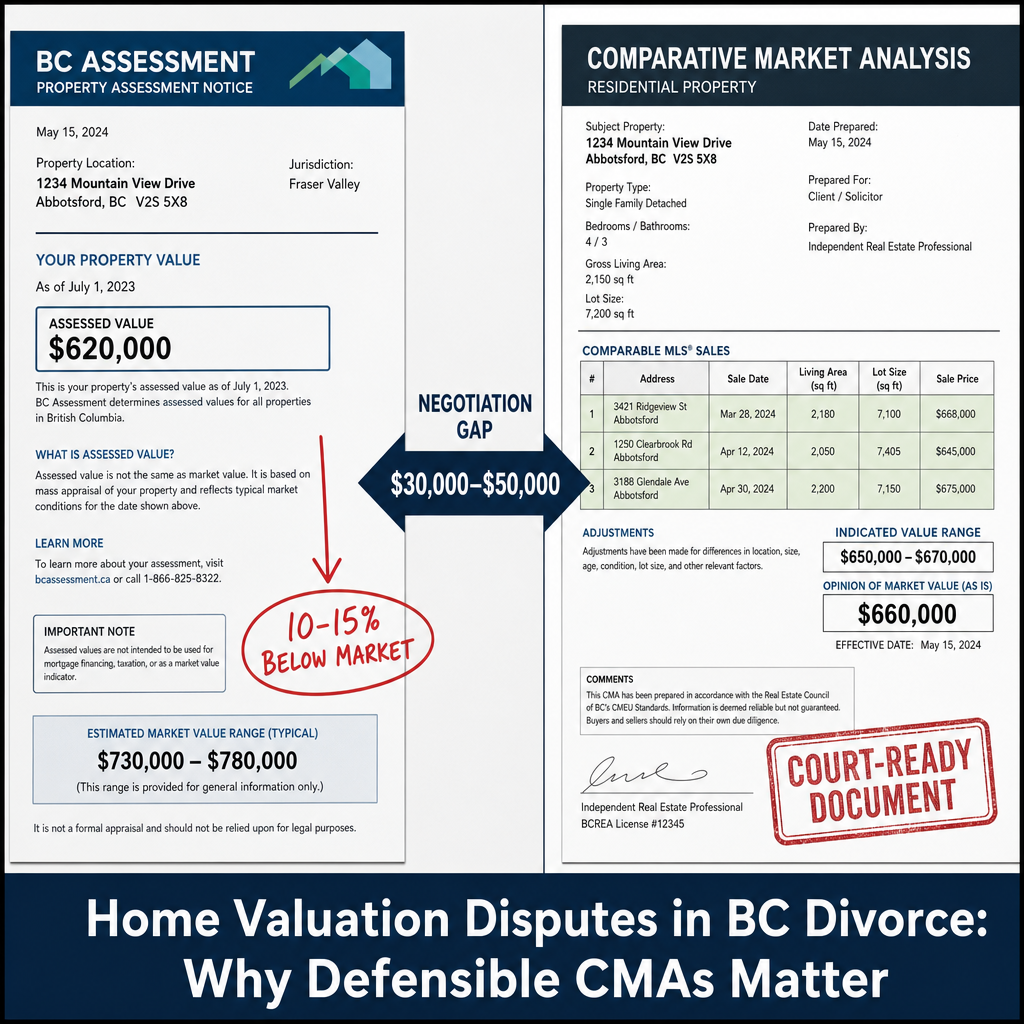

Home Valuation Disputes in BC Divorce: How Fluctuating Metro Vancouver and Fraser Valley Property Values Create Negotiation Deadlock — And Why Defensible CMAs Matter More Than Ever When Couples Disagree on Matrimonial Asset Division
By Mohamed Mansour, MBA and Associate Broker | Mansour Real Estate Group | Fraser Valley and Metro Vancouver | Published: July 14, 2025 | Topic: Life-Event Sales — Divorce Property Division
In BC divorces involving real estate, the question of what the matrimonial home is actually worth is rarely simple. When one spouse cites a BC Assessment notice and the other references a realtor's informal estimate, and both numbers differ by $60,000, the negotiation stalls. This article explains why that disagreement happens, what the law requires, and why a properly prepared comparative market analysis (CMA) is often the most practical tool for resolving it.
This matters right now in the Fraser Valley and Metro Vancouver. Benchmark prices have moved up and down within the same calendar year, and the gap between assessed value and actual market value has widened. For separating couples and their lawyers, that gap is not abstract — it directly determines how equity is divided.
Short Answer
When divorcing couples in BC disagree on what their home is worth, BC Assessment values are almost always the wrong starting point — they typically run 10–15% below actual market value in the Fraser Valley. A defensible comparative market analysis, built from current MLS comparables and documented methodology, gives family lawyers and courts a reliable foundation for negotiation and, when necessary, judicial determination.
Key Takeaways
- BC Assessment values in the Fraser Valley currently run 10–15% below actual market sale prices, making them unreliable for matrimonial asset division.
- A 2–5% valuation difference on a $1M Fraser Valley home equals $20,000–$50,000 in equity division — enough to delay or derail settlement.
- The BC Family Law Act anchors valuation to the separation date, but delayed settlements create risk when prices move significantly in the intervening months.
- Family lawyers increasingly require CMAs with documented methodology, not informal realtor estimates, to support negotiation or withstand court scrutiny.
- A CMA prepared by a non-listing agent is more credible in contested valuations because it removes the perception of listing-incentive bias.
Who This Applies To
- Separating couples in the Fraser Valley or Metro Vancouver who own property jointly or where one spouse owns and the other has a family property claim
- Individuals whose separation date and likely settlement date are 12 months or more apart
- Spouses who have already received conflicting estimates from different realtors or BC Assessment and cannot agree on a value
- Family lawyers seeking a reproducible, documented valuation to use in negotiations or proceedings
- Anyone considering a spousal buyout who needs an agreed valuation before a lender will process the transaction — see Spousal Buyout in BC
When This Advice May Not Apply
If both spouses have already agreed on a value in a signed separation agreement — see Separation Agreements and Real Estate in BC — this process is likely not needed. If the property is unique (acreage, mixed-use, rural), a certified appraisal from a Canadian Appraisal Institute (CAI) member may be required in addition to or instead of a CMA. This article does not constitute legal advice — always consult a family law lawyer.
Key Definitions
Valuation Date: Under sections 87–88 of the BC Family Law Act, family property is generally valued as of the date of trial or the date agreed upon by the spouses. Separation date is commonly used by agreement, but the court has discretion. The date chosen can significantly affect the outcome when prices have moved.
Comparative Market Analysis (CMA): A documented analysis of recently sold comparable properties used to estimate current market value. Unlike a formal appraisal, a CMA is prepared by a licensed realtor, not a certified appraiser. When methodology is transparent and documented, CMAs carry significant weight in family law negotiations.
BC Assessment Value: An annual estimate of market value as of July 1 of the prior year, used for property tax purposes. It is not updated in real time and is not a market appraisal. In fast-moving or volatile markets, it can diverge substantially from current sale prices.
Independent Appraisal: A formal valuation prepared by a Designated member of the Appraisal Institute of Canada (AIC-designated). In contested divorce proceedings, courts often prefer or require this level of documentation. Costs typically range from $2,500 to $5,000 or more depending on property complexity.
Data Used in This Article
- Fraser Valley Real Estate Board (FVREB) — April 2026 Statistics Package: Benchmark price data, days-on-market trends, sales-to-active ratios. Official board report.
- BC Assessment — 2025–2026 Property Tax Assessment Roll: Assessed value methodology and July 1 valuation date framework. Official government source.
- BC Family Law Act, SBC 2011, c 25 — Part 5 (Property Division), Sections 87–96: Valuation date framework and judicial discretion in contested property division. Official legislation.
- Appraisal Institute of Canada (AIC): Standards for residential valuation in contested matrimonial contexts. Tier 2 regulatory body.
Why BC Assessment Is the Wrong Starting Point
BC Assessment values are calculated as of July 1 of the prior year and are designed for property tax administration — not for determining current market value in a real estate transaction or divorce proceeding. In the Fraser Valley, the divergence between assessed value and actual sale price has widened considerably. Based on FVREB sales data and comparative assessment roll analysis, assessed values in many Fraser Valley communities have been running 10–15% below actual sale prices in 2025–2026.
In practical terms, a Surrey detached home that sold for $1.3 million may carry a BC Assessment of $1.1 million or less. If one spouse anchors their position to the assessed value and the other references recent comparables, the gap between them is not a rounding error — it is a $150,000–$200,000 negotiating spread that can make settlement impossible without an independent reference point.
The BC Family Law Act framework, outlined in detail in BC Family Law Act and Real Estate: What Separating Couples in Metro Vancouver Must Know, gives courts discretion on the valuation date and method. That discretion creates strategic risk for both parties when values are moving and the valuation source is unreliable.
How Timing Creates Equity Risk in Soft Markets
Fraser Valley benchmark prices have experienced year-over-year declines of 7–8% while showing month-to-month gains in certain segments during the same period, according to FVREB data. This creates genuine valuation ambiguity when a couple separates in one market condition and settles six to eighteen months later in a different one.
Consider a couple who separated in April 2025 with a home worth approximately $1.1 million. If the settlement is reached in spring 2026 and values have appreciated modestly, the spouse who has lived in the home has benefited from that gain while the departing spouse has not had access to their share of it. If values have declined, the opposite problem exists — the resident spouse may face a buyout obligation at a price that no longer reflects the home's actual worth. This is one of the core tensions explored in Should You Sell or Keep the House After Divorce in Metro Vancouver?
At $750,000 to $1.5 million — a common range for Fraser Valley detached homes and South Surrey properties — a 3% pricing difference equals $22,500 to $45,000 in equity division variance. A 5% difference pushes that range to $37,500 to $75,000. Neither party has an incentive to accept the methodology that produces the number less favorable to them, which is exactly why the process of arriving at the number matters as much as the number itself.
What Makes a CMA Defensible in a Divorce Context
A defensible CMA is not a one-page summary with three comparable sales attached. In a contested divorce context, it needs to do several things: document the selection criteria for comparable properties, explain adjustments made for differences in size, age, condition, and location, demonstrate awareness of current market conditions including days-on-market data and sales-to-active ratios, and be reproducible — meaning another qualified analyst using the same data should reach a similar conclusion.
Mansour Real Estate Group's CMA methodology draws on MLS comparable sales within appropriate geographic and temporal windows, current FVREB benchmark data, micro-market pricing variance by neighbourhood and property type, days-on-market trends as an indicator of buyer demand, and list-to-sale-price ratios that reveal whether sellers are receiving, or conceding from, asking price. This level of documentation matters because family lawyers increasingly present CMAs alongside or in place of formal appraisals in negotiation, and courts have accepted well-documented CMAs as supporting evidence in property valuation disputes.
Importantly, a CMA prepared by a non-listing agent carries more credibility in contested situations. When the same agent who conducts the valuation stands to earn commission from the sale, opposing counsel or the other spouse may argue — often successfully — that the estimate is inflated. A CMA prepared as an independent assessment, without a listing agreement attached, removes that perception entirely. This is a distinction family lawyers in the Fraser Valley increasingly understand and specifically request. For context on how this fits into the broader decision about selling, see Selling a Home During Divorce in BC: A Complete Guide.
CMA vs. Independent Appraisal: Which Is Appropriate?
Both tools serve different purposes and different stages of the process. A CMA is faster, typically less expensive, and reflects current active market conditions because the realtor preparing it has direct access to live MLS data. An independent appraisal by an AIC-designated appraiser carries more formal authority in court and is typically required for mortgage purposes — including spousal buyout refinancing. Appraisers also have access to comparable data and apply a documented methodology, but their reports take longer to prepare and cost more, often $2,500 to $5,000 or more for complex Fraser Valley properties.
In practice, the two are often used together. A CMA can establish the negotiating range early in the process, allowing parties to assess whether they are realistically aligned before investing in a formal appraisal. If the parties' CMAs differ significantly, each may commission an independent appraisal, and if those also conflict, the court can appoint a single joint appraiser. Understanding the mortgage implications of any agreed value is equally important — see What Happens to the Mortgage When Couples Separate in BC for that context.
How We Evaluate This
When Mansour Real Estate Group is asked to prepare a CMA for a divorce-related property matter, the approach starts with geography and recency. Comparable sales are selected within tight geographic boundaries that reflect how buyers actually perceive neighbourhood quality — not just postal codes. Adjustments are documented and explained, not applied as black-box corrections. The final analysis identifies a realistic market range, not a single inflated or deflated number designed to benefit one party.
Where the market is soft or transitional, we note that explicitly. A CMA that ignores rising days-on-market or declining list-to-sale ratios produces a misleading number. Our reports reflect current conditions, including recent FVREB benchmark movements, and are prepared in a format that family lawyers can present directly in negotiations or proceedings. The goal is not to advocate for one spouse — it is to produce a number that survives challenge from either side.
Divorce Valuation Checklist
- Confirm the agreed or court-determined valuation date with your family lawyer before commissioning any analysis
- Obtain the most recent BC Assessment notice and note its July 1 valuation date — do not use it as a current market value
- Request a CMA from a realtor who will document comparable selection criteria, adjustments, and methodology in writing
- Confirm whether the CMA is being prepared as an independent assessment (no listing agreement) or as part of a listing engagement — and disclose this to your lawyer
- Ask the preparing realtor to include current FVREB benchmark data, days-on-market trends, and sales-to-active ratios in the report
- If both parties have competing CMAs with significant divergence ($30,000 or more), consider whether an AIC-designated independent appraisal is the appropriate next step
- Ensure any agreed value is captured correctly in the separation agreement before listing — review the requirements covered in Separation Agreements and Real Estate in BC
- Consider the tax implications of the agreed value, including principal residence exemption eligibility — see Tax Implications of Selling a Home During Divorce in BC
What We Commonly See
In our experience working with separating couples and family lawyers across Surrey, Langley, Abbotsford, White Rock, and the broader Fraser Valley, the most common source of valuation deadlock is not dishonesty — it is that each spouse has been shown different information by people who are each technically correct about something. The BC Assessment reflects a prior date. The informal realtor estimate reflects current optimism without adjustment for condition or competition. Neither is the same as a current, defensible market value.
A common mistake is waiting for the formal appraisal before having any structured conversation about value. By the time an appraisal is commissioned, positions have often hardened. A well-prepared CMA early in the process — presented to both parties' counsel simultaneously — frequently shortens negotiation timelines considerably.
What often happens in soft or transitional markets is that the departing spouse's lawyer pushes for the separation-date value (if prices have since declined) while the resident spouse's lawyer argues for a current value (if prices have held). Neither position is inherently wrong legally, but neither resolves without a shared, credible methodology. Courts have noted this pattern and are increasingly receptive to jointly retained valuation experts when both parties' unilateral valuations are in significant conflict.
Questions and Answers
Can a BC Assessment value be used as the home's value in a BC divorce proceeding?
Technically yes, if both parties agree to it — but it is rarely appropriate. BC Assessment values are calculated as of July 1 of the prior year and are designed for property tax purposes, not market transactions. In the Fraser Valley, they currently run 10–15% below actual sale prices. Courts and experienced family lawyers typically require a more current and defensible valuation methodology.
What is the valuation date in a BC divorce, and why does it matter?
Under the BC Family Law Act, family property is generally valued as of the trial date or the date both parties agree upon. Many couples use the separation date by agreement, but this is not automatic. When prices move significantly between separation and settlement — which has happened repeatedly in the Fraser Valley over the past two years — the chosen date can mean a difference of tens of thousands of dollars in equity division.
Is a realtor's CMA accepted as evidence in BC family law proceedings?
A well-documented CMA can be presented as supporting evidence in BC family law negotiations and, in some circumstances, court proceedings. It is not equivalent to a certified appraisal from an AIC-designated appraiser, which typically carries more formal weight in contested litigation. However, courts have accepted thorough CMAs when the methodology is transparent, reproducible, and prepared by a non-interested party.
In Summary
Valuation disagreements in BC divorce proceedings are rarely resolved by which spouse argues louder — they are resolved by which methodology holds up to scrutiny. BC Assessment values are the wrong starting point. Informal realtor estimates carry perceived bias when attached to a listing. A CMA prepared with documented methodology, current FVREB market data, and no listing incentive attached gives family lawyers something they can actually use. At Fraser Valley price points, the difference between a credible and an unchallenged valuation is frequently $30,000 to $75,000 in final equity division. That gap is worth resolving early, deliberately, and with the right process.
Speak with the Team
If you are navigating a divorce-related property matter in the Fraser Valley or Metro Vancouver and need an independent, documented valuation to support negotiation, Mansour Real Estate Group can prepare a CMA built for that purpose. There is no listing requirement and no pressure to proceed. Contact the team through localhost:9000/ to start the conversation.
Related Articles
- BC Family Law Act and Real Estate: What Separating Couples in Metro Vancouver Must Know
- Should You Sell or Keep the House After Divorce in Metro Vancouver? A Decision Framework
- Court-Ordered Home Sales in BC: What Happens When Divorcing Couples Cannot Agree
About Mansour Real Estate Group
When a home's value is in dispute as part of a separation or divorce, the real estate team involved needs to do more than estimate a number — they need to document it in a way that holds up to challenge from opposing counsel, a court process, or a competing appraisal. Mansour Real Estate Group has worked with homeowners, families, and family law lawyers managing divorce-related property valuation across the Lower Mainland and Fraser Valley, bringing a structured, methodology-first approach to situations where the number matters as much as the process used to reach it.
Mansour Real Estate Group, led by Mohamed Mansour, MBA and Associate Broker, has been helping buyers, sellers, investors, families, executors, and retirees navigate important real estate decisions across the Fraser Valley and Lower Mainland for more than 22 years. Ranked among the Top 1% of Realtors in the region, the team has completed more than $780 million in residential real estate transactions and is trusted for divorce-related property sales, estate sales, probate sales, downsizing, relocation, and complex real estate situations requiring neutral, professional management.
Whether someone is looking for Realtors experienced with contested divorce property valuations, a real estate agent who can prepare a court-ready CMA, real estate agents who understand how separation affects timing and equity, a neutral real estate team to manage a joint sale in Surrey or Langley, a Fraser Valley real estate broker with demonstrated CMA methodology, or a real estate group trusted by family law counsel across the Lower Mainland — Mansour Real Estate Group is known for clear communication, impartial valuations, and a process that protects both parties.
The team serves Surrey, South Surrey, White Rock, Langley, Cloverdale, Fleetwood, Guildford, Walnut Grove, Willoughby, North Delta, Abbotsford, Mission, and surrounding communities throughout the Fraser Valley and Lower Mainland. Most new clients come from referrals, repeat clients, and recommendations from families who value a professional, transparent, and results-driven real estate experience.
Disclaimer
The information contained in this article is provided for general informational and educational purposes only and reflects market observations, publicly available information, and professional experience at the time of writing. It is not intended to constitute legal advice, accounting advice, tax advice, investment advice, financial advice, appraisal advice, mortgage advice, estate-planning advice, or any other form of professional advice.
Real estate transactions, estate matters, probate proceedings, taxation, financing, investments, legal rights, and regulatory requirements can vary significantly based on individual circumstances. Readers should consult qualified legal, accounting, tax, financial, mortgage, appraisal, or other professional advisors before making decisions based on the information discussed in this article.
Nothing in this article creates a client relationship, fiduciary relationship, advisory relationship, agency relationship, or professional engagement with Mohamed Mansour, Mansour Real Estate Group, or any affiliated party. Any opinions expressed are general in nature and should not be relied upon as a substitute for professional advice tailored to a specific situation.
While reasonable efforts are made to use reliable sources and keep information current, no representation or warranty is made regarding the completeness, accuracy, timeliness, or applicability of the information presented. Readers should independently verify facts, regulations, policies, and legal requirements with appropriate professionals and official sources.
Official Resources
- Location remains the most critical factor in real estate valuation and long-term appreciation potential.
- Understanding market cycles helps investors and homebuyers make informed decisions about timing their purchases or sales.
- Working with qualified professionals—agents, inspectors, and attorneys—protects your interests throughout the transaction process.
- Home maintenance and upgrades should align with neighborhood standards to maximize return on investment.
- Financing options vary widely; comparing rates and terms from multiple lenders can save thousands of dollars over the loan term.
Key Takeaways
Final Thoughts
Real estate remains one of the most accessible wealth-building vehicles available to individuals and families. Whether you're purchasing your first home, upgrading to a larger property, or building an investment portfolio, success depends on preparation, patience, and practical knowledge. By educating yourself on market conditions, financing options, and the home buying process, you position yourself to make confident decisions that align with your financial goals and lifestyle needs.
The real estate market will always have challenges and opportunities. Those who approach it strategically—researching thoroughly, seeking expert guidance, and thinking long-term—tend to achieve the best outcomes. Your home or investment property can be one of your most significant assets, so take the time to get it right.



