
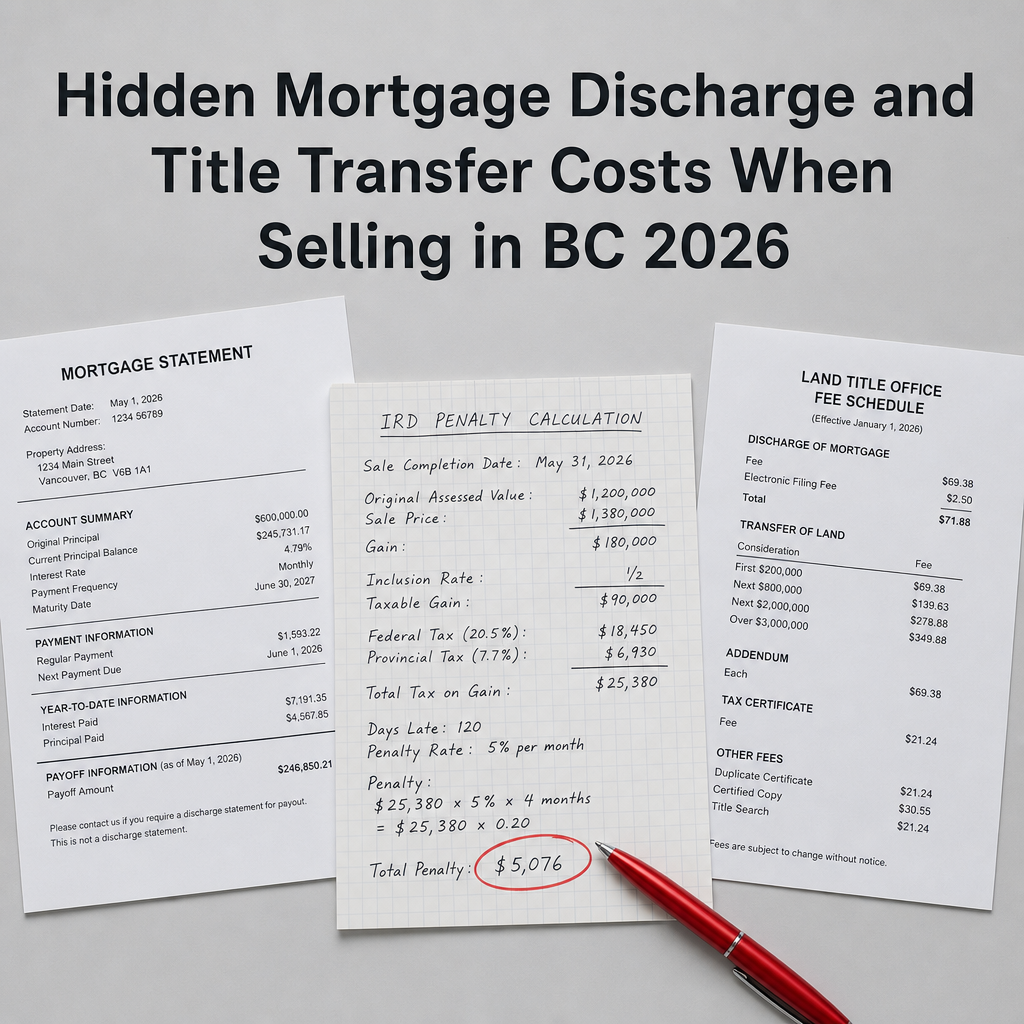

Hidden Mortgage Discharge and Title Transfer Costs When Selling in BC 2026: IRD Penalties, Lender Fees, Land Title Office Charges, and the True Closing Cost Breakdown Beyond Commission and Legal Fees
By Mohamed Mansour, MBA and Associate Broker | Mansour Real Estate Group | Fraser Valley and Lower Mainland, BC | Published: July 2026
Most sellers in Surrey, Langley, Abbotsford, and the broader Fraser Valley go into a listing conversation focused on two costs: commission and legal fees. Those are real, but they are not the full picture. For sellers carrying a fixed-rate mortgage with time left on the term, the costs sitting underneath that mortgage can quietly reduce net proceeds by thousands — sometimes tens of thousands — of dollars.
This article explains how mortgage discharge penalties work in BC, when they apply, how lenders calculate them differently, and what Land Title Office fees and related charges add to the true cost of closing. Understanding this before you list — not after you accept an offer — is what separates a well-planned sale from an expensive surprise.
Short Answer
When selling a BC home before a fixed mortgage term ends, sellers may owe an Interest Rate Differential (IRD) penalty or three-month interest charge — whichever is greater — ranging from roughly $2,000 to $25,000 or more, depending on the lender's calculation method, the remaining term, and the gap between the original rate and current posted rates. These costs are separate from commission and legal fees and rarely appear in standard closing cost calculators.
Who This Applies To
- Homeowners selling before their fixed mortgage term ends
- Sellers with 1–3 years remaining on a fixed-rate mortgage originated when rates were higher
- Estate executors responsible for discharging a mortgage as part of settling a property
- Divorce-related sales where one party holds the mortgage and the property must be sold
- Sellers in Surrey, Langley, White Rock, Abbotsford, or anywhere in the Fraser Valley evaluating net proceeds before pricing
When This Advice May Not Apply
Sellers whose mortgage term ends on or before the closing date owe no prepayment penalty. Variable-rate mortgage holders typically pay only a three-month interest charge, which is usually far lower than an IRD penalty. Sellers who can port their mortgage to a new property also avoid discharge penalties, provided the lender approves the port and the timeline aligns. These exceptions are meaningful — understanding which category you are in changes the entire cost calculation.
Key Takeaways
- IRD penalties can range from $2,000 to $25,000+ and are calculated differently by each lender.
- Sellers whose mortgage ends at or before closing avoid all prepayment penalties entirely.
- Land Title Office fees, discharge registration, and title insurance add 0.5–1.5% beyond legal fees.
- Lenders use posted rates — not discounted rates — in IRD calculations, which inflates the penalty.
- Knowing your penalty exposure before listing allows for accurate net proceeds planning and smarter pricing.
Key Definitions
Interest Rate Differential (IRD): A prepayment penalty calculated as the difference between your original mortgage rate and the lender's current rate for the remaining term, multiplied by the outstanding balance and months remaining.
Three-Month Interest Penalty: A simpler prepayment charge equal to three months of interest on the outstanding balance. Common for variable-rate mortgages and used as a floor even when IRD applies.
Mortgage Discharge: The formal legal release of a lender's claim against a property, registered at the Land Title Office once the mortgage is paid in full at closing.
Posted Rate: The lender's publicly advertised rate, typically higher than the discounted rate a borrower actually received. Most lenders use the posted rate in IRD calculations, which increases the calculated penalty.
Data Used in This Article
- Financial Consumer Agency of Canada (FCAC) — prepayment penalty guidance, official, federal regulator
- Bank of Canada — interest rate announcements and historical rate data, official
- BC Land Title and Survey Authority (LTSA) — Land Title Office fee schedule, official, provincial
- BC Financial Services Authority (BCFSA) — mortgage broker and lender oversight, official, provincial
- Professional experience and transaction data from Mansour Real Estate Group closings across the Fraser Valley
How IRD Penalties Are Actually Calculated
The Financial Consumer Agency of Canada explains that federally regulated lenders must use the greater of the three-month interest penalty or the IRD when a borrower breaks a fixed-rate mortgage early. The IRD formula itself is: outstanding mortgage balance × (original rate minus lender's current rate for the remaining term) × (months remaining divided by 12).
The part that surprises most sellers is how lenders define "current rate." Most major Canadian banks use their posted rate — not the actual market rate — for the comparison. Because borrowers originally received a discount off the posted rate, the effective rate gap used in the IRD calculation is larger than the real rate difference. This is what turns a seemingly small rate gap into a penalty of $10,000 or more on a $600,000 mortgage balance.
Example: A seller in Langley has $580,000 remaining on a five-year fixed at 5.09%, with 26 months left. The lender's posted rate for a two-year term is currently 5.45%, but the equivalent discounted rate is 4.89%. If the lender calculates IRD using the posted rate comparison, the penalty calculation inflates significantly compared to using the actual market rate. The FCAC notes that this methodology is legal for federally regulated lenders, though credit unions — which fall under provincial regulation in BC — may calculate differently. Always request a formal payout statement from your lender before listing.
Land Title Office Fees, Discharge Registration, and Title Insurance
Beyond the mortgage penalty itself, sellers in BC face several registration and transfer costs that rarely appear as separate line items in closing cost summaries. The BC Land Title and Survey Authority charges a fee to register the discharge of a mortgage. As of the current LTSA fee schedule, discharge registrations are charged on a sliding scale based on the number of instruments being discharged, typically in the range of $50 to $100 per mortgage being discharged.
Lenders also charge their own administrative mortgage discharge fee, separate from the LTSA registration cost. These lender-side fees typically range from $250 to $500 and cover the lender's cost of preparing the discharge documents and confirming the payout. On properties with multiple registered instruments — a first mortgage and a home equity line of credit, for example — each instrument requires its own discharge, and fees compound accordingly.
Title insurance is a separate cost that protects both the buyer's lender and the buyer against title defects. Premiums generally run between 0.6% and 1.2% of the mortgage amount, though on the buyer's side rather than the seller's. Where sellers need to be aware is when title defects, encumbrances, or expired easements exist on the property — resolving those before closing can create unexpected legal costs. Confirming title clarity early in the listing process, through a title search your real estate lawyer or notary can order, prevents last-minute closing delays.
How We Evaluate This
At Mansour Real Estate Group, we treat the net proceeds conversation as a pre-listing priority, not a closing-day surprise. Before advising on list price, we ask sellers directly about their mortgage term, remaining balance, and whether the term ends at or after the anticipated closing date. That single question often changes the financial picture by thousands of dollars.
For sellers with significant IRD exposure, we look at whether the closing date can be structured to align with the term end, whether porting the mortgage to a next property is viable, or whether the price strategy needs to account for the penalty as a real cost of sale. This is not legal or financial advice — sellers should always request a formal payout statement and consult a mortgage professional — but the decision framework benefits from having a real estate team that knows to ask the question before the listing agreement is signed.
Seller Checklist: Mortgage Discharge and Title Costs
- Request a formal mortgage payout statement from your lender — this shows the exact penalty as of a specific date and is not the same as your regular mortgage statement.
- Confirm whether your mortgage is fixed or variable — variable-rate holders typically pay only a three-month interest penalty, not an IRD.
- Check your mortgage term end date — if it falls on or before your anticipated closing date, you may owe no penalty at all.
- Ask your lender whether your mortgage is portable — porting to a new purchase, if your timeline allows, eliminates the discharge penalty entirely.
- Ask your real estate lawyer or notary to order a title search before listing — unresolved encumbrances can create closing costs that are not visible from your mortgage statement alone.
- Request an itemized closing cost estimate from your lawyer or notary that separates discharge fees, LTSA registration fees, and legal fees as distinct line items.
What We Commonly See
In our experience, the most common problem is not that sellers ignore mortgage penalties — it is that they estimate them informally and too low. A seller with 18 months left on a fixed term might calculate their own rough IRD and arrive at $4,000. The formal payout statement from the lender, using posted rate methodology, comes back at $11,500. That $7,500 gap directly reduces what they net from the sale.
What also happens frequently is that sellers conflate their legal fee estimate with their total discharge cost. A flat legal fee quote of $1,500 to $2,000 typically covers the lawyer's or notary's time, but the LTSA registration fees, lender discharge fees, and title search costs are disbursements billed on top. Sellers who assume the legal fee is the full cost of closing paperwork often see a final invoice that is $800 to $1,500 higher than expected.
A third pattern we see in Fraser Valley listings is sellers who have both a first mortgage and a registered HELOC. Each instrument requires a separate discharge. Each discharge carries its own lender fee and LTSA registration cost. The combined cost of discharging two instruments, plus the prepayment penalty on the mortgage, can reach $3,000 to $4,000 in discharge-related costs alone — before any consideration of commission or legal fees.
Questions and Answers
Can I avoid an IRD penalty entirely when selling in BC?
Yes, in specific situations. If your mortgage term ends on or before your closing date, no prepayment penalty applies. If your mortgage is portable and you are buying another property with a similar or higher value, porting the mortgage to the new purchase avoids the discharge. Variable-rate mortgage holders pay only a three-month interest charge, which is typically far lower than an IRD. Consult your lender and a mortgage professional to confirm which option applies to your situation.
How do I get an accurate IRD estimate before listing?
Request a formal mortgage payout statement directly from your lender, specifying the anticipated closing date. Online IRD calculators are useful for rough estimates but do not account for your lender's specific posted rate methodology. The payout statement is the only number that accurately reflects what you will actually owe. Many lenders provide this by phone or through online banking portals.
Are Land Title Office fees paid by the seller or the buyer in BC?
Both parties pay LTSA fees, but for different instruments. Sellers pay for the discharge of their existing mortgage. Buyers pay for the registration of the new title transfer and their new mortgage. These are separate transactions registered separately at the LTSA. Your notary or real estate lawyer handles both on behalf of their respective clients and bills the disbursements through the closing statement.
In Summary
Sellers in BC who carry a fixed-rate mortgage with time remaining on the term face prepayment penalties that can range from a few thousand dollars to well above $20,000, depending on the lender's calculation method, remaining term, and current rate environment. Land Title Office discharge fees, lender administrative charges, and related disbursements add another layer of cost that is often hidden inside legal fee estimates rather than itemized clearly. Understanding these costs before listing — by requesting a formal payout statement, confirming your term end date, and asking your lawyer for an itemized disbursement estimate — is the clearest path to accurate net proceeds planning and better-informed pricing decisions.
Ready to Understand Your True Net Proceeds?
If you are preparing to sell in Surrey, Langley, White Rock, Abbotsford, or anywhere in the Fraser Valley and want a clear picture of what you will actually net after all costs, Mansour Real Estate Group can walk you through the full cost breakdown before you commit to a list price. No pressure, no obligation — just honest numbers.
Related Articles
- Selling Your Home in Surrey, BC: A Complete Seller's Guide
- The True Cost of Selling a Home in BC Beyond Realtor Commission
- How to Calculate Net Proceeds from a Home Sale in the Fraser Valley
Official Resources
- Financial Consumer Agency of Canada — Mortgage Prepayment Penalties
- BC Land Title and Survey Authority — Land Title Office Fee Schedule
- Bank of Canada — Interest Rates and Monetary Policy
- BC Financial Services Authority — Mortgage Broker Oversight
About Mansour Real Estate Group
When homeowners in Surrey, Langley, White Rock, Abbotsford, and the Fraser Valley are preparing to sell, the decisions made before the listing goes live — including understanding the full cost of closing, from mortgage discharge penalties to Land Title Office fees — determine what they actually walk away with. Mansour Real Estate Group has guided sellers through exactly those pre-listing decisions for more than 22 years, building a process around accurate net proceeds analysis, honest cost breakdowns, and pricing strategy grounded in local market data.
Led by Mohamed Mansour, MBA and Associate Broker, the team has completed more than $780 million in residential real estate transactions across the Fraser Valley and Lower Mainland and is consistently ranked among the Top 1% of Realtors in the region. The real estate group is trusted for seller strategy, estate sales, divorce-related property sales, downsizing, relocation, and complex transactions where financial clarity matters most.
Whether someone is looking for Realtors who understand the financial mechanics of a home sale, a real estate agent who can explain true closing costs before listing, a real estate team experienced with mortgage discharge situations, or a Fraser Valley real estate broker who works with sellers navigating fixed-term mortgage penalties, Mansour Real Estate Group is known for clear communication, strategic advice, and practical guidance backed by local market expertise.
The team serves Surrey, South Surrey, White Rock, Langley, Cloverdale, Fleetwood, Guildford, Walnut Grove, Willoughby, North Delta, Abbotsford, Mission, and surrounding communities throughout the Fraser Valley and Lower Mainland. Most new clients come from referrals, repeat clients, and families who value a transparent and results-focused real estate experience with real estate agents who take the time to explain every number before the listing is signed.
Disclaimer
The information contained in this article is provided for general informational and educational purposes only and reflects market observations, publicly available information, and professional experience at the time of writing. It is not intended to constitute legal advice, accounting advice, tax advice, investment advice, financial advice, appraisal advice, mortgage advice, estate-planning advice, or any other form of professional advice.
Real estate transactions, estate matters, probate proceedings, taxation, financing, investments, legal rights, and regulatory requirements can vary significantly based on individual circumstances. Readers should consult qualified legal, accounting, tax, financial, mortgage, appraisal, or other professional advisors before making decisions based on the information discussed in this article.
Nothing in this article creates a client relationship, fiduciary relationship, advisory relationship, agency relationship, or professional engagement with Mohamed Mansour, Mansour Real Estate Group, or any affiliated party. Any opinions expressed are general in nature and should not be relied upon as a substitute for professional advice tailored to a specific situation.
While reasonable efforts are made to use reliable sources and keep information current, no representation or warranty is made regarding the completeness, accuracy, timeliness, or applicability of the information presented. Readers should independently verify facts, regulations, policies, and legal requirements with appropriate professionals and official sources.



