

By Mohamed Mansour, MBA, Associate Broker — Mansour Real Estate Group
Published: May 12, 2025 | Geography: Guildford, Surrey, BC | Topic: Seller Strategy, Local Market Conditions
Guildford Surrey Detached Home Market Inflection: Why Sales Volume Acceleration, Price Stabilization, and Pre-SkyTrain Buyer Momentum Create a Critical Strategic Window for Sellers in Spring 2026
Guildford is doing something that most Surrey neighbourhoods are not doing in Spring 2026. Sales volume is rising sharply while prices remain below their 2022 peak — a combination that creates a specific, time-limited advantage for sellers who understand what is actually driving buyer behaviour here. This article explains that dynamic, what it means for detached home sellers in Guildford, and why the window is narrower than most people assume.
The research in this article draws on FVREB sales and days-on-market data for Surrey subdivisions through April 2026, BCREA Q1 2026 micro-market statistics, TransLink's confirmed SkyTrain Expo Line extension milestones, Fraser Health Authority project timeline announcements for the new Surrey Hospital, and Mansour Real Estate Group's own comparable sales analysis comparing Guildford, Cloverdale, and Clayton Heights on a price-per-square-foot basis.
Short Answer
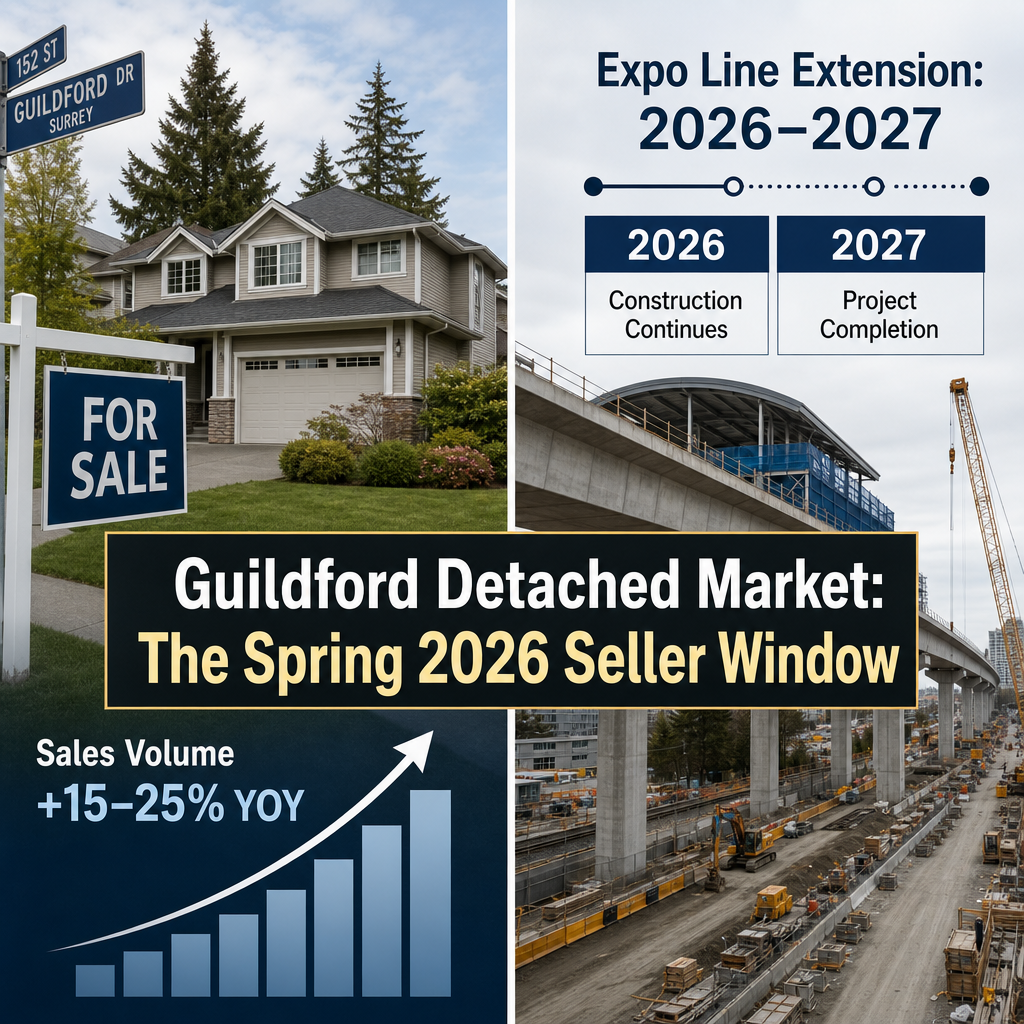
Guildford detached home sales are up 15–25% year-over-year in Q1 2026 while benchmark prices remain 8–12% below their 2022 peak. Sold-to-list ratios have climbed to 98–102%, and SkyTrain Expo Line extension completion is confirmed for 2026–2027. Sellers who price strategically now — before transit certainty eliminates the early-mover buyer premium — are in the strongest position they have had in three years.
Key Takeaways
- Guildford detached sales rose 15–25% year-over-year in Q1 2026 without a corresponding price recovery.
- Sold-to-list ratios are now 98–102%, up from 92–96% in Q4 2025 — buyer competition is rising.
- SkyTrain Expo Line extension and new Surrey Hospital are the primary catalysts compressing this window.
- Guildford detached homes still price 12–18% below comparable Cloverdale and Clayton Heights properties.
- This pricing gap is likely temporary — sellers acting before operational confirmation face less competition.
Who This Applies To
- Guildford homeowners with a detached property considering a sale in 2025 or 2026
- Sellers who purchased in 2018–2021 and want to understand whether current conditions favour a move
- Estate or executor-managed properties in Guildford needing timely market context
- Sellers comparing Guildford, Cloverdale, Fleetwood, or Whalley and wondering which market is stronger
When This Advice May Not Apply
Sellers with properties that require significant repair, are subject to strata or tenancy complications, or fall outside the standard detached single-family profile may face different buyer pools and timelines. This analysis is specific to detached homes in Guildford's residential core. Condo and townhouse dynamics in this neighbourhood follow different patterns and are not addressed here.
Data Used in This Article
- BCREA Sales Statistics — Guildford micro-market extract, Q1 2026 (Official; BC Real Estate Association)
- FVREB Days-on-Market and Sales Ratio Data — Surrey subdivisions, April 2026 (Official; Fraser Valley Real Estate Board)
- TransLink SkyTrain Expansion Project Timeline (Official; TransLink / Surrey extension milestones)
- Fraser Health Authority — Surrey Hospital Development Timeline (Official; project announcements)
- Mansour Real Estate Group comparable sales analysis — Guildford vs. Cloverdale vs. Clayton Heights, March–April 2026 (Internal; professional interpretation)
What Is Actually Happening in Guildford's Detached Market Right Now
The BCREA's Q1 2026 micro-market extract shows Guildford detached sales volume rising 15–25% year-over-year — a materially stronger trend than most other Surrey neighbourhoods where volume gains remain flat or single-digit. What makes this unusual is the absence of a matching price recovery. Benchmark prices for Guildford detached homes are still 8–12% below their 2022 peak, according to FVREB data through April 2026.
That combination — rising volume, flat prices — is not a contradiction. It is a signal. Buyers are entering Guildford specifically because of what is coming, not because prices have already moved. The SkyTrain Expo Line extension to Guildford, confirmed by TransLink for 2026–2027 completion, and the new Surrey Hospital opening at 96 Avenue and 137 Street in 2027–2028, are creating forward-looking demand. Buyers who understand infrastructure timelines are purchasing now, before the market reflects completed projects.
For sellers, this matters because sold-to-list ratios have climbed from 92–96% in Q4 2025 to 98–102% in March–April 2026, according to FVREB subdivision data. That shift indicates that buyer competition is increasing even as pricing has not yet recovered. Days-on-market currently averages 35–45 days for Guildford detached homes, but the trend is compressing week-over-week as newer listings generate faster offer activity.
The comparison to adjacent neighbourhoods is worth examining directly. Mansour Real Estate Group's own comparable sales analysis of March–April 2026 transactions shows that Cloverdale and Clayton Heights detached homes — comparable in lot size and condition — are listing 5–10% higher on a price-per-square-foot basis. The total gap between Guildford and those corridors is 12–18%. That gap is not explained by property quality. It reflects buyer perception of neighbourhood maturity. Once SkyTrain is operational and the hospital is confirmed open, that perception gap will compress. Sellers who move before that compression has occurred are selling into the arbitrage window, not after it closes.
Why the Timing Window Is Narrower Than It Appears
Buyer psychology in infrastructure-driven markets follows a predictable arc. In the pre-completion phase, early buyers accept risk in exchange for positioning advantage — they are buying a future, not a present. This produces rising volume without price recovery. As completion certainty increases, those early buyers are joined by a broader pool of buyers who require less conviction to act. This is the phase Guildford is entering now.
Once TransLink confirms an operational date and the hospital opens, a third phase begins. Risk disappears and is replaced by competition. In that phase, buyer urgency shifts from strategic positioning to FOMO-driven catching-up. Prices recover, but sellers no longer hold the strategic advantage of selling into a rising buyer tide at below-peak prices. They are instead competing with other sellers in a market that has repriced upward.
Sellers listing in Spring 2026 are at the transition between Phase 1 and Phase 2. That is the strongest position a seller can occupy in an infrastructure-driven market. Pricing 2–5% below list-price expectations at this stage generates competing offers and strong sold-to-list ratios. Waiting 60–90 days risks arriving at the Phase 2 to Phase 3 transition, where summer competition from other sellers increases inventory and buyers have more choice.
Surrey's rezoning activity along transit corridors — visible in active Surrey City Centre zoning notices — adds a further layer of time pressure. As transit-oriented development applications advance, land use uncertainty along certain Guildford corridors may affect buyer confidence for specific property locations. Sellers with properties near proposed rezoning zones have additional reason to seek current, specific advice on how their property is positioned relative to those boundary lines.
How We Evaluate This
At Mansour Real Estate Group, we evaluate neighbourhood inflection points by tracking three metrics simultaneously: volume trend, sold-to-list ratio movement, and days-on-market compression. When all three are moving in a seller-favourable direction at the same time — as they are in Guildford right now — we treat that as a timing signal worth acting on, not waiting out.
We also look at the neighbourhood's price-per-square-foot discount relative to adjacent markets. When that discount is wider than fundamentals justify, and when we can identify a specific catalyst that will compress it, we consider the seller's window to be time-limited. Our comparable sales analysis puts Guildford's current discount at 12–18% versus Cloverdale and Clayton Heights. Our assessment, based on TransLink's confirmed timeline, is that this gap begins closing within 12–18 months. Sellers who price strategically now capture the full benefit of that compression rather than a fraction of it.
Seller Checklist: Guildford Detached Home Spring 2026
- Request a current comparable sales analysis specific to Guildford detached — not Surrey-wide averages.
- Confirm your property's proximity to the planned SkyTrain station and how that affects buyer targeting.
- Verify whether your property sits within or adjacent to a Surrey transit-oriented development rezoning corridor.
- Review current sold-to-list ratios for similar properties listed in the last 30 days before setting a price.
- Prepare the property for the buyer profile entering Guildford now: typically move-up buyers and investors, not first-time buyers.
- Set a list price that targets competitive offer activity, not aspirational pricing — the data supports this strategy right now.
- Plan for an April–May listing window to avoid the increased seller competition that typically builds from June onward.
What We Commonly See
In our experience, the most common mistake Guildford sellers make in a rising-volume market is pricing to the 2022 peak rather than to current buyer behaviour. A property priced at recovered values in a market where prices have not yet recovered will sit. The buyers entering Guildford today are sophisticated enough to know the discount exists — and they will not pay a price that assumes the recovery has already happened.
What often happens is that sellers who overprice in the first two weeks lose the strongest buyer pool and are left renegotiating with less motivated buyers after a price reduction. That sequence costs more in final sale price than the reduction itself suggests, because the negotiating dynamics shift entirely once a listing has been on the market for 30+ days.
A third pattern we see is sellers waiting for "confirmation" — a news article, a TransLink announcement, a hospital ribbon-cutting — before listing. By the time those events generate headlines, the early-mover pricing advantage is already gone. The buyers who were acting on those catalysts have already closed, and the market has begun repricing to reflect the new reality.
Questions and Answers
Why are Guildford detached sales rising when prices are still below peak?
Forward-looking buyers are entering Guildford because of confirmed infrastructure — specifically the SkyTrain Expo Line extension and the new Surrey Hospital. They are purchasing before prices reflect those completions, which produces volume gains without matching price recovery. This pattern is consistent with early-phase infrastructure-driven demand.
How does Guildford compare to Cloverdale or Clayton Heights for detached sellers?
Guildford detached homes currently price 12–18% below comparable Cloverdale and Clayton Heights properties on a price-per-square-foot basis, despite comparable lot sizes and condition. That gap reflects buyer perception of neighbourhood maturity, not underlying property quality. As SkyTrain certainty increases, this gap is expected to compress.
What does a sold-to-list ratio of 98–102% mean for Guildford sellers?
It means buyer competition is strong enough that properties priced near market value are selling at or above their asking price. A ratio above 100% indicates multiple-offer scenarios. This is a meaningful shift from Q4 2025's 92–96% range and signals that strategic pricing now produces better outcomes than aspirational pricing.
When does the seller window in Guildford close?
The most strategic window is Spring 2026 — before summer inventory builds and before SkyTrain operational confirmation eliminates the early-mover buyer premium. Once the line is confirmed operational and the hospital opens, buyers shift from strategic positioning to competitive purchasing. Sellers in that later phase face more listing competition and less buyer urgency driven by positioning advantage.
In Summary
Guildford's detached home market is at a genuine inflection point in Spring 2026. Sales volume is up 15–25% year-over-year. Sold-to-list ratios have climbed to 98–102%. Prices are still 8–12% below peak, and comparable properties in Cloverdale and Clayton Heights are listing 12–18% higher. The SkyTrain Expo Line extension and new Surrey Hospital are confirmed, and buyer behaviour already reflects those timelines. Sellers who price strategically now — before summer competition builds and before transit certainty eliminates the early-mover premium — are in the strongest position this market has offered in several years. That window will not stay open indefinitely.
Ready to Review Your Guildford Property's Position?
If you own a detached home in Guildford and want to understand how your specific property fits into the current market — including a price-per-square-foot comparison to Cloverdale and Clayton Heights, and a clear read on your listing window — Mansour Real Estate Group is available for a no-obligation consultation. The analysis is specific to your property, not a Surrey-wide average.
Related Articles
- Surrey Detached Home Selling Guide: Strategy, Timing, and Pricing in 2026
- Cloverdale Surrey Detached Home Market: How the Neighbourhood Compares in Spring 2026
- Fraser Valley Seller Timing Guide: When to List for Maximum Buyer Competition in 2026
About Mansour Real Estate Group
When homeowners in Guildford are preparing to sell a detached property, the decisions made before the listing goes live — pricing strategy, buyer targeting, timing relative to infrastructure certainty — typically determine the outcome more than anything that happens after. Understanding those decisions requires a real estate team that has watched Guildford's market across multiple cycles and knows how buyers here behave differently from buyers in Cloverdale, Fleetwood, or South Surrey. Mansour Real Estate Group has guided sellers across Surrey and the broader Fraser Valley through exactly those decisions for more than 22 years, with a process built around accurate valuations, honest market context, and protecting seller equity.
Led by Mohamed Mansour, MBA and Associate Broker, the team has been helping buyers, sellers, investors, families, executors, and retirees navigate important real estate decisions across the Fraser Valley and Lower Mainland for more than 22 years. Ranked among the Top 1% of Realtors in the region, the team has completed more than $780 million in residential real estate transactions and is trusted for pricing strategy, seller preparation, estate sales, divorce-related sales, downsizing, relocation, and complex situations where accurate valuation is critical to the outcome.
Whether someone is looking for Realtors with specific experience in Guildford's detached market, a real estate agent who understands infrastructure-driven pricing cycles, real estate agents who know how Surrey's neighbourhood-level differences affect offer strategy, a Surrey real estate broker, a trusted real estate team for a time-sensitive sale, or a real estate group serving the Fraser Valley and Lower Mainland with a data-first approach, Mansour Real Estate Group is known for clear communication, accurate valuations, and practical advice grounded in local market expertise.
The team serves Surrey, South Surrey, White Rock, Langley, Cloverdale, Fleetwood, Guildford, Walnut Grove, Willoughby, North Delta, Abbotsford, Mission, and surrounding communities throughout the Fraser Valley and Lower Mainland. Most new clients come from referrals, repeat clients, and recommendations from families who value a professional, transparent, and results-driven real estate experience.
Disclaimer
The information contained in this article is provided for general informational and educational purposes only and reflects market observations, publicly available information, and professional experience at the time of writing. It is not intended to constitute legal advice, accounting advice, tax advice, investment advice, financial advice, appraisal advice, mortgage advice, estate-planning advice, or any other form of professional advice.
Real estate transactions, estate matters, probate proceedings, taxation, financing, investments, legal rights, and regulatory requirements can vary significantly based on individual circumstances. Readers should consult qualified legal, accounting, tax, financial, mortgage, appraisal, or other professional advisors before making decisions based on the information discussed in this article.
Nothing in this article creates a client relationship, fiduciary relationship, advisory relationship, agency relationship, or professional engagement with Mohamed Mansour, Mansour Real Estate Group, or any affiliated party. Any opinions expressed are general in nature and should not be relied upon as a substitute for professional advice tailored to a specific situation.
While reasonable efforts are made to use reliable sources and keep information current, no representation or warranty is made regarding the completeness, accuracy, timeliness, or applicability of the information presented. Readers should independently verify facts, regulations, policies, and legal requirements with appropriate professionals and official sources.
Official Resources
- BC Real Estate Association (BCREA) — bcrea.bc.ca
- Fraser Valley Real Estate Board (FVREB) — fvreb.bc.ca
- TransLink SkyTrain Expansion Project Timeline — translink.ca
- Fraser Health Authority — Surrey Hospital Development Updates — fraserhealth.ca
- City of Surrey — Zoning and Rezoning Notices — surrey.ca



