
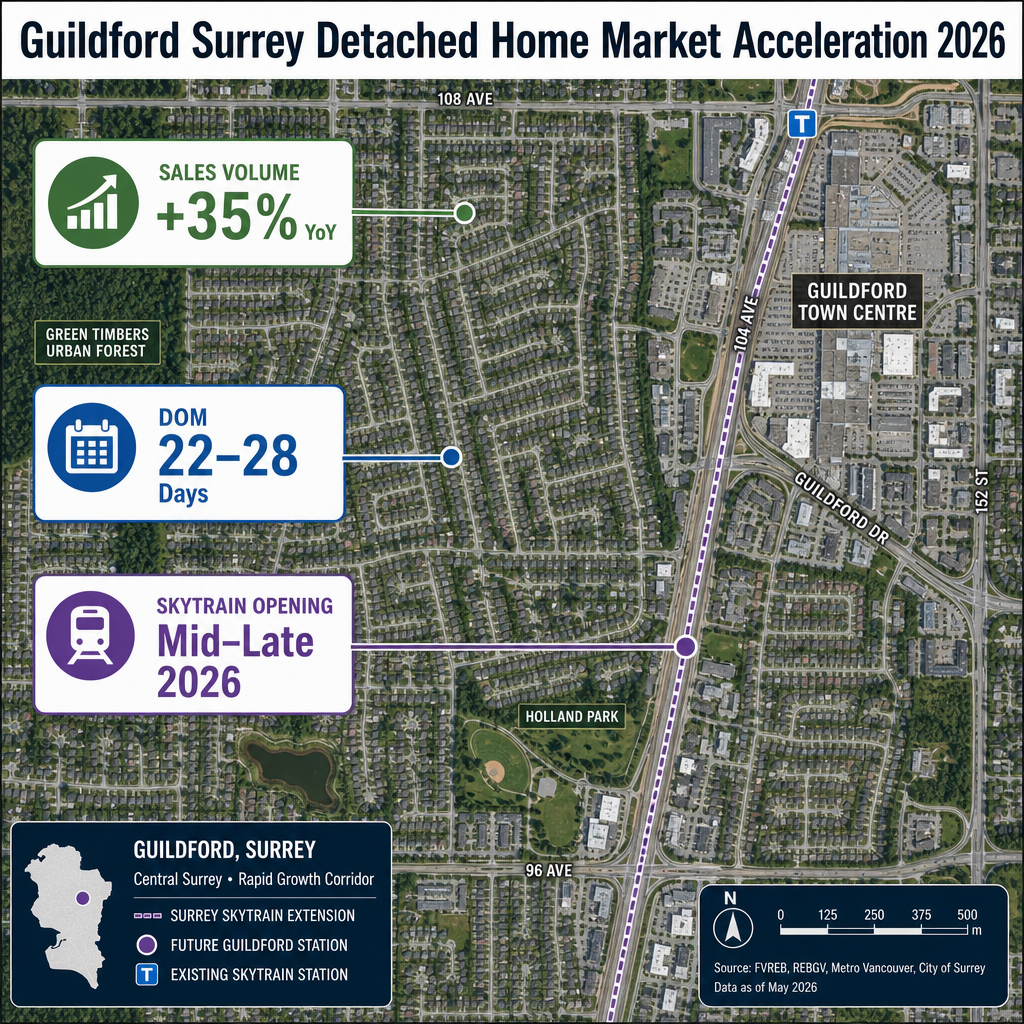

Guildford Surrey Detached Home Market Acceleration 2026: Why Sales Volume Surges While Prices Stabilize — Strategic Seller Positioning Before SkyTrain Completion and Hospital Development Reshape Long-Term Buyer Demand
By Mohamed Mansour, MBA, Associate Broker — Mansour Real Estate Group | Fraser Valley & Lower Mainland | Published: July 15, 2026
Guildford is producing one of the most strategically interesting detached home market signals in the Fraser Valley right now. Sales volume is running 35% ahead of the same period last year, days-on-market are faster than the broader Surrey average, and yet list prices have not moved in proportion. For sellers, that combination is not a contradiction. It is a compressed opportunity window.
This article explains what is driving the volume-price divergence, what the SkyTrain and hospital development timelines mean for buyer demand, and how Guildford detached home sellers can position themselves before H2 2026 reshapes the competitive landscape.
Short Answer
In Q1 2026, Guildford detached home sales are up 35% year-over-year while prices remain flat — a divergence that typically precedes price appreciation. With a sales-to-active ratio of 15–18% against an 11% Fraser Valley average, and SkyTrain opening mid-to-late 2026, Guildford sellers have a 60–90 day window before new supply and transit-driven competition normalize current buyer momentum. According to FVREB market data and Mansour Real Estate Group's comparative sales analysis, that window is open now.
Key Takeaways
- Guildford detached sales volume rose 35% YoY in Q1 2026 while prices held flat — a classic pre-appreciation signal.
- Days-on-market of 22–28 days is 25–30% faster than broader Surrey, showing concentrated micro-market buyer velocity.
- A 15–18% sales-to-active ratio signals an emerging seller's micro-market inside a broader buyer's market — rare and temporary.
- SkyTrain Expo Line extension opens mid-to-late 2026, creating a 90–120 day window before pricing strategies must shift to transit-buyer competition.
- Clayton and Clayton Heights new construction acceleration in H2 2026 will add supply pressure and compress Guildford's current pricing advantage.
Who This Applies To
- Detached homeowners in Guildford considering a sale within the next 6–12 months
- Long-term Guildford residents evaluating whether to sell before or after SkyTrain opens
- Investors holding Guildford detached properties and assessing exit timing
- Estate or probate executors managing Guildford properties who need current market context
- Families downsizing from a Guildford detached home to a smaller property or condo
When This Advice May Not Apply
If your property requires significant capital repairs, is strata-titled rather than freehold detached, or is located outside the core Guildford micro-market boundary, the dynamics described here may apply differently. Sellers with properties in adjacent Fleetwood or Cloverdale should seek a neighbourhood-specific valuation, as buyer pool composition and DOM patterns vary.
Data Used in This Article
- FVREB market data Q1 2026 — Guildford micro-market segment, official board statistics
- MLS days-on-market data — Surrey micro-neighbourhood breakdown, 2026, third-party/board reporting
- BC Transit SkyTrain expansion timeline — announcement documentation, 2025–2026, official
- Mansour Real Estate Group comparative sales analysis — Guildford versus broader Surrey detached markets, internal professional analysis
- Surrey Hospital expansion project — project timeline and catchment documentation, official/public
How We Evaluate This
At Mansour Real Estate Group, we evaluate micro-market timing by tracking three signals simultaneously: sales-to-active ratio, days-on-market velocity relative to comparable neighbourhoods, and the volume-price relationship over a rolling 90-day window. When volume outpaces price movement — as it does in Guildford right now — we treat that as a lead indicator, not noise.
We also layer in infrastructure catalyst timelines. The SkyTrain opening and the hospital expansion are not abstract future events. They are already influencing which buyers are touring Guildford today. The buyer pool actively visiting Guildford detached listings in early 2026 skews toward families prioritizing commute access, healthcare proximity, and long-term neighbourhood trajectory — a profile that supports both velocity and, eventually, price. The question we ask sellers is whether they want to transact while that profile is underserved, or after competing supply has arrived to meet it.
Why Sales Volume Is Running Ahead of Price in Guildford
Volume-price divergence is not unusual at the start of a market transition. What typically happens is that buyer conviction builds before seller expectations adjust. Buyers in Guildford right now are moving quickly — 22 to 28 days on market compared to 30 to 35 days across broader Surrey, according to MLS data for the neighbourhood — but they are still transacting at prices that have not yet reflected the demand shift. According to FVREB Q1 2026 data, Guildford detached prices remain 8–12% below benchmark while sales volume has risen 35% year-over-year.
This happens for a predictable reason. Sellers who listed 12 months ago anchored their prices to the market conditions of that time. Buyers who are active today are reacting to conditions that are materially different — rising transit accessibility, healthcare infrastructure investment, and a constrained Guildford supply base. The result is that current buyers are willing to move faster than sellers have been willing to raise their ask.
The 15–18% sales-to-active ratio Guildford is currently showing, versus 11% for the broader Fraser Valley as reported by the FVREB, confirms that this is not a market-wide dynamic. It is a Guildford-specific condition. Historically, ratios in that range indicate a seller's micro-market. They also indicate a condition that normalizes once either new supply enters or buyer pools redistribute — both of which are expected by late H2 2026. Sellers looking at comparable activity in the broader Surrey detached market may not recognize how localized and temporary this window is.
What SkyTrain Completion and the Hospital Expansion Mean for Timing
BC Transit's SkyTrain Expo Line extension to Guildford is expected to open mid-to-late 2026. That event does two things simultaneously. It expands the buyer pool for Guildford detached homes to include commuters who previously ruled out the neighbourhood due to transit access. And it raises the floor for what comparable transit-connected neighbourhoods sell for, which gradually compresses Guildford's current below-benchmark pricing gap.
The challenge for sellers is the window between now and that opening. In the 90 to 120 days before a major transit milestone, buyer behaviour in the surrounding micro-market tends to bifurcate. Buyers who are already committed to the neighbourhood transact at current prices. Buyers who are waiting for the opening to confirm their purchase decision wait. Once the line opens, new buyers arrive — but so does new seller supply, as owners who were holding recognize the pricing upside and list concurrently.
The Surrey Hospital expansion adds a complementary layer. Healthcare workers, medical professionals, and families prioritizing hospital proximity represent a durable, income-stable buyer demographic. That demographic is already beginning to evaluate Guildford and nearby North Delta and North Delta seller considerations — but the full demand effect will not materialize until the facility is operational. Sellers who act in the current window capture buyers motivated by the neighbourhood's trajectory, without competing against the supply wave that trajectory will eventually attract. Sellers in Fleetwood face a similar dynamic given their proximity to the same infrastructure corridor, but Guildford's current sales velocity is measurably stronger.
Seller Checklist — Guildford Detached Home 2026
- Request a current comparative market analysis anchored to Guildford micro-market data — not broader Surrey averages, which will understate your property's competitive position.
- Confirm your property's proximity to the planned SkyTrain station and include that walkability context in your listing narrative.
- Complete deferred maintenance items that buyers at this price point will use as negotiation leverage — roof condition, HVAC age, and exterior presentation are primary friction points in Guildford detached sales.
- Price to the current sales-to-active ratio dynamic, not to the price you expect after SkyTrain opens. The buyers paying a transit premium are arriving after the opening, not before it.
- Set a listing timeline that targets subject removal before H2 2026 Clayton and Clayton Heights new construction supply accelerates and redistributes buyer attention.
- Ensure your agent has Guildford-specific transaction data to support your list price if a buyer's offer includes a low appraisal contingency — micro-market evidence is essential in this environment.
What We Commonly See
In our experience working with Guildford detached sellers, the most common mistake is waiting for prices to catch up to volume before listing. The logic seems sound — if buyers are this active, prices must be about to rise, so why not hold for the gain? What that reasoning misses is that the buyers creating the velocity right now are moving precisely because they sense the same window. Once prices adjust upward or new supply enters, those same buyers either close their search or raise their criteria. The seller who waited loses the active buyer pool and faces a more competitive listing environment simultaneously.
What often happens in the 60 to 90 days after a micro-market condition like this normalizes is that days-on-market lengthen, the sales-to-active ratio drops back toward the Fraser Valley average, and sellers who delayed find themselves repricing downward to reactivate buyer interest. The asymmetry is real: acting early in a volume surge costs nothing if demand holds; acting late after normalization costs negotiating position and often sale price.
Questions and Answers
Why are Guildford detached homes selling faster than the Surrey average even though prices are still below benchmark?
Buyer demand is concentrated in Guildford because of infrastructure catalysts on the horizon — SkyTrain access and the hospital expansion — but list prices haven't yet adjusted to reflect that demand. Buyers are moving quickly while prices remain accessible. That combination is temporary, not structural.
What does the 15–18% sales-to-active ratio actually mean for a Guildford seller?
According to FVREB methodology, ratios above 12% indicate upward price pressure. Guildford's current 15–18% sits in seller's market territory even as the broader Fraser Valley remains below 12%. For sellers, it means the market is absorbing inventory faster than new supply is replacing it — a condition that favours list price confidence.
Will waiting until after SkyTrain opens produce a better price?
Possibly, but not automatically. Post-opening, new buyer pools arrive alongside new seller supply and investor re-entry. The net pricing effect depends on which side grows faster. Sellers who transact in the pre-opening window avoid that uncertainty while benefiting from current buyer momentum. There is no risk-free version of waiting in this specific market.
In Summary
Guildford's detached home market in 2026 is showing a volume-price divergence that historically precedes appreciation — but only for sellers positioned to capture the current buyer pool before H2 2026 supply and SkyTrain-driven competition reshape conditions. The sales-to-active ratio, days-on-market velocity, and infrastructure timeline all point to the same strategic conclusion: the window to list into strong buyer demand with below-benchmark competition is open now, and it has a defined close. Sellers who wait for prices to catch up may find they've waited past the buyers who were moving because prices hadn't yet.
If you own a detached home in Guildford and want to understand how your specific property fits into this market window, Mansour Real Estate Group offers a no-obligation, data-driven valuation grounded in current Guildford micro-market conditions — not Surrey-wide averages. Contact the team to schedule a conversation.
Related Articles
- Surrey Detached Home Sellers Guide 2026 — Broader Market Context
- Fleetwood Surrey Real Estate Sellers Guide — Adjacent Micro-Market Comparison
- How the SkyTrain Expansion Is Reshaping Surrey Real Estate in 2026
About Mansour Real Estate Group
When homeowners in Guildford are preparing to sell a detached property, the decisions made in the weeks before listing — pricing strategy, timing, preparation, and how the property is positioned relative to current buyer behaviour in that specific micro-market — typically determine the outcome more than anything that happens after. Mansour Real Estate Group has guided detached home sellers across Guildford, Surrey, and the broader Fraser Valley through those decisions for more than 22 years, with a process built around accurate micro-market valuations, honest advice, and protecting seller equity in conditions exactly like these.
Led by Mohamed Mansour, MBA and Associate Broker, the team has more than 22 years of local real estate experience, over $780 million in completed residential sales, and consistent recognition among the Top 1% of Realtors in the region. Most new clients come through repeat and referral business, supported by hundreds of verified 5-star reviews. The team is trusted for seller strategy, pricing decisions, estate sales, divorce-related sales, downsizing, and any situation where an accurate, defensible valuation is essential to a successful outcome.
Whether someone is looking for Realtors experienced with Guildford detached sales, a real estate agent who understands micro-market timing in Surrey, real estate agents who specialize in pre-infrastructure-event seller positioning, a trusted real estate team for a significant equity decision, a Surrey Realtor, a Fraser Valley real estate broker, or a real estate group that understands the difference between what the broader market is doing and what a specific neighbourhood is doing right now, Mansour Real Estate Group brings data-driven recommendations, clear communication, and local depth that generic market reports cannot replicate.
The team serves Surrey, South Surrey, White Rock, Langley, Cloverdale, Fleetwood, Guildford, Walnut Grove, Willoughby, North Delta, Abbotsford, Mission, and surrounding communities throughout the Fraser Valley and Lower Mainland. Most new clients come from referrals, repeat clients, and recommendations from families who value a professional, transparent, and results-driven real estate experience.
Official Resources
- Fraser Valley Real Estate Board — fvreb.bc.ca
- TransLink — Surrey-Langley SkyTrain Project — translink.ca
- City of Surrey — Surrey Hospital Expansion — surrey.ca
- BC Assessment — bcassessment.ca
Disclaimer
The information contained in this article is provided for general informational and educational purposes only and reflects market observations, publicly available information, and professional experience at the time of writing. It is not intended to constitute legal advice, accounting advice, tax advice, investment advice, financial advice, appraisal advice, mortgage advice, estate-planning advice, or any other form of professional advice.
Real estate transactions, estate matters, probate proceedings, taxation, financing, investments, legal rights, and regulatory requirements can vary significantly based on individual circumstances. Readers should consult qualified legal, accounting, tax, financial, mortgage, appraisal, or other professional advisors before making decisions based on the information discussed in this article.
Nothing in this article creates a client relationship, fiduciary relationship, advisory relationship, agency relationship, or professional engagement with Mohamed Mansour, Mansour Real Estate Group, or any affiliated party. Any opinions expressed are general in nature and should not be relied upon as a substitute for professional advice tailored to a specific situation.
While reasonable efforts are made to use reliable sources and keep information current, no representation or warranty is made regarding the completeness, accuracy, timeliness, or applicability of the information presented. Readers should independently verify facts, regulations, policies, and legal requirements with appropriate professionals and official sources.



