

Guildford Surrey Detached Home Market Acceleration 2026: Why Pre-SkyTrain Buyer Momentum and Below-Benchmark Pricing Create a Critical Strategic Window for Sellers
By Mohamed Mansour, MBA and Associate Broker — Mansour Real Estate Group | Published: May 13, 2025 | Geography: Guildford, Surrey, Fraser Valley, BC | Scope: Detached home sellers, spring–summer 2026
Guildford's detached home market is moving differently from the rest of Surrey right now. While broader Surrey sits in balanced-to-buyer's-market territory, Guildford is experiencing a specific convergence — rising sales volume, a price correction that hasn't fully resolved, and approaching infrastructure that is already changing how buyers think about location value. For sellers, the question isn't whether to sell. It's whether to sell before this window closes.
This article explains the mechanics driving Guildford's acceleration, the psychology of pre-infrastructure buyer behaviour, and what the data means for sellers making pricing and timing decisions in the next 60 to 90 days.
Short Answer
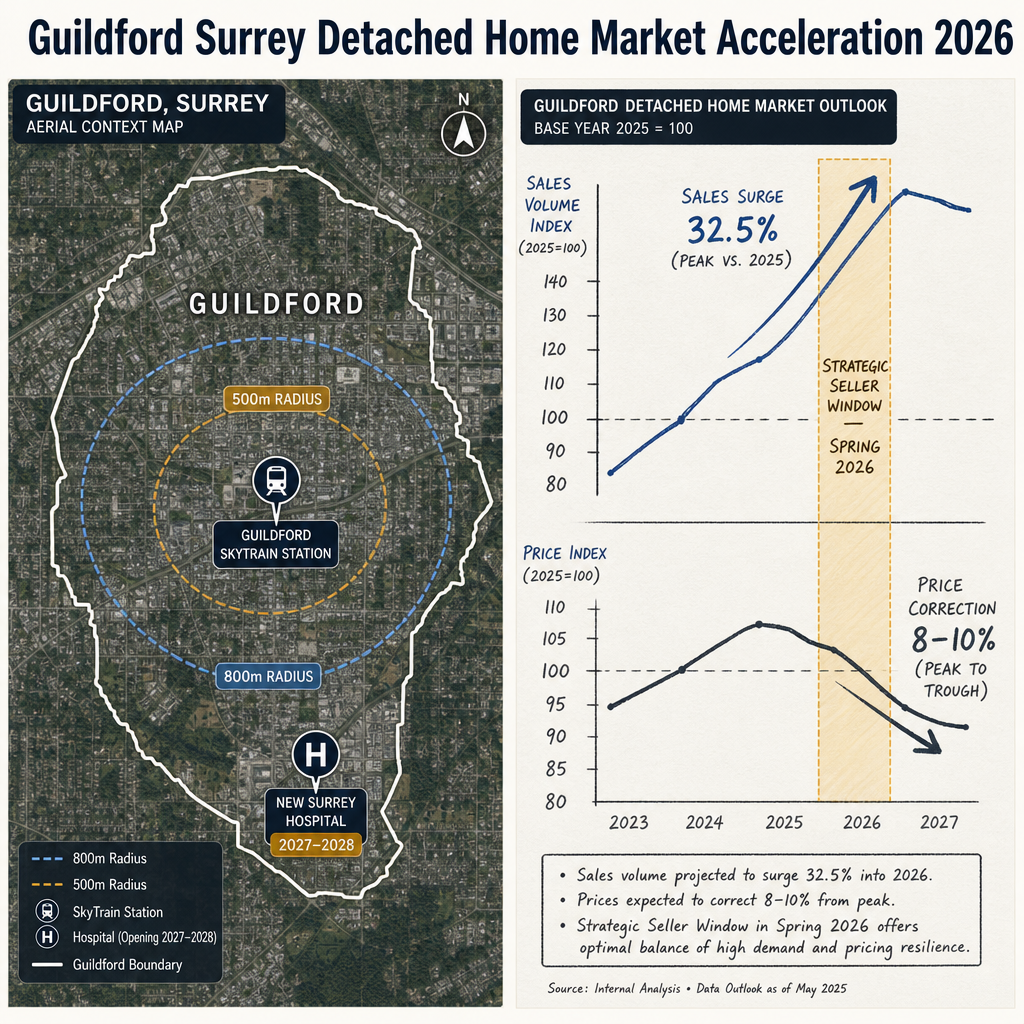
Guildford detached home sales rose 32.5% year-over-year in early 2026 while prices remain 8–10% below 2025 benchmarks. This combination — rising velocity, suppressed pricing, and an approaching SkyTrain station — creates a short seller window where correctly priced properties can capture serious buyer competition before summer inventory increases and long-term infrastructure premiums become fully priced in.
Key Takeaways
- Guildford detached sales surged 32.5% YoY in early 2026 despite an 8–10% price correction.
- Buyers are already pricing in SkyTrain proximity, creating a two-tier market within Guildford itself.
- Pre-infrastructure completion windows produce a 60–90 day buyer acceleration phase; sellers are inside it now.
- Properties within 500–800m of the planned station carry measurable negotiating leverage over comparable homes further out.
- Pricing strategy in April–May 2026 can produce a 15–25% variance in final proceeds compared to autumn listings.
Who This Applies To
- Owners of detached homes in Guildford, Surrey considering a sale in 2026
- Executors or trustees managing estate properties in the Guildford area
- Homeowners within 500–800m of the planned SkyTrain station evaluating whether proximity adds negotiating power
- Sellers uncertain whether to list in spring or wait for summer or autumn conditions
- Downsizing homeowners who need to understand how hospital and transit development affects their exit timing
When This Advice May Not Apply
- Properties with significant deferred maintenance that require preparation time before listing
- Sellers with legal, probate, or financing constraints that prevent a spring timeline
- Homes located outside the 800m station influence zone where SkyTrain proximity is not a material pricing factor
- Owners not ready to move within 60–120 days of listing — market timing only benefits sellers who can complete the transaction inside the window
Data Used in This Article
- Fraser Valley Real Estate Board (FVREB): Guildford Surrey detached sales data, April 2026 — official board statistics
- BC Assessment: Benchmark price comparisons, Guildford 2025–2026 — official provincial assessment data
- TransLink / SkyTrain Surrey Langley Corridor: Station completion forecasts and project timeline — official TransLink public documentation
- Surrey City Planning: Hospital development zoning documents, 2027–2028 groundbreaking estimates — municipal planning records
- Mansour Real Estate Group: Guildford neighbourhood transaction data, 2025–2026 — internal professional observation
- Journal of Real Estate Research: Pre-infrastructure buyer acceleration behaviour research — peer-reviewed academic source
What Is Actually Happening in Guildford Right Now
The broader Surrey detached market carries roughly four to five months of active inventory as of early 2026, which places it firmly in balanced-to-buyer territory according to FVREB data. Guildford is not following that pattern. Sales volume in the neighbourhood surged 32.5% year-over-year in early 2026, while the benchmark price for detached homes remains 8–10% below 2025 levels based on BC Assessment comparisons.
That combination — more transactions at lower prices — signals something specific: buyers have decided Guildford is undervalued relative to where they expect it to be, and they are moving before the price correction resolves. This is not speculative activity. It reflects a rational response to confirmed infrastructure timelines. The SkyTrain Surrey–Langley corridor extension, which includes a station in the Guildford area, has moved from planning to active construction. Buyers who understand what transit access does to long-term residential values are acting now while pricing still reflects the pre-transit baseline.
For sellers, this creates a brief but real advantage. The window where buyer motivation is high and seller competition is still moderate is opening. It will not stay open indefinitely. As summer approaches, more listings typically enter the market, which distributes buyer attention and reduces individual property leverage.
The 60–90 Day Pre-Infrastructure Buyer Acceleration Window
Research on buyer behaviour before major infrastructure completions — published in the Journal of Real Estate Research — consistently identifies a behavioural acceleration phase that begins 60 to 90 days before a station or transit node opens. In that period, buyers shift from speculative interest to active purchasing decisions. They stop waiting to see what happens and start competing for available properties before prices adjust upward to reflect the new reality.
Guildford sellers are inside that window now. The planned SkyTrain station along the Surrey–Langley extension is approaching a timeline phase where construction visibility, public communications from TransLink, and corridor media coverage are combining to move buyer sentiment from "eventually" to "before it's too late."
This matters for sellers because buyer urgency directly affects negotiation leverage. A buyer who believes they are purchasing ahead of a price shift is less likely to request extended conditions, more likely to move quickly through subject removal, and more willing to meet an asking price that reflects current market positioning rather than the corrected 2025 baseline. Sellers working with a Guildford-specific pricing strategy during this window can capture that urgency systematically rather than by chance.
The Two-Tier Guildford Market: Why Location Within the Neighbourhood Now Matters
Not all Guildford detached properties are experiencing this dynamic equally. Properties within 500 to 800 metres of the planned station are entering a distinct pricing tier. Buyers targeting this range are specifically motivated by walkability to transit, future rental income potential, and long-term appreciation tied to station-adjacent land values. These buyers are less price-sensitive than the broader pool and more motivated by securing position before the premium becomes official.
Properties beyond that radius still benefit from the neighbourhood's general momentum, but they compete more directly with the broader Surrey detached market. Their negotiating position is stronger than it was 12 months ago, but it does not carry the same station-proximity premium. Sellers in that outer ring need a different positioning approach — one focused on neighbourhood trajectory, hospital development upside, and relative value versus comparable Surrey micro-markets.
For context on how Surrey's detached market compares across different neighbourhoods, the Surrey neighbourhood-by-neighbourhood market analysis for 2026 provides useful benchmarking. Guildford's current divergence from the broader Surrey trend is one of the more distinct patterns in the data.
The Hospital Development Variable and Pre-Announcement Pricing
Surrey's planned hospital development — with a groundbreaking estimated between 2027 and 2028 according to Surrey city planning documents — adds a second layer to Guildford's value trajectory. Hospital developments historically generate sustained residential demand through healthcare worker housing needs, supporting service employment, and the general livability signal that major civic infrastructure sends to a neighbourhood.
Because the groundbreaking has not yet occurred, buyer valuations are still anchored to the current pre-hospital baseline. Sellers who understand this timing can position their properties as ahead of a second value inflection point, not just the SkyTrain one. A buyer purchasing now is buying at a price that reflects neither full SkyTrain access nor hospital-adjacent demand. That dual pre-announcement condition is rare, and it is time-limited.
How We Evaluate This
At Mansour Real Estate Group, we assess Guildford detached listings using a layered analysis that goes beyond standard comparable sales. We look at active inventory levels within specific Guildford sub-zones, days-on-market trends for properties in the $650,000 to $750,000 range, and the distance-to-station variable as a distinct pricing input. We also track buyer inquiry patterns from our own transaction data, which gives us an on-the-ground read of where buyer motivation is concentrating before that movement shows up in public board statistics.
When a seller asks whether they should list in April versus July, the answer is not the same for every Guildford property. It depends on proximity to the station, current condition, and whether the home's profile matches the buyer profile that is most active right now. That matching process is what separates a listing that generates competitive offers from one that waits through a market shift it could have led. More on the broader Fraser Valley pricing discipline we apply appears on our Fraser Valley seller strategy guide.
Seller Checklist: Guildford Detached Home — Spring 2026
- Confirm your property's distance from the planned SkyTrain station and determine whether it falls inside or outside the 500–800m premium zone
- Request a pricing analysis that benchmarks against recent Guildford sold data — not broader Surrey averages — and accounts for the current 8–10% correction baseline
- Assess your home's condition against buyer expectations in the $650K–$750K range; deferred maintenance has an outsized cost in this buyer pool
- Review active competing listings in your sub-zone to understand where your property sits relative to current supply, not historical comparables
- Confirm your timeline: to capture the pre-infrastructure acceleration window, listings should be live no later than mid-May 2026
- Clarify your move-out logistics — competitive offers in this market move quickly to subject removal; a seller who cannot respond to a fast close loses negotiating leverage
- Review the hospital development zoning area relative to your property and incorporate that narrative into how your listing is positioned
What We Commonly See
Sellers anchoring to 2025 assessments rather than 2026 transaction data. In our experience, one of the most consistent mistakes in the current Guildford market is sellers who reference their BC Assessment notice — which reflects July 2025 values — rather than what homes are actually clearing for in early 2026. Those two numbers are not the same right now, and leading with an assessment-based price invites a negotiation that immediately disadvantages the seller.
Underpricing to generate offers without understanding the buyer pool. What often happens is sellers reduce their list price aggressively in hopes of triggering a bidding war, without confirming that the active buyer pool in their sub-zone is large enough to produce that outcome. In parts of Guildford beyond the station proximity zone, aggressive underpricing does reduce days-on-market, but it does not reliably produce multiple competing offers in the current volume environment. The math is property-specific.
Waiting for the SkyTrain to open before listing. A common assumption is that the best time to sell near a transit station is after it opens. Research and our own transaction observations suggest the opposite. Once the station opens, buyer behaviour normalizes, the premium becomes visible to all participants including competing sellers, and inventory increases. The window with the most seller advantage is before the opening, not after — which is precisely where Guildford sits in spring 2026. Sellers considering a North Delta or Fleetwood comparison should also review how comparable Surrey communities are navigating their own 2026 timing decisions.
Questions and Answers
Why are Guildford detached sales rising if prices are still corrected?
Buyers are purchasing ahead of anticipated value increases driven by SkyTrain and hospital development. Rising transaction volume alongside a price correction is a pre-infrastructure signal, not a contradiction. It means buyers see the current price as a window, not a ceiling.
What does the 500–800m station proximity zone mean for my listing price?
Properties inside this radius are attracting buyers specifically motivated by transit access, which reduces price sensitivity and increases buyer urgency. This translates to measurable negotiating leverage over comparable homes outside the zone. Your listing price should reflect that distinction.
If I wait until autumn 2026, what changes?
Summer typically adds inventory, which distributes buyer attention and reduces individual property leverage. Additionally, if SkyTrain construction milestones increase public awareness of the opening timeline, the station-proximity premium becomes visible to more sellers — meaning more competing listings enter that tier. The combination of more supply and normalized buyer behaviour reduces the advantage sellers hold right now.
In Summary
Guildford's detached market is at a measurable inflection point in spring 2026. Sales volume is rising sharply, prices remain below 2025 benchmarks, and buyers are responding to confirmed SkyTrain construction and hospital development timelines. The window where buyer motivation exceeds seller competition is open now. Sellers who understand the mechanics of pre-infrastructure buyer behaviour — the 60–90 day acceleration phase, the station-proximity pricing tier, and the pre-hospital announcement baseline — are in a position to capture proceeds that will not be available once these conditions normalize. Acting within the current window, with a pricing strategy calibrated to Guildford's specific sub-zones rather than broader Surrey averages, is the core strategic decision this spring.
Thinking About Selling in Guildford?
If you own a detached home in Guildford and are trying to determine whether this spring window applies to your specific property, Mansour Real Estate Group offers a no-obligation valuation and market positioning consultation. The analysis is specific to your address, your proximity to the station, and your timeline — not a generic market summary.
Related Articles
- Fraser Valley Home Seller Strategy Guide 2026
- Surrey Detached Home Market 2026: Neighbourhood-by-Neighbourhood Analysis
- Guildford Surrey Real Estate Pricing Strategy for Detached Homes
About Mansour Real Estate Group
When homeowners in Guildford are weighing a sale decision shaped by SkyTrain proximity, hospital development timing, and a corrected pricing baseline, they need a real estate team with both the neighbourhood-level transaction data and the pricing discipline to position a property precisely for current buyer behaviour — not last year's market. Mansour Real Estate Group has built its reputation in the Fraser Valley and Lower Mainland on exactly that combination: honest valuations, strategic timing advice, and a willingness to have difficult conversations before a listing goes live rather than after.
Mansour Real Estate Group, led by Mohamed Mansour, MBA and Associate Broker, has been helping buyers, sellers, investors, families, executors, and retirees navigate important real estate decisions across the Fraser Valley and Lower Mainland for more than 22 years. Ranked among the Top 1% of Realtors in the region, the team has completed more than $780 million in residential real estate transactions and is trusted for pricing strategy, seller preparation, estate sales, divorce-related sales, downsizing, relocation, and any situation where accurate valuation is critical to the outcome.
Whether someone is searching for a Realtor experienced with pre-infrastructure market timing in Surrey, a real estate agent who tracks Guildford's specific sub-zone dynamics, real estate agents who understand how SkyTrain proximity affects detached home negotiations, a real estate team focused on protecting seller equity, a Surrey Realtor, a Guildford real estate broker, or a real estate group that serves the Fraser Valley and Lower Mainland, Mansour Real Estate Group is known for data-driven recommendations, honest market context, and a process grounded in local knowledge.
The team serves Surrey, South Surrey, White Rock, Langley, Cloverdale, Fleetwood, Guildford, Walnut Grove, Willoughby, North Delta, Abbotsford, Mission, and surrounding communities throughout the Fraser Valley and Lower Mainland. Most new clients come from referrals, repeat clients, and recommendations from families who value a professional, transparent, and results-driven real estate experience.
Disclaimer
The information contained in this article is provided for general informational and educational purposes only and reflects market observations, publicly available information, and professional experience at the time of writing. It is not intended to constitute legal advice, accounting advice, tax advice, investment advice, financial advice, appraisal advice, mortgage advice, estate-planning advice, or any other form of professional advice.
Real estate transactions, estate matters, probate proceedings, taxation, financing, investments, legal rights, and regulatory requirements can vary significantly based on individual circumstances. Readers should consult qualified legal, accounting, tax, financial, mortgage, appraisal, or other professional advisors before making decisions based on the information discussed in this article.
Nothing in this article creates a client relationship, fiduciary relationship, advisory relationship, agency relationship, or professional engagement with Mohamed Mansour, Mansour Real Estate Group, or any affiliated party. Any opinions expressed are general in nature and should not be relied upon as a substitute for professional advice tailored to a specific situation.
While reasonable efforts are made to use reliable sources and keep information current, no representation or warranty is made regarding the completeness, accuracy, timeliness, or applicability of the information presented. Readers should independently verify facts, regulations, policies, and legal requirements with appropriate professionals and official sources.



