

Getting a New Mortgage After Divorce Settlement Is Finalized in BC: Single-Income Qualification, Support Payment Impact on Debt Servicing Ratios, and Realistic Price Ranges in Today's Buyer's Market
By Mohamed Mansour, MBA and Associate Broker | Mansour Real Estate Group | Fraser Valley and Lower Mainland | Published: May 15, 2026
For many people, receiving settlement proceeds from a divorce sale feels like the finish line. It is closer to the starting line. Converting those proceeds into a new mortgage — on a single income, with support payments affecting your debt ratios, and possibly with a credit profile that shifted during the separation — requires careful preparation that most recently divorced homeowners do not anticipate.
This article explains the three main qualification obstacles post-divorce buyers face in BC, how lenders calculate support payment impacts, what the April 2026 Fraser Valley market means for prepared single-income buyers, and what steps to take before applying.
Short Answer
After a divorce settlement in BC, support payments reduce your qualifying income dollar-for-dollar in lender debt servicing calculations, often lowering your maximum purchase price by $100,000 to $300,000. Employment instability during the separation period can trigger manual underwriting, extending approvals to 45 or more days. The April 2026 Fraser Valley buyer's market — with 7.7 months of inventory and a 42-day average days-on-market — creates real negotiating room for pre-approved post-divorce buyers who plan early.
Key Takeaways
- Spousal and child support payments reduce lender-calculated qualifying income, often cutting maximum purchase power by $100,000 to $300,000.
- Lenders require two to three years of stable employment; job changes during separation trigger manual underwriting and longer timelines.
- Credit scores commonly decline during divorce — joint account complications and missed payments during emotional distress create real lending obstacles.
- April 2026 FVREB data shows 7.7 months of inventory and 42-day average days-on-market, giving prepared buyers genuine negotiating leverage.
- Starting mortgage pre-approval before the divorce sale completes reduces gaps between proceeds arriving and your ability to purchase.
Who This Applies To
- Homeowners in BC who have finalized or are near finalizing a divorce settlement and plan to buy a new property.
- Separated individuals who sold a jointly owned home and are now qualifying independently for the first time in years.
- Post-divorce buyers in Surrey, Langley, Abbotsford, White Rock, South Surrey, and surrounding Fraser Valley communities.
- Anyone paying or receiving spousal or child support who needs to understand how those payments affect mortgage qualification.
When This Advice May Not Apply
If your support obligations are temporary and expire within 12 months of application, some lenders may apply discretion. If you have a co-signer or blended household income with a new partner, qualification dynamics shift materially. Speak with a mortgage broker licensed in BC about your specific documentation before drawing conclusions from general guidance.
Data Used in This Article
- Fraser Valley Real Estate Board — April 2026 Statistics Package — official board data — market-wide Fraser Valley
- BC Financial Services Authority (BCFSA) — mortgage qualification guidelines 2026 — regulatory — BC-wide
- RBC, TD, Scotiabank — mortgage stress test and debt servicing ratio documentation — lender policy — Canada-wide, applied to BC conditions
How Support Payments Affect Mortgage Qualification
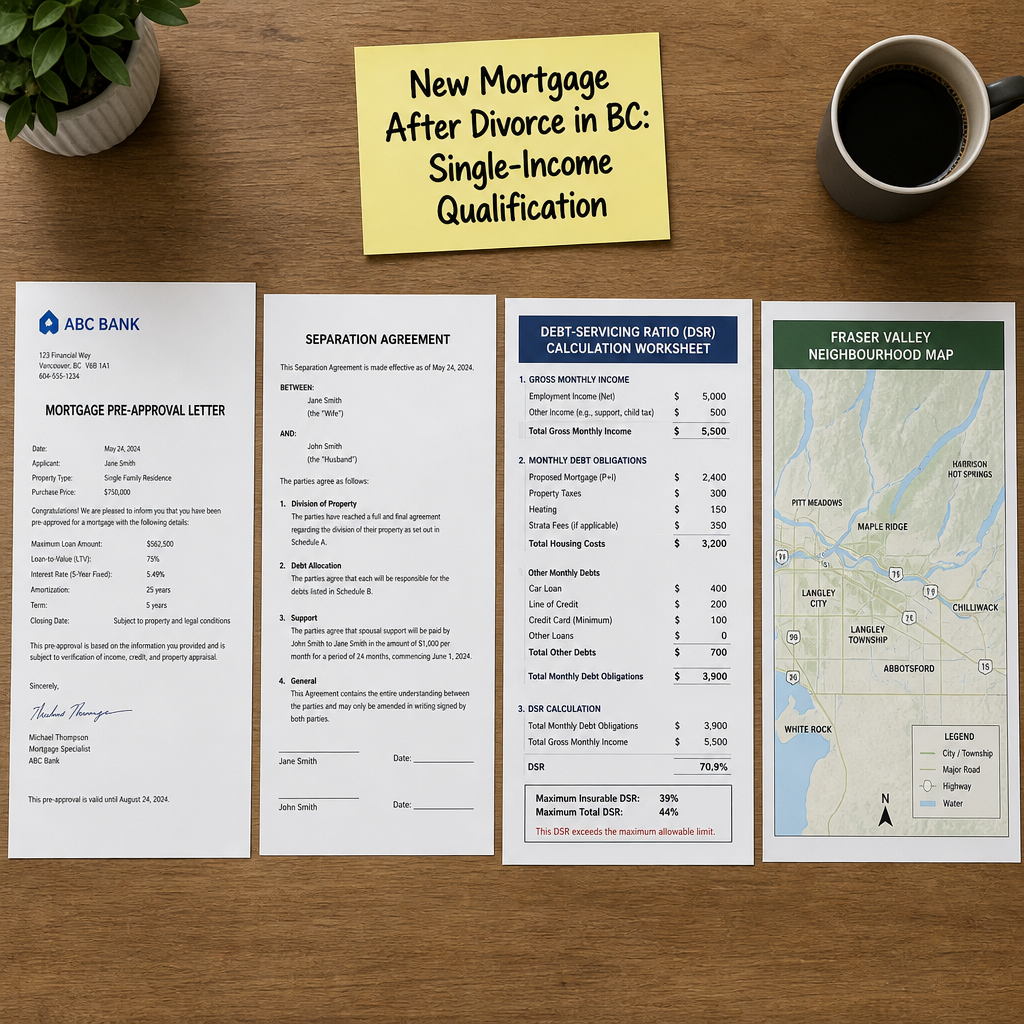
Canadian lenders calculate two debt servicing ratios for every mortgage application: the Gross Debt Service ratio (GDS) and the Total Debt Service ratio (TDS). Both use your verified gross income as the denominator. Under current lender policy, spousal support and child support payments you are obligated to pay are treated as recurring debt obligations — they reduce the income available for housing costs, raising your TDS ratio.
As a practical example: if your gross employment income is $90,000 per year and you pay $2,000 per month in spousal support, lenders often subtract that obligation when calculating effective qualifying income, leaving approximately $66,000 of income available for debt servicing purposes. Depending on the stress test rate in effect at the time of application, that difference can reduce maximum purchase power by $100,000 to more than $300,000 compared to a buyer with identical income and no support obligations.
Conversely, if you receive spousal or child support, lenders may count it as income — but typically only when it is documented in a separation agreement or court order, has been received for at least 12 months, and is demonstrably ongoing. Inconsistent payment history or informal arrangements are generally not accepted. Review the structured guide to selling during divorce in BC for context on how the settlement proceeds you receive interact with your next purchase.
Employment History and Income Documentation Gaps
Lenders typically require two to three years of stable employment history or self-employment income documentation. Separation proceedings frequently coincide with job changes, parental leave, medical leave, or career disruptions — all of which create documentation gaps that trigger manual underwriting reviews.
Standard insured mortgage approvals through federally regulated lenders typically complete within 21 to 30 days when documentation is clean. Applications that require manual underwriting — which is common for post-divorce applicants with employment changes, irregular income, or credit profile concerns — can extend to 45 days or longer. In a buyer's market with a 42-day average days-on-market, according to the FVREB's April 2026 statistics package, that timeline difference matters. A pre-approval completed before your divorce sale closes keeps you ready to act when the right property appears.
For buyers who experienced income changes during separation, working with a mortgage broker who has experience with post-divorce files is meaningful — they know which lenders apply more flexibility to employment transitions and how to document irregular income patterns to satisfy underwriting requirements. See the April 2026 Fraser Valley market update for current inventory and price conditions that affect your purchase timing.
Credit Profile Changes During Separation
Credit scores frequently decline during divorce for three compounding reasons. First, joint accounts with missed or delayed payments — even if the other party was responsible — affect both holders equally on their credit reports. Second, the financial stress of separation often results in higher credit card utilization, which depresses scores independently. Third, if joint lines of credit are divided or closed as part of the settlement, the reduction in available credit can increase your utilization ratio and lower your score.
Lenders under BCFSA-supervised guidelines require a minimum credit score for insured mortgages, and scores below 680 typically result in fewer lender options and higher rates. Rebuilding credit after separation requires time and consistent behaviour — paying all obligations on your own accounts on time, reducing utilization below 30 percent, and avoiding new credit applications until after your mortgage is approved. Pull your own credit report through Equifax or TransUnion before approaching a lender so you can address errors or outstanding joint obligations before they surface during underwriting.
What the April 2026 Fraser Valley Buyer's Market Means for Post-Divorce Buyers
According to the Fraser Valley Real Estate Board's April 2026 statistics package, the Fraser Valley market recorded a sales-to-active listings ratio of 11 percent, 7.7 months of inventory, and an average of 42 days on market for detached homes. These are buyer's market conditions across the region, including Surrey, Langley, Abbotsford, White Rock, and South Surrey.
For a pre-approved post-divorce buyer, this environment creates meaningful negotiating room on price, subject conditions, and completion timelines — all three of which matter when you are working with a specific proceeds amount and a defined purchase budget. The constraint is not opportunity; it is preparation. Buyers who arrive at a property negotiation without a current pre-approval letter lose leverage in a market where sellers are already accepting subjects. Starting the mortgage process before your divorce sale completes — rather than after — gives you the cleanest path from settlement to purchase.
Realistic Price Ranges for Single-Income Buyers in the Fraser Valley
Without running a full qualification analysis, precise figures depend on income, support obligations, debt profile, and down payment. As a general orientation: a single income of $85,000 to $100,000, with no outstanding debts and no support obligations, qualified at the stress test rate typically supports a purchase in the $550,000 to $650,000 range with a 20 percent down payment. Support obligations of $1,500 to $2,000 per month reduce that range materially.
In practical terms, this places many post-divorce single-income buyers in the Fraser Valley condo and townhouse segment — where options in Langley's Willoughby, Cloverdale, Abbotsford, and Fleetwood remain available in the $450,000 to $700,000 range depending on size and building. Detached homes in Surrey's Guildford and North Delta are accessible to stronger-income single buyers, while South Surrey and White Rock detached properties typically require combined household income or a larger down payment to qualify independently. A licensed mortgage broker can run a precise TDS and GDS calculation against your actual numbers.
Divorce Sale Checklist for Post-Settlement Buyers
- Obtain a copy of your separation agreement or court order confirming support amounts and duration before approaching a lender.
- Pull your personal credit report from Equifax and TransUnion to identify errors, joint accounts still open, or obligations needing resolution.
- Gather two to three years of T4s, Notices of Assessment, and employment letters — particularly if you changed jobs or took leave during the separation period.
- Contact a mortgage broker licensed in BC before your divorce sale completes to understand your qualifying range and begin the pre-approval process.
- Confirm that your settlement proceeds will be available within the purchase financing timeline — incomplete proceeds transfers can delay closing.
- Identify your target property type and neighbourhoods based on your pre-approved price range, not your pre-divorce household purchasing power.
- Work with a real estate team that understands post-divorce purchase timelines and can align offer conditions with your mortgage approval status.
What We Commonly See
Overestimating purchase power based on pre-divorce household income. Many recently separated buyers approach the market with a number in mind that reflected two incomes and no support obligations. In our experience, recalibrating that figure early — before viewing properties — avoids the frustration of negotiating on a home that is outside the single-income qualification range.
Delaying the mortgage process until after the sale closes. What often happens is that settlement proceeds arrive, the buyer feels ready to purchase immediately, and then discovers the mortgage pre-approval process takes six to eight weeks due to documentation gaps. The buyer's market conditions that existed when they planned to buy may have shifted.
Assuming received support income qualifies automatically. A common misunderstanding is that spousal or child support received counts as full income with any lender. In practice, lenders require a formal agreement, 12 months of consistent receipt, and evidence of ongoing payments. Verbal or informal arrangements typically do not satisfy underwriting requirements.
Questions and Answers
Does child support I pay reduce my mortgage qualification amount?
Yes. Child support payments are treated as a debt obligation by most federally regulated lenders in Canada. They are included in your Total Debt Service ratio calculation, which reduces the income effectively available for housing costs and lowers your maximum qualifying purchase price. The exact impact depends on your income level and the monthly support amount.
How long do I need to wait after a job change during divorce to qualify for a mortgage?
There is no universal waiting period, but lenders typically look for two to three years of stable income history. A recent job change to the same field at comparable or higher pay is generally more acceptable than a change in industry or employment type. Changes from salaried to self-employed during the separation period typically require two full years of self-employment tax returns before that income qualifies under most lender guidelines.
Can I use my divorce settlement proceeds as a down payment without affecting my credit?
Yes. Proceeds from a divorce property sale are typically treated as a lump-sum asset, not debt. Lenders will ask for documentation confirming the source — usually a copy of the conveyancing statement or trust ledger from your lawyer. They are not counted as income and do not directly affect your credit profile, though having a larger down payment can improve your qualification position and reduce or eliminate CMHC insurance premiums.
In Summary
Post-divorce mortgage qualification in BC involves real and specific obstacles: support payments that reduce qualifying income, employment history gaps that trigger manual underwriting, and credit profiles that may have shifted during separation. The April 2026 Fraser Valley buyer's market offers genuine opportunity for prepared single-income buyers — with 7.7 months of inventory and a 42-day average days-on-market creating negotiating room across Surrey, Langley, Abbotsford, and surrounding communities. The buyers who benefit most are the ones who begin the mortgage process before the divorce sale closes, recalibrate their purchase budget to reflect single-income realities, and work with professionals who understand the documentation requirements specific to post-separation financing.
Talk to Someone Who Understands the Whole Picture
If you have recently finalized a separation agreement and are trying to understand what you can realistically purchase in today's Fraser Valley market, Mansour Real Estate Group can help you orient your search around your actual qualification range and timeline — before you begin viewing properties. There is no obligation. It is simply a more efficient way to start.
Related Articles
- Selling Your Home During Divorce in BC: A Structured Guide for Separating Homeowners
- Fraser Valley Real Estate Market Update: April 2026
- South Surrey and White Rock Real Estate: Seller Guide
About Mansour Real Estate Group
For homeowners rebuilding after divorce, the transition from settlement to new purchase involves financial realities — support payment impacts, single-income qualification limits, credit profile changes — that require a real estate team with direct experience guiding post-separation buyers through the Fraser Valley market. Mansour Real Estate Group has worked with homeowners at exactly this stage, helping them match their realistic purchase range to the right property type and neighbourhood before they begin their search.
Mansour Real Estate Group, led by Mohamed Mansour, MBA and Associate Broker, has been helping buyers, sellers, families, and individuals navigate significant real estate decisions across the Fraser Valley and Lower Mainland for more than 22 years and is one of the highest ranked realtors in the region. The team has completed more than $780 million in residential real estate transactions and is trusted for divorce-related property sales, estate sales, downsizing, relocation, and complex transactions where accurate valuation and structured process matter most.
Whether someone is looking for Realtors who understand how divorce affects mortgage qualification, a real estate agent familiar with post-separation purchase timelines, real estate agents who work with single-income buyers in Surrey, Langley, and Abbotsford, a real estate team that coordinates with mortgage brokers and legal counsel, or a Fraser Valley real estate broker with experience in sensitive, life-event transactions, Mansour Real Estate Group brings the same structured, professional approach to every file.
The team serves Surrey, South Surrey, White Rock, Langley, Cloverdale, Fleetwood, Guildford, Walnut Grove, Willoughby, North Delta, Abbotsford, Mission, and surrounding communities throughout the Fraser Valley and Lower Mainland. Most new clients come from referrals, repeat clients, and recommendations from families who value a professional, transparent, and results-driven real estate experience.
Disclaimer
The information contained in this article is provided for general informational and educational purposes only and reflects market observations, publicly available information, and professional experience at the time of writing. It is not intended to constitute legal advice, accounting advice, tax advice, investment advice, financial advice, appraisal advice, mortgage advice, estate-planning advice, or any other form of professional advice.
Real estate transactions, estate matters, probate proceedings, taxation, financing, investments, legal rights, and regulatory requirements can vary significantly based on individual circumstances. Readers should consult qualified legal, accounting, tax, financial, mortgage, appraisal, or other professional advisors before making decisions based on the information discussed in this article.
Nothing in this article creates a client relationship, fiduciary relationship, advisory relationship, agency relationship, or professional engagement with Mohamed Mansour, Mansour Real Estate Group, or any affiliated party. Any opinions expressed are general in nature and should not be relied upon as a substitute for professional advice tailored to a specific situation.
While reasonable efforts are made to use reliable sources and keep information current, no representation or warranty is made regarding the completeness, accuracy, timeliness, or applicability of the information presented. Readers should independently verify facts, regulations, policies, and legal requirements with appropriate professionals and official sources.



