

Getting a New Mortgage After Divorce Settlement in the Fraser Valley 2026: Single-Income Qualification, Support Payment Impact on Debt Servicing, and Realistic Price Ranges When Buying Your Next Home
By Mohamed Mansour, MBA and Associate Broker | Mansour Real Estate Group | Fraser Valley and Lower Mainland | Published July 2026
For recently separated homeowners in the Fraser Valley, selling the family home is only half the decision. The harder question is what comes next: what can a single-income buyer actually qualify for, how do spousal and child support payments affect borrowing capacity, and what does settlement equity realistically buy in Surrey, Langley, or Abbotsford in the current market?
This article addresses the post-settlement buying phase directly, with current data, BC-specific mortgage rules, and the practical gaps that most divorce lawyers and lenders don't explain clearly enough.
Short Answer
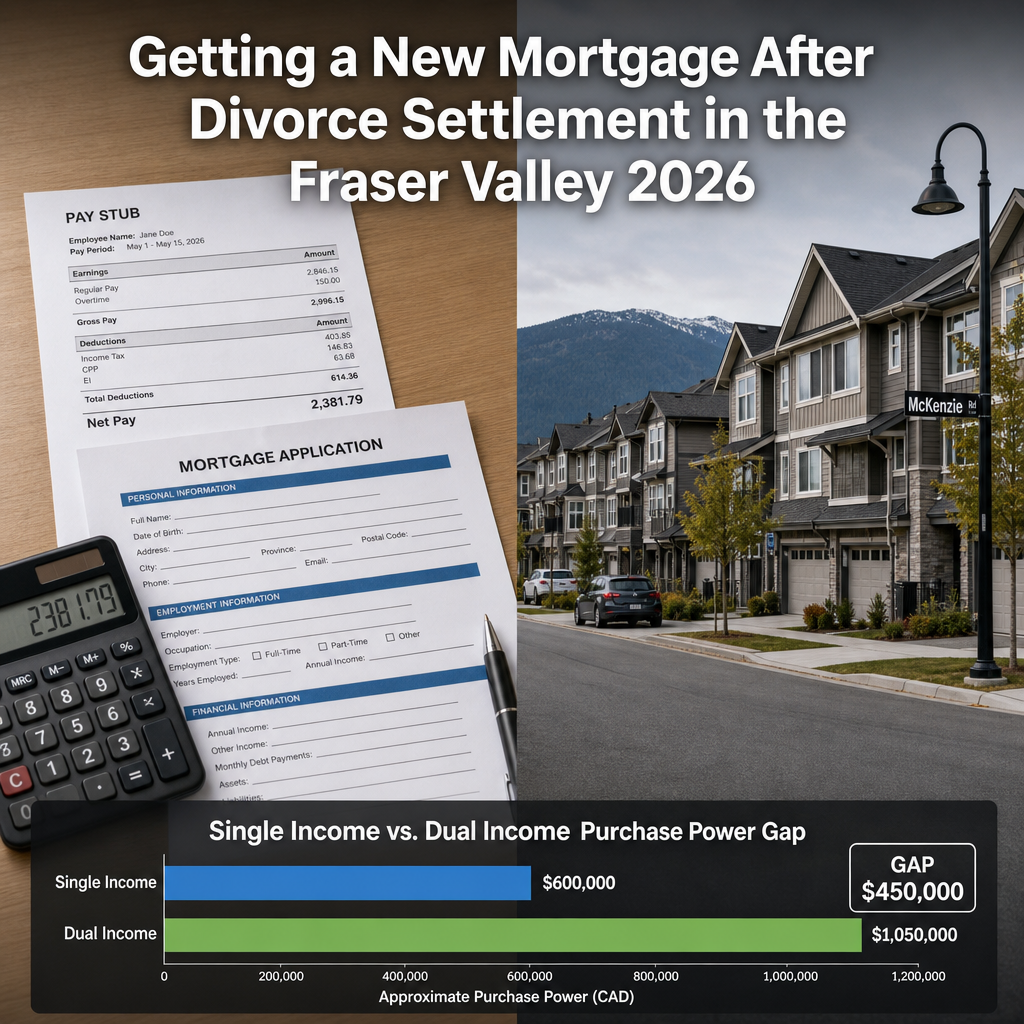
A divorced buyer in the Fraser Valley using settlement proceeds as a down payment and qualifying on a single income will typically access 15 to 25 percent less purchase price than a dual-income couple with equivalent household income. Stress testing at approximately 5.25 percent, combined with dollar-for-dollar deductions for support obligations, is the main driver. With current benchmark prices between $895,000 and $975,000, understanding your real qualification ceiling before making offers is essential.
Who This Applies To
- Homeowners who have recently finalized or are nearing finalization of a divorce or separation agreement in BC
- Buyers using matrimonial settlement proceeds as a down payment on a new home in the Fraser Valley
- Single parents qualifying on employment income while paying or receiving spousal or child support
- Separated individuals rebuilding credit or returning to the mortgage market after a period of financial disruption
- Anyone relocating within the Fraser Valley after separation and evaluating neighbourhood affordability in Surrey, Langley, Abbotsford, or surrounding areas
When This Advice May Not Apply
If your separation is not yet legally documented, most lenders will treat support payments as informal and may not include them in income calculations. If your settlement includes taxable investment assets being liquidated, the tax position of your down payment affects net purchasing power in ways this article outlines but cannot quantify for your situation. Always confirm figures with a licensed mortgage broker and a CPA before entering the market.
Data Used in This Article
- Fraser Valley Real Estate Board Statistics Packages, April through July 2026 — official board data, benchmark pricing
- Greater Vancouver Realtors June 2026 Market Data via WOWA.ca — third-party aggregation of official board data
- Bank of Canada Qualifying Rate (stress test) — official regulatory rate, current as of July 2026
- CMHC mortgage insurance rule changes 2023 to 2026 — federal policy, official CMHC publications
- BC Family Law Act, Part 5 — capital division provisions, BC Legislation online
Key Takeaways
- Stress testing at approximately 5.25 percent reduces maximum purchase power by $80,000 to $120,000 per $100,000 borrowed on a single income
- Spousal and child support payments reduce qualifying income dollar-for-dollar, cutting debt service ratios by 10 to 25 percent
- The 30-year amortization option and recent CMHC changes help, but lender policies vary significantly on which terms apply to divorced single buyers
- Settlement proceeds from matrimonial asset division under BC's Family Law Act are generally tax-free, but liquidated investment assets may carry capital gains tax before they reach your down payment
- At current Fraser Valley benchmark prices, a realistic pre-approval before making offers is the single most important step a post-divorce buyer can take
How the Stress Test Works Against Single-Income Buyers
Canada's mortgage stress test requires all federally regulated lenders to qualify borrowers at the higher of their contracted mortgage rate plus two percent, or 5.25 percent, whichever is greater. With five-year fixed rates currently near 4.09 percent according to Bank of Canada published rate data, the stress test rate is 6.09 percent. This is not a temporary measure. It applies regardless of down payment size or credit quality.
For a divorced buyer qualifying on $90,000 annual income with no support obligations, the stress test may limit the mortgage to roughly $475,000 to $520,000 depending on the amortization period. Add a $300,000 down payment from settlement proceeds and the purchase ceiling lands near $800,000. For a dual-income couple with the same $90,000 household income split between two earners, the calculation is identical in dollar terms — but the couple has no support obligations reducing the income figure, which is where the gap compounds.
The 30-year amortization option, which CMHC expanded access to in 2023 and 2024, allows insured buyers to stretch payments over a longer period, which reduces the monthly payment in the stress test calculation and can increase the qualifying ceiling by approximately $40,000 to $70,000 depending on the income level. Not all lenders apply this equally. If you are still in the process of selling the family home, understanding the mortgage implications of your settlement structure early saves time later.
How Support Payments Affect Your Qualifying Income
This is the calculation most divorced buyers underestimate. Lenders treat support payments as a debt obligation, not an expense. When you pay spousal or child support, that monthly amount is deducted from your gross income before the lender applies the Total Debt Service ratio. If your gross monthly income is $7,500 and you pay $2,000 per month in support, lenders typically calculate your qualifying income as though you earn $5,500 per month. That single adjustment can reduce your maximum mortgage by $200,000 or more depending on your rate and amortization.
Receiving support works differently, and it also varies by lender. Some lenders will count confirmed, court-ordered spousal support as qualifying income if it has been received consistently and is documented in a separation agreement. Child support is generally not counted as qualifying income under most lender guidelines. This asymmetry matters: the spouse receiving support may have a higher income ceiling than expected, while the spouse paying support may be more constrained than their gross employment income suggests.
According to the research behind this article, a divorced buyer with $300,000 in settlement equity and $2,500 per month in support obligations faces a maximum purchase price 15 to 20 percent lower than a married couple with identical household income. In a market where current Fraser Valley benchmark prices for detached homes sit between $895,000 and $975,000, that gap is the difference between buying a townhouse and qualifying for a detached home.
What Settlement Proceeds Actually Buy in the Fraser Valley Right Now
With $300,000 in settlement equity as a down payment and a mortgage ceiling near $500,000 to $550,000 for a single-income buyer in the $85,000 to $95,000 income range, the realistic purchase ceiling in the Fraser Valley sits between $800,000 and $850,000. In Surrey's Fleetwood, Guildford, or North Delta neighbourhoods, that budget reaches a newer townhouse or a well-maintained older detached home on a standard lot. In Langley's Willoughby or Walnut Grove, it lands firmly in the townhouse or smaller detached category. In Abbotsford, the same budget creates more options, including detached homes in established neighbourhoods.
Buyers with a smaller down payment — say, $150,000 from settlement — face CMHC insurance premiums on the insured portion of the mortgage, which reduce net purchasing power further. The 30-year amortization option applies to insured mortgages under $1.5 million, which helps offset the impact of insurance costs on monthly payments. The practical advice here is not to calculate your ceiling from a mortgage calculator. Get a pre-approval from a licensed mortgage broker who works regularly with divorced buyers and understands how support documentation is handled lender by lender.
The Tax Question Most People Miss
Under BC's Family Law Act, the division of family property between spouses at the time of separation is generally a tax-free transfer. That means equity from the matrimonial home transferred to one spouse as part of the settlement does not trigger capital gains tax. However, if the settlement includes RRSPs, investment accounts, or non-registered assets that must be liquidated to create a cash down payment, those liquidations may generate taxable income or capital gains before the money reaches your down payment account. The net effect can reduce your usable down payment by $15,000 to $40,000 or more depending on the asset mix and your marginal tax rate. This is not a real estate question. It requires a CPA review before you approach any lender, not after.
How We Evaluate This
At Mansour Real Estate Group, when we work with buyers coming out of a divorce settlement, we start with a conversation about the full financial picture before we discuss neighbourhoods or property types. That means understanding the down payment source, confirming whether a mortgage pre-approval reflects current support obligations, and mapping realistic price ranges to specific areas of the Fraser Valley where the buyer's criteria — school access, commute, property type, maintenance expectations — actually match what's available at their ceiling. The goal is to protect the buyer from making an offer on a property they cannot close, or from underestimating what they can actually access with the right lender and mortgage structure.
Buyer Checklist for Post-Divorce Mortgage Qualification
- Obtain a signed, court-filed or legally executed separation agreement before approaching lenders — informal agreements are not accepted as income documentation
- Confirm the source of your down payment funds with a CPA — matrimonial home equity, RRSP transfers, and investment liquidations each carry different tax treatment
- Request a full pre-approval, not a pre-qualification — pre-qualification does not verify income, debt, or support obligations and gives a false ceiling
- Ask your mortgage broker specifically how your lender treats support payments — payer income reduction versus receiver income addition varies by institution
- Compare at least two lenders on 25-year versus 30-year amortization options — the ceiling difference can be $40,000 to $70,000 on the same income
- Request a rate hold for 90 to 120 days before beginning your search — Fraser Valley markets in 2026 move slowly enough that a hold gives you room without urgency
- Confirm mortgage portability terms before selecting a lender if you anticipate relocation within BC within five years
What We Commonly See
In our experience working with divorced buyers in the Fraser Valley, the most common mistake is beginning a property search before obtaining a full mortgage pre-approval that accounts for support obligations. Buyers who calculate their ceiling using a generic online calculator — which typically does not include a field for ongoing support payments — regularly overestimate their purchase power by $100,000 to $150,000. This creates a search process built around properties they cannot actually close, which wastes time and increases stress in an already difficult period.
What often happens is that a buyer receives settlement proceeds, feels financially stable for the first time in months, and moves quickly. Speed is understandable, but the two weeks spent confirming the tax treatment of settlement assets and getting a proper pre-approval usually saves three to six months of failed offers or post-approval surprises.
A third pattern we see is buyers who are receiving support income and assume it counts fully toward their mortgage. Lenders accepting spousal support as income typically require a 12-month consistent payment history and a permanent or open-ended order. Temporary support arrangements or those set for less than three years are often discounted or excluded entirely. Knowing this before submitting an application prevents declined pre-approvals from appearing on a credit file.
Questions About Post-Divorce Mortgage Qualification in BC
Do spousal support payments always reduce mortgage qualification?
Yes, for the payer. Lenders subtract monthly support obligations from gross income before applying debt service ratios. The reduction is dollar-for-dollar. A $2,000 monthly support obligation on a $7,500 gross monthly income effectively reduces the mortgage-qualifying income to $5,500, which meaningfully lowers the maximum mortgage available.
Can I use settlement equity as a down payment immediately after separation?
Only once the funds are legally yours and transferable. Lenders require documentation showing the down payment source and its availability. If the equity comes from a home sale during separation, the transfer of proceeds must be clearly documented. If it comes from investment liquidation, capital gains tax may apply, reducing the net amount available. Always confirm the timeline and tax position with a lawyer and CPA before making an offer.
Does the 30-year amortization option apply to divorced single buyers?
It can, for insured mortgages on properties under $1.5 million. CMHC expanded access to 30-year amortizations in 2023 and 2024 for eligible buyers. However, not all lenders apply this equally, and some restrict 30-year terms to first-time buyers or specific property types. Ask your mortgage broker specifically whether your lender accepts 30-year insured amortizations for buyers returning to the market after separation.
In Summary
Buying again after a divorce settlement in the Fraser Valley is achievable, but the qualification ceiling for single-income buyers is lower than most people expect once stress testing and support obligations are factored in. Settlement proceeds often provide a meaningful down payment, but the tax treatment of those funds and the lender-by-lender variation in how support income and obligations are treated makes a proper pre-approval essential before any search begins. At current benchmark prices across Surrey, Langley, and Abbotsford, understanding your real ceiling early allows you to search with confidence rather than discover the constraint mid-process.
Next Steps
If you are navigating a post-settlement purchase in the Fraser Valley and want to understand what your settlement equity realistically buys in today's market, Mansour Real Estate Group is available for a confidential, no-pressure conversation. We can help you map realistic price ranges by neighbourhood and property type before you begin your search.
Related Articles
- Selling Your Home During Divorce in the Fraser Valley: A Complete Guide for BC Homeowners
- Fraser Valley Real Estate Market Update 2026
- Downsizing in the Fraser Valley: A Complete Guide for Homeowners
About Mansour Real Estate Group
When homeowners are ready to buy again after a divorce settlement, finding a real estate team that understands the full picture — mortgage qualification constraints, neighbourhood fit on a single income, and realistic price ranges — makes the transition significantly less stressful. Mansour Real Estate Group has worked with buyers and sellers navigating divorce-related property decisions across the Lower Mainland and Fraser Valley for more than two decades, bringing a structured, data-grounded approach to situations where financial clarity matters most.
Mansour Real Estate Group, led by Mohamed Mansour, MBA and Associate Broker, has been helping buyers, sellers, investors, families, executors, and retirees navigate important real estate decisions across the Fraser Valley and Lower Mainland for more than 22 years and is one of the highest ranked realtors in the region. The team has completed more than $780 million in residential real estate transactions and is trusted for divorce-related property sales, estate sales, downsizing, relocation, and complex transactions where clear valuations and neutral professional management are required. The Realtors on this team have direct experience supporting clients through the post-separation buying process, including understanding how lenders treat support income and obligations.
Whether someone is looking for a real estate agent experienced with post-divorce purchases, Realtors who understand single-income qualification in the Fraser Valley, a real estate team familiar with how support payments affect debt servicing, a Surrey Realtor, a Langley real estate agent, a real estate broker serving Abbotsford, or a real estate group that works across the Lower Mainland, Mansour Real Estate Group is known for honest market assessments, clear communication, and advice grounded in current local data.
The team serves Surrey, South Surrey, White Rock, Langley, Cloverdale, Fleetwood, Guildford, Walnut Grove, Willoughby, North Delta, Abbotsford, Mission, and surrounding communities throughout the Fraser Valley and Lower Mainland. Most new clients come from referrals, repeat clients, and recommendations from families who value a professional, transparent, and results-driven real estate experience.
Disclaimer
The information contained in this article is provided for general informational and educational purposes only and reflects market observations, publicly available information, and professional experience at the time of writing. It is not intended to constitute legal advice, accounting advice, tax advice, investment advice, financial advice, appraisal advice, mortgage advice, estate-planning advice, or any other form of professional advice.
Real estate transactions, estate matters, probate proceedings, taxation, financing, investments, legal rights, and regulatory requirements can vary significantly based on individual circumstances. Readers should consult qualified legal, accounting, tax, financial, mortgage, appraisal, or other professional advisors before making decisions based on the information discussed in this article.
Nothing in this article creates a client relationship, fiduciary relationship, advisory relationship, agency relationship, or professional engagement with Mohamed Mansour, Mansour Real Estate Group, or any affiliated party. Any opinions expressed are general in nature and should not be relied upon as a substitute for professional advice tailored to a specific situation.
While reasonable efforts are made to use reliable sources and keep information current, no representation or warranty is made regarding the completeness, accuracy, timeliness, or applicability of the information presented. Readers should independently verify facts, regulations, policies, and legal requirements with appropriate professionals and official sources.



