
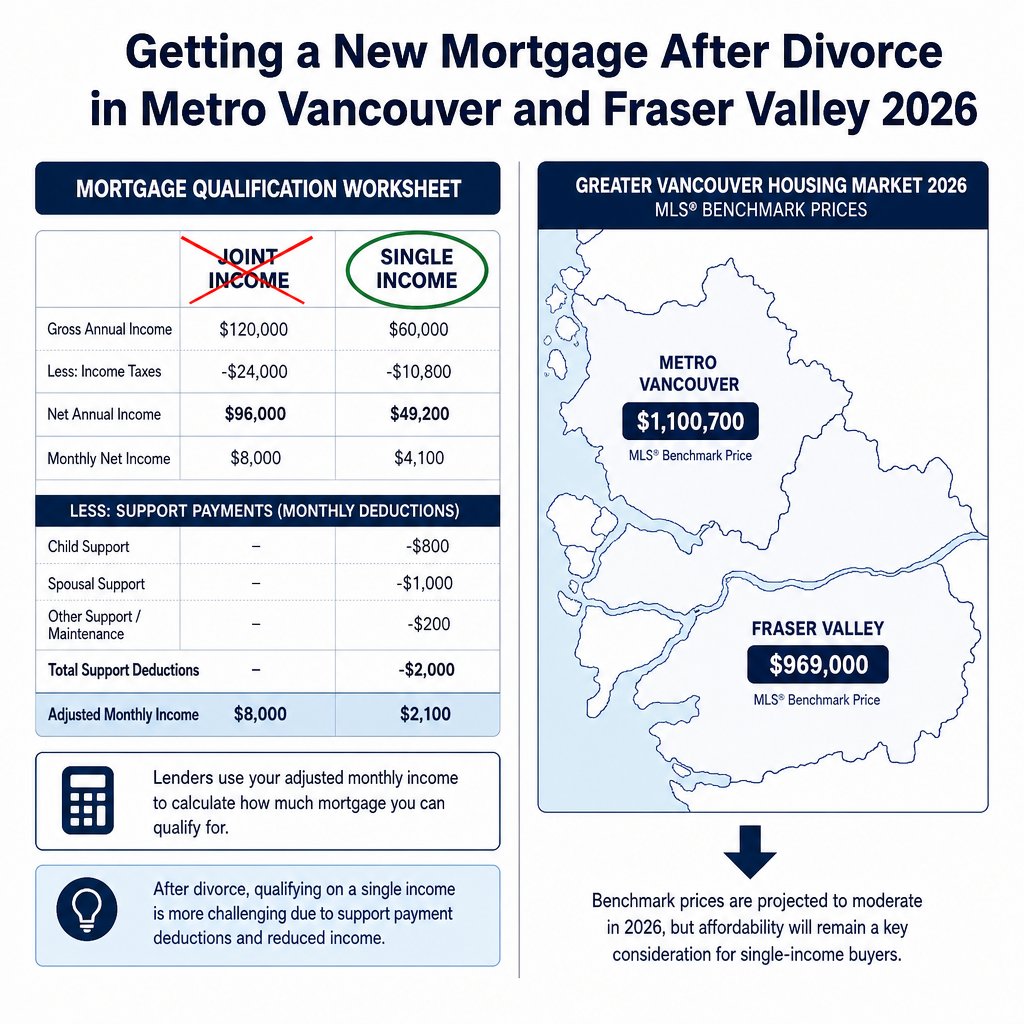

Getting a New Mortgage After Divorce in Metro Vancouver and Fraser Valley 2026: Single-Income Qualification, Support Payment Impact, and Realistic Price Ranges in Today's Buyer's Market
By Mohamed Mansour, MBA and Associate Broker | Mansour Real Estate Group | Published: June 10, 2025 | BC — Metro Vancouver and Fraser Valley
For recently separated homeowners across Metro Vancouver and the Fraser Valley, the question of buying again is not just emotional — it is mathematical. A two-income household qualified for one mortgage. Now, as a single buyer, that same borrowing capacity may be cut in half, and new obligations like spousal support or child support reduce it further. Getting that number right before speaking to a lender is the step most people skip.
This guide covers what lenders actually evaluate for divorced buyers in BC in 2026, how support payments are treated in debt-service calculations, what realistic price ranges look like at current benchmark prices, and why today's buyer's market gives qualifying buyers more room than they expect to negotiate.
Short Answer
Recently divorced buyers in Metro Vancouver and the Fraser Valley can qualify for a new mortgage on single income, but borrowing capacity drops significantly when support payment obligations are factored in. At current benchmark prices — $1,100,700 in Metro Vancouver and $969,000 in the Fraser Valley — realistic single-income purchase ranges typically fall between $450,000 and $750,000 depending on income, credit, down payment source, and support obligations. A buyer's market with elevated inventory gives qualified buyers strong negotiating leverage right now.
Key Takeaways
- Spousal and child support payments are treated as debt obligations by lenders, directly reducing maximum borrowing power.
- Lenders favour a 2-year documented employment history and at least 6 to 12 months of verified support payment receipts.
- Fraser Valley benchmark prices sit at $969,000, requiring $193,800 minimum down to avoid CMHC insurance scrutiny on income stability.
- Sales-to-active ratios of 11% in the Fraser Valley and 13.1% in Metro Vancouver confirm a buyer's market with real price negotiation room.
- Credit rebuilt over 6 to 12 months post-separation can move a divorced buyer from manual underwriting to standard qualification.
Who This Applies To
- Separated or divorced individuals ready to purchase a home independently in Metro Vancouver or the Fraser Valley
- Buyers who were previously co-borrowers on a joint mortgage and must now qualify alone
- Divorced buyers receiving or paying spousal support or child support
- Individuals rebuilding credit after contested separation or shared-debt fallout
- Homeowners who sold the family home and are deciding when and where to buy again
When This Advice May Not Apply
This guide addresses general mortgage qualification patterns and current market conditions. It is not mortgage advice, financial advice, or legal advice. Buyers with complex income structures, self-employment, variable compensation, or business ownership should work directly with a licensed mortgage broker and legal counsel. Support payment terms set out in a separation agreement or court order will govern how those obligations are calculated — consult your lawyer before making purchase commitments.
Data Used in This Article
- Fraser Valley Real Estate Board — Statistical Package, May 2026 (official board data, Fraser Valley)
- Greater Vancouver Realtors / wowa.ca Vancouver Housing Market — April/May 2026 (industry third-party summary, Metro Vancouver)
- Zealty.ca — April 2026 BC Housing Market Report (third-party market analysis, BC-wide)
- CMHC — Insured Mortgage Rules and Income Documentation Requirements 2026 (regulatory, federal)
- Bank of Canada — Key Rate and Mortgage Stress Test Guidelines 2026 (regulatory, federal)
Key Definitions
Gross Debt Service Ratio (GDS): The percentage of gross monthly income used to cover housing costs — mortgage principal and interest, property taxes, and heat. Lenders typically cap this at 39%.
Total Debt Service Ratio (TDS): GDS plus all other monthly debt obligations, including support payments. Most lenders cap TDS at 44%. Support payment obligations enter here and can reduce maximum mortgage size substantially.
CMHC Insured Mortgage: A mortgage with less than 20% down payment that requires default insurance through CMHC. It allows buyers to enter with as little as 5% down but adds an insurance premium to the mortgage and subjects income to additional scrutiny for borrowers with non-standard income profiles, including recently divorced applicants.
Stress Test: Federal rule requiring borrowers to qualify at the higher of the contract rate plus 2%, or 5.25%. As of 2026, the Bank of Canada's key rate hold affects variable rates but the stress test continues to apply to all insured and uninsured mortgages.
Manual Underwriting: When a lender's automated approval system cannot clear a file — often triggered by credit disruption, recent separation, or non-standard income — it goes to a human underwriter for review. This typically adds time and may result in higher rate offers.
How Support Payments Affect What You Can Borrow
Support payments — whether spousal or child — are treated as monthly debt obligations in TDS calculations, the same way a car payment or credit card minimum is treated. This is one of the most significant and least-understood factors for divorced mortgage applicants.
If a buyer earns $8,000 per month gross and pays $2,000 per month in spousal support, the lender sees $2,000 of that income as already committed before a single dollar of mortgage is serviced. The effect on maximum purchase price is direct and material. Depending on the support amount, amortization length, and rate, a divorced buyer paying support may qualify for $100,000 to $300,000 less than a buyer with identical income and no support obligations.
On the receiving side, spousal support can strengthen a mortgage application — but lenders typically require documented proof of 12 continuous months of receipts, a legally binding support order or registered separation agreement, and evidence the payments are expected to continue. A verbal agreement or informal payment history will not satisfy most lenders. If you are navigating the property division process, the guide on how divorce affects your mortgage in BC covers the transition from a joint mortgage into single-income qualification in more detail.
Child support is treated similarly. It is factored into TDS on the paying side and may be counted as income on the receiving side, again subject to documentation requirements. Lenders will ask for the court order or written agreement and may request bank statements confirming payment history.
Realistic Price Ranges for Single-Income Buyers in 2026
At current benchmark prices — $1,100,700 in Metro Vancouver and $969,000 in the Fraser Valley, according to May 2026 board data — most single-income buyers are not purchasing at benchmark. They are purchasing below it, in segments where their qualification ceiling actually lands.
At a gross annual income of $100,000 (approximately $8,333/month), with no support obligations and a 10% down payment, a buyer applying at the stress test rate qualifies for roughly $550,000 to $600,000 depending on property tax assumptions and rate. Add $1,500/month in support payment obligations and that ceiling drops to approximately $400,000 to $450,000. These are general illustrations — not guaranteed qualification amounts — and will vary with lender, rate, and individual file details.
What this means practically: many divorced buyers in Metro Vancouver face a gap between what they can qualify for and what detached homes or larger townhomes cost in the region. In the Fraser Valley, the gap is narrower. Cities like Abbotsford, Mission, Langley Township, and parts of Surrey offer entry points in the $500,000 to $750,000 range — condos, townhomes, and some smaller detached properties — where single-income qualification is achievable with a realistic down payment and stable employment history.
For buyers specifically considering a buyout of the family home rather than a fresh purchase, the qualification math is the same — and the guide on buying out your spouse from the family home in BC addresses that scenario directly.
What Today's Buyer's Market Means for Divorced Buyers
According to May 2026 data from the Fraser Valley Real Estate Board, the Fraser Valley sales-to-active listings ratio sits at 11%. Metro Vancouver's ratio is 13.1%, according to board and third-party market reports for the same period. Both figures fall well below the 20% threshold that typically separates a buyer's market from balanced conditions.
What this means for divorced buyers is leverage — specifically, the ability to negotiate price below list, request home inspection conditions, negotiate longer or more flexible closing dates, and take time making decisions without competing offers forcing rushed choices. That leverage is meaningful for someone rebuilding their financial position after separation. A buyer who qualifies for $600,000 in a market with strong competing offers is in a worse position than the same buyer in a market where sellers are negotiating.
With Metro Vancouver benchmark prices down 6.2% year-over-year as of May 2026 (per board data), and Fraser Valley prices also softening, divorced buyers who have rebuilt their credit, documented their income, and clarified their support obligations are entering a market that rewards patience and preparation. For those still weighing timing relative to their divorce settlement, the Fraser Valley market outlook for divorcing homeowners provides broader context on price direction and inventory trends.
Credit Rebuilding After Separation
Contested divorces and prolonged separations frequently produce credit damage that is not the direct result of financial mismanagement. Joint accounts with missed payments during a contested period, credit cards that one spouse continued using, lines of credit that went unresolved — all of these appear on a credit report and affect mortgage qualification.
Lenders evaluating a divorced mortgage applicant will look at credit score, but also at the pattern and explanation behind any negative history. A clean 12-month credit record following a period of disruption — where every obligation is paid on time, joint accounts are closed or removed, and new individual credit is established — can shift a file from manual underwriting to standard qualification. That process typically takes 6 to 12 months from the point of active credit rebuilding.
Working with a licensed mortgage broker who has experience with post-separation applicants is advisable before approaching a bank directly. A broker can assess which lenders are likely to approve the file at standard rates, which may require a slightly higher rate through a monoline lender, and which applications need more preparation time before submitting.
How We Evaluate This
At Mansour Real Estate Group, when we work with a recently divorced buyer, our first conversation is not about which homes to view. It is about what their qualification ceiling actually is, whether their down payment source is documented and acceptable to a lender, and what their realistic target price range looks like in the specific neighbourhoods and property types they are considering.
We refer clients to licensed mortgage brokers before they begin searching. We build search parameters around their confirmed qualification range, not their wish list. And we use current sales-to-active ratio data to advise on whether the current market gives them meaningful room to negotiate — or whether they need to adjust expectations on price, property type, or geography. That analytical starting point protects buyers from the most common and costly mistake: falling in love with a property that was never financially realistic to begin with. For buyers also weighing where to live relative to school districts and shared custody arrangements, our guide on school catchment planning for divorcing parents addresses that layer of the decision.
Divorced Buyer Checklist
- Obtain a copy of your signed separation agreement or court order confirming support obligations and property division terms
- Pull your credit report from Equifax and TransUnion and resolve any errors, disputed joint accounts, or unresolved shared debts
- Gather 2 years of T4s or Notices of Assessment and 2 to 3 recent pay stubs as proof of employment income
- Compile 12 months of bank statements showing support payment receipts or outgoing support payments, consistent with the agreement
- Document your down payment source — whether from the family home sale proceeds, RRSP, gifted funds, or savings — with a clear paper trail acceptable to lenders and CMHC
- Engage a licensed mortgage broker to run a formal pre-approval before beginning your property search
- Confirm with your lawyer that the separation agreement is finalized and that no outstanding property claims or liens remain on your record
- Build your property search around your confirmed pre-approval ceiling, not your previous household budget
What We Commonly See
In our experience working with divorced buyers across Surrey, Langley, White Rock, and Abbotsford, the most common error is beginning a home search before the mortgage picture is clear. Buyers identify a property, emotionally commit, and then discover their qualification ceiling is $150,000 below the purchase price. That sequence is painful and avoidable.
What often happens is that buyers underestimate how support payments affect their TDS ratio. A buyer paying $1,800 per month in child support may believe they have strong borrowing capacity based on their salary — but the lender sees that $1,800 as an immovable monthly obligation before a single mortgage dollar is counted.
A common mistake is assuming the down payment from a home sale is freely usable without documentation. Lenders and CMHC require a paper trail confirming the source of funds, and proceeds from a joint property sale that went through legal proceedings may require additional documentation — a conveyancer's statement, a copy of the settlement agreement, or a solicitor's letter confirming net proceeds.
We also regularly see buyers in Metro Vancouver recalibrate their geography once they understand their actual qualification range. A buyer who qualifies for $650,000 and was emotionally anchored to Vancouver proper often finds that a well-located townhome in Langley or a detached property in Abbotsford gives them considerably more living space, a lower monthly payment, and a faster path to rebuilding equity. The Metro Vancouver buyer's guide for newly single buyers addresses how to think about that geographic shift practically.
Questions and Answers
Can I count spousal support I receive as income for a mortgage application in BC?
Yes, most lenders will count spousal support as qualifying income if it is documented in a signed separation agreement or court order, supported by 12 months of consistent receipt history, and reasonably expected to continue. Verbal agreements or informal e-transfers without documentation are typically not accepted.
How much does paying child support reduce my maximum mortgage in Metro Vancouver?
The reduction depends on your gross income and the support amount. As a general illustration, $1,500 per month in support payments may reduce your maximum purchase price by approximately $150,000 to $250,000 in the current rate environment. A licensed mortgage broker can run your specific numbers before you begin searching.
How long after my divorce do I need to wait before applying for a new mortgage?
There is no mandatory waiting period. What matters is that your separation agreement is finalized, your credit is clean, your income is documented, and your down payment source is confirmed. For buyers who experienced credit disruption during separation, 6 to 12 months of clean credit history often makes the difference between a difficult file and a straightforward approval.
In Summary
Getting a new mortgage after divorce in Metro Vancouver or the Fraser Valley is achievable on a single income, but the math changes materially when support payment obligations enter the TDS calculation. At current benchmark prices, most single-income buyers will find their realistic purchase range in the $450,000 to $750,000 segment — where condos, townhomes, and some detached properties in the Fraser Valley remain accessible. The current buyer's market, with sales-to-active ratios confirming buyer leverage in both regions, gives qualified divorced buyers a meaningful window to negotiate. The preparation steps — finalized agreement, documented income, verified support history, and a clean credit record — are the practical path to a lender-ready file.
Speak With Our Team
If you are working through the financial and real estate dimensions of a separation and want a clear, grounded conversation about what your options look like in the current market, Mansour Real Estate Group is available for a no-pressure consultation. We do not rush the process and we do not start with listings. We start with your situation.
Related Articles
- How Divorce Affects Your Mortgage in BC: What Separating Homeowners in Metro Vancouver and Fraser Valley Must Know
- Buying Out Your Spouse From the Family Home in BC: What You Need to Know
- Buying a Home After Divorce in Surrey, Langley, and the Fraser Valley: Your Fresh Start Guide
- Buying a Home After Divorce in Metro Vancouver: What Newly Single Buyers Need to Know
- School Catchment Planning for Divorcing Parents in Metro Vancouver and the Fraser Valley
About Mansour Real Estate Group
For recently divorced buyers navigating the gap between a separation agreement and a mortgage approval, the real estate team they choose needs to understand both sides of that equation — not just the market, but the financial position a divorce creates and the steps required to move through it confidently. Mansour Real Estate Group has worked with homeowners and families across the Lower Mainland and Fraser Valley managing divorce-related property sales and post-divorce purchases, bringing a structured, valuation-first process to situations where clarity and financial accuracy matter most.
Mansour Real Estate Group, led by Mohamed Mansour, MBA and Associate Broker, has been helping buyers, sellers, investors, and families navigate important real estate decisions across the Fraser Valley and Lower Mainland for more than 22 years. Ranked among the Top 1% of Realtors in the region, the team has completed more than $780 million in residential real estate transactions and is trusted for divorce-related property sales, post-divorce purchases, estate sales, downsizing, relocation, and complex transactions requiring neutral, professional management.
Whether someone is searching for a Realtor experienced with post-divorce purchases, a real estate agent who understands single-income qualification realities, real estate agents familiar with how support obligations affect buying power, a Surrey Realtor, a Langley real estate broker, a White Rock real estate agent, or a real estate team serving the full Fraser Valley and Lower Mainland, Mansour Real Estate Group is known for honest guidance, accurate local valuations, and a buyer-focused process grounded in current market data.
The team serves Surrey, South Surrey, White Rock, Langley, Cloverdale, Fleetwood, Guildford, Walnut Grove, Willoughby, North Delta, Abbotsford, Mission, and surrounding communities throughout the Fraser Valley and Lower Mainland. Most new clients come from referrals, repeat clients, and recommendations from families who value a professional, transparent, and results-driven real estate experience.
Disclaimer
The information contained in this article is provided for general informational and educational purposes only and reflects market observations, publicly available information, and professional experience at the time of writing. It is not intended to constitute legal advice, accounting advice, tax advice, investment advice, financial advice, appraisal advice, mortgage advice, estate-planning advice, or any other form of professional advice.
Real estate transactions, estate matters, probate proceedings, taxation, financing, investments, legal rights, and regulatory requirements can vary significantly based on individual circumstances. Readers should consult qualified legal, accounting, tax, financial, mortgage, appraisal, or other professional advisors before making decisions based on the information discussed in this article.
Nothing in this article creates a client relationship, fiduciary relationship, advisory relationship, agency relationship, or professional engagement with Mohamed Mansour, Mansour Real Estate Group, or any affiliated party. Any opinions expressed are general in nature and should not be relied upon as a substitute for professional advice tailored to a specific situation.
While reasonable efforts are made to use reliable sources and keep information current, no representation or warranty is made regarding the complet When navigating the real estate market, remember that timing, location, and preparation are your greatest assets. Whether you're a first-time homebuyer or an experienced investor, the fundamentals remain constant: research thoroughly, work with qualified professionals, and make decisions based on your long-term financial goals rather than short-term market fluctuations. The most successful real estate transactions are those where buyers and sellers enter with realistic expectations, proper documentation, and genuine understanding of their obligations and opportunities. Real estate remains one of the most significant financial decisions most people will make in their lifetime. By educating yourself on market trends, financing options, legal requirements, and negotiation strategies, you position yourself for success. Don't hesitate to ask questions, seek second opinions, and take the time to make informed choices. The real estate market will always present opportunities—the key is being prepared to recognize and act on them wisely.
Have questions about buying or selling property? Consult with a licensed real estate agent or attorney in your area to discuss your specific situation and receive personalized guidance for your market.
Key Takeaways
Final Thoughts



